

If you came across Xaspaze.com through social media hype or a video leaning on some famous face, the safest move is to stop there. This is presented as a crypto casino, with the usual polished front end and an oversized welcome bonus meant to make the whole thing feel routine. It is not. The point is to get people to send cryptocurrency into a system they are unlikely to get back out of.
The setup often runs long enough to feel real. You can sign up, play around, even see apparent winnings. The fraud becomes obvious when you try to withdraw and there is suddenly one more payment in the way, usually dressed up as verification or activation. That extra deposit is the mechanism, not some administrative detail. The rest of the site exists to get you far enough in that paying it starts to feel plausible.
Scams of Xaspaze.com‘s type are known to steal personal data and passwords. Install SpyHunter Pro to scan for risks, remove any dangerous trackers, and enable real-time protection.

Try Free For 7 Days*
Buy now15% OFF if you buy straight without trial.
 OFFER
OFFERYou can usually see the problem in the basics if you look. The Xaspaze presentation is polished on purpose, and the testimonials or celebrity bait are there to create trust faster than the site deserves. We’ve seen the exact same thing with other similar sites like Kastwin or Hodeu.top.
But the company details are thin, the policies are evasive, and the whole thing does not hold up once you check it like a real business. The useful question is not whether the branding looks convincing at first glance. It is whether anything underneath it looks real.
IMPORTANT! READ BEFORE PROCEEDING!
If you already deposited funds, sent documents, connected a wallet, or installed anything associated with Xaspaze, switch from hope to damage control right away. Crypto losses are often hard to reverse, but fast action can still reduce follow-on theft, account abuse, and identity misuse.
Before replying to support messages or chasing anyone who claims they can recover your money, inspect the device you used. We strongly recommend starting with SpyHunter 5 so you can check for malware, risky downloads, unwanted browser add-ons, or other hidden changes linked to this scam.
Fastest Removal Option: Use SpyHunter 5
- 1.1Click here to download and install the anti-malware tool on your PC.
- 1.2
 Start SpyHunter 5, click the Buy button and choose between starting your 7-days free trial or directly purchasing the tool.
If you choose to buy SpyHunter 5 now, you can use our discount code, “HTRG15“, for 15% off.
- 1.3
 Once you activate SpyHunter, click Start Scan Now, select the Full Scan option, and let the tool do its job.
 - 1.4
 Once the scan completes (it could take a while, so have patience), you’ll see all malware and other undesirables listed.
Click Next to review the detections and then click Next again to delete all rogue items.
Once the scan is complete, work through the security measures below and treat every related login, wallet, and document as potentially exposed:
- Reset passwords and enable 2FA on your email, crypto exchanges, and wallets; terminate other active sessions.
- Notify any exchanges and services touched by the funds; provide TxIDs and ask that accounts/addresses be flagged per policy.
- Migrate assets to fresh wallets with new seed phrases and revoke any existing token approvals on connected chains.
- If you uploaded ID documents, place credit/fraud alerts where available and monitor for identity-theft signals.
- Assemble an evidence bundle – wallet addresses, TxIDs, site URLs, chats, and screenshots – and file reports with police/IC3 and any involved platforms.
How We Know Xaspaze is a Scam
Several signals point the same way here. Any one detail might be brushed off in isolation, but together they match the profile of a crypto-casino withdrawal scam: trust-building features are effortless, while every step that should return money to the user suddenly becomes complicated, expensive, or unverifiable.
Withdrawal tollbooths
The most revealing sign is the demand for money before money can leave. Real platforms do not ask users to prepay release fees, tax deposits, or wallet-confirmation charges just to access their own balance.
Paper-thin credentials
A scam page often decorates itself with licensing badges, registration numbers, and vague compliance claims that look official until you try to verify them. When the details fail to match public registers, the credibility collapses.
Scripted lucky streaks
Another clue is how quickly new players appear to win. Easy early results can be part of the persuasion layer, nudging users to deposit more because the balance on screen feels earned and close to cashing out.
Crypto-only isolation
Because payment happens in cryptocurrency alone, the victim is left with fewer safeguards, fewer dispute options, and more urgency to keep cooperating. That lack of recourse is not a side effect; it is part of the design.
Manufactured popularity
Fake trust signals also do heavy lifting here. Comment floods, winner notifications, referral codes, and glowing reviews can be generated or recycled to imitate a busy community without providing any proof that payouts are real.
Disposable domains
Fresh sites with privacy-masked ownership and copycat branding deserve extra suspicion. Public tools such as who.is often reveal a short lifespan, hidden ownership, or a churn pattern consistent with clone campaigns.


How the Xaspaze Scam Deception Funnel Works
Understanding the sequence matters because the scam is easier to resist once the script becomes visible. The experience is usually arranged in stages, each one answering a different emotional need: excitement first, confidence second, then urgency, confusion, and finally pressure to keep paying.
Most people are not captured by one dramatic lie. They are walked through a series of smaller manipulations that feel plausible in the moment. A reward gets attention, a polished interface lowers skepticism, a growing balance creates attachment, and withdrawal friction reframes more payments as the last step before a payout.
Bonus bait and borrowed credibility
It often begins with promo codes, influencer-style posts, direct messages, or short videos claiming someone turned a tiny deposit into a large balance. The point is to make the opportunity look popular, time-sensitive, and already validated by other users.

A polished front that lowers guard
Once visitors land on the site, the visual design does much of the persuasion. Familiar game tiles, slick animations, crypto branding, and promises of fairness are there to make the platform feel established before any real due diligence occurs.

Screen profits that invite bigger risk
After that, the account balance starts doing psychological work. Small deposits may appear to grow fast, or bonus funds may create the impression that a meaningful withdrawal is already within reach. That emotional momentum pushes victims to risk more.
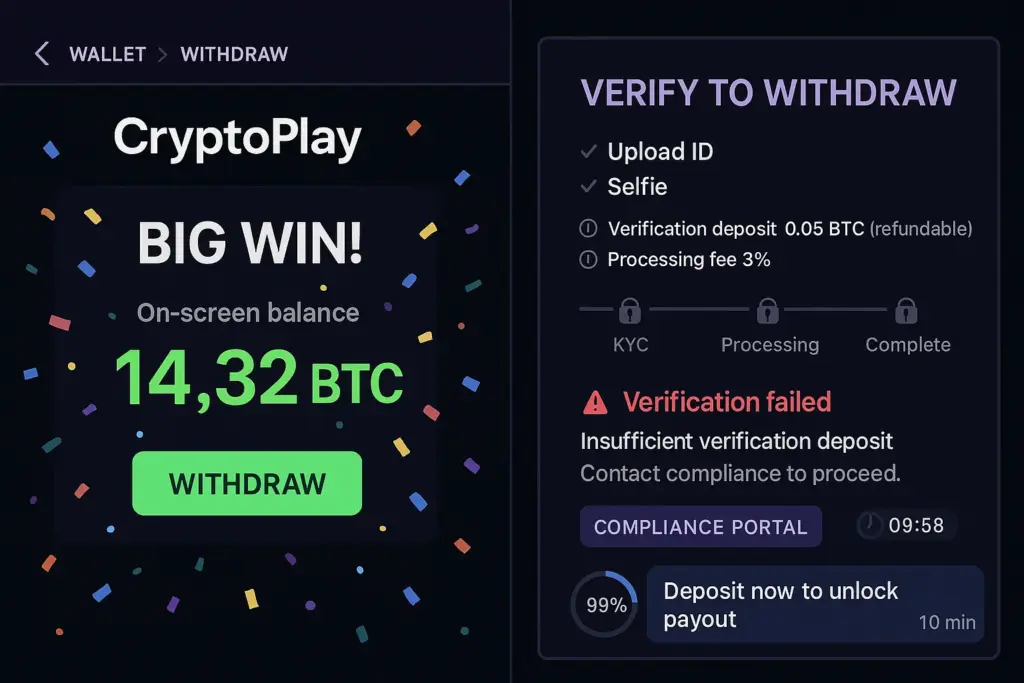
Document requests and fee ladders
The tone changes when withdrawal is attempted. Suddenly there may be a KYC review, anti-money-laundering check, tax hold, liquidity rule, VIP threshold, or wallet-validation demand. Each excuse is framed as temporary, but every step is designed to collect either more crypto or higher-value identity data.

Delay scripts and the second scam
When a victim hesitates, support tends to alternate between reassurance and pressure. The process drags on, responses become slower, and the domain may eventually go dark. In some cases a so-called recovery expert appears later, trying to monetize the same victim all over again.
Staying safe from crypto casino scams like Xaspaze
Staying safer usually means slowing down before the platform has a chance to speed you up. The checks below are ordinary, not glamorous, but they reliably expose this kind of operation. Use them before any deposit, before any upload of personal documents, and certainly before any connected-wallet approval.
Check regulators, not logos
Start with outside verification. Search the claimed operator, company name, and domain in official regulator databases rather than trusting seals pasted onto the homepage. If the entity cannot be confirmed independently, treat the site as unproven at best.
Read the domain’s backstory
Next, inspect domain age, ownership signals, and historical snapshots. A recently created address, hidden registration data, or a string of near-identical sister sites is a strong warning that the brand was built to be disposable.
Refuse any pay-to-withdraw demand
Never normalize the idea that funds must be unlocked with an extra payment. Processing deposits, tax prepayments, clearance fees, and wallet activation charges are among the most common ways these scams convert a fake balance into a real loss.
Choose channels with recourse
Safer operators do not hide behind crypto-only payment rails and vague corporate identities. Look for independently verifiable licensing, transparent company information, clear terms, and payment methods that do not eliminate every practical recovery route.
Keep wallet exposure narrow
Even outside gambling sites, limit the blast radius of any single wallet. Use separate addresses when practical, enable 2FA on related accounts, rotate sensitive credentials, and revoke token approvals that no longer need to exist on connected chains.
Treat fairness slogans as claims
Marketing language such as “provably fair” should never be accepted on faith. If the site does not show a transparent, user-verifiable method for checking outcomes, then the phrase is functioning as branding, not as evidence.
Preserve evidence early
Save wallet addresses, transaction IDs, chats, emails, screenshots, and every version of the site you can capture. Early documentation helps exchanges, stablecoin issuers, investigators, and reporting agencies understand the pattern and may support future action.
Slow yourself down on purpose
Finally, build a deliberate pause into any high-pressure offer. Step away, verify the license, inspect the domain, search for outside complaints, and only then decide. A short delay often breaks the emotional rhythm these schemes depend on.
Useful Resources for Scam Reporting and Prevention (By Country)
Reporting still matters even when the coins move fast. Strong documentation can help platforms flag addresses, help investigators connect related domains, and help other potential victims recognize the pattern sooner. The country list below is there to give you a practical place to start.
Open the country-by-country reporting list
| Country / Agency | URL | Category / Use-case | Phone/Email |
| Australia – Crime Stoppers | https://www.crimestoppers.com.au | Anonymous tips about crime | 1800 333 000 |
| Australia – National Anti-Scam Center (Scamwatch) | https://www.scamwatch.gov.au/report-a-scam | General scams; phishing; texts/emails | |
| Australia – Police Assistance Line (non-emergency) | https://www.police.gov.au | Local police report | 131 444 |
| Australia – ReportCyber (ACSC) | https://www.cyber.gov.au/report | Cybercrime (hacks, fraud, extortion) | |
| Canada – Canadian Anti-Fraud Center (CAFC) | https://www.antifraudcentre-centreantifraude.ca/report-signalez-eng.htm | General scams incl. phone/text/email | |
| France – DGCCRF (SignalConso) | https://signal.conso.gouv.fr | Consumer scams/deceptive practices | |
| France – PHAROS – Internet-Signalement | https://www.internet-signalement.gouv.fr | Online content & cybercrime reports | |
| Germany – Bundeskriminalamt / Local Police | https://www.polizei.de/Polizei/DE/Home/home_node.html | Report online fraud | |
| Germany – Weißer Ring – Victim Support | https://weisser-ring.de | Victim support | 116 006 |
| India – DoT Helpline (Sanchar Saathi) | https://sancharsaathi.gov.in | Fraudulent telecom/SIM related | 155260 |
| India – National Consumer Helpline | https://consumerhelpline.gov.in | Consumer scams | 1800-11-4000 / 1915 |
| India – National Cyber Crime Reporting Portal | https://cybercrime.gov.in | Cybercrime incl. online fraud | 1930 |
| Japan – Consumer Affairs Agency (CAA) | https://www.caa.go.jp/policies/policy/consumer_policy/caution/cybercrime/ | Consumer scams | |
| Japan – National Police Agency – Cybercrime | https://www.npa.go.jp/bureau/cyber/ | Cybercrime reporting | |
| Mexico – Guardia Nacional (National Guard) | https://www.gob.mx/gn | Cybercrime reporting | |
| Mexico – Instituto Federal de Telecomunicaciones (IFT) | https://www.ift.org.mx | Telecom/online services scams | |
| Mexico – PROFECO | https://www.gob.mx/profeco | Consumer fraud & ecommerce | |
| Netherlands – AFM – Report investment fraud | https://www.afm.nl/en/consumenten/themas/beleggen/misleiding-misbruik | Investment/crypto | |
| Netherlands – Fraudehelpdesk | https://www.fraudehelpdesk.nl/melden | General scams (incl. phishing/SMS) | 088-7867372 |
| Netherlands – Politie – Meldpunt Internetoplichting | https://www.politie.nl/themas/internetoplichting.html | Online shopping fraud | |
| New Zealand – CERT NZ | https://www.cert.govt.nz/individuals/report-an-issue/ | Phishing, identity scams | |
| New Zealand – Department of Internal Affairs – Spam | https://www.dia.govt.nz/Spam-Contact-Us | Email/SMS spam | [email protected] |
| New Zealand – IDCARE | https://www.idcare.org | Victim support (identity compromise) | 0800 121 068 |
| New Zealand – Netsafe – Report | https://www.netsafe.org.nz/report/ | Online harms & scams | |
| New Zealand – New Zealand Police (non-emergency) | https://www.police.govt.nz/use-105 | Report fraud/online crime | 105 |
| Nigeria – Economic & Financial Crimes Commission (EFCC) | https://www.efcc.gov.ng | Financial scams incl. crypto/investment | [email protected] |
| Nigeria – Nigeria Police Special Fraud Unit (SFU) | https://www.specialfraudunit.org.ng | Serious fraud | Voice/SMS: 0708 227 6895; WhatsApp: 0812 760 9914 |
| Poland – CERT Polska (CERT.PL) | https://cert.pl/en/report/ | Cyber incidents & phishing | |
| Poland – Dyzurnet.pl | https://dyzurnet.pl | Illegal online content (esp. child protection) | |
| Poland – Polish Police (Policja) | https://www.policja.pl | Report scams to police | |
| Singapore – Anti-Scam Centre / Anti-Scam Helpline | https://www.scamalert.sg | General scams; texts; calls | 1800-722-6688 |
| Singapore – Monetary Authority of Singapore (MAS) | https://www.mas.gov.sg/investor-alert-list | Investment/crypto checks | |
| Singapore – Singapore Police Force | https://www.police.gov.sg/iwitness | Police report (cybercrime) | |
| South Africa – Cybersecurity Hub (CSIRT) | https://www.cybersecurityhub.gov.za | Cyber incidents incl. scams | |
| South Africa – South African Fraud Prevention Service (SAFPS) | https://www.safps.org.za | Identity fraud support | 011-867-2234 |
| South Africa – South African Police Service (SAPS) | https://www.saps.gov.za | Police report (cybercrime unit) | |
| South Korea – Korea Communications Commission (KCC) | https://www.kcc.go.kr | Telecom-related fraud | |
| South Korea – Korea Internet & Security Agency (KISA) | https://www.kisa.or.kr | Phishing, online harms | |
| South Korea – Korean National Police Agency – Cyber Bureau | https://ecrm.cyber.go.kr | Cybercrime reporting | |
| Spain – INCIBE – Oficina de Seguridad del Internauta (OSI) | https://www.osi.es/es/reporte | Cybersecurity & online fraud | |
| Spain – Policía Nacional / Guardia Civil | https://www.policia.es | Report scams to police | |
| Sweden – Crime Victim Authority (Brottsoffermyndigheten) | https://www.brottsoffermyndigheten.se | Victim support & compensation | 090–70 82 00 |
| Sweden – Polisen (Swedish Police) | https://polisen.se | Report fraud/cybercrime | 114 14 (non-emergency); 112 (emergency) |
| Sweden – Swedish Consumer Agency (Konsumentverket) | https://www.konsumentverket.se | Unfair business practices | |
| United Arab Emirates – Abu Dhabi Police – Aman Service | https://www.adpolice.gov.ae | Cybercrime tips/reporting | SMS 2828; 800 2626 |
| United Arab Emirates – Dubai Police – eCrime | https://www.dubaipolice.gov.ae | Cybercrime reporting | 04 606 1600 |
| United Arab Emirates – Ministry of Interior – Cyber Crime Dept. | https://www.moi.gov.ae | Cybercrime incl. online scams | |
| United Arab Emirates – Telecommunications Regulatory Authority (TRA) / TDRA | https://www.tra.gov.ae | Telecom-related scams/phishing | |
| United Kingdom – Action Fraud (NFIB) | https://www.actionfraud.police.uk | General scams & cybercrime (non-emergency) | 0300 123 2040 |
| United Kingdom – Citizens Advice Consumer Service | https://www.citizensadvice.org.uk/consumer/get-more-help/if-you-need-more-help-about-a-consumer-issue/ | Consumer problems & scam guidance | 0808 223 1133 |
| United Kingdom – Financial Conduct Authority (FCA) | https://www.fca.org.uk/consumers/report-scam-us | Investment/crypto & financial services | |
| United Kingdom – National Cyber Security Centre (NCSC) | https://www.ncsc.gov.uk/collection/phishing-scams | Phishing emails & suspicious websites | |
| United Kingdom – Stop Scams UK ‘159’ | https://stopscamsuk.org.uk/159 | Banking APP fraud (direct to your bank) | 159 |
| United States – AARP Fraud Watch Network Helpline | https://www.aarp.org/money/scams-fraud/ | Victim support | 833-372-8311 |
| United States – Better Business Bureau – Scam Tracker | https://www.bbb.org/scamtracker | Business/marketplace scams | |
| United States – FBI Internet Crime Complaint Center (IC3) | https://www.ic3.gov | Internet crime incl. investment/crypto | |
| United States – Federal Trade Commission – ReportFraud | https://reportfraud.ftc.gov | General scams, phishing, texts/emails | 1-877-382-4357 |
| United States – National Center for Disaster Fraud | https://www.justice.gov/disaster-fraud | Disaster-related scams | (866) 720-5721 |
| United States – SEC Tips & Complaints | https://www.sec.gov/tcr | Investment & securities/crypto-asset offerings |
Take the lesson from the pattern, not from the promises made by the site. Protect devices, secure accounts, preserve evidence, and treat any request for more crypto or more documents as a reason to stop rather than one more hurdle to clear.
