

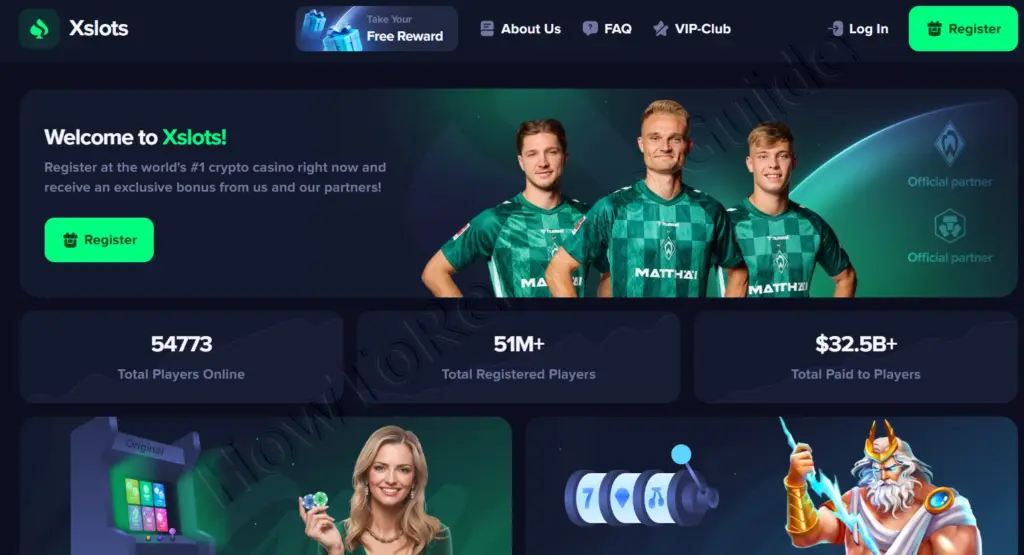
You should be very careful with Xslots.cc and other similar sites like it because they all belong to the same type of online crypto scam that tricks thousands of users every day.
Xslots.cc initially appears to be an online gambling platform, and its flashy design, celebrity-themed promo clips, and tempting signup bonuses are often enough for users to engage with it and start gambling.
The site supposedly lets you place bets with free house credit and, most of the time, those early spins result in steady wins. But this is just bait. Once you register, gamble, and start seeing apparent winnings, the site pushes you toward the real scam.
Scams of Xslots.cc‘s type are known to steal personal data and passwords. Install SpyHunter Pro to scan for risks, remove any dangerous trackers, and enable real-time protection.

Try Free For 7 Days*
Buy now15% OFF if you buy straight without trial.
 OFFER
OFFERBefore any withdrawal can happen, you are told to make an extra deposit as a way of “verification” or as a “transfer processing” fee. In other words, you must pay from your own pocket to receive money that was never truly yours.
The truth is that the scammers just want to get your deposit and, in many cases, your wallet and/or online banking details. That’s the whole purpose of this and other similar scams like Cuesax.com and Eraxan.com.
Treat any contact with Xslots.cc as a live fraud event. The sections below explain the warning signs, the extraction pattern, and the steps that matter most after exposure.
IMPORTANT! READ BEFORE PROCEEDING!
If you have already interacted with Xslots.cc, stop sending money and assume the situation is active fraud. Preserve the trail, secure accounts, and focus on containment before emotion pushes you into another payment. These five actions from the article matter most right away:
- Change passwords and secure logins for email, exchanges, and wallet-related accounts, and turn on two-factor authentication wherever available.
- Contact exchanges fast with transaction hashes and wallet addresses so suspicious activity can be flagged under their procedures.
- Move remaining assets to fresh wallets if compromise is possible, and review or revoke token approvals on connected chains.
- Treat shared ID as exposed, and watch for identity misuse, fraud alerts, or unusual credit activity where those tools are available.
- Save the evidence trail including wallet addresses, transaction IDs, chats, screenshots, dates, and domains, then file reports quickly.
How We Know Xslots.cc is a Scam
The problem with Xslots.cc is not one odd detail but a cluster of signals that fit the same fake-platform pattern again and again. When those signs appear together, the odds of a legitimate operator collapse.
Surprise withdrawal charges
The cleanest tell is a demand for new money before old money can leave. Fake platforms routinely invent release charges, taxes, or deposits the moment a victim asks to withdraw.
Counterfeit licensing
A badge in the footer proves nothing. Real verification requires an official register, and scam sites often rely on borrowed logos or claims that do not check out.
Inflated early “wins”
Fast gains on screen are part of the confidence trick. The balance can look impressive while remaining nothing more than a number under the scammer’s control.
Crypto-only rails
Crypto makes the scheme harder to reverse and easier to hide behind wallet hops. That convenience is attractive to scammers for exactly that reason.
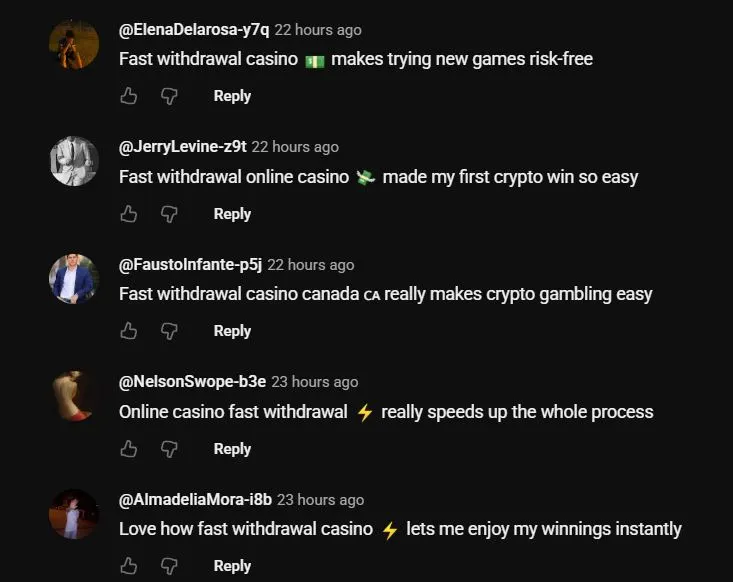
Synthetic social proof
Reviews, pop-ups, chat activity, and testimonials may be staged to imitate a busy, trusted service. None of that theater is evidence of real payouts.
Fresh, privacy-masked domains
Short-lived domains and lookalike replacements are common because the operators burn names, rebrand, and reopen with the same playbook.

How the Xslots.cc Scam Deception Funnel Works
Understanding the sequence is useful because the fraud is built as a progression. Each stage is designed to make the next request feel more reasonable, even when the whole setup is fabricated.
In practice, the path usually starts with a lure, builds trust through visible gains, and then switches into extraction mode with fees, identity demands, delays, and sometimes a second scam pretending to offer recovery.
Promo hooks and influencer codes
Many victims first encounter the pitch through ads, chat groups, or messages that frame the offer as time-sensitive and unusually generous.
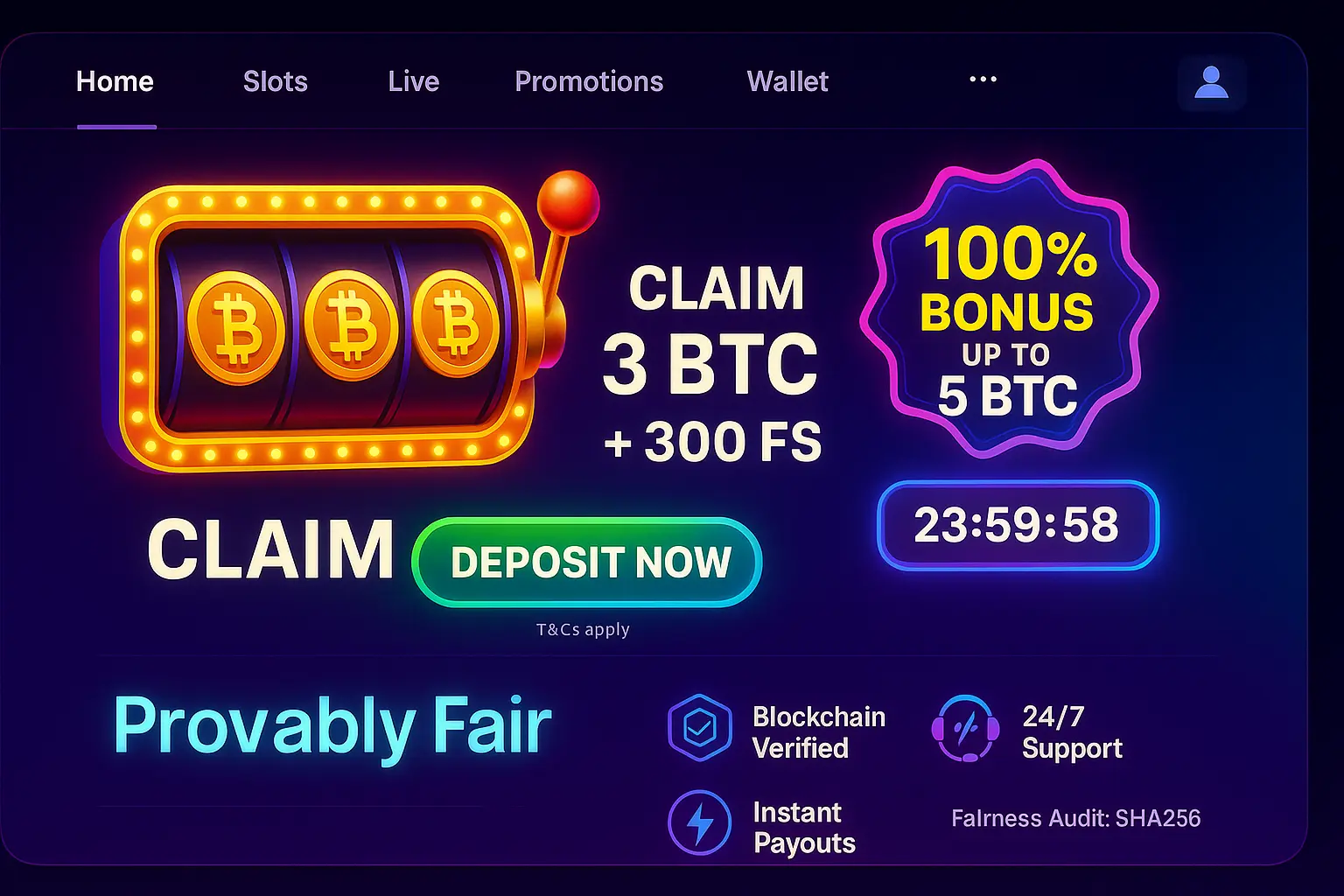
Casino skin and bonus theater
The site then presents a polished gaming front, big bonuses, and language meant to suggest easy credibility, even though the core operation may be nothing more than a fake balance system.
Inflated balances, then the gate
After signup, early success or a small apparent win helps lower suspicion. The real turn comes when withdrawal triggers a new condition that requires yet another transfer.
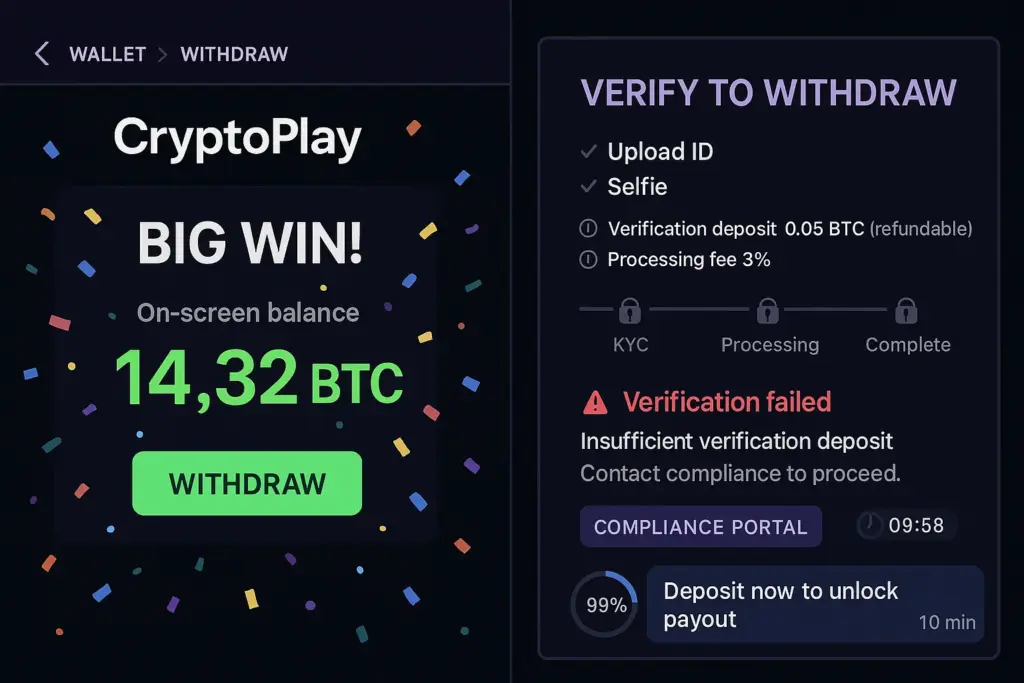
Fee-gates and KYC harvest
Support can pile on explanations such as account review, security checks, taxes, or tier upgrades while collecting more crypto and, in some cases, identity documents.

Stalling, rebrands, and “recovery” bait
When the victim hesitates, the story often shifts to delays, frozen accounts, or technical issues. After that, the site may vanish, reappear under another name, or attract fake recovery contacts.
Staying safe from crypto casino scams like Xslots.cc
Avoiding the next clone is mostly about slowing the process down and insisting on proof before you send money or documents. These habits cut through the urgency the scam depends on.
Verify license status in official registers
Check the operator in an official register rather than trusting logos or claims on the site itself. A missing record is a serious warning sign.
Check domain age and history
Look for brand-new or recycled domains, especially when ownership is hidden and the site history is thin. Short-lived names are common in clone campaigns.
Reject withdrawal fees and “unlock” deposits
No honest platform should need a separate crypto payment to release money already shown in your account. That demand is one of the clearest danger signals.
Prefer venues with recourse
Platforms with transparent company details, recognized oversight, and normal dispute channels are safer than anonymous crypto-only fronts.
Limit wallet exposure
Use strong account security, separate wallets when needed, and review approvals you no longer use so one bad interaction does not spread damage.
Validate “provably fair” claims
Marketing language is cheap. If a claim cannot be independently checked, treat it as sales copy rather than proof.
Document and report rapidly
Keep transaction hashes, wallet addresses, screenshots, domains, and chats. Quick reporting can help exchanges and investigators connect cases.
Build a deliberate slow-down reflex
Pause before depositing, verify externally, and resist any push toward immediate action. Scammers thrive on speed, not scrutiny.
Useful Resources for Scam Reporting and Prevention (By Country)
Reporting quickly still matters. Even when funds are difficult to recover, detailed complaints with hashes, wallet addresses, dates, and communications can support exchange reviews and broader investigations.
Click here to report the scam in your country
| Country / Agency | URL | Category / Use-case | Phone/Email |
| Australia – Crime Stoppers | https://www.crimestoppers.com.au | Anonymous tips about crime | 1800 333 000 |
| Australia – National Anti-Scam Center (Scamwatch) | https://www.scamwatch.gov.au/report-a-scam | General scams; phishing; texts/emails | |
| Australia – Police Assistance Line (non-emergency) | https://www.police.gov.au | Local police report | 131 444 |
| Australia – ReportCyber (ACSC) | https://www.cyber.gov.au/report | Cybercrime (hacks, fraud, extortion) | |
| Canada – Canadian Anti-Fraud Center (CAFC) | https://www.antifraudcentre-centreantifraude.ca/report-signalez-eng.htm | General scams incl. phone/text/email | |
| France – DGCCRF (SignalConso) | https://signal.conso.gouv.fr | Consumer scams/deceptive practices | |
| France – PHAROS – Internet-Signalement | https://www.internet-signalement.gouv.fr | Online content & cybercrime reports | |
| Germany – Bundeskriminalamt / Local Police | https://www.polizei.de/Polizei/DE/Home/home_node.html | Report online fraud | |
| Germany – Weißer Ring – Victim Support | https://weisser-ring.de | Victim support | 116 006 |
| India – DoT Helpline (Sanchar Saathi) | https://sancharsaathi.gov.in | Fraudulent telecom/SIM related | 155260 |
| India – National Consumer Helpline | https://consumerhelpline.gov.in | Consumer scams | 1800-11-4000 / 1915 |
| India – National Cyber Crime Reporting Portal | https://cybercrime.gov.in | Cybercrime incl. online fraud | 1930 |
| Japan – Consumer Affairs Agency (CAA) | https://www.caa.go.jp/policies/policy/consumer_policy/caution/cybercrime/ | Consumer scams | |
| Japan – National Police Agency – Cybercrime | https://www.npa.go.jp/bureau/cyber/ | Cybercrime reporting | |
| Mexico – Guardia Nacional (National Guard) | https://www.gob.mx/gn | Cybercrime reporting | |
| Mexico – Instituto Federal de Telecomunicaciones (IFT) | https://www.ift.org.mx | Telecom/online services scams | |
| Mexico – PROFECO | https://www.gob.mx/profeco | Consumer fraud & ecommerce | |
| Netherlands – AFM – Report investment fraud | https://www.afm.nl/en/consumenten/themas/beleggen/misleiding-misbruik | Investment/crypto | |
| Netherlands – Fraudehelpdesk | https://www.fraudehelpdesk.nl/melden | General scams (incl. phishing/SMS) | 088-7867372 |
| Netherlands – Politie – Meldpunt Internetoplichting | https://www.politie.nl/themas/internetoplichting.html | Online shopping fraud | |
| New Zealand – CERT NZ | https://www.cert.govt.nz/individuals/report-an-issue/ | Phishing, identity scams | |
| New Zealand – Department of Internal Affairs – Spam | https://www.dia.govt.nz/Spam-Contact-Us | Email/SMS spam | [email protected] |
| New Zealand – IDCARE | https://www.idcare.org | Victim support (identity compromise) | 0800 121 068 |
| New Zealand – Netsafe – Report | https://www.netsafe.org.nz/report/ | Online harms & scams | |
| New Zealand – New Zealand Police (non-emergency) | https://www.police.govt.nz/use-105 | Report fraud/online crime | 105 |
| Nigeria – Economic & Financial Crimes Commission (EFCC) | https://www.efcc.gov.ng | Financial scams incl. crypto/investment | [email protected] |
| Nigeria – Nigeria Police Special Fraud Unit (SFU) | https://www.specialfraudunit.org.ng | Serious fraud | Voice/SMS: 0708 227 6895; WhatsApp: 0812 760 9914 |
| Poland – CERT Polska (CERT.PL) | https://cert.pl/en/report/ | Cyber incidents & phishing | |
| Poland – Dyzurnet.pl | https://dyzurnet.pl | Illegal online content (esp. child protection) | |
| Poland – Polish Police (Policja) | https://www.policja.pl | Report scams to police | |
| Singapore – Anti-Scam Centre / Anti-Scam Helpline | https://www.scamalert.sg | General scams; texts; calls | 1800-722-6688 |
| Singapore – Monetary Authority of Singapore (MAS) | https://www.mas.gov.sg/investor-alert-list | Investment/crypto checks | |
| Singapore – Singapore Police Force | https://www.police.gov.sg/iwitness | Police report (cybercrime) | |
| South Africa – Cybersecurity Hub (CSIRT) | https://www.cybersecurityhub.gov.za | Cyber incidents incl. scams | |
| South Africa – South African Fraud Prevention Service (SAFPS) | https://www.safps.org.za | Identity fraud support | 011-867-2234 |
| South Africa – South African Police Service (SAPS) | https://www.saps.gov.za | Police report (cybercrime unit) | |
| South Korea – Korea Communications Commission (KCC) | https://www.kcc.go.kr | Telecom-related fraud | |
| South Korea – Korea Internet & Security Agency (KISA) | https://www.kisa.or.kr | Phishing, online harms | |
| South Korea – Korean National Police Agency – Cyber Bureau | https://ecrm.cyber.go.kr | Cybercrime reporting | |
| Spain – INCIBE – Oficina de Seguridad del Internauta (OSI) | https://www.osi.es/es/reporte | Cybersecurity & online fraud | |
| Spain – Policía Nacional / Guardia Civil | https://www.policia.es | Report scams to police | |
| Sweden – Crime Victim Authority (Brottsoffermyndigheten) | https://www.brottsoffermyndigheten.se | Victim support & compensation | 090–70 82 00 |
| Sweden – Polisen (Swedish Police) | https://polisen.se | Report fraud/cybercrime | 114 14 (non-emergency); 112 (emergency) |
| Sweden – Swedish Consumer Agency (Konsumentverket) | https://www.konsumentverket.se | Unfair business practices | |
| United Arab Emirates – Abu Dhabi Police – Aman Service | https://www.adpolice.gov.ae | Cybercrime tips/reporting | SMS 2828; 800 2626 |
| United Arab Emirates – Dubai Police – eCrime | https://www.dubaipolice.gov.ae | Cybercrime reporting | 04 606 1600 |
| United Arab Emirates – Ministry of Interior – Cyber Crime Dept. | https://www.moi.gov.ae | Cybercrime incl. online scams | |
| United Arab Emirates – Telecommunications Regulatory Authority (TRA) / TDRA | https://www.tra.gov.ae | Telecom-related scams/phishing | |
| United Kingdom – Action Fraud (NFIB) | https://www.actionfraud.police.uk | General scams & cybercrime (non-emergency) | 0300 123 2040 |
| United Kingdom – Citizens Advice Consumer Service | https://www.citizensadvice.org.uk/consumer/get-more-help/if-you-need-more-help-about-a-consumer-issue/ | Consumer problems & scam guidance | 0808 223 1133 |
| United Kingdom – Financial Conduct Authority (FCA) | https://www.fca.org.uk/consumers/report-scam-us | Investment/crypto & financial services | |
| United Kingdom – National Cyber Security Centre (NCSC) | https://www.ncsc.gov.uk/collection/phishing-scams | Phishing emails & suspicious websites | |
| United Kingdom – Stop Scams UK ‘159’ | https://stopscamsuk.org.uk/159 | Banking APP fraud (direct to your bank) | 159 |
| United States – AARP Fraud Watch Network Helpline | https://www.aarp.org/money/scams-fraud/ | Victim support | 833-372-8311 |
| United States – Better Business Bureau – Scam Tracker | https://www.bbb.org/scamtracker | Business/marketplace scams | |
| United States – FBI Internet Crime Complaint Center (IC3) | https://www.ic3.gov | Internet crime incl. investment/crypto | |
| United States – Federal Trade Commission – ReportFraud | https://reportfraud.ftc.gov | General scams, phishing, texts/emails | 1-877-382-4357 |
| United States – National Center for Disaster Fraud | https://www.justice.gov/disaster-fraud | Disaster-related scams | (866) 720-5721 |
| United States – SEC Tips & Complaints | https://www.sec.gov/tcr | Investment & securities/crypto-asset offerings |
The central lesson is simple: fake balances and last-minute release charges are not quirks of a rough platform but core parts of the fraud. Secure what you can, preserve the trail, and verify everything before any future deposit.
