

At first glance, Yoloshark doesn’t scream “scam.” Slick page, shiny badges, breathless testimonials, even a vague claim of being “licensed” somewhere offshore. Time out – first red flag: big optics, fuzzy facts. Looks legit, right? Scroll a little and it wobbles – no usable contact, mushy policies, zero verifiable history. That’s not reassurance; that’s camouflage.
Now here’s the tell: the “free bonus.” Real outfits spell out painful terms and don’t hand out money without strings you can read. The pattern, similar to Socmex and Derowin, is painfully familiar – you sign up, you deposit, the dashboard shows your “winnings” ticking up, and when you try to withdraw you hit excuses, fees, KYC purgatory, or a demand to deposit more to “unlock” funds. Notice the quotes. They matter.
Remember, numbers on a screen aren’t money in your wallet. If you can’t independently verify the license, owners, and payout record, assume the game is the scam and step back. Don’t negotiate with pixels. Close the tab and keep your crypto.
Scams of Yoloshark.com‘s type are known to steal personal data and passwords. Install SpyHunter Pro to scan for risks, remove any dangerous trackers, and enable real-time protection.

Try Free For 7 Days*
Buy now15% OFF if you buy straight without trial.
 OFFER
OFFERWhat is the Yoloshark.com Scam? Withdrawal Blockers: Excuses, KYC Loops, and Deposit Demands
The short answer: it is a fake casino wrapped in a familiar interface. From the outside, Yoloshark.com looks polished, with familiar casino games, fast sign-ups, and eye-catching promotions. Under the surface, it is a clone in a rotating set of clones on a new domain with hidden ownership. The product is theater. “Provably fair” badges do not link to real audits, and regulator logos are copied from legitimate authorities without a verifiable certificate. Nothing here is built for lawful payouts. It is designed to pass a quick glance so it can win your trust and your first deposit.
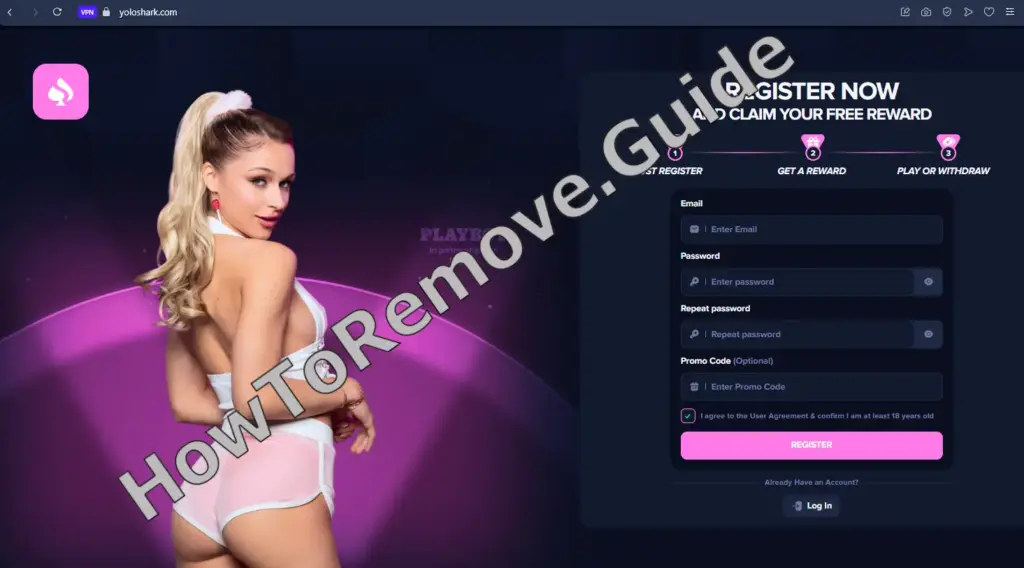
Once someone deposits, the script shifts to managed excitement. Early spins or hands seem to hit, and the on-site balance grows fast. These results are not skill or luck. They are a funnel that nudges bigger deposits. When a withdrawal request appears, friction lands without warning. They add an after-the-fact KYC check, a “processing fee,” or a VIP “unlock payment.” Some players are told to make an “anti-fraud collateral” or a “tax prepayment” to “release” funds. Each new gate is a pretext to pull more money or harvest more data.
Behind the scenes, Yoloshark.com leans on well-studied tricks from gambling and fraud. The near-miss effect keeps people playing. Sunk-cost bias whispers that paying one more gate avoids “wasting” what was already sent. Borrowed authority – stolen license seals and fake audits – short-circuits healthy doubt. Synthetic social activity pretends the site is busy and trusted. If a victim resists or runs out of funds, support goes silent, the domain rebrands, or traffic is pushed to a look-alike site. The cycle then starts again.
What to Do if You’ve been scammed by Yoloshark?
First, stop the money bleed. Crypto transfers cannot be reversed, and chasing a quick refund often leads to “recovery” scams that demand more fees. Your first moves should be defensive and documented.
Rotate security on day one. Change passwords for your email, crypto exchanges, wallets, and cloud storage. Revoke API keys. Set strong, unique passwords and enable multi-factor authentication everywhere.
Move assets off contaminated rails. Create fresh wallets with new seed phrases. Transfer remaining funds. Do not reuse any compromised phrase or private key.
Build an evidence package. Save URLs, domain lookups, chat logs, wallet addresses, transaction hashes, and timestamps. Keep everything in a dated folder so investigators and exchanges can follow the trail.
File official reports quickly. Report to your national cybercrime unit or police. If there is any U.S. nexus, submit to FBI IC3. Include your evidence list and attach transaction hashes.
Notify exchanges and issuers that may touch the funds. Open tickets with any exchange that received or may receive the crypto. Provide transaction hashes and your police report number so they can flag or freeze assets when law enforcement engages.
Treat shared KYC as a separate incident. If you uploaded IDs or selfies, assume identity risk. Turn on account alerts, consider a credit freeze where available, and watch for new accounts opened in your name.
Ignore unsolicited “recovery agents.” A second-wave scam targets recent victims with promises of fast refunds for a “small fee” or a remote-access session. Decline and disengage.
Track on-chain movements. Use blockchain explorers to map outgoing hops. Even without clawback, the history helps investigators link addresses and sometimes pressure exit points.
The Yoloshark Legitimacy Illusion: Shiny Badges, Fuzzy Facts
The template is churn-and-burn. If you slow down before depositing, the tells are obvious and repeatable.
Withdrawal paywalls labeled as “verification.” Any site that demands a payment, “anti-fraud collateral,” or a VIP “unlock payment” to release your own balance is running an advance-fee play. Legitimate operators do not charge you to withdraw your funds.
Unverifiable licensing and audits. Regulator logos that do not link to a current, matching certificate on the authority’s site are for show. The same goes for “provably fair” labels with no public, third-party validation.
Crypto only with no chargeback path. The insistence on irreversible rails without reputable fiat processors or buyer protections stacks the odds against you before you start.
Fresh, opaque domains and shape-shifting brands. New registration dates, hidden owners, and a row of near-identical sites are standard markers for disposable operations.
Synthetic social proof. Pop-ups of “recent wins,” bot comments, cloned review pages, and influencer codes without outside confirmation exist to make you hurry, not to help you verify.
Tips to Stay Protected From Casino site Scams Like Yoloshark
Prevention beats cleanup. A few steady habits, used every time, will screen out most of these sites before any money leaves your wallet.
Verify the license rather than the logo. Check the operator in the regulator’s public register and confirm the listed domain matches the site in front of you. If there is no entry or the details do not match, walk away.
Refuse any pay-to-withdraw tactic. When a site asks for a “processing fee,” a VIP “unlock payment,” or an “anti-fraud collateral” to release winnings, treat that as decisive proof of fraud and stop all contact.
Test the rails with trivial amounts. If you still want to try a new venue, attempt a tiny withdrawal early and then wait. Stalling or moving goalposts is your cue to quit.
Investigate off-platform. Look for independent reporting and real enforcement actions. Treat testimonials that live only on the operator’s pages as marketing, not evidence.
Guard your identity. Do not upload sensitive documents to an unverified site. If you slip, assume misuse is possible. Use a password manager and multi-factor authentication to limit the damage from any account takeover.
Prefer accountable payments, transparent terms, and responsible-gaming tools. Reputable operators support fiat options with consumer protections and publish clear dispute processes.
Examine domain history and footprint. A domain age under a year and repeated rebrands are risk flags. Combine that with thin company details and you likely found a fly-by-night.
Use protective tooling. Browser extensions and security suites that flag suspect domains and block trackers can surface problems you might miss during bonus chasing.
