

OneStart.exe is a shape-shifting “AI browser” bundle that sneaks in with free PDF editors, templates, and other “helpful” downloads. It installs per-user (no admin rights) and drops a sticky desktop toolbar.
The most typical symptoms include sudden search redirects (requests bounce through onestart.ai before landing on Yahoo), intrusive pop-ups/offers, sluggish browsing, and the browser reappearing after you think you removed it.
You might also notice it living under your profile’s AppData folder and new shortcuts in Start or on the desktop.
This post walks you through understanding what OneStart.exe is, why it persists, and how to fully remove it and any companions it drags along.
OneStart may expose your browser to redirects, ads, and persistent unwanted components. Install SpyHunter Pro to scan for risks, remove related threats, and enable real-time protection.
 OFFER
OFFER*Source of claim SH can remove it. Trial w/Credit card; image is for illustration; full terms.
Is OneStart.exe a Virus?
Not exactly a virus, but still problematic. OneStart.exe is not a classic self-replicating malware like viruses and is instead something more akin to a Trojan that masquarades as an “AI-assisted” Chromium browser (some related builds use Electron).
It installs to the user profile (e.g., %APPDATA%\OneStart.ai\OneStart\<version>\) and rewires search flows, often via onestart.ai. OneStart.exe maintains its own update channel using Advanced Installer AIU configs fetched from attacker-controlled infrastructure (e.g., onestartapi[.]com/api/bb/updates.txt) and polls for bundled Chrome extensions.
Historically, sibling campaigns executed Node.js scripts from %TEMP%, and the backend frequently rotates through random CloudFront-backed domains (7df4va[.]com, mka3e8[.]com), indicating shared control and a mature delivery pipeline.
How dangerous is OneStart.exe?
OneStart.exe’s danger levels aren’t consistent and can differ but it certainly has the potential to cause trouble. It tracks browsing (earlier builds even piggy-backed additional shopping extensions), hijacks search, and can expose you to scam sites and unwanted downloads.
Most critically, the same operator infrastructure behind OneStart.exe has been used to deliver secondary payloads – e.g., on August 21, 2025, the cluster was observed silently activating to drop the TamperedChef stealer. Domain-swapping across endpoints (AppSuite/ManualFinder/OneStart.exe) still yields valid responses, underscoring a unified, long-lived actor.
Treat OneStart.exe like a foothold that can escalate: remove it completely, hunt for co-installed companions, and scrutinize traffic to rotating CloudFront-style domains.
OneStart Malware Removal Guide
A lot of users run into trouble when trying to remove OneStart.exe. First, try the easy way – a normal uninstall. If that doesn’t do the trick, you’ll need to go deeper. More advanced removal methods are available, and skipping them could leave OneStart.exe lurking in your system.
Quick Steps to Uninstall the OneStart Browser
- 1.1Open Settings, go to Apps, and use the Installation Date filter to find any recent installations.
- 1.2Look for programs named OneStart.exe or OneStart.ai or anything unfamiliar that was installed at the same time.
- 1.3Click on the suspicious software and select Uninstall. Follow the prompts to complete the removal.
- 1.4Fire up File Explorer and head over to C:\Program Files and C:\Program Files (x86).
- 1.5If you spot any folders named “OneStart” or “Quick Updater“, delete them without hesitation.
Once you’ve completed these steps, restart your computer. If OneStart is still lurking around, it’s time to dig deeper.
SUMMARY:
Before You Begin: Something to Keep in Mind
The guide you are about to see next includes some steps that inexperienced users may find challenging. In case you aren’t confident you can complete one or more of the steps, I suggest you opt for the alternative solution of using a tool like SpyHunter 5 to take care of the malware for you.
How to Fully Uninstall OneStart ai
If the quick fix didn’t get rid of OneStart.exe, then you’ve got some work to do. This thing doesn’t just disappear – it leaves traces everywhere. You need to track down every piece of it. But before diving in, some prep work is required, or you’ll just be wasting time.
1. Preparing for the OneStart.exe Uninstallation
- 1.1
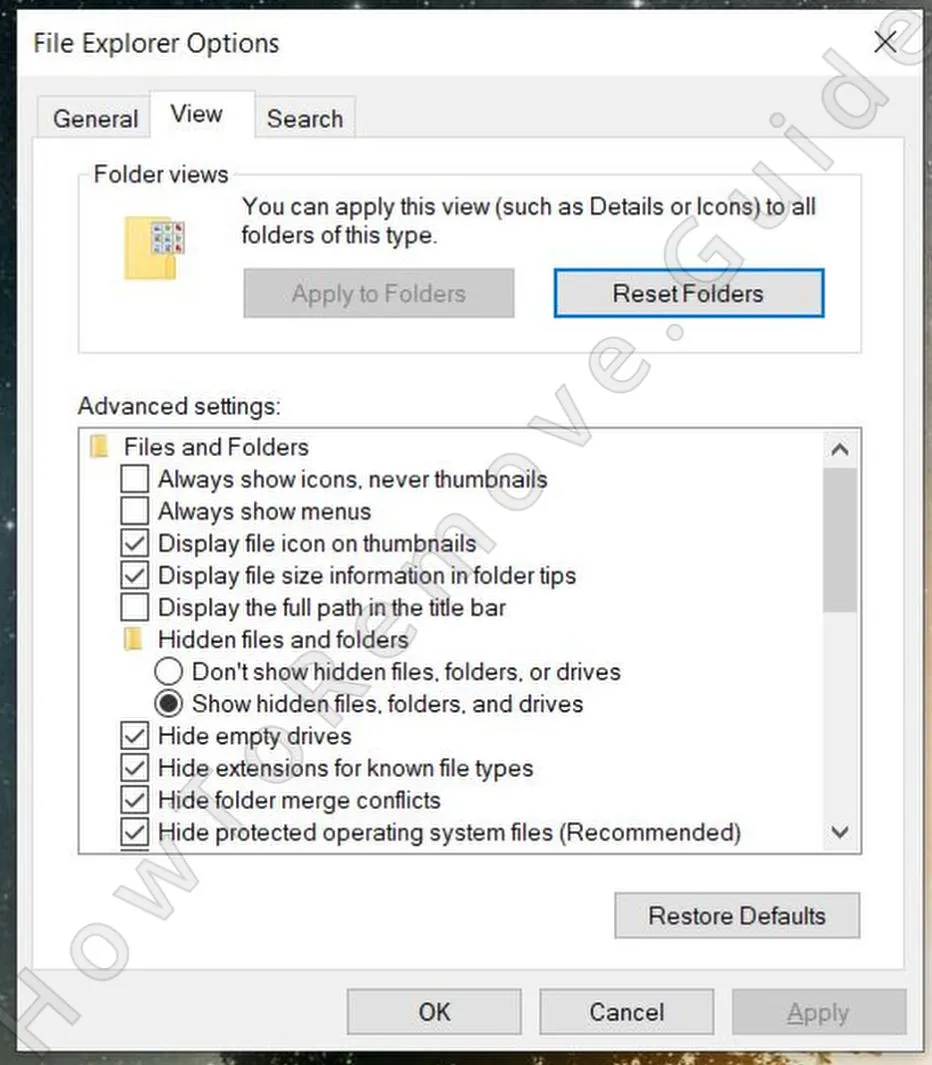 Open File Explorer, click on the View tab, and select Options (or Folder Options). Under the View tab, enable Show hidden files, folders, and drives. Click Apply, then OK.
 - 1.2Download and install LockHunter, a handy free tool for removing files that won’t delete. You’ll need it later.
Uninstall OneStart App From the Task Manager
Here’s the deal – OneStart.exe probably has background processes running, and as long as they’re active, you won’t be able to remove it completely. Open Task Manager and hunt down anything suspicious. Shut it down before moving forward, or else OneStart.exe is just going to keep coming back.
2. How to Delete OneStart.ai Processes in the Task Manager
- 2.1Press Ctrl + Shift + Esc to open Task Manager. Click More Details if needed.
- 2.2Under the Processes tab, sort everything by CPU Usage or Memory to spot any suspicious activity.
- 2.3
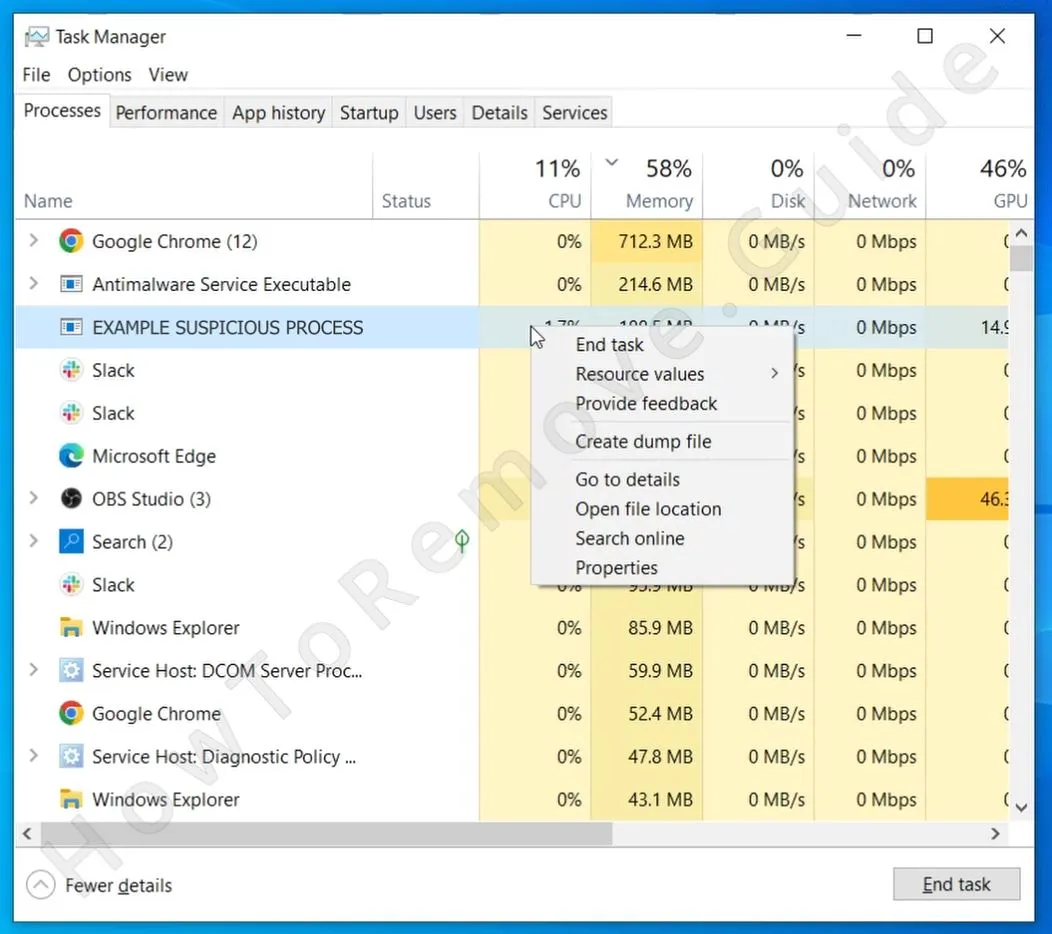 Find any processes related to OneStart, QuickUpater.exe, or anything else suspicious. Right-click and select Open File Location to go to the respective process folder.
 - 2.4Without closing the process folder, return to the Task Manager, select the rogue process, and hit End Task.
- 2.5Now, go to the file location that should still be open and delete everything there.
- 2.6If a file refuses to go away and you get a “File/Folder is being used by another process” error, use LockHunter: Right-click the stubborn file, select “What’s locking this file/process?”, and delete it from there.
OneStart may expose your browser to redirects, ads, and persistent unwanted components. Install SpyHunter Pro to scan for risks, remove related threats, and enable real-time protection.
*Source of claim SH can remove it. Trial w/Credit card; image is for illustration; full terms.
Delete OneStart.exe Virus Files
OneStart.exe doesn’t just sit in one place – it scatters files all over your system. If you’re serious about removing it, you need to check all potential hiding spots. Anything tied to OneStart.exe has to go. If you leave even one piece behind, it could reinstall itself without you noticing.
3. How to Get Rid of OneStart.exe Files
- 3.1Search for these file locations and check if OneStart is hiding there:
► C:\Users\YourUsername\AppData\Roaming\OneStart\bar\updater.exe
► C:\Users\YourUsername\AppData\Local\Programs
► C:\Users\YourUsername\AppData\Roaming\Microsoft\Windows\Start Menu\Programs
► C:\Program Files
► C:\Program Files (x86)
► C:\ProgramData\Microsoft\Windows\Start Menu\Programs\Startup
► C:\Users\YourUsername\AppData\Roaming\Microsoft\Windows\Start Menu\Programs\Startup - 3.2If you see anything linked to OneStart.exe or QuickUpdater.exe delete it. But be careful – double-check file names to avoid removing important system files.
- 3.3
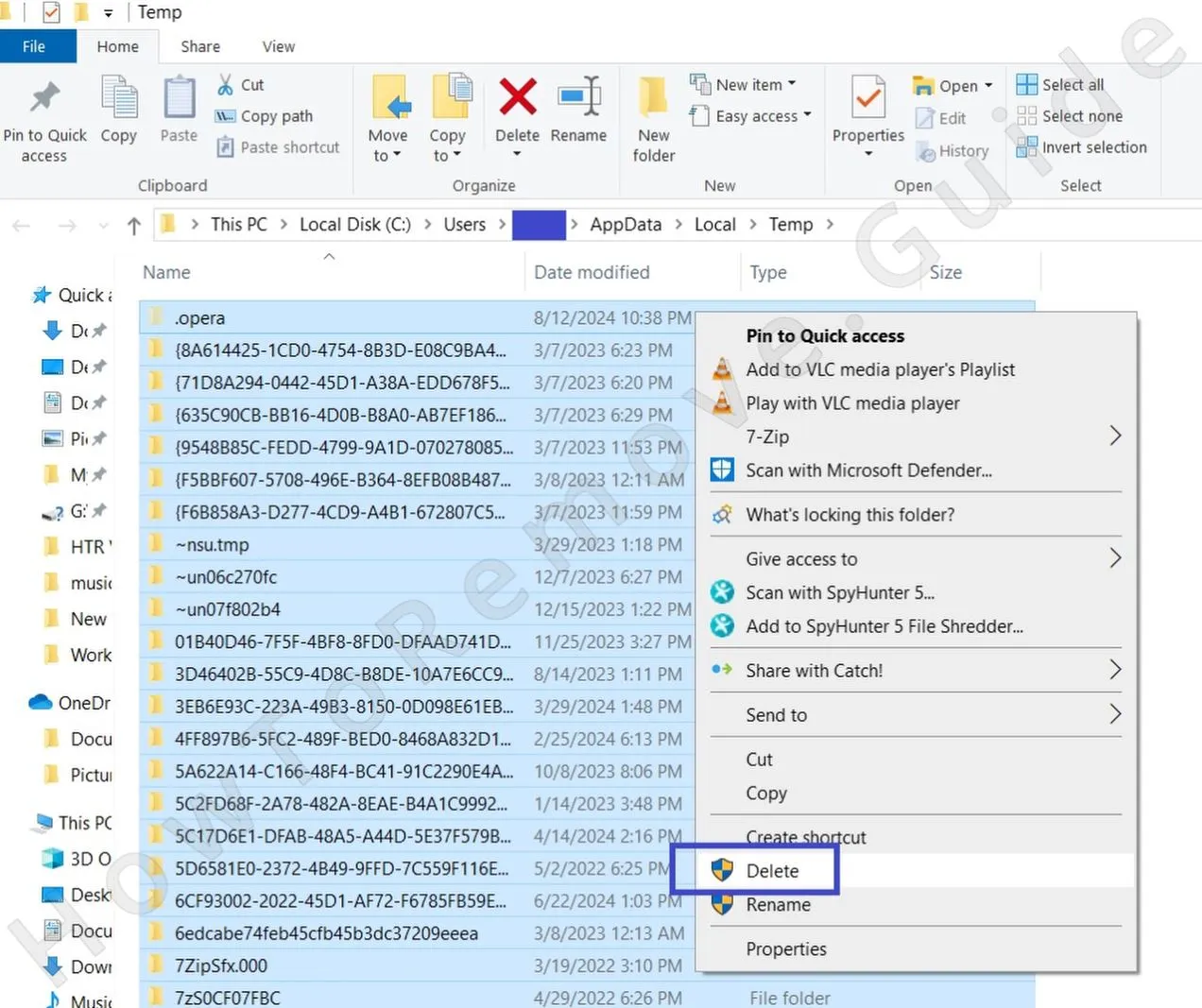 Go to C:\Users\YourUsername\AppData\Local\Temp and delete everything inside. It’s all temporary junk.
 - 3.4If any files refuse to delete, remember LockHunter – it’s your best friend in this process.
Disable OneStart.exe Startup Items
This malware is known to create startup items that let it launch on its own whenever the system is started. These items give OneStart.exe persistence in the system and make it harder to remove. You must, therefore, look for such items linked to the malware and disable them before moving on to the next steps.
4. How to Remove OneStart.exe Startup Items
- 4.1Press Ctrl + Shift + Esc to open Task Manager and head to the Startup tab.
- 4.2Look for anything related to OneStart.exe or any suspicious items, and disable them.
- 4.3Keep only the programs you actually want running on startup.
Close Task Manager when you’re done.
Remove OneStart.exe Scheduled Tasks
OneStart.exe isn’t just lurking in your system – it might have set up scheduled tasks to keep itself running. You need to check Task Scheduler and remove anything tied to OneStart.exe. If you don’t, it might just restart itself the next time you turn your computer on.
5. Eliminate OneStart.exe Scheduled Tasks
- 5.1
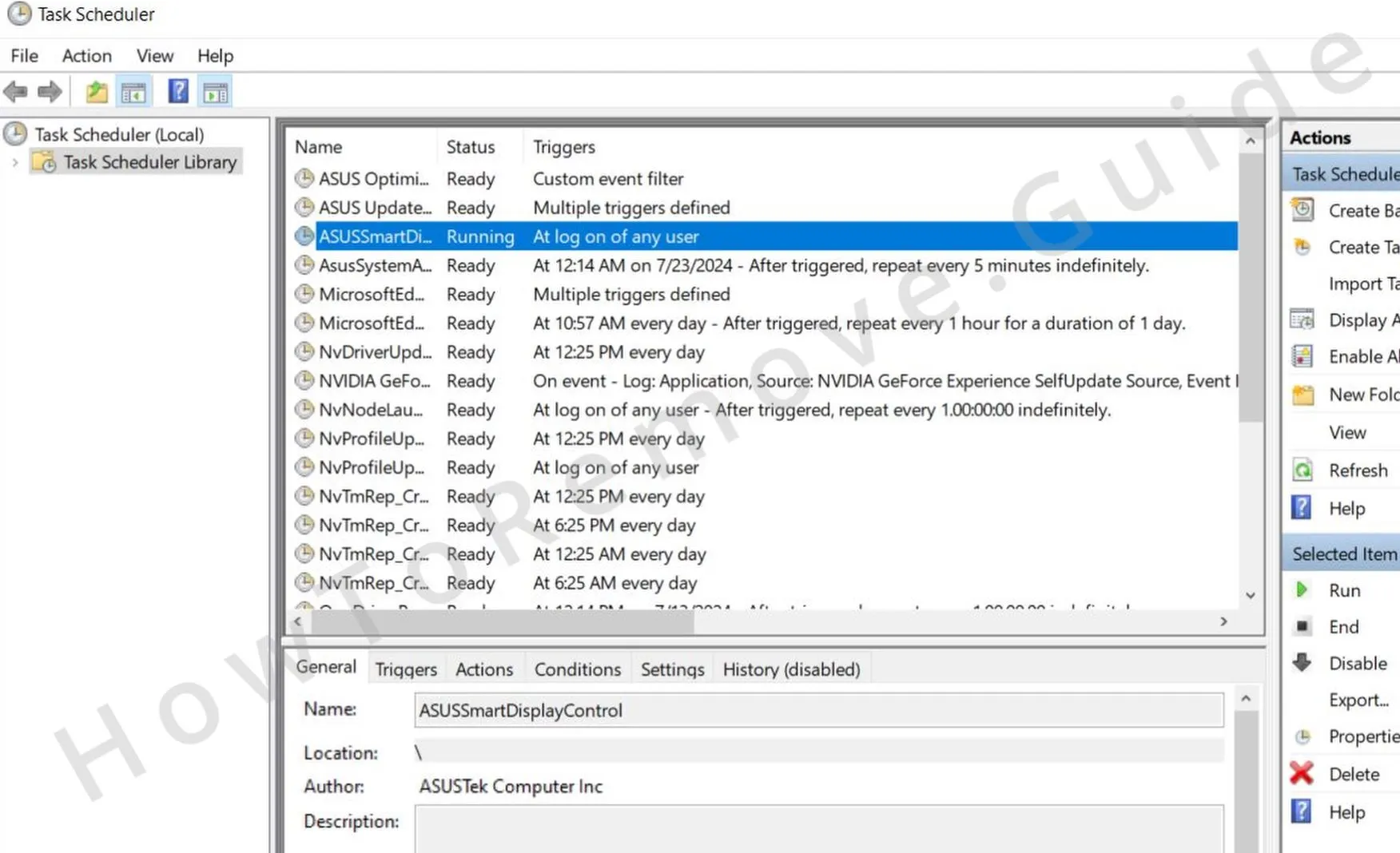 Open the Start Menu, type Task Scheduler, and launch it. Navigate to the Task Scheduler Library.
 - 5.2Examine all the tasks one by one: Click each one, select the Actions tab, the look at what the task is set to run. If any tasks are set to open suspicious .exe files or scripts, note down the files’ paths and then delete the tasks.
- 5.3After deleting the rogue task/s, go to the noted file paths and remove any remaining files.
Uninstall the OneStart.exe Malware App Through the Windows Registry
Here’s where things get tricky – OneStart.exe buries itself in the Windows Registry. Deleting these entries is the only way to make sure it’s really gone, but be careful. Messing with the registry can break your system if you’re not cautious. Double-check everything before deleting anything.
6. How to Remove OneStart.exe Through the System Registry
- 6.1Press Win + R, type regedit, and hit Enter.
- 6.2Press Ctrl + F, type “OneStart”, and delete every result you find. Keep searching until no more entries show up.
Repeat the process with “Quick Updater” and remove those too. - 6.3Check these registry locations for OneStart.exe traces:
►HKEY_USERS\Software\OneStart.ai
►HKEY_USERS\Software\Microsoft\Windows\CurrentVersion\Run
►HKEY_LOCAL_MACHINE\Software\Wow6432Node\Microsoft\Windows\CurrentVersion\Uninstall{31F4B209-D4E1-41E0-A34F-35EFF7117AE8} - 6.4Also, take a look at these common malware hideouts:
►HKCU\Software\Microsoft\Windows\CurrentVersion\Run
►HKCU\Software\Microsoft\Windows\CurrentVersion\RunOnce
►HKLM\Software\Microsoft\Windows\CurrentVersion\Run
►HKLM\Software\Microsoft\Windows\CurrentVersion\RunOnce
►HKLM\Software\Microsoft\Windows\CurrentVersion\Policies\Explorer\Run
►HKCU\Software\Microsoft\Windows\CurrentVersion\Policies\Explorer\Run
►HKEY_LOCAL_MACHINE\Software\Microsoft\Windows\CurrentVersion\RunServices
►HKEY_LOCAL_MACHINE\Software\Microsoft\Windows\CurrentVersion\RunServicesOnce
►HKEY_LOCAL_MACHINE\Software\Microsoft\Windows\CurrentVersion\RunOnce\Setup
►HKEY_LOCAL_MACHINE\SYSTEM\CurrentControlSet\Services
Look inside these locations, check the values on the right, and delete anything suspicious. But don’t delete the actual keys – just the bad entries inside them.

How to Avoid OneStart.exe in the Future
The biggest trap with OneStart.exe is that it rarely arrives alone – it’s piggy-backed into your life by “free” PDF editors, recipe/manual viewers, template packs, and similar bait. Skip ad-backed download portals and stick to built-in viewers or official vendors. If you do download something, check the publisher before you run it and be suspicious of installers that promise an “AI browser,” a desktop toolbar, or a “software hub.”
- Disable Automatic Downloads
In your browser settings, force “Ask where to save each file.” That single toggle stops drive-by downloads and makes you consciously approve every file – useful when a bundled installer tries to drop extras like a Chromium fork that later lives in%APPDATA%\OneStart.ai\…. - Use Enhanced Security in your browser
Turn on stricter protections (e.g., Enhanced protection and Always use secure connections in Chromium-based browsers). OneStart.exe’s ecosystem relies on sketchy redirect chains (requests bouncing throughonestart.ai) and rotating CloudFront-style domains (7df4va[.]com,mka3e8[.]com); harder blocking and real-time checks reduce the chance those land. - Install an ad-blocker
Quality blockers kneecap the pop-ups/redirects that funnel you to “free PDF converter” ads and bundleware pages, and they’ll warn on known rogue endpoints. This dramatically lowers exposure to the campaigns that seeded OneStart.exe and its cousins.
Extra hygiene that pays off:
Treat unexpected new Chrome extensions (especially ones that “present offers” or watch shopping/video sites) as red flags; prune immediately.
Prefer manual installs over “one-click” web installers; avoid anything that updates from off-brand endpoints (e.g., Advanced Installer AIU feeds like /api/bb/updates.txt on attacker-controlled domains).
After any software install, glance at Scheduled Tasks and startup entries; OneStart.exe-style bundles often set logon tasks to re-pull the payload even if you delete it once.