

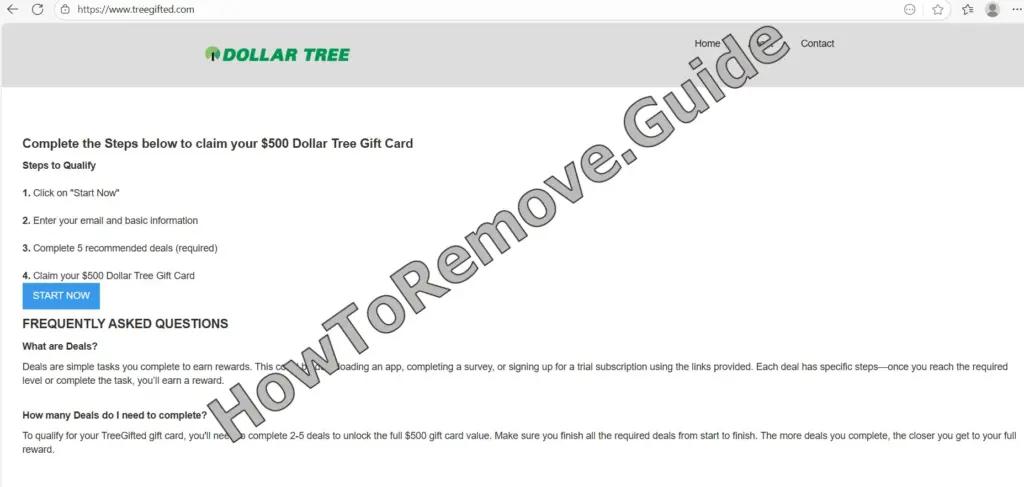
You saw a banner promising you could “Claim your $500 Dollar Tree Gift Card!” by tapping a Start or Claim button, right? Time out. Before you type anything, look at the page. The flow – tap a button, enter “basic information,” complete a few “recommended deals,” collect a windfall – looks friendly on the surface and predatory underneath. If the steps read “Click on ‘Start Now,’ enter your email and details, complete the deals, claim your $500 Dollar Tree Gift Card,” you’re staring at the script.
Scams like TreeGifted.com are known to steal personal data and passwords. Install SpyHunter Pro to scan for risks, remove dangerous trackers, and enable real-time protection.
 OFFER
OFFER*Source of claim SH can remove it. Trial w/Credit card; image is for illustration; full terms.
What is the TreeGifted.com Scam?
So what is this page trying to be? TreeGifted.com presents itself as a promotional platform and borrows a familiar retailer’s name to feel legitimate. The headline number is $500, and some versions wave $750 for extra sparkle. Here’s your first red flag: shifting requirements. One screen insists five deals are required. Another says two to five. A third says three to five “recommended deals.” That wobble isn’t a typo; it’s a lever designed to keep you in the funnel long enough to monetize every step you take.
Under the hood, the incentive is pay-per-action. Every click, every form submission, every trial start, and every app install , similara to MoneyChik and MyReliefCheck, can ring a commission bell for the operators. Notice what’s missing: verified recipients, authentic winner confirmations, any evidence that the windfall ever arrives. Also missing: an authorized connection to the retailer whose name they lean on. Dollar Tree has not endorsed this, and you won’t find the giveaway on official channels like DollarTree.com. The name is there to borrow trust, not to provide it.
Timeout again, because the bait is right in the phrasing. The page shouts “GET STARTED NOW” or “Claim Now,” then pushes you into a chain of redirects through multiple sites, like treegifted[.]sites, you didn’t ask to visit. Early on, you’re asked for “basic information,” which in practice can include your email, phone number, full name, address, and date of birth. That is identity scaffolding. Handing it over turns you from visitor to product, which is exactly the pivot the funnel wants.
What happens if you keep going? People who follow the steps describe a familiar rhythm. Sometimes there’s no real confirmation page. If a congratulations screen appears at all, it typically leads to more offers rather than any payout process. Meanwhile, those “deals” have strings. Trial subscriptions flip into unexpected monthly charges. App downloads come bundled with trackers you didn’t bargain for. Inboxes fill with marketing you never requested, and phones get friendlier with robocalls. In worse cases, accounts get compromised and identity theft risks tick upward because your information now circulates more widely.
How the TreeGifted.com Funnel Works
Let’s walk the funnel beat by beat so you can spot it in the wild. Step one is the bait: a high-value gift card wrapped in urgency – “Act now! Limited supply!” – to move you rather than inform you. Step two is the button press – “Start,” “GET STARTED NOW,” or “Claim Now” – launching monetized redirects across numerous sites. Step three is the form that “just needs” contact details but actually wants enough personal information to map your identity. Step four is the deal wall: trial subscriptions, app downloads, surveys, and sweepstakes entries that ask for more permissions and sometimes for credit card details. Step five is the endless loop: finish what they asked, and you’re shown more offers, upsells, and “recommended deals,” keeping the meter running. Step six is the fallout: no verifiable payout, but plenty of charges, spam, robocalls, and long-tail risk.
Still on the fence? Here’s a diagnostic kit. No verifiable company information – no physical address, no business registration, no functioning customer service. No privacy policy or legal disclosure explaining what happens to your data. Synthetic social proof shows up as vague counters like “137 people claimed this offer today.” Those counters are theater, not transparency. And the inconsistent deal counts we already flagged? That’s the flywheel that keeps you clicking because the finish line is always a few steps away.
There’s a timing clue as well. The domain itself is a short-term player: registered in March 2025 and set to expire in March 2026. Sites engineered for a quick harvest don’t plan for anniversaries. They show up, collect sign-ups, and evaporate when negative feedback accumulates. That lifecycle also explains why verified winners never appear – because verified winners would anchor the site in reality. Instead, you get generic forms and cheerful buttons, and that’s as concrete as it gets.
Let’s talk about the name on the marquee. Using a recognizable retailer’s name is a trust hack; it piggybacks on familiarity. If this were an authorized promotion, you’d see it on the retailer’s official site, full stop. You don’t. The promotion isn’t there, and there’s no endorsement. This is camouflage: a sticker slapped on instructions that route you into unrelated networks and third-party pages where every action you take can be monetized without delivering anything back to you.
I want to pause and highlight the language cues because they’re repeat offenders. Words like “simple,” “recommended,” and “basic information” are chosen to lower your guard. The phrase “complete X deals” makes each step sound finite and fair, like chores you can knock out before lunch. The scare quotes matter here because that “value” you watch climb on a dashboard is just numbers on a screen. You can’t verify where anything is invested or stored, and you can’t audit the pipeline. You’re being asked to trust the counter, not the contents.
Recognizing Warning Signs on TreeGifted.com
So what do you do in the moment? First, resist the tempo. The page is trying to rush you with urgency blurbs and rolling counters. Second, inspect the site’s spine. Is there a physical address? A real company registration? A working support channel? A privacy policy that says something concrete? Third, read the ask. Email, phone number, full name, address, and date of birth – those are not “basic.” Pair that with credit card fields for “trial” offers and you’ve built a permission structure that hands over money and identity in the same breath.
If you’ve already stepped in, you’re not doomed; you’re just early to cleanup. Cancel any trial subscriptions you touched. Watch your statements for unexpected monthly charges. Tighten your accounts – change passwords, enable two-factor authentication, and monitor for alerts. Expect a spike in spam and robocalls because your details may now live in more places. And remember: device risk travels with app downloads that include trackers or worse; scan and remove anything you don’t recognize.
Let’s connect the dots. We have the promise – $500 on the marquee, sometimes $750 in the banner – paired with inconsistent requirements: five deals here, two to five there, three to five somewhere else. We have no winners you can verify, no proof of payout, and no official listing on DollarTree.com. We have the button language – “GET STARTED NOW,” “Claim Now” – leading to a redirect maze. We have synthetic social proof – “137 people claimed this offer today.” We have the absence of company identity and policy.
Here’s where it becomes clear. The giveaway isn’t the product. You are. The operators earn when you act – when you click, when you submit, when you install, when you “complete a deal.” That’s why the goalposts move. That’s why the loop doesn’t end. The funnel is designed to monetize your steps, not reward them. Once you see that, the page reads differently. The buttons aren’t invitations; they’re turnstiles. And the fastest way to win is not to play at all.
So treat pages like this the way you’d treat a stranger who shows up at your door with a contract you didn’t request and a timer buzzing in their hand. Thank them for the drama, close the door, and check the official site for any real promotion. If it isn’t on DollarTree.com, it isn’t real. If the page can’t provide basics – a true address, a registration you can verify, a privacy policy with teeth, a support channel that answers – walk. The only thing you’re “claiming” otherwise is a headache. Remember: if it’s not on DollarTree.com, it isn’t real. Screenshots and counters don’t prove anything without verified winners.
Bottom line
The pitch frames itself as a quick path to a gift card, but the concrete details point the other way. No verified winners. No transparent operator. No authorized endorsement. No policy guardrails. In place of clarity, you get urgency, counters, redirects, and ever-shifting requirements. Guard your time. Guard your data. Guard your money. The cleanest win here is the one where you step back, shut the tab, and keep your information to yourself.
