

Did you recently receive an alarming text claiming to be from the Texas Department of Motor Vehicles and warning that you must pay for an unpaid toll fee, a missed traffic ticket, or an unpaid traffic violation? Did it threaten to suspend your license, suspend your vehicle registration, damage your credit, or tack on extra charges if you did not act right away? If so, do not rush to click the link or send any payment. This is very likely part of the txdmv.org text scam.
If the message you received points you to txdmv.org, txdmv.org-gess.eu.cc/dmv/, a strange .life domain, or any other non-government address, you should treat it as suspicious immediately. The goal of this scam, similar to Txtag and the Wisconsin DMV scams, is to frighten you into reacting before you stop and think. That is exactly why it helps to slow down, look at the details, and understand how this scheme works.
Scams of TxDMV.org‘s type are known to steal personal data and passwords. Install SpyHunter Pro to scan for risks, remove any dangerous trackers, and enable real-time protection.

Try Free For 7 Days*
Buy now15% OFF if you buy straight without trial.
 OFFER
OFFERUnderstanding the Txdmv.org Scam
Like many SMS phishing scams, the txdmv.org scam tries to create panic first and rational thinking second. The message usually pretends to come from the Texas Department of Motor Vehicles (TxDMV), and in some cases from TxDOT, in order to sound official. The story varies a little from text to text, but the pressure tactic stays the same: you supposedly owe money for a traffic-related issue, and if you do not pay quickly, serious consequences will follow.
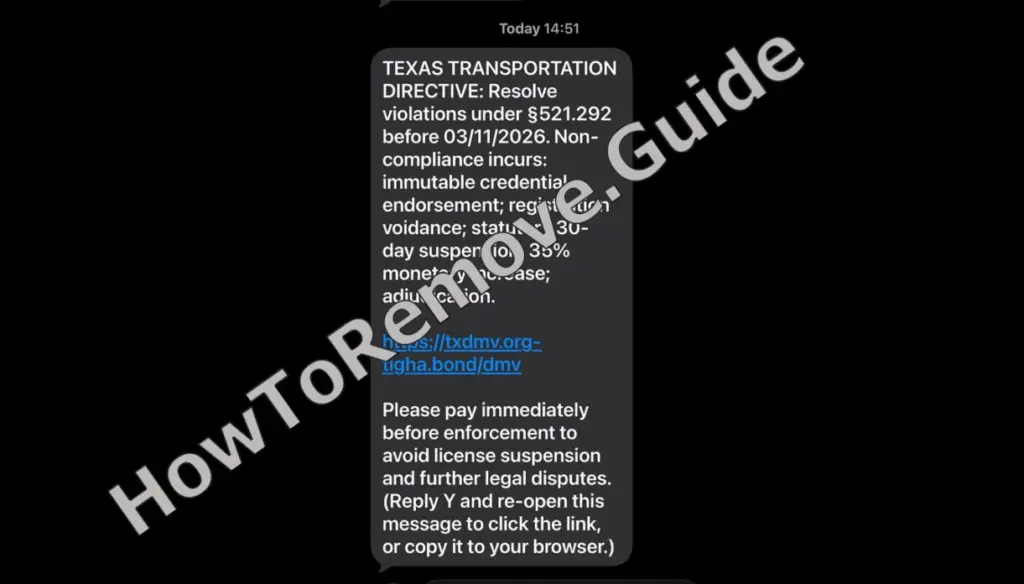
Some messages claim you have an “unpaid toll fee.” Others say you missed a traffic ticket or have an unpaid traffic violation. The threats are often dramatic. Victims report messages warning of license penalties, registration suspension, credit reporting, and even transfer to a collection agency. One reported version threatened to suspend driving privileges for “3.0” days, add a 55% administrative charge, damage the recipient’s credit, and suspend vehicle registration. Another version said penalties would take effect on March 22 and demanded payment by March 21, 2026.
This is the emotional hook of the scam. The text wants you to imagine escalating fines, legal trouble, or loss of driving privileges, and then solve the “problem” by clicking the link it provides. But that link does not lead to a legitimate government payment portal. It leads to a spoofed site meant to harvest payment details and personal information.
One reported example used the sender number +63 912 293 8934, which has a non-U.S. prefix. Another clue in some versions is a prompt telling the recipient to “Reply Y” before proceeding, which appears to be an attempt to get the target to engage and confirm that the number is active.
What to Do If You’ve Fallen for the Txdmv.org Scam
If you already clicked, replied, or submitted information, do not panic, but do act quickly and carefully.
If you sent money or entered payment details, contact your payment provider or card issuer right away and explain that you may have responded to a phishing payment-harvest scheme. If you shared personal information, take stock of exactly what was entered so you can describe it accurately when reporting the incident.
The extracted guidance connected to this scam is very clear on the next steps: do not continue engaging, do not send additional payment, and report the incident. The text specifically names the Federal Trade Commission through ReportFraud.ftc.gov and the FBI’s Internet Crime Complaint Center (IC3) as reporting channels. If the text mentioned a traffic ticket, law enforcement agencies also advised looking up the real phone number for your local law enforcement agency or local court and contacting them directly through independently found contact information.
Most importantly, do not go back to the suspicious link to “check” anything. Use only trusted sources you found yourself. In this case, the legitimate Texas DMV site mentioned in the source material is TxDMV.gov, not txdmv.org and not any variation built around that name.
How the Txdmv.org Scam Tricks You
The txdmv.org scam uses a few very specific tactics to make a fake message feel official enough to obey.
Impersonation of government agencies.
The most obvious trick is using the name of a real Texas agency. Victims have received texts claiming to be from TxDMV, the DMV, or TxDOT. That official-sounding label is supposed to short-circuit skepticism. Many people see a government name and assume the rest must be real.
Threat-based urgency.
The message does not just say you owe money. It tries to rush you. It warns of immediate penalties, looming deadlines, or sudden escalation. A deadline like March 21, 2026, with penalties starting March 22, is meant to make you act before checking the facts. The same goes for threats about license suspension, collections, damaged credit, or registration loss.
Confusing language.
This scam does not always sound polished. In fact, some of its odd wording is part of the pattern. Police departments highlighted bizarre phrases such as “immutable credential endorsement,” “registration voidance,” and “statutory 30-day suspension.” The Texarkana Police Department mocked the wording directly, saying, “We’re not sure what half of that crap means – and we’re pretty sure whoever wrote it doesn’t either.” That awkward pseudo-legal language is there to intimidate, not inform.
Suspicious infrastructure.
The scam also leans on deceptive links and fake domains. The official site named in the source material is TxDMV.gov. By contrast, scam versions use addresses like txdmv.org, txdmv.org-gess.eu.cc/dmv/, or other non-government domains. Recipients also flagged links with no .gov in the address, a .life domain, or what they described as a “non TX website.”
Foreign or unknown senders.
Another repeated pattern is the origin of the text itself. Recipients noticed unknown or foreign phone numbers, including a Philippines area code. One commenter put it bluntly: “It literally has a Phillipines area code…..” That alone was enough for many readers to identify the scam.
Recognizing Warning Signs of the Txdmv.org Scam
There are a few red flags that come up again and again in the source material, and they are worth memorizing.
An urgent demand with immediate consequences.
This scam leans hard on pressure. If the message says your license will be suspended, your registration will be frozen, or your credit will be harmed unless you act immediately, that is a major warning sign.
A strange or non-government link.
The source material is explicit here: the legitimate site is TxDMV.gov, not txdmv.org or any other variation. If the message sends you to a weird address, a nested spoof like txdmv.org-gess.eu.cc/dmv/, or any site without .gov, do not trust it.
Odd wording and weird phrases.
Messages packed with terms like “immutable credential endorsement” or “registration voidance” are not sounding official; they are sounding fake. As the Texarkana Police Department put it, “The goal is to get you to click the link and hand over your information. The real DMV isn’t sending out threats filled with random big words and weird phrases.”
A mismatch between the claim and the real agency role.
Multiple police departments emphasized that the Texas DMV does not issue traffic tickets. As the Amarillo Police Department noted, traffic tickets come from local police departments, sheriff’s offices, or state troopers, not the DMV. So a text claiming the DMV is threatening you over a citation should immediately raise doubts.
A foreign or unfamiliar sender number.
A non-U.S. prefix or a sender linked to the Philippines is another concrete red flag mentioned repeatedly by recipients and police.
How to Handle a Scam Text
If you suspect the message is fraudulent, your best move is not to engage with it at all. Do not click the link. Do not reply. Do not send money. Do not provide personal information.
Delete the message once you have confirmed it is suspicious. Several victims in the shared discussion said they did exactly that, with one replying that they had “deleted & reported as spam.” Others reported getting the same message too, which shows how broadly this scam is being pushed.
If the text makes you nervous because it mentions a ticket or traffic violation, do not use the contact information inside the message. Instead, independently look up the real number for your local court or local law enforcement agency and ask there. That simple step breaks the scammer’s control over the interaction.
Reporting Fraudulent DMV Texts
Reporting these messages matters. The guidance in the source material specifically recommends reporting them to the Federal Trade Commission at ReportFraud.ftc.gov and to the FBI’s Internet Crime Complaint Center (IC3). Doing so helps authorities track recurring campaigns, spoofed domains, and message patterns.
Useful Resources for Scam Reporting and Prevention (By Country)
Click here to report the scam in your country
| Country / Agency | URL | Category / Use-case | Phone/Email |
| Australia – Crime Stoppers | https://www.crimestoppers.com.au | Anonymous tips about crime | 1800 333 000 |
| Australia – National Anti-Scam Center (Scamwatch) | https://www.scamwatch.gov.au/report-a-scam | General scams; phishing; texts/emails | |
| Australia – Police Assistance Line (non-emergency) | https://www.police.gov.au | Local police report | 131 444 |
| Australia – ReportCyber (ACSC) | https://www.cyber.gov.au/report | Cybercrime (hacks, fraud, extortion) | |
| Canada – Canadian Anti-Fraud Center (CAFC) | https://www.antifraudcentre-centreantifraude.ca/report-signalez-eng.htm | General scams incl. phone/text/email | |
| France – DGCCRF (SignalConso) | https://signal.conso.gouv.fr | Consumer scams/deceptive practices | |
| France – PHAROS – Internet-Signalement | https://www.internet-signalement.gouv.fr | Online content & cybercrime reports | |
| Germany – Bundeskriminalamt / Local Police | https://www.polizei.de/Polizei/DE/Home/home_node.html | Report online fraud | |
| Germany – Weißer Ring – Victim Support | https://weisser-ring.de | Victim support | 116 006 |
| India – DoT Helpline (Sanchar Saathi) | https://sancharsaathi.gov.in | Fraudulent telecom/SIM related | 155260 |
| India – National Consumer Helpline | https://consumerhelpline.gov.in | Consumer scams | 1800-11-4000 / 1915 |
| India – National Cyber Crime Reporting Portal | https://cybercrime.gov.in | Cybercrime incl. online fraud | 1930 |
| Japan – Consumer Affairs Agency (CAA) | https://www.caa.go.jp/policies/policy/consumer_policy/caution/cybercrime/ | Consumer scams | |
| Japan – National Police Agency – Cybercrime | https://www.npa.go.jp/bureau/cyber/ | Cybercrime reporting | |
| Mexico – Guardia Nacional (National Guard) | https://www.gob.mx/gn | Cybercrime reporting | |
| Mexico – Instituto Federal de Telecomunicaciones (IFT) | https://www.ift.org.mx | Telecom/online services scams | |
| Mexico – PROFECO | https://www.gob.mx/profeco | Consumer fraud & ecommerce | |
| Netherlands – AFM – Report investment fraud | https://www.afm.nl/en/consumenten/themas/beleggen/misleiding-misbruik | Investment/crypto | |
| Netherlands – Fraudehelpdesk | https://www.fraudehelpdesk.nl/melden | General scams (incl. phishing/SMS) | 088-7867372 |
| Netherlands – Politie – Meldpunt Internetoplichting | https://www.politie.nl/themas/internetoplichting.html | Online shopping fraud | |
| New Zealand – CERT NZ | https://www.cert.govt.nz/individuals/report-an-issue/ | Phishing, identity scams | |
| New Zealand – Department of Internal Affairs – Spam | https://www.dia.govt.nz/Spam-Contact-Us | Email/SMS spam | [email protected] |
| New Zealand – IDCARE | https://www.idcare.org | Victim support (identity compromise) | 0800 121 068 |
| New Zealand – Netsafe – Report | https://www.netsafe.org.nz/report/ | Online harms & scams | |
| New Zealand – New Zealand Police (non-emergency) | https://www.police.govt.nz/use-105 | Report fraud/online crime | 105 |
| Nigeria – Economic & Financial Crimes Commission (EFCC) | https://www.efcc.gov.ng | Financial scams incl. crypto/investment | [email protected] |
| Nigeria – Nigeria Police Special Fraud Unit (SFU) | https://www.specialfraudunit.org.ng | Serious fraud | Voice/SMS: 0708 227 6895; WhatsApp: 0812 760 9914 |
| Poland – CERT Polska (CERT.PL) | https://cert.pl/en/report/ | Cyber incidents & phishing | |
| Poland – Dyzurnet.pl | https://dyzurnet.pl | Illegal online content (esp. child protection) | |
| Poland – Polish Police (Policja) | https://www.policja.pl | Report scams to police | |
| Singapore – Anti-Scam Centre / Anti-Scam Helpline | https://www.scamalert.sg | General scams; texts; calls | 1800-722-6688 |
| Singapore – Monetary Authority of Singapore (MAS) | https://www.mas.gov.sg/investor-alert-list | Investment/crypto checks | |
| Singapore – Singapore Police Force | https://www.police.gov.sg/iwitness | Police report (cybercrime) | |
| South Africa – Cybersecurity Hub (CSIRT) | https://www.cybersecurityhub.gov.za | Cyber incidents incl. scams | |
| South Africa – South African Fraud Prevention Service (SAFPS) | https://www.safps.org.za | Identity fraud support | 011-867-2234 |
| South Africa – South African Police Service (SAPS) | https://www.saps.gov.za | Police report (cybercrime unit) | |
| South Korea – Korea Communications Commission (KCC) | https://www.kcc.go.kr | Telecom-related fraud | |
| South Korea – Korea Internet & Security Agency (KISA) | https://www.kisa.or.kr | Phishing, online harms | |
| South Korea – Korean National Police Agency – Cyber Bureau | https://ecrm.cyber.go.kr | Cybercrime reporting | |
| Spain – INCIBE – Oficina de Seguridad del Internauta (OSI) | https://www.osi.es/es/reporte | Cybersecurity & online fraud | |
| Spain – Policía Nacional / Guardia Civil | https://www.policia.es | Report scams to police | |
| Sweden – Crime Victim Authority (Brottsoffermyndigheten) | https://www.brottsoffermyndigheten.se | Victim support & compensation | 090–70 82 00 |
| Sweden – Polisen (Swedish Police) | https://polisen.se | Report fraud/cybercrime | 114 14 (non-emergency); 112 (emergency) |
| Sweden – Swedish Consumer Agency (Konsumentverket) | https://www.konsumentverket.se | Unfair business practices | |
| United Arab Emirates – Abu Dhabi Police – Aman Service | https://www.adpolice.gov.ae | Cybercrime tips/reporting | SMS 2828; 800 2626 |
| United Arab Emirates – Dubai Police – eCrime | https://www.dubaipolice.gov.ae | Cybercrime reporting | 04 606 1600 |
| United Arab Emirates – Ministry of Interior – Cyber Crime Dept. | https://www.moi.gov.ae | Cybercrime incl. online scams | |
| United Arab Emirates – Telecommunications Regulatory Authority (TRA) / TDRA | https://www.tra.gov.ae | Telecom-related scams/phishing | |
| United Kingdom – Action Fraud (NFIB) | https://www.actionfraud.police.uk | General scams & cybercrime (non-emergency) | 0300 123 2040 |
| United Kingdom – Citizens Advice Consumer Service | https://www.citizensadvice.org.uk/consumer/get-more-help/if-you-need-more-help-about-a-consumer-issue/ | Consumer problems & scam guidance | 0808 223 1133 |
| United Kingdom – Financial Conduct Authority (FCA) | https://www.fca.org.uk/consumers/report-scam-us | Investment/crypto & financial services | |
| United Kingdom – National Cyber Security Centre (NCSC) | https://www.ncsc.gov.uk/collection/phishing-scams | Phishing emails & suspicious websites | |
| United Kingdom – Stop Scams UK ‘159’ | https://stopscamsuk.org.uk/159 | Banking APP fraud (direct to your bank) | 159 |
| United States – AARP Fraud Watch Network Helpline | https://www.aarp.org/money/scams-fraud/ | Victim support | 833-372-8311 |
| United States – Better Business Bureau – Scam Tracker | https://www.bbb.org/scamtracker | Business/marketplace scams | |
| United States – FBI Internet Crime Complaint Center (IC3) | https://www.ic3.gov | Internet crime incl. investment/crypto | |
| United States – Federal Trade Commission – ReportFraud | https://reportfraud.ftc.gov | General scams, phishing, texts/emails | 1-877-382-4357 |
| United States – National Center for Disaster Fraud | https://www.justice.gov/disaster-fraud | Disaster-related scams | (866) 720-5721 |
| United States – SEC Tips & Complaints | https://www.sec.gov/tcr | Investment & securities/crypto-asset offerings |
This is especially useful with a scam like this one because it appears to be spreading widely. Texans were described as flooding social media channels with images of the texts, and multiple people in the shared discussion said they had just received the same message. The more often the scam is reported, the easier it becomes for officials and platforms to warn others.
Final Thoughts
The txdmv.org text scam works because it combines official-sounding names, alarming threats, fake deadlines, and deceptive links into one stressful message. But once you know the signs, the scam becomes much easier to spot. A text from a supposed Texas agency that comes from a foreign number, uses bizarre legal-sounding language, threatens instant penalties, and points to a site like txdmv.org instead of TxDMV.gov is not something you should obey. It is something you should avoid, delete, and report.
That is the safest response: slow down, verify independently, and never let a threatening text rush you into handing over your money or personal information.
