

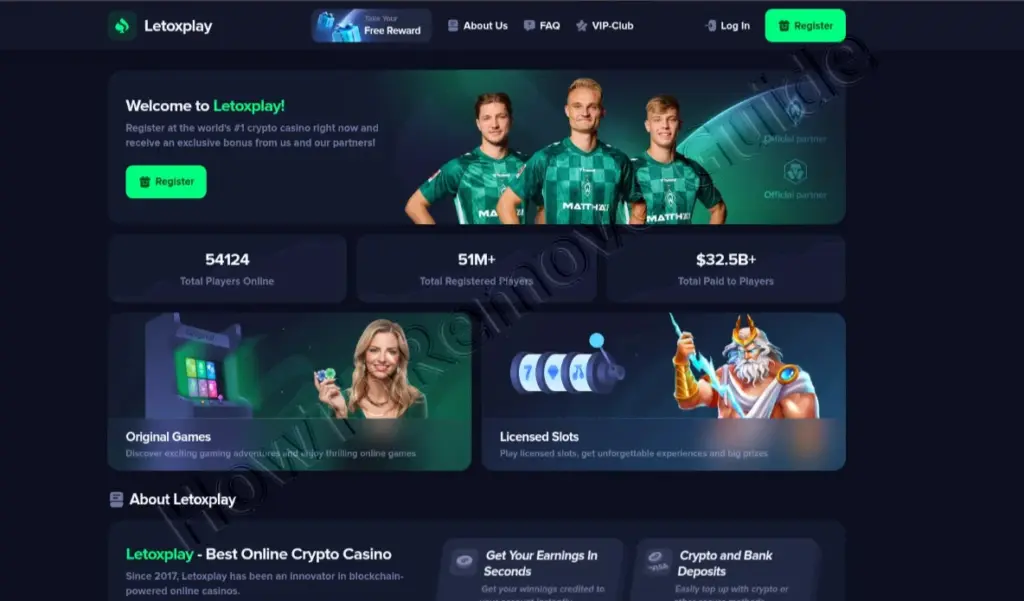
Online gambling is always a risk, and the more a particular platform promises you, the riskier it is. Case in point, Letoxplay ropes in users by promising them a huge starter bonus, free of any conditionals. You are allowed to gamble with house credit without worrying about your own money.
But beneath the glossy casino look, Letoxplay.com fits a common fraud model we’ve seen hundreds of times before with other sites like Xbezo.bet and Veag.bet. The games on such sites are always unusually generous, and it always looks like you are hitting it big.
Scams like Letoxplay.com are known to steal personal data and passwords. Install SpyHunter Pro to scan for risks, remove dangerous trackers, and enable real-time protection.
 OFFER
OFFER*Source of claim SH can remove it. Trial w/Credit card; image is for illustration; full terms.
In fact, that’s still part of the performance that gets you to trust this site even more. The end goal is to make you compliant and then ask you for a “small” deposit out of your own pocket before you are able to withdraw anything. Of course, the moment you make the transfer, the deposit disappears along with your supposed “winnings.”
And the worst part of it all is that this transfer might also let the hackers gain hold of sensitive personal data and even allow them to target any connected wallets or bank accounts.
Any touchpoint involving Letoxplay, should be handled like a digital-security problem. The sections below explain the recurring indicators, the typical trap flow, and the actions that help contain loss and reduce follow-on abuse.
IMPORTANT! READ BEFORE PROCEEDING!
For anyone who has already used Letoxplay, the priority is to stop escalation immediately. End the conversation, reject all follow-up instructions, secure your email and wallet access, and save evidence while it is still available. These five emergency actions are the most useful first moves if you want to limit damage rather than chase promises:
- Reset passwords and enable 2FA on your email, crypto exchanges, and wallets; terminate other active sessions.
- Notify any exchanges and services touched by the funds; provide TxIDs and ask that accounts/addresses be flagged per policy.
- Migrate assets to fresh wallets with new seed phrases and revoke any existing token approvals on connected chains.
- If you uploaded ID documents, place credit/fraud alerts where available and monitor for identity-theft signals.
- Assemble an evidence bundle – wallet addresses, TxIDs, site URLs, chats, and screenshots – and file reports with police/IC3 and any involved platforms.
How We Know Letoxplay is a Scam
Look past the animations and promotional language and the same fraud fingerprints start showing up. The signals below are common across bogus crypto casinos because the underlying scam depends on the same weak points every time.
Surprise withdrawal charges
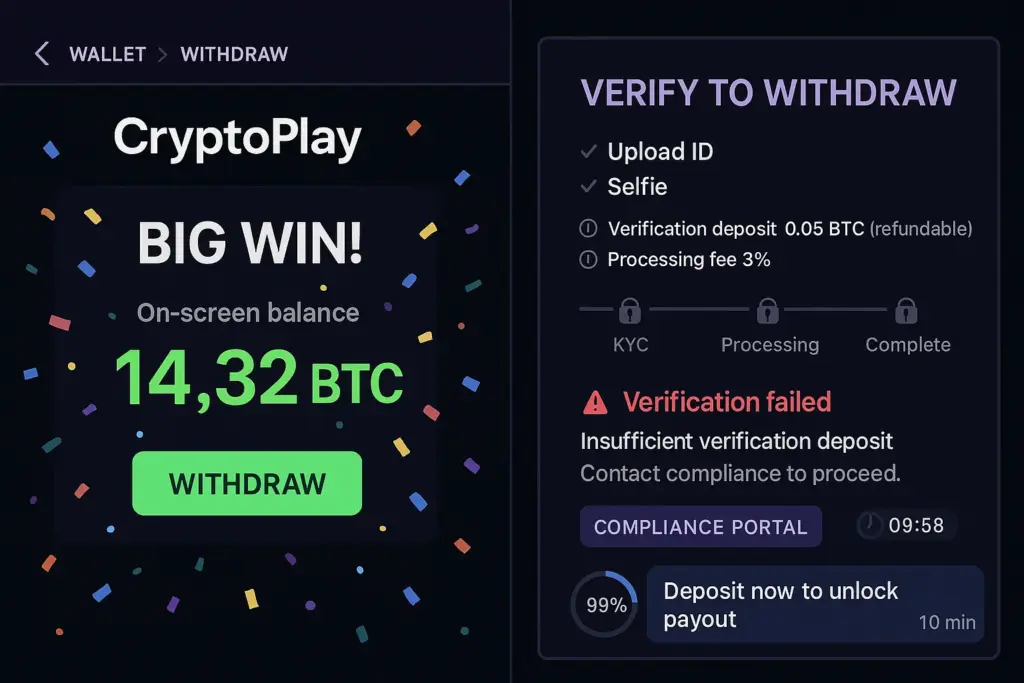
A platform that blocks payouts until you prepay a release cost is showing you the fraud in plain view. Whether the label says handling fee, tax settlement, liquidity check, or verification deposit, the message is the same: send more money and hope.
Counterfeit licensing
Scam operators borrow credibility wherever they can. They may paste licensing text, legal jargon, or compliance icons onto the page, but those claims often collapse the moment you search for a matching company in an official register.
Inflated early “wins”
The oversized winning streak at the start is not a reward for luck. It is a persuasion device designed to change your reference point from “Should I trust this site?” to “How do I get my winnings out?”
Crypto-only rails
Restricting payments to cryptocurrency helps the scam stay one-sided. The victim takes on volatility, irreversibility, and tracing difficulty, while the operator avoids the consumer protections that normally accompany card or bank payment rails.
Synthetic social proof
Crowd signals on fraudulent casino sites are rarely organic. Comment streams, success notifications, influencer references, and coupon chatter may all be staged to make independent due diligence feel unnecessary.
Fresh, privacy-masked domains
Infrastructure clues are often stronger than the sales copy. A recently created domain with hidden ownership, thin company details, and close resemblance to other scam brands should be treated as disposable bait; public tools including who.is can reveal those patterns.

How the Letoxplay Scam Deception Funnel Works
Understanding the scam flow is useful because each stage is meant to manipulate a different emotion. Excitement starts the process, commitment keeps it moving, and frustration is weaponized later to extract even more funds or identity material.
Seen as a whole, Letoxplay follows a repeating conversion path: attract with a reward story, simulate positive results, interrupt the payout, demand more from the victim, then disappear or recycle the playbook under another name.
Promo hooks and influencer codes
Most victims are not cold-called into sending money right away. They are first nudged by an ad, clip, recommendation, or promo code that frames the platform as popular, time-sensitive, and already vetted by other users.

Casino skin and bonus theater
After that, the site works hard to look ordinary. Clean dashboards, casino game imagery, bonus banners, and reassuring wording are there to create familiarity before the user asks basic questions about regulation, reserves, or ownership.

Inflated balances, then the gate
Then the account starts “proving” itself with suspiciously favorable outcomes. Those gains build emotional attachment to the balance, which is crucial because the scam needs the victim to see an extra transfer as a path to recovering something larger.
Fee-gates and KYC harvest
The withdrawal stage is where the mask drops. Support introduces identity checks late, adds payment conditions that were not clear at deposit time, and keeps redefining the issue so the victim feels just one step away from resolution.

Stalling, rebrands, and “recovery” bait
Eventually the excuses run out or the victim stops cooperating. That is when response times worsen, access may become erratic, and a later approach from a supposed recovery specialist can reopen the cycle by promising restitution for yet another payment.
Staying safe from crypto casino scams like Letoxplay
Staying safer in the future usually comes down to replacing impulse with procedure. The points below are effective because they force a site to survive basic verification before excitement, greed, or pressure gets a chance to take over.
Verify license status in official registers
Start with licensing and company identity, not with promotional terms. If you cannot independently confirm the operator, the jurisdiction, and the regulatory status through official sources, there is no reason to trust the rest of the presentation.
Check domain age and history
Check when the domain appeared and how it has behaved over time. Scam casinos often cycle through young domains, hidden registrants, and recycled layouts because the brand name matters less to them than the speed of replacement.
Reject withdrawal fees and “unlock” deposits
Treat payout-related payment demands as a stop signal. A legitimate service might review activity or request documents, but it should not require you to send additional cryptocurrency to release funds supposedly already credited to your account.
Prefer venues with recourse
Whenever possible, prefer services that leave a paper trail and a complaint path. Transparent business details, recognizable payment methods, and clear dispute mechanisms make it far harder for a bad actor to isolate you once a problem begins.
Limit wallet exposure
Reduce the blast radius of any one mistake. Use dedicated wallets where sensible, enable two-factor authentication, protect your email carefully, and avoid reusing credentials across exchanges, wallet apps, and sign-in services.
Validate “provably fair” claims
Healthy skepticism also applies to technical claims. Terms such as “provably fair,” “audited,” or “secured” mean little unless there is a reliable way for an ordinary user to verify what is being claimed and by whom.
Document and report rapidly
Good documentation can matter more than hopeful negotiation. Save the site URL, account screens, chat logs, wallet destinations, transaction hashes, and any uploaded-document history so you are not relying on memory later.
Build a deliberate slow-down reflex
A deliberate cooling-off step is one of the cheapest defenses available. Waiting long enough to perform a few outside checks often breaks the emotional rhythm that these scams rely on to keep deposits flowing.
Useful Resources for Scam Reporting and Prevention (By Country)
Reporting is still worth doing even when recovery is uncertain. Timely complaints can help platforms flag addresses, help investigators connect related domains, and help future victims avoid the same trap once patterns are documented.
Click here to report the scam in your country
| Country / Agency | URL | Category / Use-case | Phone/Email |
| Australia – Crime Stoppers | https://www.crimestoppers.com.au | Anonymous tips about crime | 1800 333 000 |
| Australia – National Anti-Scam Center (Scamwatch) | https://www.scamwatch.gov.au/report-a-scam | General scams; phishing; texts/emails | |
| Australia – Police Assistance Line (non-emergency) | https://www.police.gov.au | Local police report | 131 444 |
| Australia – ReportCyber (ACSC) | https://www.cyber.gov.au/report | Cybercrime (hacks, fraud, extortion) | |
| Canada – Canadian Anti-Fraud Center (CAFC) | https://www.antifraudcentre-centreantifraude.ca/report-signalez-eng.htm | General scams incl. phone/text/email | |
| France – DGCCRF (SignalConso) | https://signal.conso.gouv.fr | Consumer scams/deceptive practices | |
| France – PHAROS – Internet-Signalement | https://www.internet-signalement.gouv.fr | Online content & cybercrime reports | |
| Germany – Bundeskriminalamt / Local Police | https://www.polizei.de/Polizei/DE/Home/home_node.html | Report online fraud | |
| Germany – Weißer Ring – Victim Support | https://weisser-ring.de | Victim support | 116 006 |
| India – DoT Helpline (Sanchar Saathi) | https://sancharsaathi.gov.in | Fraudulent telecom/SIM related | 155260 |
| India – National Consumer Helpline | https://consumerhelpline.gov.in | Consumer scams | 1800-11-4000 / 1915 |
| India – National Cyber Crime Reporting Portal | https://cybercrime.gov.in | Cybercrime incl. online fraud | 1930 |
| Japan – Consumer Affairs Agency (CAA) | https://www.caa.go.jp/policies/policy/consumer_policy/caution/cybercrime/ | Consumer scams | |
| Japan – National Police Agency – Cybercrime | https://www.npa.go.jp/bureau/cyber/ | Cybercrime reporting | |
| Mexico – Guardia Nacional (National Guard) | https://www.gob.mx/gn | Cybercrime reporting | |
| Mexico – Instituto Federal de Telecomunicaciones (IFT) | https://www.ift.org.mx | Telecom/online services scams | |
| Mexico – PROFECO | https://www.gob.mx/profeco | Consumer fraud & ecommerce | |
| Netherlands – AFM – Report investment fraud | https://www.afm.nl/en/consumenten/themas/beleggen/misleiding-misbruik | Investment/crypto | |
| Netherlands – Fraudehelpdesk | https://www.fraudehelpdesk.nl/melden | General scams (incl. phishing/SMS) | 088-7867372 |
| Netherlands – Politie – Meldpunt Internetoplichting | https://www.politie.nl/themas/internetoplichting.html | Online shopping fraud | |
| New Zealand – CERT NZ | https://www.cert.govt.nz/individuals/report-an-issue/ | Phishing, identity scams | |
| New Zealand – Department of Internal Affairs – Spam | https://www.dia.govt.nz/Spam-Contact-Us | Email/SMS spam | [email protected] |
| New Zealand – IDCARE | https://www.idcare.org | Victim support (identity compromise) | 0800 121 068 |
| New Zealand – Netsafe – Report | https://www.netsafe.org.nz/report/ | Online harms & scams | |
| New Zealand – New Zealand Police (non-emergency) | https://www.police.govt.nz/use-105 | Report fraud/online crime | 105 |
| Nigeria – Economic & Financial Crimes Commission (EFCC) | https://www.efcc.gov.ng | Financial scams incl. crypto/investment | [email protected] |
| Nigeria – Nigeria Police Special Fraud Unit (SFU) | https://www.specialfraudunit.org.ng | Serious fraud | Voice/SMS: 0708 227 6895; WhatsApp: 0812 760 9914 |
| Poland – CERT Polska (CERT.PL) | https://cert.pl/en/report/ | Cyber incidents & phishing | |
| Poland – Dyzurnet.pl | https://dyzurnet.pl | Illegal online content (esp. child protection) | |
| Poland – Polish Police (Policja) | https://www.policja.pl | Report scams to police | |
| Singapore – Anti-Scam Centre / Anti-Scam Helpline | https://www.scamalert.sg | General scams; texts; calls | 1800-722-6688 |
| Singapore – Monetary Authority of Singapore (MAS) | https://www.mas.gov.sg/investor-alert-list | Investment/crypto checks | |
| Singapore – Singapore Police Force | https://www.police.gov.sg/iwitness | Police report (cybercrime) | |
| South Africa – Cybersecurity Hub (CSIRT) | https://www.cybersecurityhub.gov.za | Cyber incidents incl. scams | |
| South Africa – South African Fraud Prevention Service (SAFPS) | https://www.safps.org.za | Identity fraud support | 011-867-2234 |
| South Africa – South African Police Service (SAPS) | https://www.saps.gov.za | Police report (cybercrime unit) | |
| South Korea – Korea Communications Commission (KCC) | https://www.kcc.go.kr | Telecom-related fraud | |
| South Korea – Korea Internet & Security Agency (KISA) | https://www.kisa.or.kr | Phishing, online harms | |
| South Korea – Korean National Police Agency – Cyber Bureau | https://ecrm.cyber.go.kr | Cybercrime reporting | |
| Spain – INCIBE – Oficina de Seguridad del Internauta (OSI) | https://www.osi.es/es/reporte | Cybersecurity & online fraud | |
| Spain – Policía Nacional / Guardia Civil | https://www.policia.es | Report scams to police | |
| Sweden – Crime Victim Authority (Brottsoffermyndigheten) | https://www.brottsoffermyndigheten.se | Victim support & compensation | 090–70 82 00 |
| Sweden – Polisen (Swedish Police) | https://polisen.se | Report fraud/cybercrime | 114 14 (non-emergency); 112 (emergency) |
| Sweden – Swedish Consumer Agency (Konsumentverket) | https://www.konsumentverket.se | Unfair business practices | |
| United Arab Emirates – Abu Dhabi Police – Aman Service | https://www.adpolice.gov.ae | Cybercrime tips/reporting | SMS 2828; 800 2626 |
| United Arab Emirates – Dubai Police – eCrime | https://www.dubaipolice.gov.ae | Cybercrime reporting | 04 606 1600 |
| United Arab Emirates – Ministry of Interior – Cyber Crime Dept. | https://www.moi.gov.ae | Cybercrime incl. online scams | |
| United Arab Emirates – Telecommunications Regulatory Authority (TRA) / TDRA | https://www.tra.gov.ae | Telecom-related scams/phishing | |
| United Kingdom – Action Fraud (NFIB) | https://www.actionfraud.police.uk | General scams & cybercrime (non-emergency) | 0300 123 2040 |
| United Kingdom – Citizens Advice Consumer Service | https://www.citizensadvice.org.uk/consumer/get-more-help/if-you-need-more-help-about-a-consumer-issue/ | Consumer problems & scam guidance | 0808 223 1133 |
| United Kingdom – Financial Conduct Authority (FCA) | https://www.fca.org.uk/consumers/report-scam-us | Investment/crypto & financial services | |
| United Kingdom – National Cyber Security Centre (NCSC) | https://www.ncsc.gov.uk/collection/phishing-scams | Phishing emails & suspicious websites | |
| United Kingdom – Stop Scams UK ‘159’ | https://stopscamsuk.org.uk/159 | Banking APP fraud (direct to your bank) | 159 |
| United States – AARP Fraud Watch Network Helpline | https://www.aarp.org/money/scams-fraud/ | Victim support | 833-372-8311 |
| United States – Better Business Bureau – Scam Tracker | https://www.bbb.org/scamtracker | Business/marketplace scams | |
| United States – FBI Internet Crime Complaint Center (IC3) | https://www.ic3.gov | Internet crime incl. investment/crypto | |
| United States – Federal Trade Commission – ReportFraud | https://reportfraud.ftc.gov | General scams, phishing, texts/emails | 1-877-382-4357 |
| United States – National Center for Disaster Fraud | https://www.justice.gov/disaster-fraud | Disaster-related scams | (866) 720-5721 |
| United States – SEC Tips & Complaints | https://www.sec.gov/tcr | Investment & securities/crypto-asset offerings |
The bottom line is straightforward: fake casino sites count on urgency and illusion, so your best defense is slow verification, tight account hygiene, and a refusal to pay anyone for the privilege of withdrawing your own money.
