

At first glance, SelfTrade.ai looks like a polished crypto platform built around AI, live data, and nonstop market activity. It also leans on branding tied to Elon Musk and X Corp, which should push careful readers to slow down and verify every claim.
The site says it takes crypto payments only, skips identity checks, and frames its trading system as dependable. Those details matter because celebrity-endorsed crypto offers and polished trading pages are common patterns in online investment fraud.
Even the platform’s own materials leave room for concern: its FAQ says withdrawals are normally handled within a day, while its terms also allow delays tied to internal reviews. When sending funds is easy but getting them back may depend on vague internal checks, that is a serious red flag.
Scams of SelfTrade.ai‘s type are known to steal personal data and passwords. Install SpyHunter Pro to scan for risks, remove any dangerous trackers, and enable real-time protection.

Try Free For 7 Days*
Buy now15% OFF if you buy straight without trial.
 OFFER
OFFERI would treat SelfTrade.ai with extreme caution. Anyone considering it should verify whether the service is properly authorised where they live, ignore celebrity hype, refuse pressure to deposit more, and stop immediately if access to funds becomes difficult.
The guidance below is meant to help you spot the pattern early, contain damage quickly, and avoid copycat sites using names like SelfTrade.ai, Velriqo.com, or Selviorex. These operations rely on invented balances, false credibility, and time pressure, so the safest response is calm verification before any wallet connection, document upload, or payment.
IMPORTANT! READ BEFORE PROCEEDING!
If you already interacted with SelfTrade.ai – stop all further payments immediately and switch into containment mode. Ignore demands for a release charge, stop sending documents, and distrust anyone offering paid recovery. Secure connected accounts, save evidence, and assume any wallet or login used during the encounter may now need review.
- Move remaining assets to a fresh, clean wallet and revoke any suspicious token approvals linked to the scam touchpoint.
- Change passwords and enable app-based 2FA on email, exchanges, and chat accounts; review active sessions and delete unused API keys.
- Preserve evidence: screenshots, URLs, videos or ads, wallet addresses, TXIDs, and chat logs – keep everything for official reports.
- Notify the sending platform (your exchange or service) with TXIDs and the destination address so they can flag or freeze if possible.
- Report promptly to your national cybercrime unit (e.g., IC3 in the US, Action Fraud in the UK) and to the platform where you saw the promotion.
How We Know SelfTrade.ai is a Scam
Taken together, the warning signs are difficult to explain away as harmless mistakes. This is the same cluster of signals repeatedly found on cloned fake-exchange pages: invented account value, pressure to prepay, unverifiable operations, and a structure built to disappear once enough users begin asking hard questions.
Promo-code mirage
A bonus code that suddenly paints crypto onto a dashboard does not prove that an account was funded. It is a visual nudge meant to make users feel they are already in profit, which lowers resistance to the next demand.
Unlock-deposit demand
Demands for an activation payment, liquidity check, wallet-verification amount, or similar precondition are classic advance-fee tactics. Real platforms do not require a separate crypto transfer just to unlock assets that supposedly already belong to the customer.
Deepfake endorsements
Endorsements are easy to counterfeit and powerful at first glance. AI voice cloning, face swaps, stitched interview clips, and copied brand imagery are commonly used to borrow credibility from public figures who have no connection to the site.
No on-chain TXIDs
A genuine withdrawal system leaves evidence that can be checked. If support cannot produce a believable payout record, a usable transaction hash, or a clear explanation of fund movement, the displayed balance is likely only decorative.
Bogus licensing & compliance
Regulatory language on scam pages is often costume rather than proof. Generic trust badges, vague compliance claims, and invented registration details can be dropped into a template in minutes, but legitimate authorization survives independent verification.
Clone-site churn
Domain churn is another familiar marker. Once complaints start stacking up, the same design and script can be relaunched under a different address, allowing the operators to keep the scheme running while shedding the reputation of the old site.

How the SelfTrade.ai Scam Deception Funnel Works
Knowing the sequence matters because the scam is designed to feel smooth while it is unfolding. Each stage has a narrow purpose: attract attention, calm doubts, create the appearance of value, introduce a payable obstacle, and keep the victim engaged with new explanations.
Most victims are moved from bait to sign-up, from sign-up to a fabricated balance, and from that balance to an artificial paywall disguised as procedure. After the first transfer lands, the promised opportunity turns into a maze of delays and new conditions.
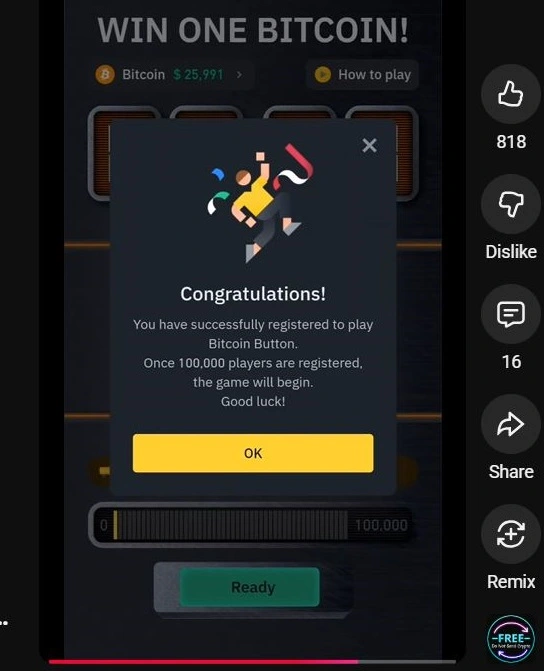
Promo hooks and influencer codes
The first contact often comes through short-form videos, comment sections, private messages, or copied success stories claiming that a special offer is still active. Scarcity language matters because it pushes people to act before they verify the source.

Casino skin and bonus theater
Some versions lean into a gambling-style visual identity rather than a restrained exchange look. Loud bonus banners, exaggerated win figures, and glossy interface elements are used to trigger excitement first and scrutiny later.

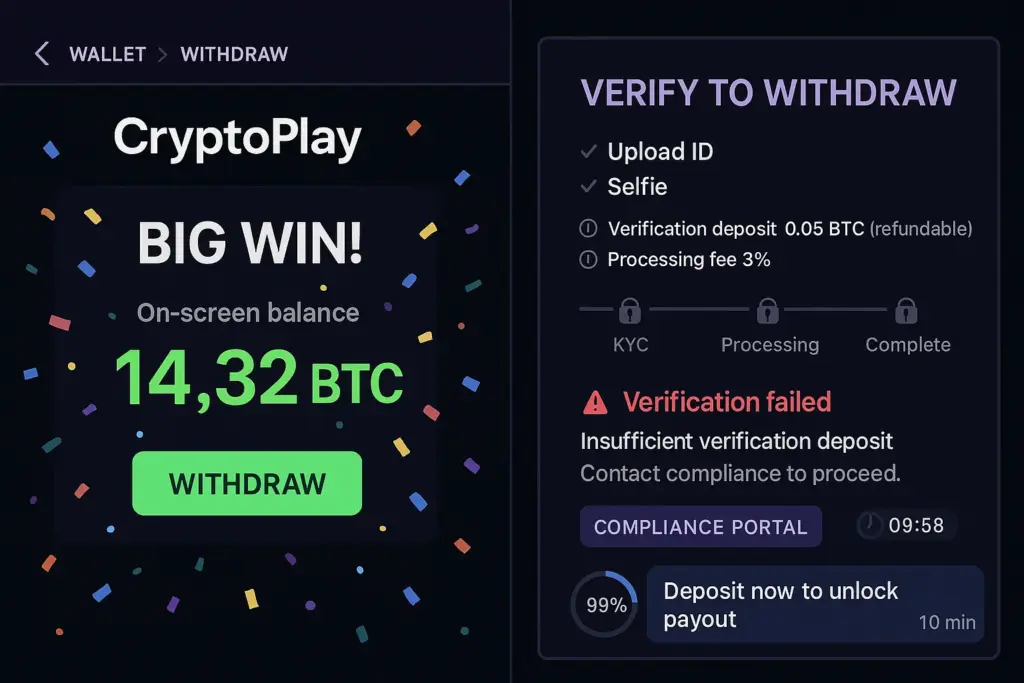
Inflated balances, then the gate
Inside the account area, the user is shown gains, credits, or a supposedly withdrawable balance that feels close enough to be real. The trap closes when the site says one last payment is required before the transfer can proceed.
Fee-gates and KYC harvest
Once that first fee is sent, the reasons multiply. Operators may cite tax clearance, anti-money-laundering review, wallet matching, risk scoring, account limits, or VIP status, all to justify more payments or the collection of identity documents.

Stalling, rebrands, and “recovery” bait
When victims hesitate, support often becomes patient and sympathetic instead of aggressive. That tone is strategic: it buys time, preserves hope, and may squeeze out one more transfer before the site vanishes, rebrands, or hands the victim to a fake recovery pitch.
Staying safe from crypto scams like SelfTrade.ai
Protection is less about intuition than routine. A few repeatable habits make fake-exchange pages far easier to spot, and those same habits limit how far the damage spreads if you ever do click through to a malicious promotion.
Never pay to withdraw
Any demand to prepay for access to your own funds should end the interaction. Legitimate services disclose costs clearly and do not ask customers to push extra crypto to an arbitrary address before a withdrawal can even begin.
Verify endorsements at the source
Treat every celebrity clip or influencer endorsement as untrusted until you confirm it on an official channel. If the claim exists only inside an ad, repost, or third-party page, manipulation is a far safer assumption than authenticity.
Navigate with your own bookmarks
Using your own saved links for exchanges, wallets, and blockchain tools cuts off one of the easiest scam entry points. Ads, promoted posts, search placements, and unsolicited messages are common ways users are funneled toward lookalike domains.
Check regulator registers & warnings
Whenever a site claims authorization, check the regulator directly instead of trusting badges on the page. A missing record, mismatched company name, or unrelated jurisdiction is more than enough reason to leave without testing anything.
Segregate risk with burner wallets
Separate your serious holdings from experiments and unknown services. Keeping savings in hardware or offline storage, while using a low-value wallet for risky interactions, ensures one bad click does not expose your main reserves.
Harden accounts with 2FA & hygiene
Basic account security still matters even when the theft starts with crypto. Strong unique passwords, app-based two-factor authentication, session reviews, and removal of unused API keys can stop a scam-site incident from snowballing into broader account compromise.
Revoke approvals & migrate
If you connected a wallet or approved contract permissions, review those approvals promptly with trusted tools and move assets if necessary. Standing permissions can remain useful to attackers long after the original site has gone offline.
Protect identity & slow down
Document uploads create a second danger beyond lost coins. If you submitted ID images or personal details, monitor for impersonation attempts, watch statements and account notices closely, and consider protective steps such as fraud alerts or a credit freeze where available.
Where to report SelfTrade.ai-style crypto scams (by country)
Reporting still helps even when recovery is uncertain. Preserve screenshots, wallet addresses, transaction identifiers, chat logs, emails, and the exact domain involved, then notify your exchange, the platform that carried the promotion, and the reporting channel listed for your country.
Click here to report the scam in your country
| Country / Agency | URL | Category / Use-case | Phone/Email |
| Australia – Crime Stoppers | https://www.crimestoppers.com.au | Anonymous tips about crime | 1800 333 000 |
| Australia – National Anti-Scam Center (Scamwatch) | https://www.scamwatch.gov.au/report-a-scam | General scams; phishing; texts/emails | |
| Australia – Police Assistance Line (non-emergency) | https://www.police.gov.au | Local police report | 131 444 |
| Australia – ReportCyber (ACSC) | https://www.cyber.gov.au/report | Cybercrime (hacks, fraud, extortion) | |
| Canada – Canadian Anti-Fraud Center (CAFC) | https://www.antifraudcentre-centreantifraude.ca/report-signalez-eng.htm | General scams incl. phone/text/email | |
| France – DGCCRF (SignalConso) | https://signal.conso.gouv.fr | Consumer scams/deceptive practices | |
| France – PHAROS – Internet-Signalement | https://www.internet-signalement.gouv.fr | Online content & cybercrime reports | |
| Germany – Bundeskriminalamt / Local Police | https://www.polizei.de/Polizei/DE/Home/home_node.html | Report online fraud | |
| Germany – Weißer Ring – Victim Support | https://weisser-ring.de | Victim support | 116 006 |
| India – DoT Helpline (Sanchar Saathi) | https://sancharsaathi.gov.in | Fraudulent telecom/SIM related | 155260 |
| India – National Consumer Helpline | https://consumerhelpline.gov.in | Consumer scams | 1800-11-4000 / 1915 |
| India – National Cyber Crime Reporting Portal | https://cybercrime.gov.in | Cybercrime incl. online fraud | 1930 |
| Japan – Consumer Affairs Agency (CAA) | https://www.caa.go.jp/policies/policy/consumer_policy/caution/cybercrime/ | Consumer scams | |
| Japan – National Police Agency – Cybercrime | https://www.npa.go.jp/bureau/cyber/ | Cybercrime reporting | |
| Mexico – Guardia Nacional (National Guard) | https://www.gob.mx/gn | Cybercrime reporting | |
| Mexico – Instituto Federal de Telecomunicaciones (IFT) | https://www.ift.org.mx | Telecom/online services scams | |
| Mexico – PROFECO | https://www.gob.mx/profeco | Consumer fraud & ecommerce | |
| Netherlands – AFM – Report investment fraud | https://www.afm.nl/en/consumenten/themas/beleggen/misleiding-misbruik | Investment/crypto | |
| Netherlands – Fraudehelpdesk | https://www.fraudehelpdesk.nl/melden | General scams (incl. phishing/SMS) | 088-7867372 |
| Netherlands – Politie – Meldpunt Internetoplichting | https://www.politie.nl/themas/internetoplichting.html | Online shopping fraud | |
| New Zealand – CERT NZ | https://www.cert.govt.nz/individuals/report-an-issue/ | Phishing, identity scams | |
| New Zealand – Department of Internal Affairs – Spam | https://www.dia.govt.nz/Spam-Contact-Us | Email/SMS spam | [email protected] |
| New Zealand – IDCARE | https://www.idcare.org | Victim support (identity compromise) | 0800 121 068 |
| New Zealand – Netsafe – Report | https://www.netsafe.org.nz/report/ | Online harms & scams | |
| New Zealand – New Zealand Police (non-emergency) | https://www.police.govt.nz/use-105 | Report fraud/online crime | 105 |
| Nigeria – Economic & Financial Crimes Commission (EFCC) | https://www.efcc.gov.ng | Financial scams incl. crypto/investment | [email protected] |
| Nigeria – Nigeria Police Special Fraud Unit (SFU) | https://www.specialfraudunit.org.ng | Serious fraud | Voice/SMS: 0708 227 6895; WhatsApp: 0812 760 9914 |
| Poland – CERT Polska (CERT.PL) | https://cert.pl/en/report/ | Cyber incidents & phishing | |
| Poland – Dyzurnet.pl | https://dyzurnet.pl | Illegal online content (esp. child protection) | |
| Poland – Polish Police (Policja) | https://www.policja.pl | Report scams to police | |
| Singapore – Anti-Scam Centre / Anti-Scam Helpline | https://www.scamalert.sg | General scams; texts; calls | 1800-722-6688 |
| Singapore – Monetary Authority of Singapore (MAS) | https://www.mas.gov.sg/investor-alert-list | Investment/crypto checks | |
| Singapore – Singapore Police Force | https://www.police.gov.sg/iwitness | Police report (cybercrime) | |
| South Africa – Cybersecurity Hub (CSIRT) | https://www.cybersecurityhub.gov.za | Cyber incidents incl. scams | |
| South Africa – South African Fraud Prevention Service (SAFPS) | https://www.safps.org.za | Identity fraud support | 011-867-2234 |
| South Africa – South African Police Service (SAPS) | https://www.saps.gov.za | Police report (cybercrime unit) | |
| South Korea – Korea Communications Commission (KCC) | https://www.kcc.go.kr | Telecom-related fraud | |
| South Korea – Korea Internet & Security Agency (KISA) | https://www.kisa.or.kr | Phishing, online harms | |
| South Korea – Korean National Police Agency – Cyber Bureau | https://ecrm.cyber.go.kr | Cybercrime reporting | |
| Spain – INCIBE – Oficina de Seguridad del Internauta (OSI) | https://www.osi.es/es/reporte | Cybersecurity & online fraud | |
| Spain – Policía Nacional / Guardia Civil | https://www.policia.es | Report scams to police | |
| Sweden – Crime Victim Authority (Brottsoffermyndigheten) | https://www.brottsoffermyndigheten.se | Victim support & compensation | 090–70 82 00 |
| Sweden – Polisen (Swedish Police) | https://polisen.se | Report fraud/cybercrime | 114 14 (non-emergency); 112 (emergency) |
| Sweden – Swedish Consumer Agency (Konsumentverket) | https://www.konsumentverket.se | Unfair business practices | |
| United Arab Emirates – Abu Dhabi Police – Aman Service | https://www.adpolice.gov.ae | Cybercrime tips/reporting | SMS 2828; 800 2626 |
| United Arab Emirates – Dubai Police – eCrime | https://www.dubaipolice.gov.ae | Cybercrime reporting | 04 606 1600 |
| United Arab Emirates – Ministry of Interior – Cyber Crime Dept. | https://www.moi.gov.ae | Cybercrime incl. online scams | |
| United Arab Emirates – Telecommunications Regulatory Authority (TRA) / TDRA | https://www.tra.gov.ae | Telecom-related scams/phishing | |
| United Kingdom – Action Fraud (NFIB) | https://www.actionfraud.police.uk | General scams & cybercrime (non-emergency) | 0300 123 2040 |
| United Kingdom – Citizens Advice Consumer Service | https://www.citizensadvice.org.uk/consumer/get-more-help/if-you-need-more-help-about-a-consumer-issue/ | Consumer problems & scam guidance | 0808 223 1133 |
| United Kingdom – Financial Conduct Authority (FCA) | https://www.fca.org.uk/consumers/report-scam-us | Investment/crypto & financial services | |
| United Kingdom – National Cyber Security Centre (NCSC) | https://www.ncsc.gov.uk/collection/phishing-scams | Phishing emails & suspicious websites | |
| United Kingdom – Stop Scams UK ‘159’ | https://stopscamsuk.org.uk/159 | Banking APP fraud (direct to your bank) | 159 |
| United States – AARP Fraud Watch Network Helpline | https://www.aarp.org/money/scams-fraud/ | Victim support | 833-372-8311 |
| United States – Better Business Bureau – Scam Tracker | https://www.bbb.org/scamtracker | Business/marketplace scams | |
| United States – FBI Internet Crime Complaint Center (IC3) | https://www.ic3.gov | Internet crime incl. investment/crypto | |
| United States – Federal Trade Commission – ReportFraud | https://reportfraud.ftc.gov | General scams, phishing, texts/emails | 1-877-382-4357 |
| United States – National Center for Disaster Fraud | https://www.justice.gov/disaster-fraud | Disaster-related scams | (866) 720-5721 |
| United States – SEC Tips & Complaints | https://www.sec.gov/tcr | Investment & securities/crypto-asset offerings |
