

People usually do not arrive at Wazbee.fun thinking they are walking into a scam. They arrive because some piece of online bait made the place look worth a look, with free crypto or casino money sitting just close enough to feel possible.
From there, the site does not need much subtlety. The page looks clean, and the bonus gives the number on the screen a little weight. The games only have to give enough back to make that number feel less imaginary. Once that happens, the withdrawal button stops feeling like a test and starts feeling like the obvious next move.
Scams of Wazbee.fun‘s type are known to steal personal data and passwords. Install SpyHunter Pro to scan for risks, remove any dangerous trackers, and enable real-time protection.

Try Free For 7 Days*
Buy now15% OFF if you buy straight without trial.
 OFFER
OFFERThe trap shows itself when the money is supposed to leave the site. Suddenly Wazbee wants real payment before anything can move. They may call it verification, or they may call it an unlock step because that sounds less like another grab. The pressure is the point. By then, people are trying not to lose winnings they never really had.
That is the move behind Wazbee, Uitgamb, Kesowin, and other similar scams: curiosity turns into commitment before the fake balance is exposed. Spot that pressure early enough, and the number on the screen does not get a chance to cost real money.
IMPORTANT! READ BEFORE PROCEEDING!
If you already moved funds, uploaded ID, linked a wallet, or installed software connected with Wazbee, assume the event may still be unfolding. Fast containment can matter even when the original transfer itself cannot be reversed.
Before you interact further with support or respond to any third party offering help, check the system you used. We strongly recommend starting with SpyHunter 5 to inspect for malware, suspicious installers, altered browser settings, or extensions that may have been introduced while engaging with this scam.
Fastest Removal Option: Use SpyHunter 5
- 1.1Click here to download and install the anti-malware tool on your PC.
- 1.2
 Start SpyHunter 5, click the Buy button and choose between starting your 7-days free trial or directly purchasing the tool.
If you choose to buy SpyHunter 5 now, you can use our discount code, “HTRG15“, for 15% off.
- 1.3
 Once you activate SpyHunter, click Start Scan Now, select the Full Scan option, and let the tool do its job.
 - 1.4
 Once the scan completes (it could take a while, so have patience), you’ll see all malware and other undesirables listed.
Click Next to review the detections and then click Next again to delete all rogue items.
After that scan, continue with the follow-up protections below and work from the assumption that credentials, wallet permissions, documents, and related accounts touched during the incident may all need review.
- Reset passwords and enable 2FA on your email, crypto exchanges, and wallets; terminate other active sessions.
- Notify any exchanges and services touched by the funds; provide TxIDs and ask that accounts/addresses be flagged per policy.
- Migrate assets to fresh wallets with new seed phrases and revoke any existing token approvals on connected chains.
- If you uploaded ID documents, place credit/fraud alerts where available and monitor for identity-theft signals.
- Assemble an evidence bundle – wallet addresses, TxIDs, site URLs, chats, and screenshots – and file reports with police/IC3 and any involved platforms.
How We Know Wazbee is a Scam
Multiple warning signals converge here. What matters is not one isolated flaw, but the way the site reproduces the same risk profile seen in repeatable crypto-casino fraud schemes.
Withdrawal rules appear only at the end
A critical indicator is the way costs emerge only when the user tries to withdraw. A legitimate operator does not wait until cash-out to invent release fees, tax prepayments, clearance deposits, or wallet activation charges.
Official language without accountability
Another danger sign is the heavy use of regulatory vocabulary unsupported by evidence. Scam pages often rely on compliance terms, certificates, and registrations that sound authoritative while remaining impossible to validate independently.
Returns are shown before they are earned
The platform may display strong early performance because those numbers serve a behavioral purpose. They encourage bigger deposits, reduce skepticism, and make the user feel that stopping now would mean walking away from money that already feels real.
The payment path removes fallback options
When everything flows through crypto alone, the victim is operating in an environment with less recourse and fewer friction points. That lack of recoverability is useful to the operator because it keeps the pressure on the user instead of on the platform.
Popularity can be fabricated cheaply
A crowded interface is not the same thing as a real user base. Pop-up wins, glowing comments, referral chatter, and enthusiastic testimonials can be manufactured at low cost to create the impression of safety and momentum.
The infrastructure looks disposable
Short-lived domains, hidden ownership, and copycat branding are recurring features in this space. Public checks such as who.is can help show whether the site appeared recently and whether its identity trail is unusually thin.


How the Wazbee Scam Deception Funnel Works
Breaking the scam down into stages helps because the pattern is operationally consistent. Once the sequence is visible, the emotional pressure loses some of its edge.
Most victims are not persuaded all at once. They are moved across a chain of low-friction decisions that gradually increases commitment while reducing their willingness to step back and reassess.
Discovery begins with easy credibility
The first contact often comes through promoted content, chat messages, comments, or referral-style media that frames the platform as already familiar to other users. That borrowed credibility is designed to lower initial resistance.

The interface is part of the attack
After arrival, the site’s design helps manage behavior. Clean graphics, standard casino labels, bonus callouts, and familiar game elements are used to make caution feel unnecessary and the platform feel routine.

Visible profit encourages deeper exposure
The displayed balance then does strategic work. Once users see fast apparent gains, they become more willing to send another deposit, submit documents, or accept a delay because the perceived upside has grown larger in their minds.
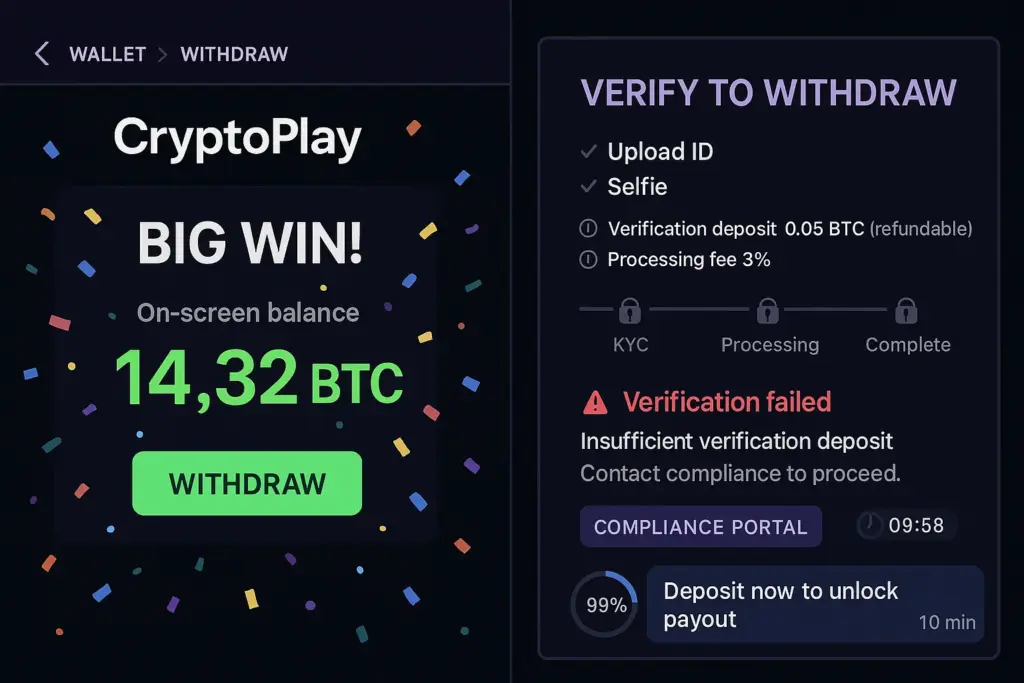
Withdrawal becomes an extraction phase
The operational handoff occurs at cash-out. This is where support can introduce verification steps, compliance reviews, tax obligations, or priority unlocks that all point to the same outcome: one more payment or one more surrender of sensitive information.

Resolution is replaced by attrition
When the victim pushes back, the site often slows everything down. Responses become scripted, deadlines move, and the user is kept in a holding pattern. If the domain disappears, another actor may later exploit the situation again by pretending to offer recovery services.
Staying safe from crypto casino scams like Wazbee
Reducing exposure starts with routine diligence rather than special expertise. The checks below are practical because they test the claims that scam sites most want users to accept without question.
Validate the operator independently
Search official registers, not just the homepage. Confirm the named company, the license, and the stated jurisdiction through outside sources. If those claims cannot be independently matched, the safest assumption is that the site has not earned trust.
Read the domain as risk metadata
A domain can tell you a lot before any deposit is made. Recent creation dates, hidden registrants, and families of lookalike addresses all point toward infrastructure intended for quick turnover rather than stable long-term operation.
Never pay to unlock displayed funds
Once a platform says more crypto is required to release an account balance, the safest interpretation is that the withdrawal itself is the lure. Processing costs, tax release payments, and verification deposits are common mechanisms for extending the fraud.
Use services that can actually be challenged
Good risk reduction includes choosing operators that leave identifiable footprints and practical dispute paths. Transparent companies, confirmed regulation, and payment methods with some recoverability are all preferable to anonymous crypto-only channels.
Constrain wallet and account exposure
Compartmentalization matters. Where possible, separate wallets by use case, move remaining assets away from exposed addresses, enable 2FA on connected accounts, and review approvals or sessions that may still allow downstream misuse.
Marketing phrases are not controls
Statements such as “provably fair” or “fully compliant” should be verified the same way any other security claim would be verified. Without a clear, user-checkable method behind them, they are persuasive labels rather than operational safeguards.
Capture evidence while access remains
Preserve every artifact you can: screenshots, emails, chats, transaction hashes, wallet addresses, and page copies. Scam infrastructure can change quickly, and evidence tends to degrade once the operator decides the victim is no longer paying.
Build in a verification pause
A short pause changes the decision environment. Stop, verify the company, examine the domain, read outside complaints, and ask whether the site would still look trustworthy if every claim made inside its own interface were removed.
Useful Resources for Scam Reporting and Prevention (By Country)
Even when the money path itself cannot be unwound, reporting has value. Well-kept records can help exchanges, complaint centers, and investigators connect the same wallets, domains, and tactics across many victims.
Open the reporting references below
| Country / Agency | URL | Category / Use-case | Phone/Email |
| Australia – Crime Stoppers | https://www.crimestoppers.com.au | Anonymous tips about crime | 1800 333 000 |
| Australia – National Anti-Scam Center (Scamwatch) | https://www.scamwatch.gov.au/report-a-scam | General scams; phishing; texts/emails | |
| Australia – Police Assistance Line (non-emergency) | https://www.police.gov.au | Local police report | 131 444 |
| Australia – ReportCyber (ACSC) | https://www.cyber.gov.au/report | Cybercrime (hacks, fraud, extortion) | |
| Canada – Canadian Anti-Fraud Center (CAFC) | https://www.antifraudcentre-centreantifraude.ca/report-signalez-eng.htm | General scams incl. phone/text/email | |
| France – DGCCRF (SignalConso) | https://signal.conso.gouv.fr | Consumer scams/deceptive practices | |
| France – PHAROS – Internet-Signalement | https://www.internet-signalement.gouv.fr | Online content & cybercrime reports | |
| Germany – Bundeskriminalamt / Local Police | https://www.polizei.de/Polizei/DE/Home/home_node.html | Report online fraud | |
| Germany – Weißer Ring – Victim Support | https://weisser-ring.de | Victim support | 116 006 |
| India – DoT Helpline (Sanchar Saathi) | https://sancharsaathi.gov.in | Fraudulent telecom/SIM related | 155260 |
| India – National Consumer Helpline | https://consumerhelpline.gov.in | Consumer scams | 1800-11-4000 / 1915 |
| India – National Cyber Crime Reporting Portal | https://cybercrime.gov.in | Cybercrime incl. online fraud | 1930 |
| Japan – Consumer Affairs Agency (CAA) | https://www.caa.go.jp/policies/policy/consumer_policy/caution/cybercrime/ | Consumer scams | |
| Japan – National Police Agency – Cybercrime | https://www.npa.go.jp/bureau/cyber/ | Cybercrime reporting | |
| Mexico – Guardia Nacional (National Guard) | https://www.gob.mx/gn | Cybercrime reporting | |
| Mexico – Instituto Federal de Telecomunicaciones (IFT) | https://www.ift.org.mx | Telecom/online services scams | |
| Mexico – PROFECO | https://www.gob.mx/profeco | Consumer fraud & ecommerce | |
| Netherlands – AFM – Report investment fraud | https://www.afm.nl/en/consumenten/themas/beleggen/misleiding-misbruik | Investment/crypto | |
| Netherlands – Fraudehelpdesk | https://www.fraudehelpdesk.nl/melden | General scams (incl. phishing/SMS) | 088-7867372 |
| Netherlands – Politie – Meldpunt Internetoplichting | https://www.politie.nl/themas/internetoplichting.html | Online shopping fraud | |
| New Zealand – CERT NZ | https://www.cert.govt.nz/individuals/report-an-issue/ | Phishing, identity scams | |
| New Zealand – Department of Internal Affairs – Spam | https://www.dia.govt.nz/Spam-Contact-Us | Email/SMS spam | [email protected] |
| New Zealand – IDCARE | https://www.idcare.org | Victim support (identity compromise) | 0800 121 068 |
| New Zealand – Netsafe – Report | https://www.netsafe.org.nz/report/ | Online harms & scams | |
| New Zealand – New Zealand Police (non-emergency) | https://www.police.govt.nz/use-105 | Report fraud/online crime | 105 |
| Nigeria – Economic & Financial Crimes Commission (EFCC) | https://www.efcc.gov.ng | Financial scams incl. crypto/investment | [email protected] |
| Nigeria – Nigeria Police Special Fraud Unit (SFU) | https://www.specialfraudunit.org.ng | Serious fraud | Voice/SMS: 0708 227 6895; WhatsApp: 0812 760 9914 |
| Poland – CERT Polska (CERT.PL) | https://cert.pl/en/report/ | Cyber incidents & phishing | |
| Poland – Dyzurnet.pl | https://dyzurnet.pl | Illegal online content (esp. child protection) | |
| Poland – Polish Police (Policja) | https://www.policja.pl | Report scams to police | |
| Singapore – Anti-Scam Centre / Anti-Scam Helpline | https://www.scamalert.sg | General scams; texts; calls | 1800-722-6688 |
| Singapore – Monetary Authority of Singapore (MAS) | https://www.mas.gov.sg/investor-alert-list | Investment/crypto checks | |
| Singapore – Singapore Police Force | https://www.police.gov.sg/iwitness | Police report (cybercrime) | |
| South Africa – Cybersecurity Hub (CSIRT) | https://www.cybersecurityhub.gov.za | Cyber incidents incl. scams | |
| South Africa – South African Fraud Prevention Service (SAFPS) | https://www.safps.org.za | Identity fraud support | 011-867-2234 |
| South Africa – South African Police Service (SAPS) | https://www.saps.gov.za | Police report (cybercrime unit) | |
| South Korea – Korea Communications Commission (KCC) | https://www.kcc.go.kr | Telecom-related fraud | |
| South Korea – Korea Internet & Security Agency (KISA) | https://www.kisa.or.kr | Phishing, online harms | |
| South Korea – Korean National Police Agency – Cyber Bureau | https://ecrm.cyber.go.kr | Cybercrime reporting | |
| Spain – INCIBE – Oficina de Seguridad del Internauta (OSI) | https://www.osi.es/es/reporte | Cybersecurity & online fraud | |
| Spain – Policía Nacional / Guardia Civil | https://www.policia.es | Report scams to police | |
| Sweden – Crime Victim Authority (Brottsoffermyndigheten) | https://www.brottsoffermyndigheten.se | Victim support & compensation | 090–70 82 00 |
| Sweden – Polisen (Swedish Police) | https://polisen.se | Report fraud/cybercrime | 114 14 (non-emergency); 112 (emergency) |
| Sweden – Swedish Consumer Agency (Konsumentverket) | https://www.konsumentverket.se | Unfair business practices | |
| United Arab Emirates – Abu Dhabi Police – Aman Service | https://www.adpolice.gov.ae | Cybercrime tips/reporting | SMS 2828; 800 2626 |
| United Arab Emirates – Dubai Police – eCrime | https://www.dubaipolice.gov.ae | Cybercrime reporting | 04 606 1600 |
| United Arab Emirates – Ministry of Interior – Cyber Crime Dept. | https://www.moi.gov.ae | Cybercrime incl. online scams | |
| United Arab Emirates – Telecommunications Regulatory Authority (TRA) / TDRA | https://www.tra.gov.ae | Telecom-related scams/phishing | |
| United Kingdom – Action Fraud (NFIB) | https://www.actionfraud.police.uk | General scams & cybercrime (non-emergency) | 0300 123 2040 |
| United Kingdom – Citizens Advice Consumer Service | https://www.citizensadvice.org.uk/consumer/get-more-help/if-you-need-more-help-about-a-consumer-issue/ | Consumer problems & scam guidance | 0808 223 1133 |
| United Kingdom – Financial Conduct Authority (FCA) | https://www.fca.org.uk/consumers/report-scam-us | Investment/crypto & financial services | |
| United Kingdom – National Cyber Security Centre (NCSC) | https://www.ncsc.gov.uk/collection/phishing-scams | Phishing emails & suspicious websites | |
| United Kingdom – Stop Scams UK ‘159’ | https://stopscamsuk.org.uk/159 | Banking APP fraud (direct to your bank) | 159 |
| United States – AARP Fraud Watch Network Helpline | https://www.aarp.org/money/scams-fraud/ | Victim support | 833-372-8311 |
| United States – Better Business Bureau – Scam Tracker | https://www.bbb.org/scamtracker | Business/marketplace scams | |
| United States – FBI Internet Crime Complaint Center (IC3) | https://www.ic3.gov | Internet crime incl. investment/crypto | |
| United States – Federal Trade Commission – ReportFraud | https://reportfraud.ftc.gov | General scams, phishing, texts/emails | 1-877-382-4357 |
| United States – National Center for Disaster Fraud | https://www.justice.gov/disaster-fraud | Disaster-related scams | (866) 720-5721 |
| United States – SEC Tips & Complaints | https://www.sec.gov/tcr | Investment & securities/crypto-asset offerings |
The safest lesson is to focus on the operating pattern rather than the last excuse support gave you. When a polished site combines easy early gains with delayed withdrawals, extra payment demands, and identity collection, the right response is to secure what remains and stop feeding the process.
