

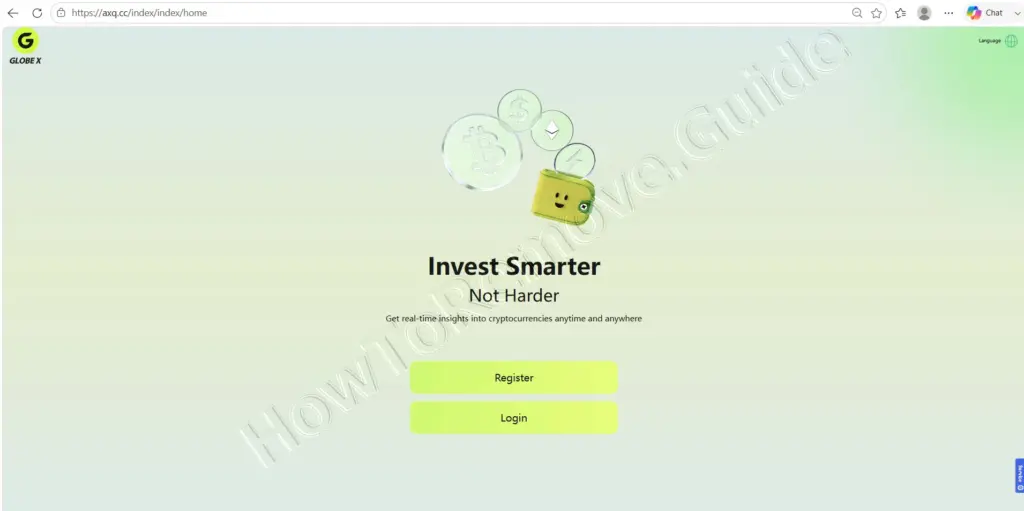
Axq.cc looks like a cryptocurrency platform, but here is the first thing you need to understand: the money shown in the account may not exist. People are often pulled in through random messages claiming that a large USDT balance is waiting for them, complete with login details.
Now that sounds like easy money, and that is exactly the point. The dashboard is there to make the story feel real, but when you try to withdraw, the site may suddenly demand a VIP upgrade, activation fee, verification payment, or another crypto deposit. That is the scam.
Scams of Axq.cc‘s type are known to steal personal data and passwords. Install SpyHunter Pro to scan for risks, remove any dangerous trackers, and enable real-time protection.

Try Free For 7 Days*
Buy now15% OFF if you buy straight without trial.
 OFFER
OFFERAxq.cc, similar to Hbq.cc, also asks for personal information, separate passwords, and USDT transfers over the TRC20 network, so do not mistake a polished page for a legitimate service. Entering wallet details, payment information, or recovery credentials could lead to phishing, account theft, and even more scam attempts later.
If you have already used the site, stop sending money, save messages and transaction records, change exposed passwords, and contact your exchange or wallet provider. Crypto payments are often difficult to recover.
IMPORTANT! READ BEFORE PROCEEDING!
Interaction with Axq.cc should trigger immediate containment. Funds may be gone, but credentials, device integrity, wallet permissions, and identity data can still be protected if you stop communicating and secure the environment quickly.
Run the SpyHunter 5 scan shown below if the site pushed software, downloads, extensions, or unusual browser prompts. After that, check wallets and accounts methodically instead of following any further instructions from the scammers.
Protect Your System and Privacy Using SpyHunter 5
- 1.1Click here to download and install SpyHunter on your PC.
- 1.2Start SpyHunter 5, click the Buy button and choose between starting your 7-days free trial or directly purchasing the tool.
If you choose to buy SpyHunter 5 now, you can use our discount code, “HTRG15“, for 15% off.
- 1.3
 Once you activate SpyHunter, click Start Scan Now, select the Full Scan option, and let the tool do its job.
 - 1.4
 Once the scan completes (it could take a while, so have patience), you’ll see all undesirables listed as well as any system vulnerabilities that may endanger your privacy.
Click Next to review the detections and then click Next again to delete all rogue items.
The post-scan phase is about closing doors. Change critical passwords, review exchange security, move assets away from exposed wallets, preserve evidence, and avoid anyone who appears afterward promising guaranteed recovery.
- Move remaining assets to a fresh, clean wallet and revoke any suspicious token approvals linked to the scam touchpoint.
- Change passwords and enable app-based 2FA on email, exchanges, and chat accounts; review active sessions and delete unused API keys.
- Preserve evidence: screenshots, URLs, videos or ads, wallet addresses, TXIDs, and chat logs – keep everything for official reports.
- Notify the sending platform (your exchange or service) with TXIDs and the destination address so they can flag or freeze if possible.
- Report promptly to your national cybercrime unit (e.g., IC3 in the US, Action Fraud in the UK) and to the platform where you saw the promotion.
How We Know Axq.cc is a Scam
Axq.cc raises multiple red flags that fit a well-known fake-platform pattern. The strongest indicators are not subtle: money appears without proof, payout requires payment, identity checks feel improvised, and the site offers trust signals that cannot be validated elsewhere.
Bonus-first manipulation
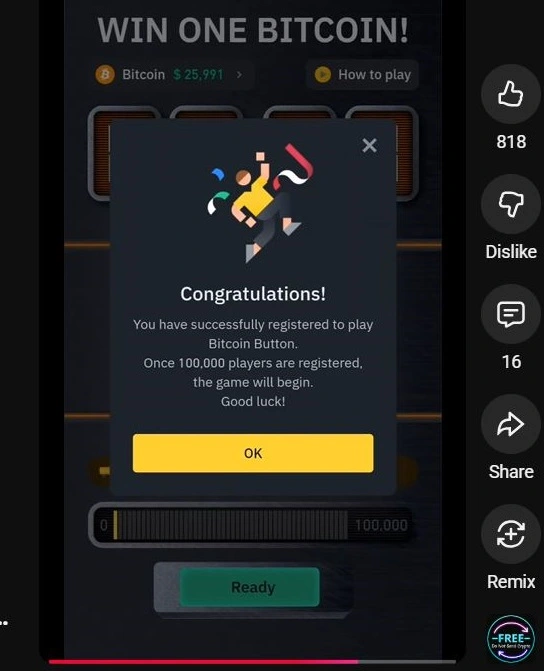
The scam begins by giving the user a reason to feel lucky. A sudden balance or reward creates emotional ownership, even though the platform has not actually transferred anything to the user.
Deposit before withdrawal
The moment a site requires a payment to unlock or process a withdrawal, the risk becomes extreme. That structure mirrors advance-fee fraud, with crypto used because transfers are difficult to reverse.
Fake social authority
Endorsement clips, influencer-style codes, and fabricated success stories are designed to make skepticism feel unnecessary. The safer move is to verify outside the promotional channel.
Opaque payout status
Internal messages like “pending,” “approved,” or “awaiting release” do not prove funds are moving. Without an independent transaction hash, the platform controls the story completely.
Decorative regulation claims
Scam sites may display security seals, audits, or compliance text without any real backing. If the claim cannot be matched to a regulator, auditor, or known company record, it should not be trusted.
Short-lived web presence
A disposable domain lets the operators abandon complaints and relaunch with the same backend story. Repeated layouts and identical wording across different names are classic signs of a scam kit.
How the Axq.cc Scam Deception Funnel Works
The deception works best when the user does not slow down. Axq.cc turns attention into registration, registration into a fake reward, and the fake reward into a payment request that appears to solve a temporary obstacle.
Most victims first see a promotion, click through to a polished page, enter basic information, and receive an apparent account credit. The withdrawal step then introduces the hidden condition: send crypto first.
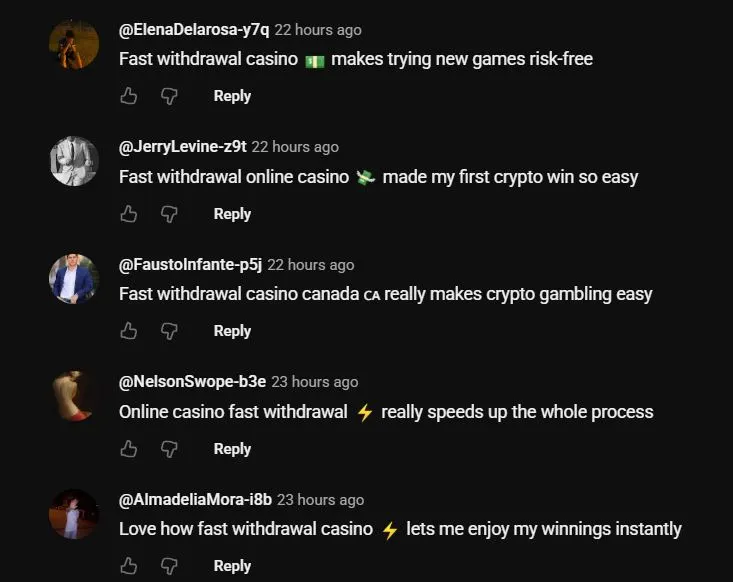
Promo hooks and influencer codes
Scammers seed the offer through channels where quick reactions are normal. A comment thread, short-form video, or private message can make the promotion feel like a discovery rather than an ad.
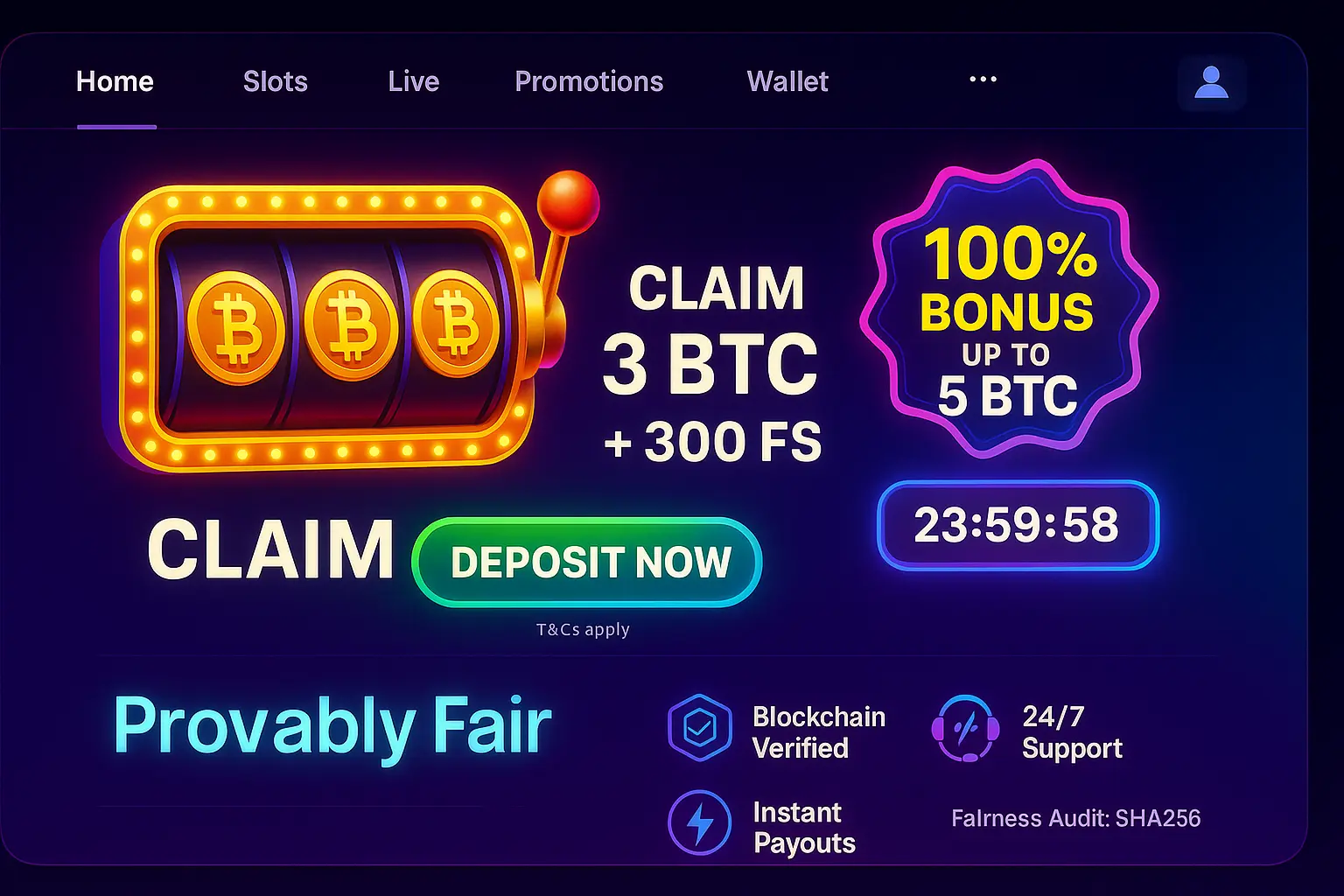
Casino skin and bonus theater
The account area may look busy with charts, balances, and buttons. That visual movement is meant to suggest infrastructure, but it does not confirm custody, liquidity, or any real exchange function.
Inflated balances, then the gate
The fake balance usually arrives before the user has earned anything. By the time withdrawal is blocked, the user is already focused on rescuing the displayed amount rather than questioning its origin.
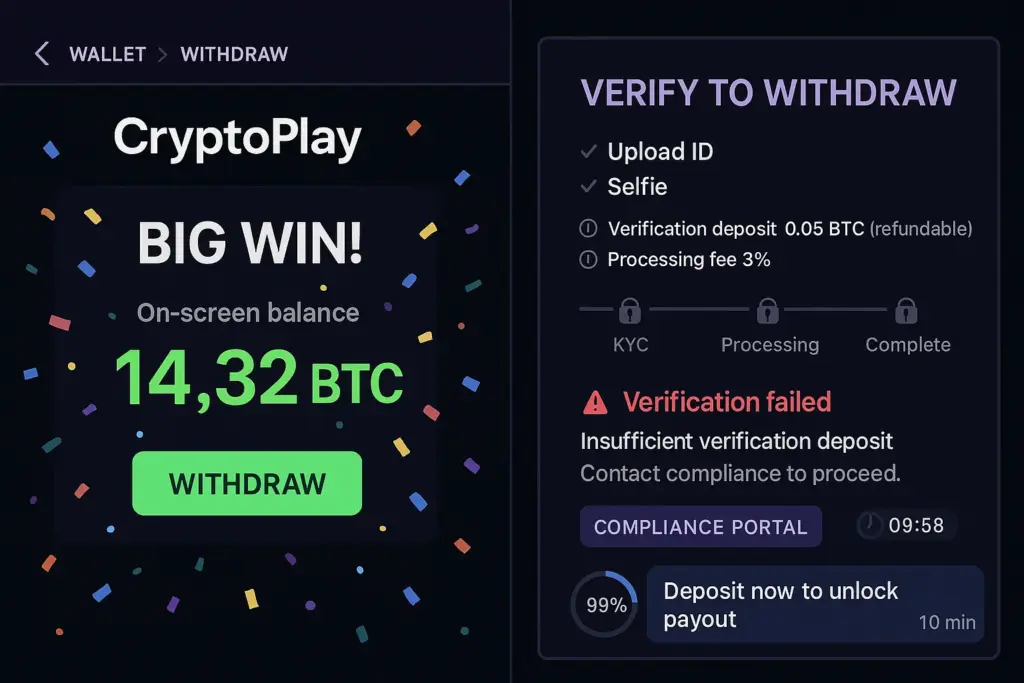
Fee-gates and KYC harvest
Fees can multiply once the first deposit is made. A processing charge becomes a compliance hold, then a tax issue, then another wallet-verification step, each one demanding more crypto.

Stalling, rebrands, and “recovery” bait
When the victim hesitates, support may use reassurance or pressure. If the victim refuses, messages may stop; later, separate “fund recovery” actors may appear with a second advance-fee scheme.
Staying safe from crypto scams like Axq.cc
Staying safe means building friction into your own decisions. Slow verification, separated wallets, clean bookmarks, and skepticism toward sudden bonuses remove the pressure that scams like Axq.cc depend on.
Never pay to withdraw
Refuse to pay a platform in order to withdraw from it. A legitimate service may charge disclosed fees, but it should not require a new deposit to release a claimed account balance.
Verify endorsements at the source
Verify famous-name promotions through the person’s official channels. A convincing clip is not enough, especially now that synthetic voices and faces are widely used in scam advertising.
Navigate with your own bookmarks
Use controlled navigation for crypto accounts. Bookmarks, known apps, and manually checked domains are safer than links from sponsored posts, comment sections, or strangers in chat.
Check regulator registers & warnings
Inspect the company claims with outside records. Real registration and licensing details should be specific, consistent, and searchable in official sources, not only displayed as graphics on the page.
Segregate risk with burner wallets
Keep risk contained by wallet design. A temporary wallet with minimal funds is far safer for testing unknown interactions than connecting a wallet that holds long-term savings.
Harden accounts with 2FA & hygiene
After any suspicious interaction, refresh account security. Password changes, two-factor upgrades, session reviews, and API-key cleanup can prevent the scam from becoming a larger breach.
Revoke approvals & migrate
Review approvals before assuming the danger is over. A wallet connection can leave permissions behind, so revoke anything suspicious and move assets if the address has been exposed.
Protect identity & slow down
If documents were uploaded, prepare for possible identity misuse. Watch for credit activity, unexpected verification emails, account-reset attempts, and messages that reference details only the scam collected.
Where to report Axq.cc-style crypto scams (by country)
Reports are stronger when evidence is organized. Keep the URL, screenshots, timestamps, wallet addresses, transaction IDs, support messages, and promotional links together in one folder.
Click here to report the scam in your country
| Country / Agency | URL | Category / Use-case | Phone/Email |
| Australia – Crime Stoppers | https://www.crimestoppers.com.au | Anonymous tips about crime | 1800 333 000 |
| Australia – National Anti-Scam Center (Scamwatch) | https://www.scamwatch.gov.au/report-a-scam | General scams; phishing; texts/emails | |
| Australia – Police Assistance Line (non-emergency) | https://www.police.gov.au | Local police report | 131 444 |
| Australia – ReportCyber (ACSC) | https://www.cyber.gov.au/report | Cybercrime (hacks, fraud, extortion) | |
| Canada – Canadian Anti-Fraud Center (CAFC) | https://www.antifraudcentre-centreantifraude.ca/report-signalez-eng.htm | General scams incl. phone/text/email | |
| France – DGCCRF (SignalConso) | https://signal.conso.gouv.fr | Consumer scams/deceptive practices | |
| France – PHAROS – Internet-Signalement | https://www.internet-signalement.gouv.fr | Online content & cybercrime reports | |
| Germany – Bundeskriminalamt / Local Police | https://www.polizei.de/Polizei/DE/Home/home_node.html | Report online fraud | |
| Germany – Weißer Ring – Victim Support | https://weisser-ring.de | Victim support | 116 006 |
| India – DoT Helpline (Sanchar Saathi) | https://sancharsaathi.gov.in | Fraudulent telecom/SIM related | 155260 |
| India – National Consumer Helpline | https://consumerhelpline.gov.in | Consumer scams | 1800-11-4000 / 1915 |
| India – National Cyber Crime Reporting Portal | https://cybercrime.gov.in | Cybercrime incl. online fraud | 1930 |
| Japan – Consumer Affairs Agency (CAA) | https://www.caa.go.jp/policies/policy/consumer_policy/caution/cybercrime/ | Consumer scams | |
| Japan – National Police Agency – Cybercrime | https://www.npa.go.jp/bureau/cyber/ | Cybercrime reporting | |
| Mexico – Guardia Nacional (National Guard) | https://www.gob.mx/gn | Cybercrime reporting | |
| Mexico – Instituto Federal de Telecomunicaciones (IFT) | https://www.ift.org.mx | Telecom/online services scams | |
| Mexico – PROFECO | https://www.gob.mx/profeco | Consumer fraud & ecommerce | |
| Netherlands – AFM – Report investment fraud | https://www.afm.nl/en/consumenten/themas/beleggen/misleiding-misbruik | Investment/crypto | |
| Netherlands – Fraudehelpdesk | https://www.fraudehelpdesk.nl/melden | General scams (incl. phishing/SMS) | 088-7867372 |
| Netherlands – Politie – Meldpunt Internetoplichting | https://www.politie.nl/themas/internetoplichting.html | Online shopping fraud | |
| New Zealand – CERT NZ | https://www.cert.govt.nz/individuals/report-an-issue/ | Phishing, identity scams | |
| New Zealand – Department of Internal Affairs – Spam | https://www.dia.govt.nz/Spam-Contact-Us | Email/SMS spam | [email protected] |
| New Zealand – IDCARE | https://www.idcare.org | Victim support (identity compromise) | 0800 121 068 |
| New Zealand – Netsafe – Report | https://www.netsafe.org.nz/report/ | Online harms & scams | |
| New Zealand – New Zealand Police (non-emergency) | https://www.police.govt.nz/use-105 | Report fraud/online crime | 105 |
| Nigeria – Economic & Financial Crimes Commission (EFCC) | https://www.efcc.gov.ng | Financial scams incl. crypto/investment | [email protected] |
| Nigeria – Nigeria Police Special Fraud Unit (SFU) | https://www.specialfraudunit.org.ng | Serious fraud | Voice/SMS: 0708 227 6895; WhatsApp: 0812 760 9914 |
| Poland – CERT Polska (CERT.PL) | https://cert.pl/en/report/ | Cyber incidents & phishing | |
| Poland – Dyzurnet.pl | https://dyzurnet.pl | Illegal online content (esp. child protection) | |
| Poland – Polish Police (Policja) | https://www.policja.pl | Report scams to police | |
| Singapore – Anti-Scam Centre / Anti-Scam Helpline | https://www.scamalert.sg | General scams; texts; calls | 1800-722-6688 |
| Singapore – Monetary Authority of Singapore (MAS) | https://www.mas.gov.sg/investor-alert-list | Investment/crypto checks | |
| Singapore – Singapore Police Force | https://www.police.gov.sg/iwitness | Police report (cybercrime) | |
| South Africa – Cybersecurity Hub (CSIRT) | https://www.cybersecurityhub.gov.za | Cyber incidents incl. scams | |
| South Africa – South African Fraud Prevention Service (SAFPS) | https://www.safps.org.za | Identity fraud support | 011-867-2234 |
| South Africa – South African Police Service (SAPS) | https://www.saps.gov.za | Police report (cybercrime unit) | |
| South Korea – Korea Communications Commission (KCC) | https://www.kcc.go.kr | Telecom-related fraud | |
| South Korea – Korea Internet & Security Agency (KISA) | https://www.kisa.or.kr | Phishing, online harms | |
| South Korea – Korean National Police Agency – Cyber Bureau | https://ecrm.cyber.go.kr | Cybercrime reporting | |
| Spain – INCIBE – Oficina de Seguridad del Internauta (OSI) | https://www.osi.es/es/reporte | Cybersecurity & online fraud | |
| Spain – Policía Nacional / Guardia Civil | https://www.policia.es | Report scams to police | |
| Sweden – Crime Victim Authority (Brottsoffermyndigheten) | https://www.brottsoffermyndigheten.se | Victim support & compensation | 090–70 82 00 |
| Sweden – Polisen (Swedish Police) | https://polisen.se | Report fraud/cybercrime | 114 14 (non-emergency); 112 (emergency) |
| Sweden – Swedish Consumer Agency (Konsumentverket) | https://www.konsumentverket.se | Unfair business practices | |
| United Arab Emirates – Abu Dhabi Police – Aman Service | https://www.adpolice.gov.ae | Cybercrime tips/reporting | SMS 2828; 800 2626 |
| United Arab Emirates – Dubai Police – eCrime | https://www.dubaipolice.gov.ae | Cybercrime reporting | 04 606 1600 |
| United Arab Emirates – Ministry of Interior – Cyber Crime Dept. | https://www.moi.gov.ae | Cybercrime incl. online scams | |
| United Arab Emirates – Telecommunications Regulatory Authority (TRA) / TDRA | https://www.tra.gov.ae | Telecom-related scams/phishing | |
| United Kingdom – Action Fraud (NFIB) | https://www.actionfraud.police.uk | General scams & cybercrime (non-emergency) | 0300 123 2040 |
| United Kingdom – Citizens Advice Consumer Service | https://www.citizensadvice.org.uk/consumer/get-more-help/if-you-need-more-help-about-a-consumer-issue/ | Consumer problems & scam guidance | 0808 223 1133 |
| United Kingdom – Financial Conduct Authority (FCA) | https://www.fca.org.uk/consumers/report-scam-us | Investment/crypto & financial services | |
| United Kingdom – National Cyber Security Centre (NCSC) | https://www.ncsc.gov.uk/collection/phishing-scams | Phishing emails & suspicious websites | |
| United Kingdom – Stop Scams UK ‘159’ | https://stopscamsuk.org.uk/159 | Banking APP fraud (direct to your bank) | 159 |
| United States – AARP Fraud Watch Network Helpline | https://www.aarp.org/money/scams-fraud/ | Victim support | 833-372-8311 |
| United States – Better Business Bureau – Scam Tracker | https://www.bbb.org/scamtracker | Business/marketplace scams | |
| United States – FBI Internet Crime Complaint Center (IC3) | https://www.ic3.gov | Internet crime incl. investment/crypto | |
| United States – Federal Trade Commission – ReportFraud | https://reportfraud.ftc.gov | General scams, phishing, texts/emails | 1-877-382-4357 |
| United States – National Center for Disaster Fraud | https://www.justice.gov/disaster-fraud | Disaster-related scams | (866) 720-5721 |
| United States – SEC Tips & Complaints | https://www.sec.gov/tcr | Investment & securities/crypto-asset offerings |
