

Hbq.cc appears to be a suspicious cryptocurrency-themed website connected with messages that claim a stranger has left behind a large USDT balance. This kind of lure is designed to make people curious, emotional, or greedy enough to open the site and trust the displayed account details.
The invented balance is what does the work. You are supposed to get comfortable with Hbq.cc, treat the profit as yours, and only see the mechanism clearly when you try to take money out. Then they want one more crypto payment first, usually under some verification story, and that demand is the scam, not a hurdle on the way to a real withdrawal.
Scams of Hbq.cc‘s type are known to steal personal data and passwords. Install SpyHunter Pro to scan for risks, remove any dangerous trackers, and enable real-time protection.

Try Free For 7 Days*
Buy now15% OFF if you buy straight without trial.
 OFFER
OFFERSecurity checks have associated the domain with phishing, fraud, and suspicious web activity. That means users should avoid entering passwords, wallet information, personal details, or payment data on the page, even if the login credentials were sent in a message.
Hbq.cc and other such scam sites like Cryptoqk and Yzzq919.cc don’t need to last long. Once enough people realize what is going on, the domain dies and the same operation comes back somewhere else under a different name. Hbq.cc may look fresh, but the fraud behind it is old.
IMPORTANT! READ BEFORE PROCEEDING!
Even a brief interaction with Hbq.cc can put more than one asset at risk. A deposit, an uploaded document, a connected wallet, or a downloaded file can expose your funds, your accounts, and your personal identity data at the same time. Act quickly if you already clicked around, sent crypto, or installed anything associated with this page.
Because these schemes sometimes arrive alongside fake apps, browser prompts, or copied wallet tools, we strongly recommend starting with SpyHunter 5 to inspect the device you used and rule out any extra malware before you continue with account cleanup.
Fastest Removal Option: Use SpyHunter 5
- 1.1Click here to download and install the anti-malware tool on your PC.
- 1.2
 Start SpyHunter 5, click the Buy button and choose between starting your 7-days free trial or directly purchasing the tool.
If you choose to buy SpyHunter 5 now, you can use our discount code, “HTRG15“, for 15% off.
- 1.3
 Once you activate SpyHunter, click Start Scan Now, select the Full Scan option, and let the tool do its job.
 - 1.4
 Once the scan completes (it could take a while, so have patience), you’ll see all malware and other undesirables listed.
Click Next to review the detections and then click Next again to delete all rogue items.
Once that initial scan is complete, it is also strongly recommended that you work through the protection steps below, because the immediate loss may be crypto, yet the longer-term damage often involves leaked credentials, risky wallet permissions, and reused personal information.
- Move remaining assets to a fresh, clean wallet and revoke any suspicious token approvals linked to the scam touchpoint.
- Change passwords and enable app-based 2FA on email, exchanges, and chat accounts; review active sessions and delete unused API keys.
- Preserve evidence: screenshots, URLs, videos or ads, wallet addresses, TXIDs, and chat logs – keep everything for official reports.
- Notify the sending platform (your exchange or service) with TXIDs and the destination address so they can flag or freeze if possible.
- Report promptly to your national cybercrime unit (e.g., IC3 in the US, Action Fraud in the UK) and to the platform where you saw the promotion.
How We Know Hbq.cc is a Scam
Several warning signs point in the same direction here. Fraud analysts keep seeing this exact cluster of behaviors on cloned crypto sites, and Hbq.cc matches the pattern through its promises, its payment demands, its missing transparency, and the way it tries to rush trust before verification.
Instant balance illusion
A promo code or quick sign-up reward may seem to drop funds straight into the account, but that display is not proof that any asset exists. In these schemes, the balance is only there to trigger excitement, lower skepticism, and make a later payment feel rational.
Withdrawal blocked by prepayment
No legitimate crypto service needs you to send a separate deposit just to access your own money. When a site demands an activation transfer, a release fee, or a tax payment before withdrawal, it is using classic advance-fee fraud wrapped in crypto language.
Borrowed authority and fake faces
Another clue is the reliance on famous names, polished spokesperson videos, and social proof that cannot be verified. Deepfakes, voice clones, and fabricated endorsements are cheap to produce, which makes them perfect tools for lending instant credibility to a fake platform.
No verifiable payout trail
When payout evidence never arrives, the story falls apart. A real platform can point to transaction records, wallet movement, and support logs that make sense, whereas scam operators dodge specifics and keep users focused on the next supposed requirement.
Decoration-only compliance claims
Claims about regulation, licensing, and anti-fraud monitoring are often pasted in as visual props. If badges, certificates, or registration numbers cannot be confirmed through genuine public records, they function as costume jewelry rather than evidence of legitimacy.
Disposable domains and cloned pages
Finally, the churn itself is revealing. The same page layout, bonus story, and support script can reappear on fresh domains after the old one burns out, which is a strong sign that the site belongs to a serial operation rather than a real business.
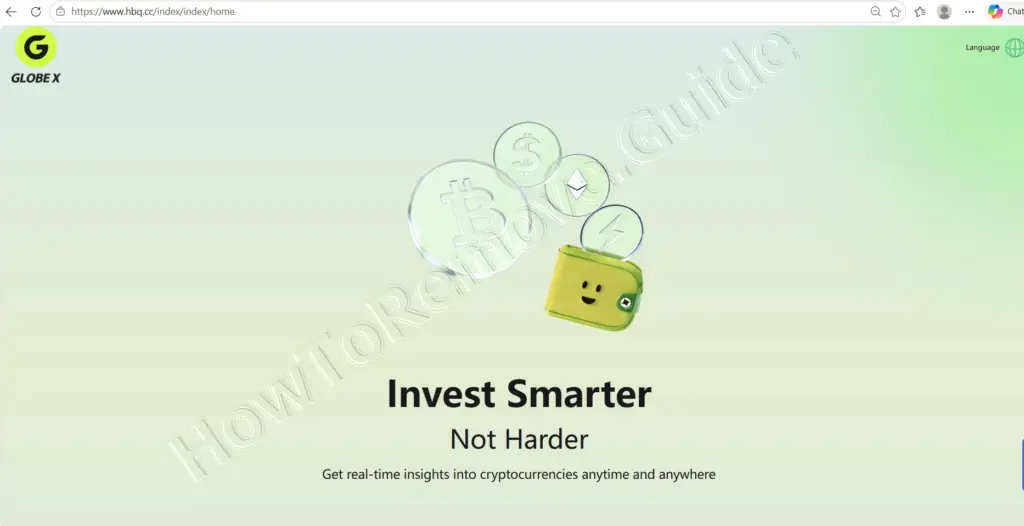
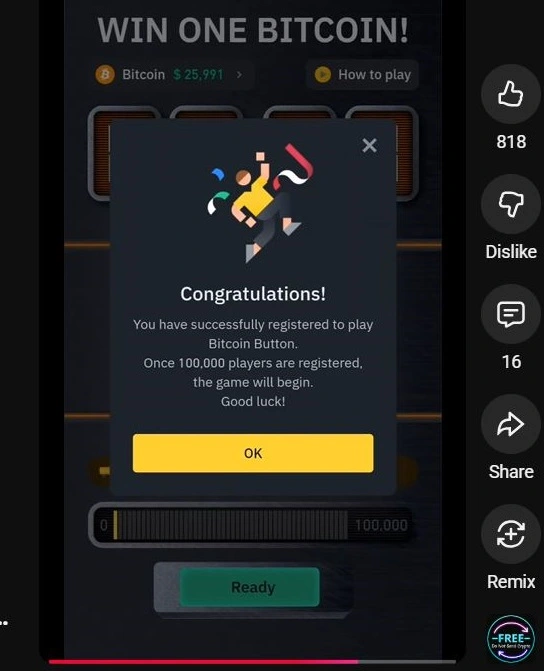
How the Hbq.cc Scam Deception Funnel Works
Learning the sequence matters because these scams do not rely on one perfect lie. They use a chain of small nudges, each one designed to make the next step feel harmless, until the victim is committed emotionally, financially, and sometimes even with identity documents.
The usual path begins with public bait, moves into a frictionless sign-up, escalates with a fake account balance, and ends with a growing set of payment barriers. Understanding that flow makes it easier to spot the moment when curiosity is being turned into controlled loss.
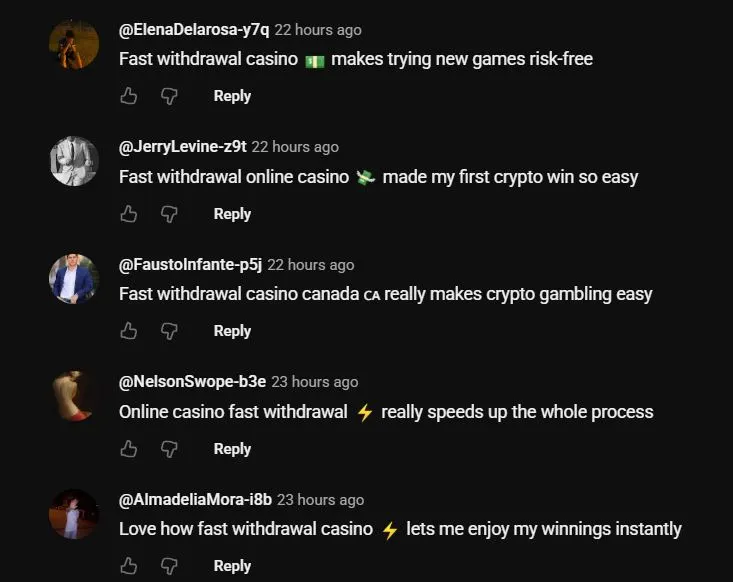
Promo hooks and influencer codes
Most victims first encounter sites like Hbq.cc through boosted posts, comment spam, direct messages, or short-form videos promising insider access, free crypto, or a code tied to a celebrity or influencer. The lure is designed to feel exclusive, urgent, and easy to claim before reason has time to catch up.
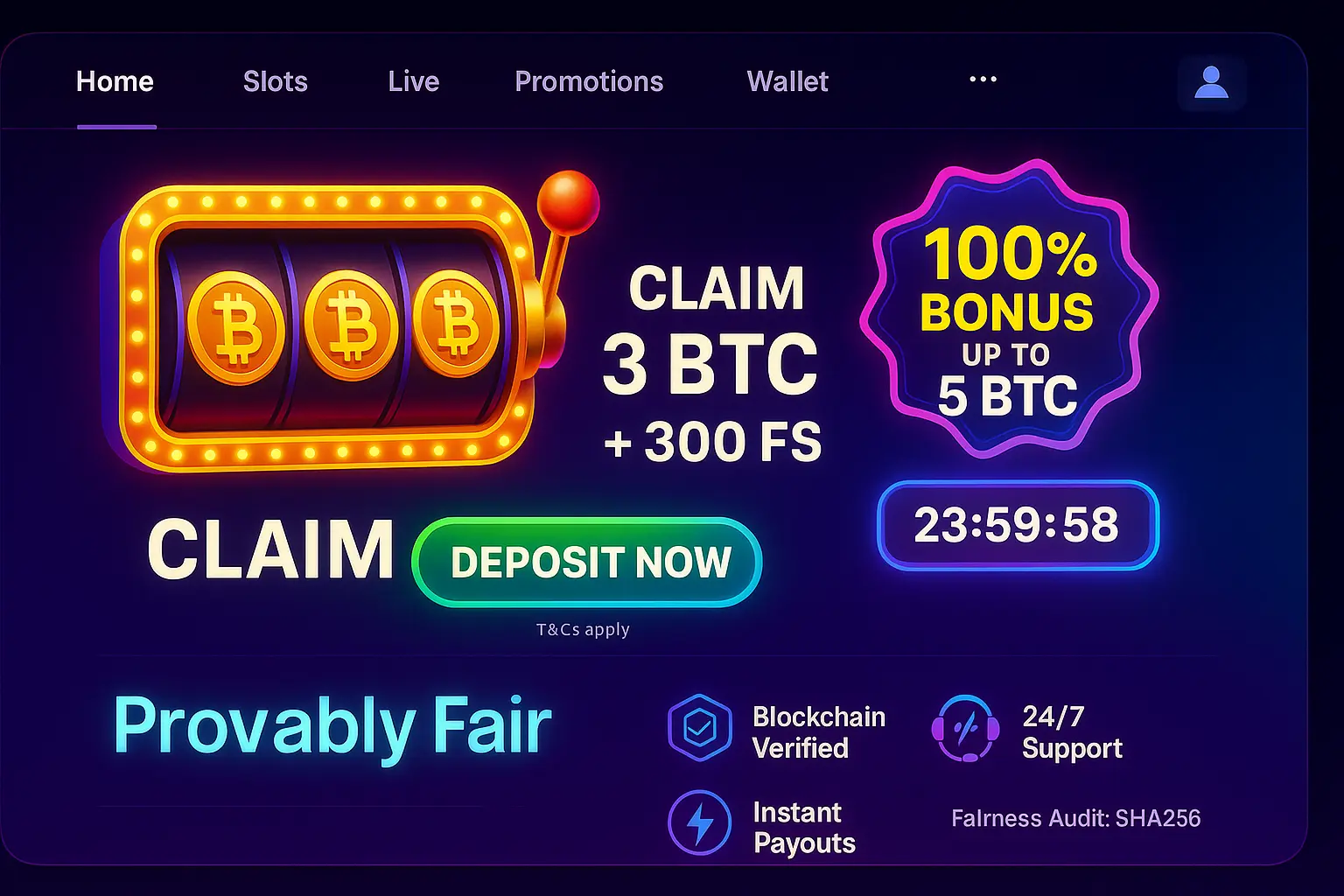
Casino skin and bonus theater
On the landing page, the operators copy the visual language of legitimate exchanges or gaming-style bonus promotions to create a fast sense of familiarity. Flashy rewards, polished charts, and fake activity feeds are there to imitate momentum, not to document any real market activity.
Inflated balances, then the gate
After sign-up, the account suddenly appears funded, profitable, or ready for withdrawal. That is the psychological pivot: once the victim believes money is waiting inside, a small deposit for verification or processing sounds temporary, even though it is the first real transfer to the scammers.
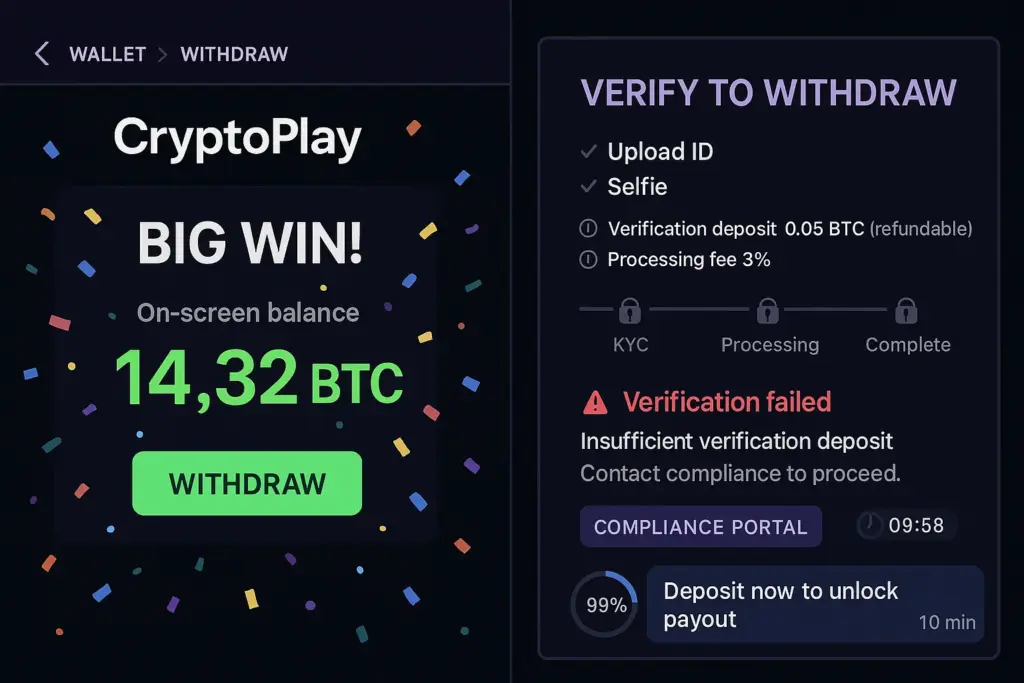
Fee-gates and KYC harvest
Next comes the squeeze. Support agents or automated prompts introduce KYC checks, AML reviews, account tiers, tax notices, or clearance fees, each framed as the final obstacle. In reality, every extra requirement is just another excuse to collect more crypto or harvest more personal data.

Stalling, rebrands, and “recovery” bait
When a target hesitates, the tone usually shifts to stalling and reassurance. Replies become slower, excuses grow more elaborate, and the promise of release stays just out of reach until the site disappears. Afterward, some victims are contacted again by fake recovery services trying to monetize the same loss twice.
Staying safe from crypto scams like Hbq.cc
Good habits do not need to be complicated to be effective. A small set of verification routines, wallet boundaries, and account defenses can block most Hbq.cc-type traps before they ever progress beyond an ad, a message, or a persuasive-looking login page.
Never pay to withdraw
Any request to prepay in order to receive funds should end the conversation immediately. Honest services disclose charges clearly and deduct them in normal ways; they do not invent release deposits, clearance transfers, or emergency unlock fees that must be paid in crypto first.
Verify endorsements at the source
Before trusting a glowing clip or giveaway, trace it back to an official source you already know is real. Viral endorsements are easy to fake, and scammers depend on borrowed authority to create the feeling that checking the claim would be unnecessary or overly cautious.
Navigate with your own bookmarks
For routine access, rely on bookmarks you created yourself instead of ads, sponsored results, or links sent by strangers. That single habit removes many of the common entry points used by clone sites, typo domains, and promotional messages pushing victims toward Hbq.cc-style pages.
Check regulator registers & warnings
Whenever a site claims to be registered or supervised, verify that statement independently through the appropriate regulator, watchdog, or warning list. Fraudulent platforms often count on users seeing a seal, a logo, or a license number and never taking the extra minute to confirm it.
Segregate risk with burner wallets
Separate your storage from your experimentation. Keep meaningful holdings in a hardware wallet or other offline setup, and use a low-value wallet for unknown services so that one bad click cannot expose everything you own across multiple assets.
Harden accounts with 2FA & hygiene
Account hygiene matters just as much as wallet hygiene. Change passwords if you interacted with Hbq.cc, use unique credentials everywhere, enable app-based two-factor authentication, review active sessions, and remove stale API keys that could give an attacker a quiet second path into your accounts.
Revoke approvals & migrate
If you connected a Web3 wallet anywhere in the process, inspect existing approvals with reputable tools and revoke anything unnecessary. Standing permissions can outlive the original scam page, so moving remaining assets to a fresh wallet is often the safest follow-up after exposure.
Protect identity & slow down
Should you have uploaded identification documents to a fake verification form, think beyond crypto loss alone. Watch for identity misuse, monitor connected financial accounts, and consider freezes or alerts available in your jurisdiction, because stolen documents can be recycled into later fraud attempts.
Where to report Hbq.cc-style crypto scams (by country)
One more protective step is documentation. Save screenshots, URLs, chat logs, wallet addresses, transaction hashes, and any downloaded files, then report the incident to the platform that sent the traffic and to the relevant cybercrime or financial-fraud authority in your country. Good records may not reverse the transfer, but they can support investigations and help warn the next target before the same template returns.
Click here to report the scam in your country
| Country / Agency | URL | Category / Use-case | Phone/Email |
| Australia – Crime Stoppers | https://www.crimestoppers.com.au | Anonymous tips about crime | 1800 333 000 |
| Australia – National Anti-Scam Center (Scamwatch) | https://www.scamwatch.gov.au/report-a-scam | General scams; phishing; texts/emails | |
| Australia – Police Assistance Line (non-emergency) | https://www.police.gov.au | Local police report | 131 444 |
| Australia – ReportCyber (ACSC) | https://www.cyber.gov.au/report | Cybercrime (hacks, fraud, extortion) | |
| Canada – Canadian Anti-Fraud Center (CAFC) | https://www.antifraudcentre-centreantifraude.ca/report-signalez-eng.htm | General scams incl. phone/text/email | |
| France – DGCCRF (SignalConso) | https://signal.conso.gouv.fr | Consumer scams/deceptive practices | |
| France – PHAROS – Internet-Signalement | https://www.internet-signalement.gouv.fr | Online content & cybercrime reports | |
| Germany – Bundeskriminalamt / Local Police | https://www.polizei.de/Polizei/DE/Home/home_node.html | Report online fraud | |
| Germany – Weißer Ring – Victim Support | https://weisser-ring.de | Victim support | 116 006 |
| India – DoT Helpline (Sanchar Saathi) | https://sancharsaathi.gov.in | Fraudulent telecom/SIM related | 155260 |
| India – National Consumer Helpline | https://consumerhelpline.gov.in | Consumer scams | 1800-11-4000 / 1915 |
| India – National Cyber Crime Reporting Portal | https://cybercrime.gov.in | Cybercrime incl. online fraud | 1930 |
| Japan – Consumer Affairs Agency (CAA) | https://www.caa.go.jp/policies/policy/consumer_policy/caution/cybercrime/ | Consumer scams | |
| Japan – National Police Agency – Cybercrime | https://www.npa.go.jp/bureau/cyber/ | Cybercrime reporting | |
| Mexico – Guardia Nacional (National Guard) | https://www.gob.mx/gn | Cybercrime reporting | |
| Mexico – Instituto Federal de Telecomunicaciones (IFT) | https://www.ift.org.mx | Telecom/online services scams | |
| Mexico – PROFECO | https://www.gob.mx/profeco | Consumer fraud & ecommerce | |
| Netherlands – AFM – Report investment fraud | https://www.afm.nl/en/consumenten/themas/beleggen/misleiding-misbruik | Investment/crypto | |
| Netherlands – Fraudehelpdesk | https://www.fraudehelpdesk.nl/melden | General scams (incl. phishing/SMS) | 088-7867372 |
| Netherlands – Politie – Meldpunt Internetoplichting | https://www.politie.nl/themas/internetoplichting.html | Online shopping fraud | |
| New Zealand – CERT NZ | https://www.cert.govt.nz/individuals/report-an-issue/ | Phishing, identity scams | |
| New Zealand – Department of Internal Affairs – Spam | https://www.dia.govt.nz/Spam-Contact-Us | Email/SMS spam | [email protected] |
| New Zealand – IDCARE | https://www.idcare.org | Victim support (identity compromise) | 0800 121 068 |
| New Zealand – Netsafe – Report | https://www.netsafe.org.nz/report/ | Online harms & scams | |
| New Zealand – New Zealand Police (non-emergency) | https://www.police.govt.nz/use-105 | Report fraud/online crime | 105 |
| Nigeria – Economic & Financial Crimes Commission (EFCC) | https://www.efcc.gov.ng | Financial scams incl. crypto/investment | [email protected] |
| Nigeria – Nigeria Police Special Fraud Unit (SFU) | https://www.specialfraudunit.org.ng | Serious fraud | Voice/SMS: 0708 227 6895; WhatsApp: 0812 760 9914 |
| Poland – CERT Polska (CERT.PL) | https://cert.pl/en/report/ | Cyber incidents & phishing | |
| Poland – Dyzurnet.pl | https://dyzurnet.pl | Illegal online content (esp. child protection) | |
| Poland – Polish Police (Policja) | https://www.policja.pl | Report scams to police | |
| Singapore – Anti-Scam Centre / Anti-Scam Helpline | https://www.scamalert.sg | General scams; texts; calls | 1800-722-6688 |
| Singapore – Monetary Authority of Singapore (MAS) | https://www.mas.gov.sg/investor-alert-list | Investment/crypto checks | |
| Singapore – Singapore Police Force | https://www.police.gov.sg/iwitness | Police report (cybercrime) | |
| South Africa – Cybersecurity Hub (CSIRT) | https://www.cybersecurityhub.gov.za | Cyber incidents incl. scams | |
| South Africa – South African Fraud Prevention Service (SAFPS) | https://www.safps.org.za | Identity fraud support | 011-867-2234 |
| South Africa – South African Police Service (SAPS) | https://www.saps.gov.za | Police report (cybercrime unit) | |
| South Korea – Korea Communications Commission (KCC) | https://www.kcc.go.kr | Telecom-related fraud | |
| South Korea – Korea Internet & Security Agency (KISA) | https://www.kisa.or.kr | Phishing, online harms | |
| South Korea – Korean National Police Agency – Cyber Bureau | https://ecrm.cyber.go.kr | Cybercrime reporting | |
| Spain – INCIBE – Oficina de Seguridad del Internauta (OSI) | https://www.osi.es/es/reporte | Cybersecurity & online fraud | |
| Spain – Policía Nacional / Guardia Civil | https://www.policia.es | Report scams to police | |
| Sweden – Crime Victim Authority (Brottsoffermyndigheten) | https://www.brottsoffermyndigheten.se | Victim support & compensation | 090–70 82 00 |
| Sweden – Polisen (Swedish Police) | https://polisen.se | Report fraud/cybercrime | 114 14 (non-emergency); 112 (emergency) |
| Sweden – Swedish Consumer Agency (Konsumentverket) | https://www.konsumentverket.se | Unfair business practices | |
| United Arab Emirates – Abu Dhabi Police – Aman Service | https://www.adpolice.gov.ae | Cybercrime tips/reporting | SMS 2828; 800 2626 |
| United Arab Emirates – Dubai Police – eCrime | https://www.dubaipolice.gov.ae | Cybercrime reporting | 04 606 1600 |
| United Arab Emirates – Ministry of Interior – Cyber Crime Dept. | https://www.moi.gov.ae | Cybercrime incl. online scams | |
| United Arab Emirates – Telecommunications Regulatory Authority (TRA) / TDRA | https://www.tra.gov.ae | Telecom-related scams/phishing | |
| United Kingdom – Action Fraud (NFIB) | https://www.actionfraud.police.uk | General scams & cybercrime (non-emergency) | 0300 123 2040 |
| United Kingdom – Citizens Advice Consumer Service | https://www.citizensadvice.org.uk/consumer/get-more-help/if-you-need-more-help-about-a-consumer-issue/ | Consumer problems & scam guidance | 0808 223 1133 |
| United Kingdom – Financial Conduct Authority (FCA) | https://www.fca.org.uk/consumers/report-scam-us | Investment/crypto & financial services | |
| United Kingdom – National Cyber Security Centre (NCSC) | https://www.ncsc.gov.uk/collection/phishing-scams | Phishing emails & suspicious websites | |
| United Kingdom – Stop Scams UK ‘159’ | https://stopscamsuk.org.uk/159 | Banking APP fraud (direct to your bank) | 159 |
| United States – AARP Fraud Watch Network Helpline | https://www.aarp.org/money/scams-fraud/ | Victim support | 833-372-8311 |
| United States – Better Business Bureau – Scam Tracker | https://www.bbb.org/scamtracker | Business/marketplace scams | |
| United States – FBI Internet Crime Complaint Center (IC3) | https://www.ic3.gov | Internet crime incl. investment/crypto | |
| United States – Federal Trade Commission – ReportFraud | https://reportfraud.ftc.gov | General scams, phishing, texts/emails | 1-877-382-4357 |
| United States – National Center for Disaster Fraud | https://www.justice.gov/disaster-fraud | Disaster-related scams | (866) 720-5721 |
| United States – SEC Tips & Complaints | https://www.sec.gov/tcr | Investment & securities/crypto-asset offerings |
