

Aezabet.com raises serious concerns because it presents itself as a celebrity-backed betting site while using the familiar bait of a signup reward. When a gambling platform leans on Elon Musk branding to win trust, caution should come first.
The bigger problem is not only whether the site is real, but whether any displayed winnings can ever be collected. In schemes like this, polished dashboards and rising balances can serve as pressure tools that steer people toward more deposits.
That risk grows when a platform wants crypto payments, since these transfers are usually far harder to reverse than card transactions or bank disputes. One recent security analysis also described Aezabet.com as an extremely young domain, which is another reason to question its credibility.
Scams of Aezabet.com‘s type are known to steal personal data and passwords. Install SpyHunter Pro to scan for risks, remove any dangerous trackers, and enable real-time protection.

Try Free For 7 Days*
Buy now15% OFF if you buy straight without trial.
 OFFER
OFFERAnyone thinking about using this casino should stop before sending money, verify every claim through trusted outside channels, and never pay a so-called release or verification fee to unlock a cash-out. If the site brought suspicious downloads or other problems, SpyHunter 5 may help when manual cleanup feels too difficult.
Anyone who has engaged with Aezabet, Beasttrials.com or Rezowin, should focus on containment and verification, not persuasion. The priority is to stop the next loss, protect whatever accounts remain exposed, and avoid the classic trap of paying one final demand in the hope of recovering everything.
IMPORTANT! READ BEFORE PROCEEDING!
If you already sent money or documents to Aezabet, act as though the operators may keep testing you for more. They may frame the next request as routine, urgent, or refundable. Do not let that framing decide your next move. Lock down your accounts, preserve the transaction trail, and assume further contact is designed to extract additional value. The five urgent actions listed here are the most important first steps.
- Reset passwords and enable 2FA on your email, crypto exchanges, and wallets; terminate other active sessions.
- Notify any exchanges and services touched by the funds; provide TxIDs and ask that accounts/addresses be flagged per policy.
- Migrate assets to fresh wallets with new seed phrases and revoke any existing token approvals on connected chains.
- If you uploaded ID documents, place credit/fraud alerts where available and monitor for identity-theft signals.
- Assemble an evidence bundle – wallet addresses, TxIDs, site URLs, chats, and screenshots – and file reports with police/IC3 and any involved platforms.
How We Know Aezabet is a Scam
We consider Aezabet a scam because the individual clues fit together into a well-known fraud model. The site invites trust aggressively, proves legitimacy weakly, and handles withdrawal in a way that only makes sense if the real goal is to keep the user sending funds inward.
Withdrawal is blocked by paid prerequisites
Scam casinos often let the user believe the hard part is over and then introduce a fee, reserve, or compliance payment to release the balance. That reversal is one of the clearest signs that the displayed funds are not genuinely available.
The proof of legitimacy is self-contained
When the strongest evidence comes from the site itself – its own badges, its own compliance page, its own claims – that is a problem. Real authorization should be verifiable outside the platform, not merely asserted within it.
Success appears too convenient
A suspiciously smooth run of bonuses or favorable outcomes can be part of the setup. The purpose is to create confidence, attachment, and the sense that paying a later obstacle would be foolish not to do.
Irreversible transfers dominate the design
If the site is structured around crypto-only deposits, victims have fewer practical tools once something goes wrong. In a risky context, that payment design serves the operator far more than the customer.
Trust signals can be manufactured cheaply
Win alerts, testimonials, comment chatter, and promotional codes are all easy to generate or fake. They can make a platform feel socially validated without proving that anybody has actually withdrawn a cent.
The web footprint suggests churn
Rapidly registered domains, concealed ownership, and near-duplicate branding often indicate an operation that expects to rotate identities. Fraud campaigns frequently treat websites as throwaway wrappers around the same core script.


How the Aezabet Scam Deception Funnel Works
Understanding the mechanism matters because it weakens the emotional pull. Once you can name the stages – lure, reassurance, attachment, obstruction – the requests stop feeling like special cases and start looking like a system.
The deception funnel is usually direct. The user is enticed to join, shown enough positive feedback to keep going, and then pushed into solving invented withdrawal problems with more money or more personal exposure.
Hype and promotions start the cycle
Victims may first see Aezabet through bonus-heavy ads, referral-style posts, chat messages, or comment threads implying that others are cashing out easily. The social framing is meant to reduce skepticism before any research happens.

Familiar design fills in the credibility gaps
Once they arrive, users see recognizable casino elements: game categories, account panels, promotional badges, and active-looking support. Familiarity can feel like proof, even though it is just a visual strategy.

The account value becomes psychologically real
As the displayed balance grows, users begin thinking in terms of what they are about to receive rather than what they can verify. That shift is crucial because it turns later fees into perceived gateways to a reward.
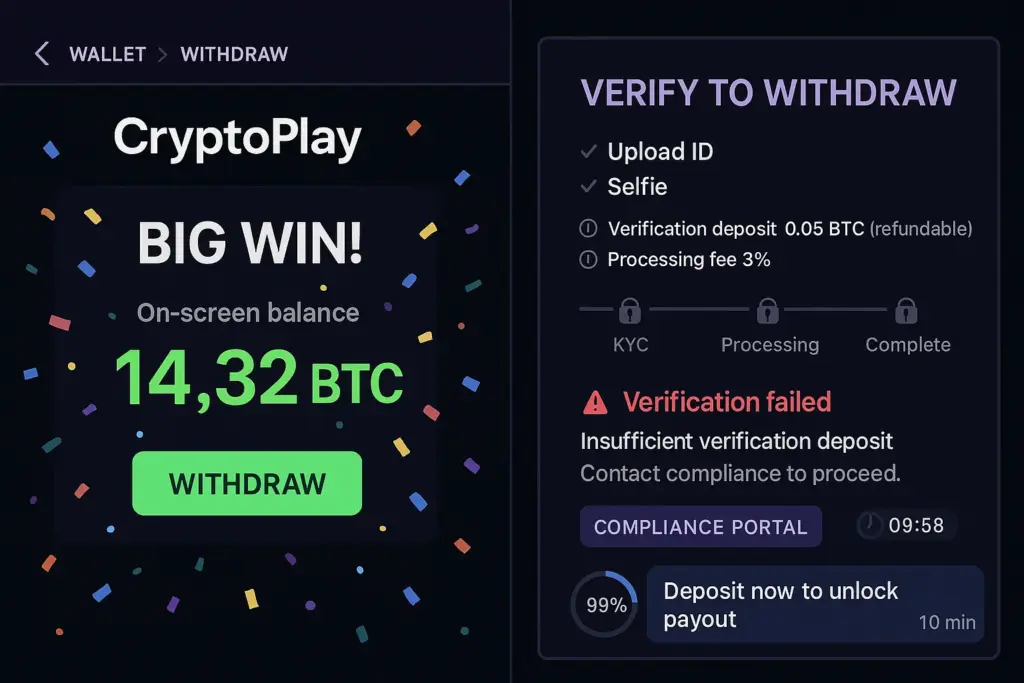
Every withdrawal attempt spawns a new reason to pay
AML checks, wallet activation, tax handling, risk review, reserve requirements, and VIP unlocking can all be used as excuses. The wording changes, but the function stays the same: more money goes in, no money comes out.

When the pressure fails, the brand can change
If the victim stops paying, communication may stall and the site may eventually fade or redirect. The same operators can then reappear behind a new name and domain with the same playbook and different branding.
Staying safe from crypto casino scams like Aezabet
Defending yourself against scams like Aezabet means relying on procedure over impulse. The more consistent your checks are before any payment, the less room there is for hype, urgency, or visible balances to steer you.
Confirm who is actually licensed
Search the relevant register yourself and compare the company identity, brand, and domain. If the authorization cannot be matched cleanly outside the site, you do not have enough proof to proceed safely.
Check whether the domain looks disposable
Recent registration, hidden owner details, and a cluster of similar sites are all signs that the operator may be using replaceable infrastructure. That matters because disappearing later may already be part of the plan.
Refuse every pay-to-withdraw demand
Whether it is called a verification fee, tax amount, reserve payment, or release charge, sending more crypto to retrieve your own balance is exactly the pattern these scams rely on. Stop at the first such request.
Favor services that can be traced and challenged
Transparent ownership, visible licensing, normal payments, and workable complaint routes create accountability. Where everything is opaque and final, the user carries nearly all of the risk.
Compartmentalize exposure across wallets
Using different wallets for storage, routine movement, and experimentation makes a bad interaction easier to contain. One wrong connection should not expose all of your funds or your full activity trail.
Ask how the fairness claim can be checked
Do not give weight to technical slogans unless there is a clear method to validate them independently. A fairness claim that depends entirely on the operator’s word is not a meaningful safeguard.
Keep an evidence log in real time
Save screenshots, wallet addresses, hashes, chat transcripts, emails, and records of what you uploaded while events are still unfolding. Documentation created early is usually clearer and more complete.
Make verification a hard prerequisite
Set a rule that you do not deposit, connect, or upload until licensing, domain history, and outside complaints have been checked. Turning verification into a prerequisite helps remove emotion from the decision.
Useful Resources for Scam Reporting and Prevention (By Country)
Fast reporting can still create value even when a direct refund is unlikely. It may help exchanges monitor suspicious addresses and give investigators a better chance to connect your experience to a wider scam network.
Open the regional reporting list
| Country / Agency | URL | Category / Use-case | Phone/Email |
| Australia – Crime Stoppers | https://www.crimestoppers.com.au | Anonymous tips about crime | 1800 333 000 |
| Australia – National Anti-Scam Center (Scamwatch) | https://www.scamwatch.gov.au/report-a-scam | General scams; phishing; texts/emails | |
| Australia – Police Assistance Line (non-emergency) | https://www.police.gov.au | Local police report | 131 444 |
| Australia – ReportCyber (ACSC) | https://www.cyber.gov.au/report | Cybercrime (hacks, fraud, extortion) | |
| Canada – Canadian Anti-Fraud Center (CAFC) | https://www.antifraudcentre-centreantifraude.ca/report-signalez-eng.htm | General scams incl. phone/text/email | |
| France – DGCCRF (SignalConso) | https://signal.conso.gouv.fr | Consumer scams/deceptive practices | |
| France – PHAROS – Internet-Signalement | https://www.internet-signalement.gouv.fr | Online content & cybercrime reports | |
| Germany – Bundeskriminalamt / Local Police | https://www.polizei.de/Polizei/DE/Home/home_node.html | Report online fraud | |
| Germany – Weißer Ring – Victim Support | https://weisser-ring.de | Victim support | 116 006 |
| India – DoT Helpline (Sanchar Saathi) | https://sancharsaathi.gov.in | Fraudulent telecom/SIM related | 155260 |
| India – National Consumer Helpline | https://consumerhelpline.gov.in | Consumer scams | 1800-11-4000 / 1915 |
| India – National Cyber Crime Reporting Portal | https://cybercrime.gov.in | Cybercrime incl. online fraud | 1930 |
| Japan – Consumer Affairs Agency (CAA) | https://www.caa.go.jp/policies/policy/consumer_policy/caution/cybercrime/ | Consumer scams | |
| Japan – National Police Agency – Cybercrime | https://www.npa.go.jp/bureau/cyber/ | Cybercrime reporting | |
| Mexico – Guardia Nacional (National Guard) | https://www.gob.mx/gn | Cybercrime reporting | |
| Mexico – Instituto Federal de Telecomunicaciones (IFT) | https://www.ift.org.mx | Telecom/online services scams | |
| Mexico – PROFECO | https://www.gob.mx/profeco | Consumer fraud & ecommerce | |
| Netherlands – AFM – Report investment fraud | https://www.afm.nl/en/consumenten/themas/beleggen/misleiding-misbruik | Investment/crypto | |
| Netherlands – Fraudehelpdesk | https://www.fraudehelpdesk.nl/melden | General scams (incl. phishing/SMS) | 088-7867372 |
| Netherlands – Politie – Meldpunt Internetoplichting | https://www.politie.nl/themas/internetoplichting.html | Online shopping fraud | |
| New Zealand – CERT NZ | https://www.cert.govt.nz/individuals/report-an-issue/ | Phishing, identity scams | |
| New Zealand – Department of Internal Affairs – Spam | https://www.dia.govt.nz/Spam-Contact-Us | Email/SMS spam | [email protected] |
| New Zealand – IDCARE | https://www.idcare.org | Victim support (identity compromise) | 0800 121 068 |
| New Zealand – Netsafe – Report | https://www.netsafe.org.nz/report/ | Online harms & scams | |
| New Zealand – New Zealand Police (non-emergency) | https://www.police.govt.nz/use-105 | Report fraud/online crime | 105 |
| Nigeria – Economic & Financial Crimes Commission (EFCC) | https://www.efcc.gov.ng | Financial scams incl. crypto/investment | [email protected] |
| Nigeria – Nigeria Police Special Fraud Unit (SFU) | https://www.specialfraudunit.org.ng | Serious fraud | Voice/SMS: 0708 227 6895; WhatsApp: 0812 760 9914 |
| Poland – CERT Polska (CERT.PL) | https://cert.pl/en/report/ | Cyber incidents & phishing | |
| Poland – Dyzurnet.pl | https://dyzurnet.pl | Illegal online content (esp. child protection) | |
| Poland – Polish Police (Policja) | https://www.policja.pl | Report scams to police | |
| Singapore – Anti-Scam Centre / Anti-Scam Helpline | https://www.scamalert.sg | General scams; texts; calls | 1800-722-6688 |
| Singapore – Monetary Authority of Singapore (MAS) | https://www.mas.gov.sg/investor-alert-list | Investment/crypto checks | |
| Singapore – Singapore Police Force | https://www.police.gov.sg/iwitness | Police report (cybercrime) | |
| South Africa – Cybersecurity Hub (CSIRT) | https://www.cybersecurityhub.gov.za | Cyber incidents incl. scams | |
| South Africa – South African Fraud Prevention Service (SAFPS) | https://www.safps.org.za | Identity fraud support | 011-867-2234 |
| South Africa – South African Police Service (SAPS) | https://www.saps.gov.za | Police report (cybercrime unit) | |
| South Korea – Korea Communications Commission (KCC) | https://www.kcc.go.kr | Telecom-related fraud | |
| South Korea – Korea Internet & Security Agency (KISA) | https://www.kisa.or.kr | Phishing, online harms | |
| South Korea – Korean National Police Agency – Cyber Bureau | https://ecrm.cyber.go.kr | Cybercrime reporting | |
| Spain – INCIBE – Oficina de Seguridad del Internauta (OSI) | https://www.osi.es/es/reporte | Cybersecurity & online fraud | |
| Spain – Policía Nacional / Guardia Civil | https://www.policia.es | Report scams to police | |
| Sweden – Crime Victim Authority (Brottsoffermyndigheten) | https://www.brottsoffermyndigheten.se | Victim support & compensation | 090–70 82 00 |
| Sweden – Polisen (Swedish Police) | https://polisen.se | Report fraud/cybercrime | 114 14 (non-emergency); 112 (emergency) |
| Sweden – Swedish Consumer Agency (Konsumentverket) | https://www.konsumentverket.se | Unfair business practices | |
| United Arab Emirates – Abu Dhabi Police – Aman Service | https://www.adpolice.gov.ae | Cybercrime tips/reporting | SMS 2828; 800 2626 |
| United Arab Emirates – Dubai Police – eCrime | https://www.dubaipolice.gov.ae | Cybercrime reporting | 04 606 1600 |
| United Arab Emirates – Ministry of Interior – Cyber Crime Dept. | https://www.moi.gov.ae | Cybercrime incl. online scams | |
| United Arab Emirates – Telecommunications Regulatory Authority (TRA) / TDRA | https://www.tra.gov.ae | Telecom-related scams/phishing | |
| United Kingdom – Action Fraud (NFIB) | https://www.actionfraud.police.uk | General scams & cybercrime (non-emergency) | 0300 123 2040 |
| United Kingdom – Citizens Advice Consumer Service | https://www.citizensadvice.org.uk/consumer/get-more-help/if-you-need-more-help-about-a-consumer-issue/ | Consumer problems & scam guidance | 0808 223 1133 |
| United Kingdom – Financial Conduct Authority (FCA) | https://www.fca.org.uk/consumers/report-scam-us | Investment/crypto & financial services | |
| United Kingdom – National Cyber Security Centre (NCSC) | https://www.ncsc.gov.uk/collection/phishing-scams | Phishing emails & suspicious websites | |
| United Kingdom – Stop Scams UK ‘159’ | https://stopscamsuk.org.uk/159 | Banking APP fraud (direct to your bank) | 159 |
| United States – AARP Fraud Watch Network Helpline | https://www.aarp.org/money/scams-fraud/ | Victim support | 833-372-8311 |
| United States – Better Business Bureau – Scam Tracker | https://www.bbb.org/scamtracker | Business/marketplace scams | |
| United States – FBI Internet Crime Complaint Center (IC3) | https://www.ic3.gov | Internet crime incl. investment/crypto | |
| United States – Federal Trade Commission – ReportFraud | https://reportfraud.ftc.gov | General scams, phishing, texts/emails | 1-877-382-4357 |
| United States – National Center for Disaster Fraud | https://www.justice.gov/disaster-fraud | Disaster-related scams | (866) 720-5721 |
| United States – SEC Tips & Complaints | https://www.sec.gov/tcr | Investment & securities/crypto-asset offerings |
Aezabet relies on the user believing that the next step will finally release the payout. Do not let that hope set your policy. Verify first, reject every fee-based withdrawal demand, and treat the platform’s polished surface as part of the pressure – not proof that it is safe.
