

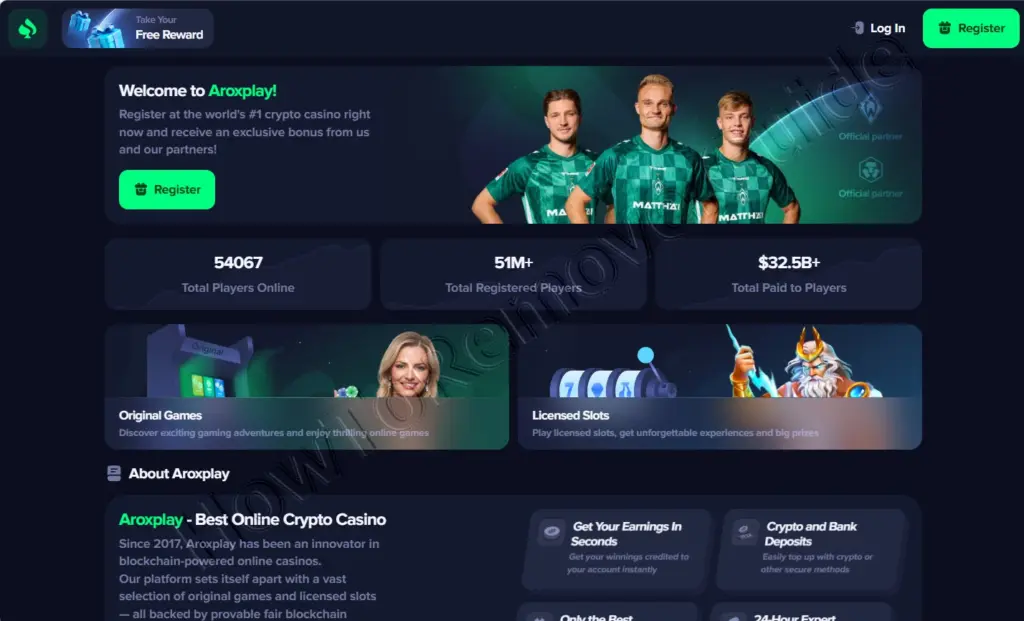
Aroxplay presents itself as a modern crypto casino, promising huge bonuses, fast payouts, and a long operating history. On the surface, that can sound like a typical gambling platform. A closer look, however, points to a high-risk setup built to attract deposits before problems begin.
One of the clearest warning signs is the gap between image and reality. The site promotes enormous player numbers and billions supposedly paid out, while recent checks tied the domain to an April 2026 registration. That mismatch alone is enough to make careful users question the story.
Scams of Aroxplay.com‘s type are known to steal personal data and passwords. Install SpyHunter Pro to scan for risks, remove any dangerous trackers, and enable real-time protection.

Try Free For 7 Days*
Buy now15% OFF if you buy straight without trial.
 OFFER
OFFERReports linked to Aroxplay also describe a familiar pattern: users are shown appealing balances or rewards, but trouble starts when they try to cash out. At that stage, the platform may demand extra crypto payments, more personal details, or other last-minute conditions that keep the money moving in only one direction.
For readers, the key point is simple: this is not just about gambling losses, but about a possible withdrawal trap that can expose both funds and personal data. Spotting those red flags early can make it far easier to avoid the scam and reduce the fallout.
Handle exposure to Aroxplay, Rezowin, or Aezabet as you would any account-security incident. The material below focuses on recognition, fast containment, and the practical habits that make the next clone easier to spot before money moves.
Scams of Aroxplay.com‘s type are known to steal personal data and passwords. Install SpyHunter Pro to scan for risks, remove any dangerous trackers, and enable real-time protection.
Try Free For 7 Days*
Buy now15% OFF if you buy straight without trial.
IMPORTANT! READ BEFORE PROCEEDING!
If your accounts have already touched Aroxplay, assume the safest response is immediate containment. Stop engaging, do not approve another payment, secure connected services, and save records before the site changes or disappears. The five emergency measures below are aimed at reducing follow-on harm right away:
- Reset passwords and enable 2FA on your email, crypto exchanges, and wallets; terminate other active sessions.
- Notify any exchanges and services touched by the funds; provide TxIDs and ask that accounts/addresses be flagged per policy.
- Migrate assets to fresh wallets with new seed phrases and revoke any existing token approvals on connected chains.
- If you uploaded ID documents, place credit/fraud alerts where available and monitor for identity-theft signals.
- Assemble an evidence bundle – wallet addresses, TxIDs, site URLs, chats, and screenshots – and file reports with police/IC3 and any involved platforms.
How We Know Aroxplay is a Scam
Forget the casino aesthetics for a moment and examine the operating pattern. The warning signs below are not minor quirks; together they point to a setup whose purpose is to delay withdrawals, collect extra funds, and pressure users into handing over identity material.
Surprise withdrawal charges
Advance charges tied to withdrawals are one of the clearest danger signals in this category. A real service does not trap your balance behind a made-up prepayment and ask you to send more crypto before you can access what is supposedly already yours.
Counterfeit licensing
Licensing claims deserve to be tested, not admired. Fraudulent sites often copy the language of regulated operators, but their company names, addresses, or approval numbers fail to align with any legitimate public record.
Inflated early “wins”
The pattern of early success is also revealing. When a new account starts accumulating eye-catching winnings almost immediately, that apparent luck may be functioning as stage dressing for the later demand cycle.
Crypto-only rails
Limiting transactions to cryptocurrency gives the scammers structural advantages. It narrows the victim’s recovery options, keeps payment friction low for the fraudster, and makes every emotional decision more expensive to unwind.
Synthetic social proof
Many of the reassuring signals surrounding these sites are synthetic by design. Auto-generated win notifications, suspiciously enthusiastic reviews, and affiliate-style recommendations are used to imitate the confidence that real reputations take time to build.
Fresh, privacy-masked domains
Short-lived infrastructure is another recurring clue. When a domain is young, ownership details are obscured, and related sites keep appearing with the same template, that points to a replaceable scam asset rather than a durable business; public checks such as who.is often make that clearer.

How the Aroxplay Scam Deception Funnel Works
Following the funnel step by step makes the pressure tactics much easier to recognize in the moment. Each phase has a job: attract attention, reduce suspicion, increase emotional investment, obstruct withdrawal, and prolong contact long enough to extract more value.
In broad terms, Aroxplay moves victims through a repeatable path: marketing hook, plausible interface, engineered winnings, withdrawal blockade, serial payment demands, and then either disappearance or migration to the next brand shell.
Promo hooks and influencer codes
The opening lure frequently arrives through social channels, ads, or promo-style sharing. Instead of asking for trust directly, the scam borrows it from a story about bonus access, quick gains, or other users supposedly cashing out with ease.

Casino skin and bonus theater
After the click, presentation takes over. The site tries to feel finished and familiar, using polished visuals and casino conventions to discourage users from slowing down and verifying who actually runs the platform.

Inflated balances, then the gate
What comes next is the confidence-building phase. Favorable outcomes inflate the visible balance and create the sense that the user is already in profit, which makes later payment requests feel like temporary obstacles instead of the scam itself.
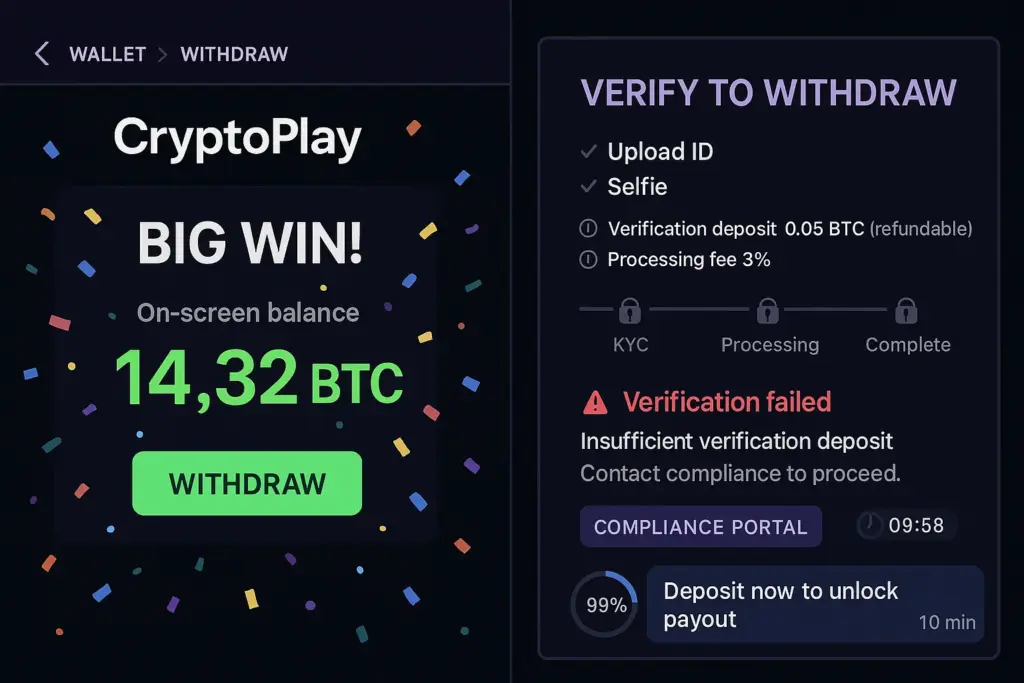
Fee-gates and KYC harvest
At withdrawal, the narrative changes completely. Compliance language appears late, new rules materialize without warning, and support positions each extra crypto transfer as the last administrative hurdle even though another one is usually waiting behind it.

Stalling, rebrands, and “recovery” bait
The endgame is attrition. Some victims are strung along until they stop paying, some are ignored once they ask harder questions, and some are targeted again by fake recovery operators who exploit the same loss and urgency from a different angle.
Staying safe from crypto casino scams like Aroxplay
Avoiding the next version of this scam means committing to checks that are less exciting than the offer itself. The tips below matter because they create friction in exactly the place scammers want thoughtless speed.
Verify license status in official registers
Independent license verification should come before any deposit. Search regulator databases yourself, match the legal entity carefully, and treat vague compliance wording as meaningless until a real authority confirms it.
Check domain age and history
Domain research is a simple but underused filter. New registration dates, hidden ownership, and recycled branding across similar sites often reveal a disposable network long before a victim reaches the withdrawal stage.
Reject withdrawal fees and “unlock” deposits
Make “pay to release funds” a non-negotiable stop point. Processing charges, tax prepayments, wallet activation costs, and verification transfers all belong in the same warning category because they turn withdrawal into an extraction event.
Prefer venues with recourse
Prefer services that can be challenged through normal channels. Verifiable ownership, readable terms, mainstream payment options, and credible complaint routes all raise the cost of fraud and lower the chance of being isolated.
Limit wallet exposure
Your own account setup also matters. Strong passwords, separate wallets, cautious approval management, and protected email access can limit how much damage one scam interaction is able to spread across your wider financial life.
Validate “provably fair” claims
Technical buzzwords should never substitute for proof. If a platform leans heavily on fairness, transparency, or audit language without offering evidence that withstands outside checking, treat those claims as persuasion rather than as verification.
Document and report rapidly
Capture evidence as you go instead of after the fact. Transaction hashes, wallet addresses, chats, screenshots, timestamps, domain names, and document-upload records can all help when you report the incident or alert a service provider.
Build a deliberate slow-down reflex
One of the strongest practical defenses is a forced pause. Stepping away long enough to run a few independent checks can puncture the emotional momentum that fake gambling wins and urgent payout deadlines are meant to create.
Useful Resources for Scam Reporting and Prevention (By Country)
Fast reporting will not guarantee recovery, but it can still be useful. The earlier exchanges, cybercrime units, and other relevant platforms receive accurate details, the better the chance of linking activity and warning others before the next domain spins up.
Click here to report the scam in your country
| Country / Agency | URL | Category / Use-case | Phone/Email |
| Australia – Crime Stoppers | https://www.crimestoppers.com.au | Anonymous tips about crime | 1800 333 000 |
| Australia – National Anti-Scam Center (Scamwatch) | https://www.scamwatch.gov.au/report-a-scam | General scams; phishing; texts/emails | |
| Australia – Police Assistance Line (non-emergency) | https://www.police.gov.au | Local police report | 131 444 |
| Australia – ReportCyber (ACSC) | https://www.cyber.gov.au/report | Cybercrime (hacks, fraud, extortion) | |
| Canada – Canadian Anti-Fraud Center (CAFC) | https://www.antifraudcentre-centreantifraude.ca/report-signalez-eng.htm | General scams incl. phone/text/email | |
| France – DGCCRF (SignalConso) | https://signal.conso.gouv.fr | Consumer scams/deceptive practices | |
| France – PHAROS – Internet-Signalement | https://www.internet-signalement.gouv.fr | Online content & cybercrime reports | |
| Germany – Bundeskriminalamt / Local Police | https://www.polizei.de/Polizei/DE/Home/home_node.html | Report online fraud | |
| Germany – Weißer Ring – Victim Support | https://weisser-ring.de | Victim support | 116 006 |
| India – DoT Helpline (Sanchar Saathi) | https://sancharsaathi.gov.in | Fraudulent telecom/SIM related | 155260 |
| India – National Consumer Helpline | https://consumerhelpline.gov.in | Consumer scams | 1800-11-4000 / 1915 |
| India – National Cyber Crime Reporting Portal | https://cybercrime.gov.in | Cybercrime incl. online fraud | 1930 |
| Japan – Consumer Affairs Agency (CAA) | https://www.caa.go.jp/policies/policy/consumer_policy/caution/cybercrime/ | Consumer scams | |
| Japan – National Police Agency – Cybercrime | https://www.npa.go.jp/bureau/cyber/ | Cybercrime reporting | |
| Mexico – Guardia Nacional (National Guard) | https://www.gob.mx/gn | Cybercrime reporting | |
| Mexico – Instituto Federal de Telecomunicaciones (IFT) | https://www.ift.org.mx | Telecom/online services scams | |
| Mexico – PROFECO | https://www.gob.mx/profeco | Consumer fraud & ecommerce | |
| Netherlands – AFM – Report investment fraud | https://www.afm.nl/en/consumenten/themas/beleggen/misleiding-misbruik | Investment/crypto | |
| Netherlands – Fraudehelpdesk | https://www.fraudehelpdesk.nl/melden | General scams (incl. phishing/SMS) | 088-7867372 |
| Netherlands – Politie – Meldpunt Internetoplichting | https://www.politie.nl/themas/internetoplichting.html | Online shopping fraud | |
| New Zealand – CERT NZ | https://www.cert.govt.nz/individuals/report-an-issue/ | Phishing, identity scams | |
| New Zealand – Department of Internal Affairs – Spam | https://www.dia.govt.nz/Spam-Contact-Us | Email/SMS spam | [email protected] |
| New Zealand – IDCARE | https://www.idcare.org | Victim support (identity compromise) | 0800 121 068 |
| New Zealand – Netsafe – Report | https://www.netsafe.org.nz/report/ | Online harms & scams | |
| New Zealand – New Zealand Police (non-emergency) | https://www.police.govt.nz/use-105 | Report fraud/online crime | 105 |
| Nigeria – Economic & Financial Crimes Commission (EFCC) | https://www.efcc.gov.ng | Financial scams incl. crypto/investment | [email protected] |
| Nigeria – Nigeria Police Special Fraud Unit (SFU) | https://www.specialfraudunit.org.ng | Serious fraud | Voice/SMS: 0708 227 6895; WhatsApp: 0812 760 9914 |
| Poland – CERT Polska (CERT.PL) | https://cert.pl/en/report/ | Cyber incidents & phishing | |
| Poland – Dyzurnet.pl | https://dyzurnet.pl | Illegal online content (esp. child protection) | |
| Poland – Polish Police (Policja) | https://www.policja.pl | Report scams to police | |
| Singapore – Anti-Scam Centre / Anti-Scam Helpline | https://www.scamalert.sg | General scams; texts; calls | 1800-722-6688 |
| Singapore – Monetary Authority of Singapore (MAS) | https://www.mas.gov.sg/investor-alert-list | Investment/crypto checks | |
| Singapore – Singapore Police Force | https://www.police.gov.sg/iwitness | Police report (cybercrime) | |
| South Africa – Cybersecurity Hub (CSIRT) | https://www.cybersecurityhub.gov.za | Cyber incidents incl. scams | |
| South Africa – South African Fraud Prevention Service (SAFPS) | https://www.safps.org.za | Identity fraud support | 011-867-2234 |
| South Africa – South African Police Service (SAPS) | https://www.saps.gov.za | Police report (cybercrime unit) | |
| South Korea – Korea Communications Commission (KCC) | https://www.kcc.go.kr | Telecom-related fraud | |
| South Korea – Korea Internet & Security Agency (KISA) | https://www.kisa.or.kr | Phishing, online harms | |
| South Korea – Korean National Police Agency – Cyber Bureau | https://ecrm.cyber.go.kr | Cybercrime reporting | |
| Spain – INCIBE – Oficina de Seguridad del Internauta (OSI) | https://www.osi.es/es/reporte | Cybersecurity & online fraud | |
| Spain – Policía Nacional / Guardia Civil | https://www.policia.es | Report scams to police | |
| Sweden – Crime Victim Authority (Brottsoffermyndigheten) | https://www.brottsoffermyndigheten.se | Victim support & compensation | 090–70 82 00 |
| Sweden – Polisen (Swedish Police) | https://polisen.se | Report fraud/cybercrime | 114 14 (non-emergency); 112 (emergency) |
| Sweden – Swedish Consumer Agency (Konsumentverket) | https://www.konsumentverket.se | Unfair business practices | |
| United Arab Emirates – Abu Dhabi Police – Aman Service | https://www.adpolice.gov.ae | Cybercrime tips/reporting | SMS 2828; 800 2626 |
| United Arab Emirates – Dubai Police – eCrime | https://www.dubaipolice.gov.ae | Cybercrime reporting | 04 606 1600 |
| United Arab Emirates – Ministry of Interior – Cyber Crime Dept. | https://www.moi.gov.ae | Cybercrime incl. online scams | |
| United Arab Emirates – Telecommunications Regulatory Authority (TRA) / TDRA | https://www.tra.gov.ae | Telecom-related scams/phishing | |
| United Kingdom – Action Fraud (NFIB) | https://www.actionfraud.police.uk | General scams & cybercrime (non-emergency) | 0300 123 2040 |
| United Kingdom – Citizens Advice Consumer Service | https://www.citizensadvice.org.uk/consumer/get-more-help/if-you-need-more-help-about-a-consumer-issue/ | Consumer problems & scam guidance | 0808 223 1133 |
| United Kingdom – Financial Conduct Authority (FCA) | https://www.fca.org.uk/consumers/report-scam-us | Investment/crypto & financial services | |
| United Kingdom – National Cyber Security Centre (NCSC) | https://www.ncsc.gov.uk/collection/phishing-scams | Phishing emails & suspicious websites | |
| United Kingdom – Stop Scams UK ‘159’ | https://stopscamsuk.org.uk/159 | Banking APP fraud (direct to your bank) | 159 |
| United States – AARP Fraud Watch Network Helpline | https://www.aarp.org/money/scams-fraud/ | Victim support | 833-372-8311 |
| United States – Better Business Bureau – Scam Tracker | https://www.bbb.org/scamtracker | Business/marketplace scams | |
| United States – FBI Internet Crime Complaint Center (IC3) | https://www.ic3.gov | Internet crime incl. investment/crypto | |
| United States – Federal Trade Commission – ReportFraud | https://reportfraud.ftc.gov | General scams, phishing, texts/emails | 1-877-382-4357 |
| United States – National Center for Disaster Fraud | https://www.justice.gov/disaster-fraud | Disaster-related scams | (866) 720-5721 |
| United States – SEC Tips & Complaints | https://www.sec.gov/tcr | Investment & securities/crypto-asset offerings |
Viewed plainly, the lesson is simple: do not mistake a polished front end for a trustworthy operator, and never send more money to solve a withdrawal problem created by the platform itself.
