

If Azjili.com is on your screen, I would slow down before the homepage gets a chance to do its job. The polished look is not much of a signal. Scam casinos often spend enough on the front door to make the questions behind it feel less urgent.
With Azjili.com, the business basics do not hold up. You should be able to tell who runs the place and what happens when money leaves the account; here, that part stays too muddy. The terms only make the picture worse, because they read less like player protection and more like cover for blocking a withdrawal. Even the broader shape feels familiar in the wrong way: a recent-looking crypto casino with a design that could have come from the same pile of fake gambling sites.
Scams of Azjili.com‘s type are known to steal personal data and passwords. Install SpyHunter Pro to scan for risks, remove any dangerous trackers, and enable real-time protection.

Try Free For 7 Days*
Buy now15% OFF if you buy straight without trial.
 OFFER
OFFERThe bonus is there to get you leaning forward. It makes the account balance feel close enough to chase, then the site asks for a real crypto deposit before any “winnings” can move. Calling that activation gives the scam too much credit; by then, it is simply asking you to pay fraudsters directly.
This article is meant to help you read Azjili.com and other similar scams like Wazbee and Uitgamb as a trap before it gets either your crypto or your personal details.
IMPORTANT! READ BEFORE PROCEEDING!
If you have already interacted with Azjili.com in any serious way, treat the situation as active exposure rather than a closed mistake. Deposits, uploaded ID, wallet approvals, or downloaded files can create risks that continue long after the site stops replying.
Before you read another promise from support or answer anyone claiming they can retrieve the lost funds, examine the device involved. We strongly recommend beginning with SpyHunter 5 so you can look for malicious downloads, risky browser changes, tracking components, or other unwanted additions tied to the scam path.
Fastest Removal Option: Use SpyHunter 5
- 1.1Click here to download and install the anti-malware tool on your PC.
- 1.2
 Start SpyHunter 5, click the Buy button and choose between starting your 7-days free trial or directly purchasing the tool.
If you choose to buy SpyHunter 5 now, you can use our discount code, “HTRG15“, for 15% off.
- 1.3
 Once you activate SpyHunter, click Start Scan Now, select the Full Scan option, and let the tool do its job.
 - 1.4
 Once the scan completes (it could take a while, so have patience), you’ll see all malware and other undesirables listed.
Click Next to review the detections and then click Next again to delete all rogue items.
Once that device check is done, move on to the security steps below and assume that logins, wallets, linked services, and any personal data shared during contact with Azjili.com may need immediate attention.
- Reset passwords and enable 2FA on your email, crypto exchanges, and wallets; terminate other active sessions.
- Notify any exchanges and services touched by the funds; provide TxIDs and ask that accounts/addresses be flagged per policy.
- Migrate assets to fresh wallets with new seed phrases and revoke any existing token approvals on connected chains.
- If you uploaded ID documents, place credit/fraud alerts where available and monitor for identity-theft signals.
- Assemble an evidence bundle – wallet addresses, TxIDs, site URLs, chats, and screenshots – and file reports with police/IC3 and any involved platforms.
How We Know Azjili.com is a Scam
The signs here are not random quirks. They form a consistent pattern that fake crypto casinos repeat because the same trust triggers and pressure points keep working on new audiences.
Withdrawal suddenly has a price
Perhaps the most telling sign is the moment cash-out stops being routine and starts costing extra. Reputable services do not demand a release payment, a tax pre-fund, or a wallet check deposit before sending out money already shown as available.
Legitimacy by decoration
These sites often surround themselves with compliance language, badges, and licensing claims meant to short-circuit scrutiny. Once checked outside the site, those signals frequently prove vague, unverifiable, or completely invented.
Winning that feels a little too easy
A suspiciously friendly run of early results can be part of the script. Fast gains reduce doubt, create excitement, and persuade the user that sending more money now is simply how people capitalize on a lucky streak.
Payments routed where leverage fades
Crypto-only payment channels are not just a branding choice. They also remove many of the protections, reversals, and intermediary checks that would otherwise give a victim more options once something goes wrong.
Social proof built on stage props
Comment sections, winner alerts, support chatter, and referral language may exist mainly to create the feeling that many others are happily using the platform. The impression of consensus becomes a substitute for real proof.
A name that can vanish overnight
Disposable domains are central to this ecosystem. When a site is new, ownership is obscured, and lookalike versions keep surfacing, public tools such as who.is help show how thin the identity behind the brand really is.


How the Azjili.com Scam Deception Funnel Works
Understanding the manipulation sequence matters because predictability weakens its power. Once you can see how the scam advances from temptation to extraction, it becomes easier to interrupt.
People are rarely captured by one outrageous lie. More often, they are moved step by step through an experience that keeps rewarding belief and punishing hesitation.
Social lures that create borrowed trust
The entry point is often a feed post, a short video, a message, or a referral code that implies ordinary users are already profiting. That apparent endorsement lowers resistance before the target even reaches the website.

Design that makes caution feel unnecessary
After arrival, the site tries to feel familiar enough that deeper questions seem excessive. Clean layouts, standard casino labels, animated game tiles, and polished bonus panels encourage the brain to treat the platform as known territory.

Balances used as persuasion tools
The account value on display is not just information. It is part of the pressure system. A quickly rising balance changes how users think, making them more likely to justify extra deposits or documentation because a much larger reward appears within reach.
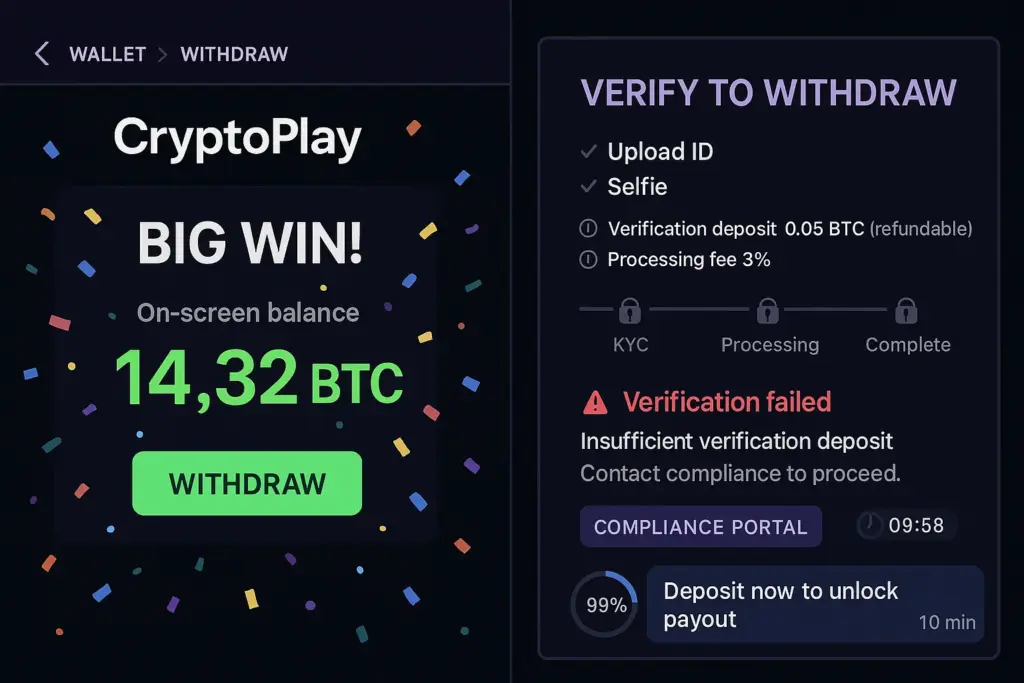
Compliance excuses that multiply
When withdrawal is attempted, the platform often deploys official-sounding obstacles: anti-fraud review, tax release, source-of-funds checks, or VIP activation. Each new explanation exists to normalize one more payment or one more surrender of personal data.

Exhaustion, silence, then a rerun
The later stage often relies on fatigue. Support alternates reassurance with urgency, days stretch into weeks, and the victim is kept in a cycle of waiting and hoping. When the domain fades out, a separate “recovery” actor may try to monetize the same desperation all over again.
Staying safe from crypto casino scams like Azjili.com
Staying safer means interrupting the emotional pacing these sites rely on. The most effective defenses are usually simple checks that slow the experience down and force verification back into the process.
Trust registries, not homepage theater
Begin with independent confirmation. Search the regulator, the company, and the domain outside the site. If the operator cannot be matched to an official source, the polished branding on the page should not carry the argument for legitimacy.
Look for a short and shallow history
A thin domain history is often revealing. Newly created sites, privacy-hidden registrations, and clusters of related lookalike addresses are all consistent with operations that expect to burn a brand quickly and replace it just as fast.
Treat extra payment demands as the end
The moment a service asks you to pay in order to access your own displayed funds, the safest move is to stop. Processing deposits, tax advances, and verification charges are among the most common ways these scams keep converting belief into fresh losses.
Favor platforms that leave a paper trail
Opaque companies and crypto-only payment flows work in the scammer’s favor because they reduce accountability. Transparent ownership, independently confirmed regulation, and payment channels with meaningful dispute options are far better signs of a service worth considering.
Reduce the blast radius around your wallet
Use compartmentalization wherever possible. Keep separate wallets for different activities, rotate passwords tied to exchanges or email, enable 2FA, and review or revoke approvals that could still let third parties interact with assets after the fact.
Read big claims as marketing first
Phrases like “provably fair” are easy to print and easy to believe when money appears to be flowing. They only matter if the operator gives users a clear, independently checkable way to verify outcomes and controls.
Archive proof while you still can
Take screenshots, save messages, note wallet addresses, and preserve transaction records early. Scam operators can shut down domains, delete chats, or pivot identities quickly, so evidence is most available before the victim publicly resists.
Add friction on purpose
A deliberate pause can break the influence cycle. Leave the site, consult someone uninvolved, look for outside complaints, and test whether the story still sounds solid once the excitement of the interface is no longer in front of you.
Useful Resources for Scam Reporting and Prevention (By Country)
Reports remain useful because they turn isolated experiences into visible patterns. Complaint data, wallet traces, and repeated narratives can help platforms and authorities flag infrastructure that would otherwise keep cycling through new victims.
Use the reporting resources below
| Country / Agency | URL | Category / Use-case | Phone/Email |
| Australia – Crime Stoppers | https://www.crimestoppers.com.au | Anonymous tips about crime | 1800 333 000 |
| Australia – National Anti-Scam Center (Scamwatch) | https://www.scamwatch.gov.au/report-a-scam | General scams; phishing; texts/emails | |
| Australia – Police Assistance Line (non-emergency) | https://www.police.gov.au | Local police report | 131 444 |
| Australia – ReportCyber (ACSC) | https://www.cyber.gov.au/report | Cybercrime (hacks, fraud, extortion) | |
| Canada – Canadian Anti-Fraud Center (CAFC) | https://www.antifraudcentre-centreantifraude.ca/report-signalez-eng.htm | General scams incl. phone/text/email | |
| France – DGCCRF (SignalConso) | https://signal.conso.gouv.fr | Consumer scams/deceptive practices | |
| France – PHAROS – Internet-Signalement | https://www.internet-signalement.gouv.fr | Online content & cybercrime reports | |
| Germany – Bundeskriminalamt / Local Police | https://www.polizei.de/Polizei/DE/Home/home_node.html | Report online fraud | |
| Germany – Weißer Ring – Victim Support | https://weisser-ring.de | Victim support | 116 006 |
| India – DoT Helpline (Sanchar Saathi) | https://sancharsaathi.gov.in | Fraudulent telecom/SIM related | 155260 |
| India – National Consumer Helpline | https://consumerhelpline.gov.in | Consumer scams | 1800-11-4000 / 1915 |
| India – National Cyber Crime Reporting Portal | https://cybercrime.gov.in | Cybercrime incl. online fraud | 1930 |
| Japan – Consumer Affairs Agency (CAA) | https://www.caa.go.jp/policies/policy/consumer_policy/caution/cybercrime/ | Consumer scams | |
| Japan – National Police Agency – Cybercrime | https://www.npa.go.jp/bureau/cyber/ | Cybercrime reporting | |
| Mexico – Guardia Nacional (National Guard) | https://www.gob.mx/gn | Cybercrime reporting | |
| Mexico – Instituto Federal de Telecomunicaciones (IFT) | https://www.ift.org.mx | Telecom/online services scams | |
| Mexico – PROFECO | https://www.gob.mx/profeco | Consumer fraud & ecommerce | |
| Netherlands – AFM – Report investment fraud | https://www.afm.nl/en/consumenten/themas/beleggen/misleiding-misbruik | Investment/crypto | |
| Netherlands – Fraudehelpdesk | https://www.fraudehelpdesk.nl/melden | General scams (incl. phishing/SMS) | 088-7867372 |
| Netherlands – Politie – Meldpunt Internetoplichting | https://www.politie.nl/themas/internetoplichting.html | Online shopping fraud | |
| New Zealand – CERT NZ | https://www.cert.govt.nz/individuals/report-an-issue/ | Phishing, identity scams | |
| New Zealand – Department of Internal Affairs – Spam | https://www.dia.govt.nz/Spam-Contact-Us | Email/SMS spam | [email protected] |
| New Zealand – IDCARE | https://www.idcare.org | Victim support (identity compromise) | 0800 121 068 |
| New Zealand – Netsafe – Report | https://www.netsafe.org.nz/report/ | Online harms & scams | |
| New Zealand – New Zealand Police (non-emergency) | https://www.police.govt.nz/use-105 | Report fraud/online crime | 105 |
| Nigeria – Economic & Financial Crimes Commission (EFCC) | https://www.efcc.gov.ng | Financial scams incl. crypto/investment | [email protected] |
| Nigeria – Nigeria Police Special Fraud Unit (SFU) | https://www.specialfraudunit.org.ng | Serious fraud | Voice/SMS: 0708 227 6895; WhatsApp: 0812 760 9914 |
| Poland – CERT Polska (CERT.PL) | https://cert.pl/en/report/ | Cyber incidents & phishing | |
| Poland – Dyzurnet.pl | https://dyzurnet.pl | Illegal online content (esp. child protection) | |
| Poland – Polish Police (Policja) | https://www.policja.pl | Report scams to police | |
| Singapore – Anti-Scam Centre / Anti-Scam Helpline | https://www.scamalert.sg | General scams; texts; calls | 1800-722-6688 |
| Singapore – Monetary Authority of Singapore (MAS) | https://www.mas.gov.sg/investor-alert-list | Investment/crypto checks | |
| Singapore – Singapore Police Force | https://www.police.gov.sg/iwitness | Police report (cybercrime) | |
| South Africa – Cybersecurity Hub (CSIRT) | https://www.cybersecurityhub.gov.za | Cyber incidents incl. scams | |
| South Africa – South African Fraud Prevention Service (SAFPS) | https://www.safps.org.za | Identity fraud support | 011-867-2234 |
| South Africa – South African Police Service (SAPS) | https://www.saps.gov.za | Police report (cybercrime unit) | |
| South Korea – Korea Communications Commission (KCC) | https://www.kcc.go.kr | Telecom-related fraud | |
| South Korea – Korea Internet & Security Agency (KISA) | https://www.kisa.or.kr | Phishing, online harms | |
| South Korea – Korean National Police Agency – Cyber Bureau | https://ecrm.cyber.go.kr | Cybercrime reporting | |
| Spain – INCIBE – Oficina de Seguridad del Internauta (OSI) | https://www.osi.es/es/reporte | Cybersecurity & online fraud | |
| Spain – Policía Nacional / Guardia Civil | https://www.policia.es | Report scams to police | |
| Sweden – Crime Victim Authority (Brottsoffermyndigheten) | https://www.brottsoffermyndigheten.se | Victim support & compensation | 090–70 82 00 |
| Sweden – Polisen (Swedish Police) | https://polisen.se | Report fraud/cybercrime | 114 14 (non-emergency); 112 (emergency) |
| Sweden – Swedish Consumer Agency (Konsumentverket) | https://www.konsumentverket.se | Unfair business practices | |
| United Arab Emirates – Abu Dhabi Police – Aman Service | https://www.adpolice.gov.ae | Cybercrime tips/reporting | SMS 2828; 800 2626 |
| United Arab Emirates – Dubai Police – eCrime | https://www.dubaipolice.gov.ae | Cybercrime reporting | 04 606 1600 |
| United Arab Emirates – Ministry of Interior – Cyber Crime Dept. | https://www.moi.gov.ae | Cybercrime incl. online scams | |
| United Arab Emirates – Telecommunications Regulatory Authority (TRA) / TDRA | https://www.tra.gov.ae | Telecom-related scams/phishing | |
| United Kingdom – Action Fraud (NFIB) | https://www.actionfraud.police.uk | General scams & cybercrime (non-emergency) | 0300 123 2040 |
| United Kingdom – Citizens Advice Consumer Service | https://www.citizensadvice.org.uk/consumer/get-more-help/if-you-need-more-help-about-a-consumer-issue/ | Consumer problems & scam guidance | 0808 223 1133 |
| United Kingdom – Financial Conduct Authority (FCA) | https://www.fca.org.uk/consumers/report-scam-us | Investment/crypto & financial services | |
| United Kingdom – National Cyber Security Centre (NCSC) | https://www.ncsc.gov.uk/collection/phishing-scams | Phishing emails & suspicious websites | |
| United Kingdom – Stop Scams UK ‘159’ | https://stopscamsuk.org.uk/159 | Banking APP fraud (direct to your bank) | 159 |
| United States – AARP Fraud Watch Network Helpline | https://www.aarp.org/money/scams-fraud/ | Victim support | 833-372-8311 |
| United States – Better Business Bureau – Scam Tracker | https://www.bbb.org/scamtracker | Business/marketplace scams | |
| United States – FBI Internet Crime Complaint Center (IC3) | https://www.ic3.gov | Internet crime incl. investment/crypto | |
| United States – Federal Trade Commission – ReportFraud | https://reportfraud.ftc.gov | General scams, phishing, texts/emails | 1-877-382-4357 |
| United States – National Center for Disaster Fraud | https://www.justice.gov/disaster-fraud | Disaster-related scams | (866) 720-5721 |
| United States – SEC Tips & Complaints | https://www.sec.gov/tcr | Investment & securities/crypto-asset offerings |
The site wants users to focus on the next promised payout. A safer focus is the structure underneath it: borrowed trust, inflated balances, blocked withdrawals, escalating requests, and eventual disappearance. That structure is the warning, and recognizing it early can save far more than one deposit.
