

Betaras is the kind of “too good to be true” crypto casino that appears every few days with a bonus big enough to short-circuit common sense. It claims you can register, enter a promo code, and instantly gamble with thousands in “free” crypto. It is hyped by suspicious celebrity posts or recycled testimonials. The red flags stack fast, though. It has vague ownership, no verifiable phone number and paper-thin policies which are clearly copy-pasted from somewhere.
When you try to cash out, Betaras demands an “activation” or “transfer deposit” first, framing it as a refundable fee. Send it, and your money vanishes while your winnings stay “pending.” Then come delays, extra requirements, and offers of bigger “bonus earnings” if you deposit again. This is a mass-produced clone scam, not a casino. Learning the tells now can save you money and nerves.
Scams of Betaras.com‘s type are known to steal personal data and passwords. Install SpyHunter Pro to scan for risks, remove any dangerous trackers, and enable real-time protection.

Try Free For 7 Days*
Buy now15% OFF if you buy straight without trial.
 OFFER
OFFERWhether you’ve been pulled in by Betaras (or a similar scheme like Watomy or Vusewin.cc) or you’re trying to avoid this kind of setup in the future, this guide is meant to help. Below you’ll find practical warning signs, ways to reduce risk, and what to do to limit harm if you already sent funds or shared information.
IMPORTANT! READ BEFORE PROCEEDING!
If you interacted with Betaras, treat it as an ongoing security issue. Focus on stopping additional losses and preventing account takeovers by tightening access everywhere you can, rather than negotiating with “support” or trying to reason your way into a withdrawal that keeps getting delayed.
- Update passwords for your email and exchanges; enable 2FA everywhere.
- Stop contact immediately and do not send any more crypto for any reason.
- Move any remaining funds to a new wallet (new seed phrase) if you suspect compromise.
- If you shared documents, place fraud alerts/credit monitoring and prepare to report the incident.
- Keep evidence: transaction IDs, wallet addresses, screenshots, and chat logs.
How We Tell When a Casino Site Is a Scam
A cluster of repeated red flags pushed us to treat this as a scam operation rather than a legitimate gambling platform. The pattern is familiar: an attractive front end, a balance that behaves like a scoreboard, and a “withdrawal” process that mainly exists to demand extra payments or personal data.
Shifting withdrawal requirements
The cash-out process suddenly gets complicated right when you try to leave, which is the opposite of how a real operator behaves when it wants to keep customers happy.
Manufactured “community” cues
The site can look busy and convincing, but it’s trivial to fake: winner tickers, chat spam, and “live” counters do not prove that payouts happen.
Never-ending conditions
Once you push for withdrawal, the requirements stack up – fee, deposit, upgrade, minimum threshold – each framed as the last hurdle before release.
Disposable domains and hosting fog
Many scams in this category look temporary on purpose, cycling through short-lived domains and rebranding when complaints or warnings start to spread.
Pay-to-withdraw logic
The clearest tell is the logic break: any service that demands additional payment to access your own funds is behaving like a fee trap, not a casino.
No verifiable accountability
Check licensing outside the website; a real operator can be verified through a regulator, not only through an on-page badge or footer claim.
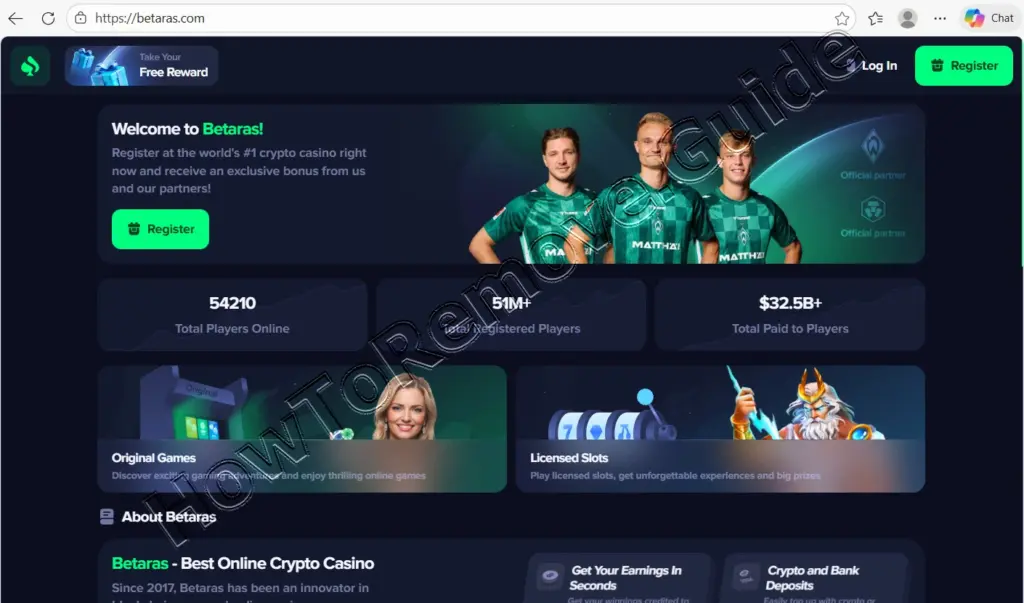

How This Scam’s Deception Funnel Works
These operations succeed by redirecting attention away from verification and toward emotion – excitement, urgency, and sunk cost. With Betaras, the manipulation is rarely one big lie; it’s a sequence of small prompts that make each next payment or disclosure feel like the “reasonable” step.
The setup is designed so that once you attempt a withdrawal, the explanation shifts: a new condition appears, presented as standard compliance or a technical requirement.
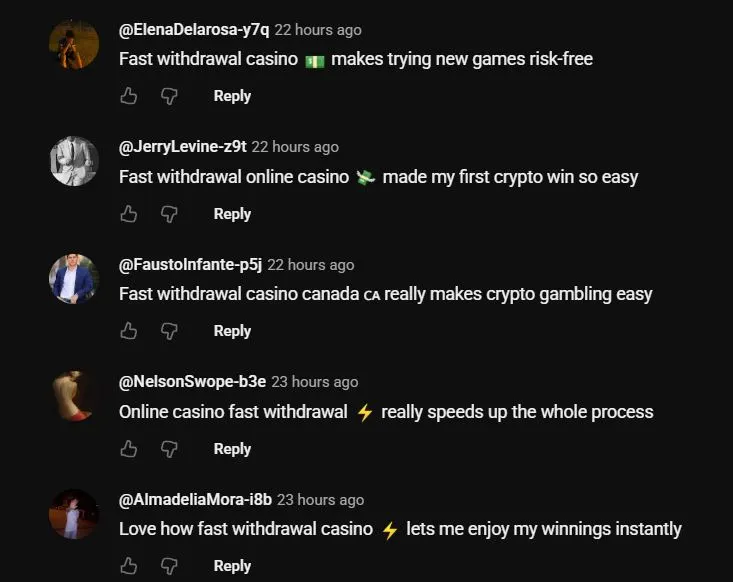
Promo links and creator codes
Discovery often starts in hype-heavy places – ads, promo codes, or “everyone’s winning” chatter – where urgency is pushed to replace basic checks.
Casino-like skin and bonus show
Onboarding is kept nearly frictionless, while bright rewards make depositing feel like gaining an edge instead of taking on risk.

Inflated balances, then the lock
Early play is often tuned to build confidence, showing unusually strong results that nudge you toward larger deposits and “one more run.”
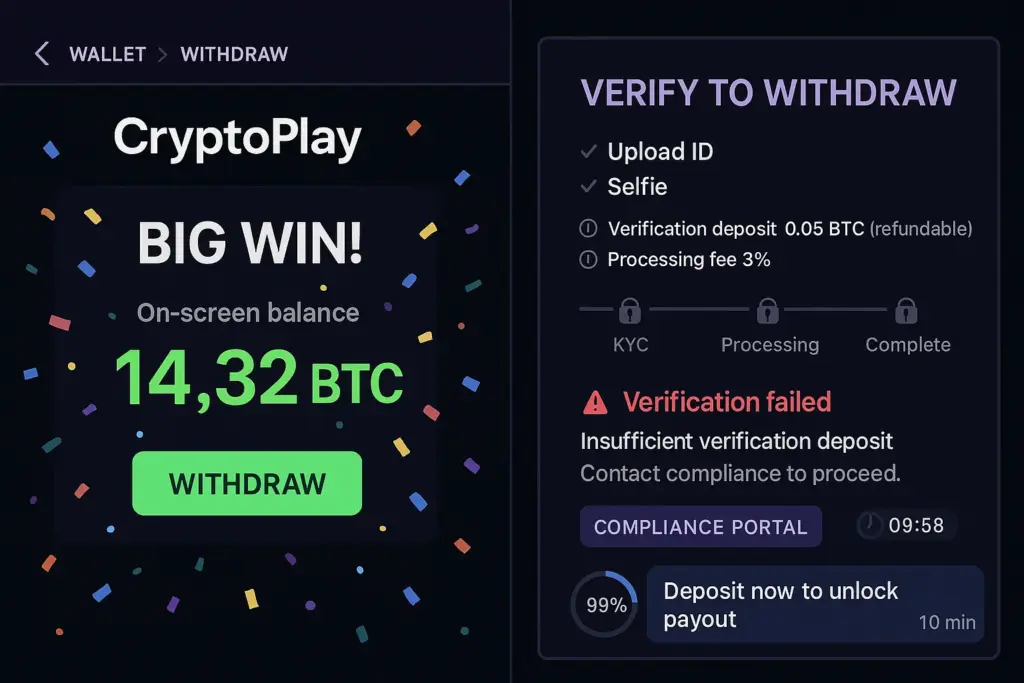
Fee locks and KYC harvesting
When you attempt to withdraw, the explanation flips: a new condition appears, framed as compliance or a technical step. If you provided ID photos or selfies, treat it as identity exposure – lock down accounts and watch for new accounts opened in your name.

Stalling, rebrands, and “recovery” bait
When payments stop, support becomes evasive or disappears, and the branding may quietly move to a new domain with the same script. Treat unsolicited “recovery” messages as suspicious, especially if someone asks for a fee to help.
Staying safe from crypto casino scams like Neidax.com
Long-term safety is mostly about resisting urgency and repeating a few checks every time you see a new platform. With Betaras, the pressure usually comes from hype and momentum, so your best defense is a small set of habits that keep you in control of timing, verification, and what you connect your wallet to.
Confirm license status in official registers
Confirm licensing somewhere other than the website; a legitimate operator can be verified through a regulator, not only through a logo or footer claim.
Review domain age and history
Check domain age and registration details before depositing, because disposable sites often have short, unclear histories and rapid rebrands.
Refuse withdrawal fees and “unlock” deposits
Do not send funds to “unlock” a withdrawal, no matter whether it’s described as verification, processing, or a tax.
Choose venues with recourse
Test any unfamiliar service with a very small deposit and an early cash-out attempt; predictable withdrawals are a baseline requirement, not a bonus.
Reduce wallet exposure
Keep wallet hygiene strict: do not connect your primary wallet to unknown sites, and revoke permissions if you already did.
Verify “provably fair” claims
The site’s “trust” cues are often shallow: unclear ownership, vague licensing statements, and no straightforward way to confirm who is behind the operation.
Document and report quickly
Save evidence: transaction IDs, wallet addresses, screenshots, and chat logs. Submit a report through your national cybercrime/fraud reporting channel and/or financial regulator.
Build a deliberate slow-down habit
Search the platform name and domain alongside terms like “withdrawal” and “fee” to see what independent reports mention.
Useful Resources for Scam Reporting and Prevention (By Country)
Documenting a scam can feel pointless until it isn’t. Good reports help connect wallets, domains, and infrastructure across victims, and exchanges may at least flag addresses or preserve records. Save the essentials: deposit addresses, TxIDs, timestamps, screenshots of withdrawal demands, and any messages that show “pay-to-withdraw” pressure.
Click here to report the scam in your country
| Country / Agency | URL | Category / Use-case | Phone/Email |
| Australia – Crime Stoppers | https://www.crimestoppers.com.au | Anonymous tips about crime | 1800 333 000 |
| Australia – National Anti-Scam Center (Scamwatch) | https://www.scamwatch.gov.au/report-a-scam | General scams; phishing; texts/emails | |
| Australia – Police Assistance Line (non-emergency) | https://www.police.gov.au | Local police report | 131 444 |
| Australia – ReportCyber (ACSC) | https://www.cyber.gov.au/report | Cybercrime (hacks, fraud, extortion) | |
| Canada – Canadian Anti-Fraud Center (CAFC) | https://www.antifraudcentre-centreantifraude.ca/report-signalez-eng.htm | General scams incl. phone/text/email | |
| France – DGCCRF (SignalConso) | https://signal.conso.gouv.fr | Consumer scams/deceptive practices | |
| France – PHAROS – Internet-Signalement | https://www.internet-signalement.gouv.fr | Online content & cybercrime reports | |
| Germany – Bundeskriminalamt / Local Police | https://www.polizei.de/Polizei/DE/Home/home_node.html | Report online fraud | |
| Germany – Weißer Ring – Victim Support | https://weisser-ring.de | Victim support | 116 006 |
| India – DoT Helpline (Sanchar Saathi) | https://sancharsaathi.gov.in | Fraudulent telecom/SIM related | 155260 |
| India – National Consumer Helpline | https://consumerhelpline.gov.in | Consumer scams | 1800-11-4000 / 1915 |
| India – National Cyber Crime Reporting Portal | https://cybercrime.gov.in | Cybercrime incl. online fraud | 1930 |
| Japan – Consumer Affairs Agency (CAA) | https://www.caa.go.jp/policies/policy/consumer_policy/caution/cybercrime/ | Consumer scams | |
| Japan – National Police Agency – Cybercrime | https://www.npa.go.jp/bureau/cyber/ | Cybercrime reporting | |
| Mexico – Guardia Nacional (National Guard) | https://www.gob.mx/gn | Cybercrime reporting | |
| Mexico – Instituto Federal de Telecomunicaciones (IFT) | https://www.ift.org.mx | Telecom/online services scams | |
| Mexico – PROFECO | https://www.gob.mx/profeco | Consumer fraud & ecommerce | |
| Netherlands – AFM – Report investment fraud | https://www.afm.nl/en/consumenten/themas/beleggen/misleiding-misbruik | Investment/crypto | |
| Netherlands – Fraudehelpdesk | https://www.fraudehelpdesk.nl/melden | General scams (incl. phishing/SMS) | 088-7867372 |
| Netherlands – Politie – Meldpunt Internetoplichting | https://www.politie.nl/themas/internetoplichting.html | Online shopping fraud | |
| New Zealand – CERT NZ | https://www.cert.govt.nz/individuals/report-an-issue/ | Phishing, identity scams | |
| New Zealand – Department of Internal Affairs – Spam | https://www.dia.govt.nz/Spam-Contact-Us | Email/SMS spam | [email protected] |
| New Zealand – IDCARE | https://www.idcare.org | Victim support (identity compromise) | 0800 121 068 |
| New Zealand – Netsafe – Report | https://www.netsafe.org.nz/report/ | Online harms & scams | |
| New Zealand – New Zealand Police (non-emergency) | https://www.police.govt.nz/use-105 | Report fraud/online crime | 105 |
| Nigeria – Economic & Financial Crimes Commission (EFCC) | https://www.efcc.gov.ng | Financial scams incl. crypto/investment | [email protected] |
| Nigeria – Nigeria Police Special Fraud Unit (SFU) | https://www.specialfraudunit.org.ng | Serious fraud | Voice/SMS: 0708 227 6895; WhatsApp: 0812 760 9914 |
| Poland – CERT Polska (CERT.PL) | https://cert.pl/en/report/ | Cyber incidents & phishing | |
| Poland – Dyzurnet.pl | https://dyzurnet.pl | Illegal online content (esp. child protection) | |
| Poland – Polish Police (Policja) | https://www.policja.pl | Report scams to police | |
| Singapore – Anti-Scam Centre / Anti-Scam Helpline | https://www.scamalert.sg | General scams; texts; calls | 1800-722-6688 |
| Singapore – Monetary Authority of Singapore (MAS) | https://www.mas.gov.sg/investor-alert-list | Investment/crypto checks | |
| Singapore – Singapore Police Force | https://www.police.gov.sg/iwitness | Police report (cybercrime) | |
| South Africa – Cybersecurity Hub (CSIRT) | https://www.cybersecurityhub.gov.za | Cyber incidents incl. scams | |
| South Africa – South African Fraud Prevention Service (SAFPS) | https://www.safps.org.za | Identity fraud support | 011-867-2234 |
| South Africa – South African Police Service (SAPS) | https://www.saps.gov.za | Police report (cybercrime unit) | |
| South Korea – Korea Communications Commission (KCC) | https://www.kcc.go.kr | Telecom-related fraud | |
| South Korea – Korea Internet & Security Agency (KISA) | https://www.kisa.or.kr | Phishing, online harms | |
| South Korea – Korean National Police Agency – Cyber Bureau | https://ecrm.cyber.go.kr | Cybercrime reporting | |
| Spain – INCIBE – Oficina de Seguridad del Internauta (OSI) | https://www.osi.es/es/reporte | Cybersecurity & online fraud | |
| Spain – Policía Nacional / Guardia Civil | https://www.policia.es | Report scams to police | |
| Sweden – Crime Victim Authority (Brottsoffermyndigheten) | https://www.brottsoffermyndigheten.se | Victim support & compensation | 090–70 82 00 |
| Sweden – Polisen (Swedish Police) | https://polisen.se | Report fraud/cybercrime | 114 14 (non-emergency); 112 (emergency) |
| Sweden – Swedish Consumer Agency (Konsumentverket) | https://www.konsumentverket.se | Unfair business practices | |
| United Arab Emirates – Abu Dhabi Police – Aman Service | https://www.adpolice.gov.ae | Cybercrime tips/reporting | SMS 2828; 800 2626 |
| United Arab Emirates – Dubai Police – eCrime | https://www.dubaipolice.gov.ae | Cybercrime reporting | 04 606 1600 |
| United Arab Emirates – Ministry of Interior – Cyber Crime Dept. | https://www.moi.gov.ae | Cybercrime incl. online scams | |
| United Arab Emirates – Telecommunications Regulatory Authority (TRA) / TDRA | https://www.tra.gov.ae | Telecom-related scams/phishing | |
| United Kingdom – Action Fraud (NFIB) | https://www.actionfraud.police.uk | General scams & cybercrime (non-emergency) | 0300 123 2040 |
| United Kingdom – Citizens Advice Consumer Service | https://www.citizensadvice.org.uk/consumer/get-more-help/if-you-need-more-help-about-a-consumer-issue/ | Consumer problems & scam guidance | 0808 223 1133 |
| United Kingdom – Financial Conduct Authority (FCA) | https://www.fca.org.uk/consumers/report-scam-us | Investment/crypto & financial services | |
| United Kingdom – National Cyber Security Centre (NCSC) | https://www.ncsc.gov.uk/collection/phishing-scams | Phishing emails & suspicious websites | |
| United Kingdom – Stop Scams UK ‘159’ | https://stopscamsuk.org.uk/159 | Banking APP fraud (direct to your bank) | 159 |
| United States – AARP Fraud Watch Network Helpline | https://www.aarp.org/money/scams-fraud/ | Victim support | 833-372-8311 |
| United States – Better Business Bureau – Scam Tracker | https://www.bbb.org/scamtracker | Business/marketplace scams | |
| United States – FBI Internet Crime Complaint Center (IC3) | https://www.ic3.gov | Internet crime incl. investment/crypto | |
| United States – Federal Trade Commission – ReportFraud | https://reportfraud.ftc.gov | General scams, phishing, texts/emails | 1-877-382-4357 |
| United States – National Center for Disaster Fraud | https://www.justice.gov/disaster-fraud | Disaster-related scams | (866) 720-5721 |
| United States – SEC Tips & Complaints | https://www.sec.gov/tcr | Investment & securities/crypto-asset offerings |
Weirdly, the most dangerous part of Betaras.com is the story it tries to install in your head: “I’m up big, the money is mine, and one more step will unlock it.” That story is engineered – so your best defense is refusing paid “unlock” steps, verifying legitimacy outside the platform, and moving quickly on account security when something smells off.
Staying safe is mostly about resisting urgency, never paying to withdraw, and treating any document upload or wallet connection to a dubious site as a reason to tighten security immediately.
