

Just like any other crypto casino scam site, Dodepex advertises itself as the “#1 decentralized crypto gaming platform,” that’s supposedly backed by billionaire geniuses and can get you rich in half an hour.
It dangles absurd signup rewards – sometimes “up to $10,000” in crypto – just for registering and entering a promo code. That’s the honey-dipped hook that ropes in inexperienced and naive users.
Scams of Dodepex.com‘s type are known to steal personal data and passwords. Install SpyHunter Pro to scan for risks, remove any dangerous trackers, and enable real-time protection.

Try Free For 7 Days*
Buy now15% OFF if you buy straight without trial.
 OFFER
OFFERAnd like any other scam of this type, its pages will have polished graphics, flashy jackpots, and a balance that climbs fast enough to make you believe you’ve beaten the system and are about to win it big.
But then you request a withdrawal, and suddenly your account must be “activated,” “verified,” or “cleared” by sending an additional deposit first. The payment is framed as a security step, but it’s the actual gist of the scam. In other words, never send any of your real-life money to such sites because you won’t see that money again.
If you already interacted with Dodepex, Husewin.cc, or Rolexspin.com, assume your accounts and identity could be at risk (even if you haven’t deposited any money!). Act now by following the tips below to reduce harm, preserve evidence, and avoid getting pulled into follow-up “recovery” traps that target victims a second time.
IMPORTANT! READ BEFORE PROCEEDING!
If you have already interacted with Dodepex, assume your accounts and identity could be at risk and act now to reduce harm. Stop sending funds, stop responding to prompts, and preserve evidence before anything disappears. Here are five emergency steps we strongly recommend you take right now:
- Reset passwords on your email and any exchange accounts you use, and lock down anything tied to money or identity.
- Turn on 2FA everywhere money or identity is involved, starting with email and exchange logins.
- Move any remaining crypto to a fresh wallet with a new seed phrase if there’s any chance your setup was exposed.
- Save screenshots and records – TXIDs, wallet addresses, and all messages connected to Dodepex – while you still can.
- Freeze credit and monitor identity activity if you shared documents, and keep an eye out for follow-up “recovery” pitches.
How We Know Dodepex is a Scam
Several signals typical of fake crypto casinos point to Dodepex being fraudulent, not merely “high risk.” The tells below show up when the site’s story depends on manufactured trust, inflated balances, and obstacles that appear precisely when you try to take money out.
Surprise withdrawal charges
Then comes the moment you try to cash out – suddenly you’re told to pay a fee or make a “verification” deposit, and the goalposts keep moving after you comply.
Counterfeit licensing
Regulators don’t live inside a casino’s footer, so verify licensing through an official registry rather than trusting a badge or a pasted claim.
Inflated early “wins”
Early results often look unusually favorable, building trust through a convincing on-screen balance that you don’t actually control.
Crypto-only rails
A boring checklist is your friend here, because the slick interface is designed to make you act before you verify anything outside the site.
Synthetic social proof
Meanwhile, the site keeps up the illusion with fake chat activity and manufactured social proof to keep you emotionally invested.
Fresh, privacy-masked domains
Before depositing anywhere, check domain history via WHOIS and treat very new registrations as suspicious; public lookups like WHOIS make the churn easier to spot.


How the Dodepex Scam Deception Funnel Works
Understanding the mechanics matters, because these scams aren’t random – they’re designed as a predictable sequence that nudges decisions under excitement and stress. Once you recognize the rhythm, the next move becomes easier to spot, especially when the story flips from “fun” to “unlocking” what you think you’ve already won.
These scams are engineered like a theme park ride: smooth onboarding, dopamine lights, and then the trap door that appears right when you try to cash out.
Promo hooks and influencer codes
After a social post or promo code lures you in, the flow pushes quick sign-up so momentum stays high and doubt stays low.

Casino skin and bonus theater
The hook is usually a huge signup bonus, and the polished look is there to make you forget the most basic question: where is the proof this is real?

Inflated balances, then the gate
Early results often look unusually favorable, building trust through a convincing on-screen balance, and then the story flips when you request a withdrawal.
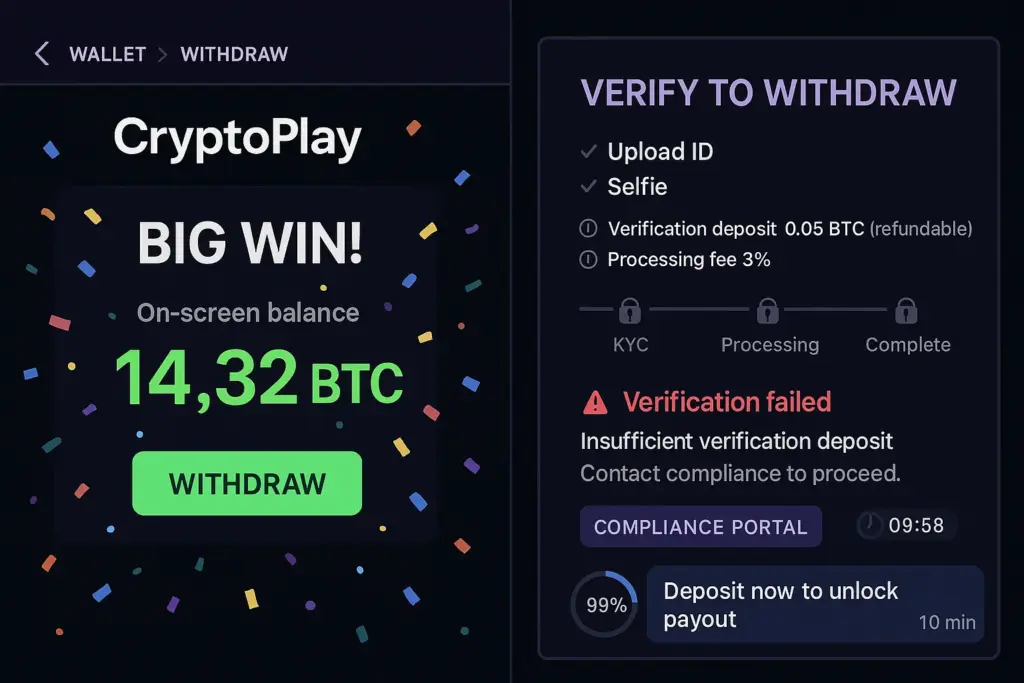
Fee-gates and KYC harvest
What makes the withdrawal stage so potent is the way it reframes the situation: you stop gambling for fun and start “rescuing” money that feels like it already belongs to you.

Stalling, rebrands, and “recovery” bait
Eventually, the endgame arrives: silence, account restrictions, or a domain shift that strands you, and then “recovery” pitches often show up to target victims a second time.
Staying safe from crypto casino scams like Dodepex
Keeping yourself safe is less about being paranoid and more about being systematic; the habits below reduce exposure before money ever leaves your control. Learning the red flags is only the first step – research first, act second, and treat boredom as a security feature.
Verify license status in official registers
Regulators don’t live inside a casino’s footer, so verify licensing through an official registry rather than trusting the site’s own claims.
Check domain age and history
Before depositing anywhere, check domain history via WHOIS and treat very new registrations as suspicious.
Reject withdrawal fees and “unlock” deposits
Any platform that requires paying to withdraw is signaling fraud, full stop – walk away immediately.
Prefer venues with recourse
External research beats internal testimonials, so look for independent reports that aren’t hosted by the site itself.
Limit wallet exposure
Reset passwords on your email and exchange accounts, and turn on 2FA everywhere money or identity is involved.
Validate “provably fair” claims
Be skeptical of anything you can’t verify outside the site, because the slick presentation is designed to substitute confidence for proof.
Document and report rapidly
Save screenshots, TXIDs, wallet addresses, and all messages connected to Dodepex so you can link your documentation to any report.
Build a deliberate slow-down reflex
Research first, act second: check domain history, verify licensing, and don’t let excitement make the decision for you.
Useful Resources for Scam Reporting and Prevention (By Country)
Documentation is your friend, not because it guarantees recovery, but because it preserves the facts if a regulated service ever becomes involved. Save screenshots and records – TXIDs, wallet addresses, and all messages connected to Dodepex – so your report isn’t just a story, but a trail.
Click here to report the scam in your country
| Country / Agency | URL | Category / Use-case | Phone/Email |
| Australia – Crime Stoppers | https://www.crimestoppers.com.au | Anonymous tips about crime | 1800 333 000 |
| Australia – National Anti-Scam Center (Scamwatch) | https://www.scamwatch.gov.au/report-a-scam | General scams; phishing; texts/emails | |
| Australia – Police Assistance Line (non-emergency) | https://www.police.gov.au | Local police report | 131 444 |
| Australia – ReportCyber (ACSC) | https://www.cyber.gov.au/report | Cybercrime (hacks, fraud, extortion) | |
| Canada – Canadian Anti-Fraud Center (CAFC) | https://www.antifraudcentre-centreantifraude.ca/report-signalez-eng.htm | General scams incl. phone/text/email | |
| France – DGCCRF (SignalConso) | https://signal.conso.gouv.fr | Consumer scams/deceptive practices | |
| France – PHAROS – Internet-Signalement | https://www.internet-signalement.gouv.fr | Online content & cybercrime reports | |
| Germany – Bundeskriminalamt / Local Police | https://www.polizei.de/Polizei/DE/Home/home_node.html | Report online fraud | |
| Germany – Weißer Ring – Victim Support | https://weisser-ring.de | Victim support | 116 006 |
| India – DoT Helpline (Sanchar Saathi) | https://sancharsaathi.gov.in | Fraudulent telecom/SIM related | 155260 |
| India – National Consumer Helpline | https://consumerhelpline.gov.in | Consumer scams | 1800-11-4000 / 1915 |
| India – National Cyber Crime Reporting Portal | https://cybercrime.gov.in | Cybercrime incl. online fraud | 1930 |
| Japan – Consumer Affairs Agency (CAA) | https://www.caa.go.jp/policies/policy/consumer_policy/caution/cybercrime/ | Consumer scams | |
| Japan – National Police Agency – Cybercrime | https://www.npa.go.jp/bureau/cyber/ | Cybercrime reporting | |
| Mexico – Guardia Nacional (National Guard) | https://www.gob.mx/gn | Cybercrime reporting | |
| Mexico – Instituto Federal de Telecomunicaciones (IFT) | https://www.ift.org.mx | Telecom/online services scams | |
| Mexico – PROFECO | https://www.gob.mx/profeco | Consumer fraud & ecommerce | |
| Netherlands – AFM – Report investment fraud | https://www.afm.nl/en/consumenten/themas/beleggen/misleiding-misbruik | Investment/crypto | |
| Netherlands – Fraudehelpdesk | https://www.fraudehelpdesk.nl/melden | General scams (incl. phishing/SMS) | 088-7867372 |
| Netherlands – Politie – Meldpunt Internetoplichting | https://www.politie.nl/themas/internetoplichting.html | Online shopping fraud | |
| New Zealand – CERT NZ | https://www.cert.govt.nz/individuals/report-an-issue/ | Phishing, identity scams | |
| New Zealand – Department of Internal Affairs – Spam | https://www.dia.govt.nz/Spam-Contact-Us | Email/SMS spam | [email protected] |
| New Zealand – IDCARE | https://www.idcare.org | Victim support (identity compromise) | 0800 121 068 |
| New Zealand – Netsafe – Report | https://www.netsafe.org.nz/report/ | Online harms & scams | |
| New Zealand – New Zealand Police (non-emergency) | https://www.police.govt.nz/use-105 | Report fraud/online crime | 105 |
| Nigeria – Economic & Financial Crimes Commission (EFCC) | https://www.efcc.gov.ng | Financial scams incl. crypto/investment | [email protected] |
| Nigeria – Nigeria Police Special Fraud Unit (SFU) | https://www.specialfraudunit.org.ng | Serious fraud | Voice/SMS: 0708 227 6895; WhatsApp: 0812 760 9914 |
| Poland – CERT Polska (CERT.PL) | https://cert.pl/en/report/ | Cyber incidents & phishing | |
| Poland – Dyzurnet.pl | https://dyzurnet.pl | Illegal online content (esp. child protection) | |
| Poland – Polish Police (Policja) | https://www.policja.pl | Report scams to police | |
| Singapore – Anti-Scam Centre / Anti-Scam Helpline | https://www.scamalert.sg | General scams; texts; calls | 1800-722-6688 |
| Singapore – Monetary Authority of Singapore (MAS) | https://www.mas.gov.sg/investor-alert-list | Investment/crypto checks | |
| Singapore – Singapore Police Force | https://www.police.gov.sg/iwitness | Police report (cybercrime) | |
| South Africa – Cybersecurity Hub (CSIRT) | https://www.cybersecurityhub.gov.za | Cyber incidents incl. scams | |
| South Africa – South African Fraud Prevention Service (SAFPS) | https://www.safps.org.za | Identity fraud support | 011-867-2234 |
| South Africa – South African Police Service (SAPS) | https://www.saps.gov.za | Police report (cybercrime unit) | |
| South Korea – Korea Communications Commission (KCC) | https://www.kcc.go.kr | Telecom-related fraud | |
| South Korea – Korea Internet & Security Agency (KISA) | https://www.kisa.or.kr | Phishing, online harms | |
| South Korea – Korean National Police Agency – Cyber Bureau | https://ecrm.cyber.go.kr | Cybercrime reporting | |
| Spain – INCIBE – Oficina de Seguridad del Internauta (OSI) | https://www.osi.es/es/reporte | Cybersecurity & online fraud | |
| Spain – Policía Nacional / Guardia Civil | https://www.policia.es | Report scams to police | |
| Sweden – Crime Victim Authority (Brottsoffermyndigheten) | https://www.brottsoffermyndigheten.se | Victim support & compensation | 090–70 82 00 |
| Sweden – Polisen (Swedish Police) | https://polisen.se | Report fraud/cybercrime | 114 14 (non-emergency); 112 (emergency) |
| Sweden – Swedish Consumer Agency (Konsumentverket) | https://www.konsumentverket.se | Unfair business practices | |
| United Arab Emirates – Abu Dhabi Police – Aman Service | https://www.adpolice.gov.ae | Cybercrime tips/reporting | SMS 2828; 800 2626 |
| United Arab Emirates – Dubai Police – eCrime | https://www.dubaipolice.gov.ae | Cybercrime reporting | 04 606 1600 |
| United Arab Emirates – Ministry of Interior – Cyber Crime Dept. | https://www.moi.gov.ae | Cybercrime incl. online scams | |
| United Arab Emirates – Telecommunications Regulatory Authority (TRA) / TDRA | https://www.tra.gov.ae | Telecom-related scams/phishing | |
| United Kingdom – Action Fraud (NFIB) | https://www.actionfraud.police.uk | General scams & cybercrime (non-emergency) | 0300 123 2040 |
| United Kingdom – Citizens Advice Consumer Service | https://www.citizensadvice.org.uk/consumer/get-more-help/if-you-need-more-help-about-a-consumer-issue/ | Consumer problems & scam guidance | 0808 223 1133 |
| United Kingdom – Financial Conduct Authority (FCA) | https://www.fca.org.uk/consumers/report-scam-us | Investment/crypto & financial services | |
| United Kingdom – National Cyber Security Centre (NCSC) | https://www.ncsc.gov.uk/collection/phishing-scams | Phishing emails & suspicious websites | |
| United Kingdom – Stop Scams UK ‘159’ | https://stopscamsuk.org.uk/159 | Banking APP fraud (direct to your bank) | 159 |
| United States – AARP Fraud Watch Network Helpline | https://www.aarp.org/money/scams-fraud/ | Victim support | 833-372-8311 |
| United States – Better Business Bureau – Scam Tracker | https://www.bbb.org/scamtracker | Business/marketplace scams | |
| United States – FBI Internet Crime Complaint Center (IC3) | https://www.ic3.gov | Internet crime incl. investment/crypto | |
| United States – Federal Trade Commission – ReportFraud | https://reportfraud.ftc.gov | General scams, phishing, texts/emails | 1-877-382-4357 |
| United States – National Center for Disaster Fraud | https://www.justice.gov/disaster-fraud | Disaster-related scams | (866) 720-5721 |
| United States – SEC Tips & Complaints | https://www.sec.gov/tcr | Investment & securities/crypto-asset offerings |
Finally, watch for the second-wave trap: after a loss, “recovery agents” often appear promising miracles for upfront payment, so treat those messages as hostile until proven otherwise through official channels.
