

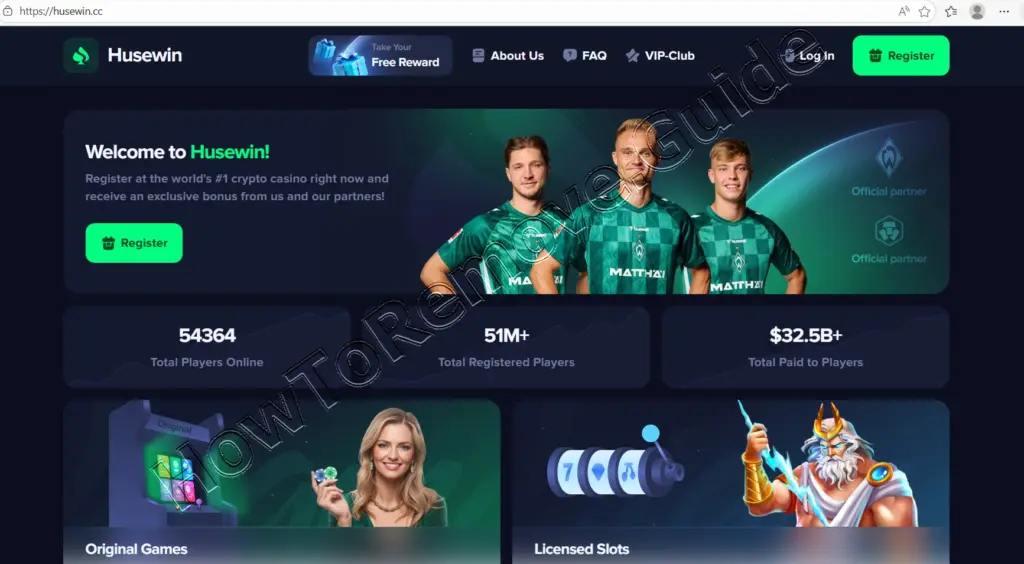
Husewin.cc operates as a classic withdrawal trap, where any attempt to cash out triggers demands for extra deposits labeled as liquidity fees. Once paid, those funds disappear permanently. There is no license or transparent ownership, and no reliable support channel. Husewin.cc is one of many rapidly deployed clone scams designed to burn victims quickly before vanishing.
Scams of Husewin.cc‘s type are known to steal personal data and passwords. Install SpyHunter Pro to scan for risks, remove any dangerous trackers, and enable real-time protection.

Try Free For 7 Days*
Buy now15% OFF if you buy straight without trial.
 OFFER
OFFERAfter a couple of spins, the on-screen balance jumps again, and the site starts nudging you toward a withdrawal as if everything is working normally.
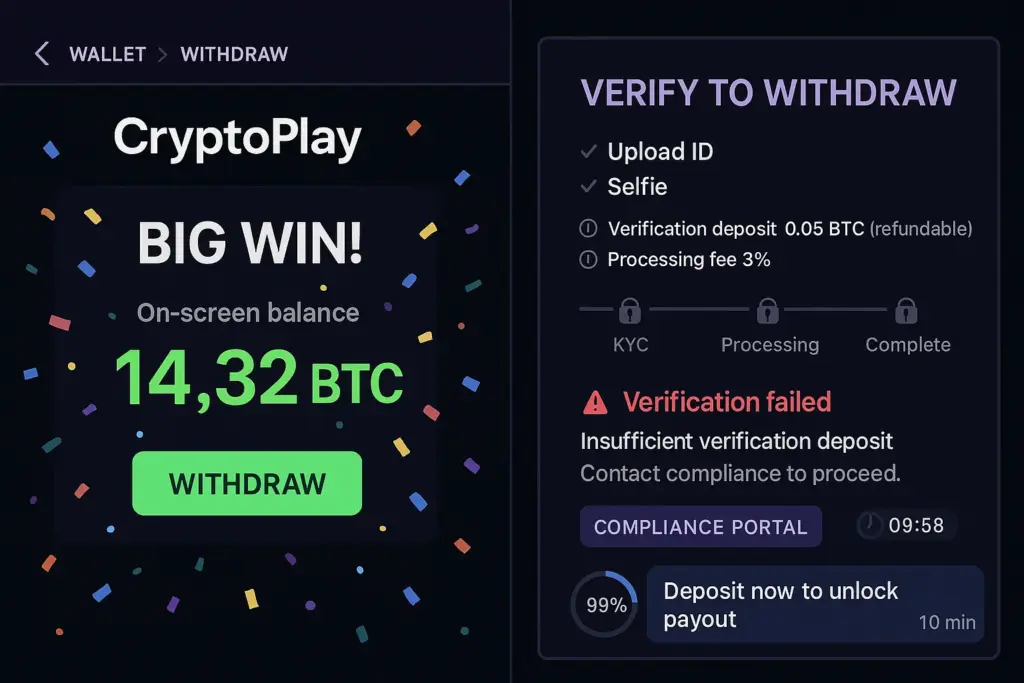
That is when the hook sets: “support” claims your account must be “verified” by sending a deposit, presented as a refundable processing fee. It is not refundable, and the winnings are not real. The entire setup exists to extract extra payments through a fake deposit requirement.
Husewin.cc is not a one-off trick. Nusewin, Tusewin.cc, and many similar sites follow the same script. Even if this specific clone didn’t catch you, another lookalike can. Use this post to recognize the common tactics and the practical steps to take if you already engaged.
IMPORTANT! READ THIS BEFORE YOU DO ANYTHING ELSE!
If you already interacted with Husewin.cc, stop now – no more replies, no more “unlock” payments, and no screen-sharing. Switch to damage control instead: lock down accounts, separate clean funds from any exposed wallets, and save anything that supports a report. Here are five urgent actions we strongly recommend you take right now:
- 1) Change passwords and turn on 2FA after any contact with Husewin.cc for email, exchanges, and wallet-linked services; sign out other sessions wherever possible.
- 2) Contact any exchanges or apps involved and provide wallet addresses and TxIDs; request flags/holds according to their fraud procedures.
- 3) Move remaining assets to new wallets created from fresh seed phrases, and revoke token approvals on chains you used with the site.
- 4) If you submitted identity documents, place fraud/credit alerts where available and watch for account-opening and SIM-swap warning signs.
- 5) Create an evidence pack – URLs, chat logs, email headers, screenshots, wallet addresses, and TxIDs – then file reports with police/IC3 and any platforms touched.
How We Spot Husewin.cc Crypto Casino
Flashy branding and smooth animations are meant to keep you from checking fundamentals, but the red flags tend to repeat. With Husewin.cc, you can spot the same practical tells seen in fake crypto casinos: withdrawals blocked by surprise “fees” and “verification,” plus extra identity collection layered on top to increase leverage.
1) Fees that show up at the finish line
Withdrawals on Husewin.cc suddenly come with new conditions, including extra payments described as admin charges, tax clearance, or verification. Legitimate services do not require you to send money to access money you already own.
2) Regulation cosplay
Badges, seals, and license numbers are displayed like props, but the details fall apart when checked in official registries – it is confidence theater, not compliance.
3) Too-easy early “success”
The site pays you on-screen at the start to build emotional commitment and push larger deposits; the “generosity” disappears the moment you try to cash out.
4) One-way money routes
Crypto-only funding removes chargebacks and reduces accountability. That convenience is also what makes the scheme durable.
5) Manufactured crowd noise
Popups, canned testimonials, and suspicious review patterns try to simulate a thriving user base without offering verifiable proof of real payouts.
6) Disposable, privacy-masked domains
Short-lived domains with hidden ownership and a family tree of near-identical clones are a classic footprint; public lookups like who.is can show how quickly these operations rotate identities.

How This Scam Funnel Typically Works
Understanding the sequence matters because these operations repeat the same moves across different domains and brand names. With Husewin.cc, recognizing the pattern early helps you predict the next “requirement” before it lands, which makes it easier to stop before you send more money or data.
The flow is usually consistent: an easy bonus hook, then on-screen “wins” that boost confidence, followed by a withdrawal attempt that triggers a gate. With Husewin.cc, the gate tends to be a mix of fees and late-stage KYC, plus delays meant to wear you down while clones and “recovery” scams search for repeat targets.
1) Promo codes and influencer-style bait
The funnel often begins with “exclusive” codes, celebrity-style shoutouts, and comment bait that creates urgency. The goal is to move you from curiosity to action before you verify anything about Husewin.cc.

2) Casino visuals, bonus banners, trust cues
A familiar casino interface, oversized bonus banners, and “fair play” language are used to shortcut trust and push you toward the first deposit.

3) Big balances first, then a withdrawal gate
Early activity is tuned to make you feel “in profit,” but the first withdrawal attempt triggers a new checkpoint: KYC plus a demanded deposit or fee to “validate” the transaction.
4) Fee walls plus KYC data collection
Each “review” adds a fresh reason to pay – VIP tiers, AML screens, settlement charges – while document requests expand to capture reusable identity data.

5) Stalling, rebrands, and “recovery” bait
Support often alternates between reassurance and pressure, then turns into endless “processing.” If the domain vanishes, a near-identical clone may appear. Later, a supposed “recovery specialist” can reach out and charge again, selling the illusion of getting funds back.
Staying safe from crypto casino scams like Husewin.cc
Staying safer mostly comes down to what you do before excitement takes over. These checks slow decision-making, force independent confirmation, and reduce the blast radius if Husewin.cc or a similar site gets your attention for a moment. The goal is not perfect paranoia – it is avoiding irreversible steps when the claims are still unverified.
Confirm licenses in official registries
Verify licensing by searching official regulator databases using the company identity and domain. If you cannot confirm it independently, treat the operation as unlicensed.
Review domain age and change history
Look for a newly registered domain, privacy masking, or repeated rebrands tied to the same infrastructure. Short lifespans and clone patterns are a major red flag.
Refuse withdrawal fees and “unlock” deposits
If Husewin.cc demands a payment to “activate,” “clear,” or “verify” a withdrawal, treat it as a hard stop. That demand is the engine that keeps the scam running.
Pick venues that offer recourse
Use services that can be verified and that offer clear dispute options; crypto-only “casinos” with vague ownership maximize irreversibility by design.
Reduce wallet exposure
Segment funds, use fresh addresses for risky interactions, keep 2FA tight, and regularly revoke token approvals you no longer need across connected networks.
Check “provably fair” claims
If the platform cannot show a clear, independently checkable method for verifying outcomes, treat “provably fair” as marketing rather than evidence.
Preserve evidence and report quickly
Save the receipts: TxIDs, wallet addresses, emails, chat logs, and screenshots. Report fast to the relevant authorities and any exchanges involved to preserve the best chance of action.
Practice a built-in slow-down habit
When a site tries to rush you, pause. Verify first, sleep on it, and continue only if the claims still hold up the next day.
Useful Resources for Scam Reporting and Prevention (By Country)
Even when crypto moves quickly, filing a report fast can still matter. Good records help connect wallets, support investigations, and sometimes prompt platform action when law enforcement gets involved. The directory below is meant to route complaints to the right place.
Open the reporting list for your country
| Country / Agency | URL | Category / Use-case | Phone/Email |
| Australia – Crime Stoppers | https://www.crimestoppers.com.au | Anonymous tips about crime | 1800 333 000 |
| Australia – National Anti-Scam Center (Scamwatch) | https://www.scamwatch.gov.au/report-a-scam | General scams; phishing; texts/emails | |
| Australia – Police Assistance Line (non-emergency) | https://www.police.gov.au | Local police report | 131 444 |
| Australia – ReportCyber (ACSC) | https://www.cyber.gov.au/report | Cybercrime (hacks, fraud, extortion) | |
| Canada – Canadian Anti-Fraud Center (CAFC) | https://www.antifraudcentre-centreantifraude.ca/report-signalez-eng.htm | General scams incl. phone/text/email | |
| France – DGCCRF (SignalConso) | https://signal.conso.gouv.fr | Consumer scams/deceptive practices | |
| France – PHAROS – Internet-Signalement | https://www.internet-signalement.gouv.fr | Online content & cybercrime reports | |
| Germany – Bundeskriminalamt / Local Police | https://www.polizei.de/Polizei/DE/Home/home_node.html | Report online fraud | |
| Germany – Weißer Ring – Victim Support | https://weisser-ring.de | Victim support | 116 006 |
| India – DoT Helpline (Sanchar Saathi) | https://sancharsaathi.gov.in | Fraudulent telecom/SIM related | 155260 |
| India – National Consumer Helpline | https://consumerhelpline.gov.in | Consumer scams | 1800-11-4000 / 1915 |
| India – National Cyber Crime Reporting Portal | https://cybercrime.gov.in | Cybercrime incl. online fraud | 1930 |
| Japan – Consumer Affairs Agency (CAA) | https://www.caa.go.jp/policies/policy/consumer_policy/caution/cybercrime/ | Consumer scams | |
| Japan – National Police Agency – Cybercrime | https://www.npa.go.jp/bureau/cyber/ | Cybercrime reporting | |
| Mexico – Guardia Nacional (National Guard) | https://www.gob.mx/gn | Cybercrime reporting | |
| Mexico – Instituto Federal de Telecomunicaciones (IFT) | https://www.ift.org.mx | Telecom/online services scams | |
| Mexico – PROFECO | https://www.gob.mx/profeco | Consumer fraud & ecommerce | |
| Netherlands – AFM – Report investment fraud | https://www.afm.nl/en/consumenten/themas/beleggen/misleiding-misbruik | Investment/crypto | |
| Netherlands – Fraudehelpdesk | https://www.fraudehelpdesk.nl/melden | General scams (incl. phishing/SMS) | 088-7867372 |
| Netherlands – Politie – Meldpunt Internetoplichting | https://www.politie.nl/themas/internetoplichting.html | Online shopping fraud | |
| New Zealand – CERT NZ | https://www.cert.govt.nz/individuals/report-an-issue/ | Phishing, identity scams | |
| New Zealand – Department of Internal Affairs – Spam | https://www.dia.govt.nz/Spam-Contact-Us | Email/SMS spam | [email protected] |
| New Zealand – IDCARE | https://www.idcare.org | Victim support (identity compromise) | 0800 121 068 |
| New Zealand – Netsafe – Report | https://www.netsafe.org.nz/report/ | Online harms & scams | |
| New Zealand – New Zealand Police (non-emergency) | https://www.police.govt.nz/use-105 | Report fraud/online crime | 105 |
| Nigeria – Economic & Financial Crimes Commission (EFCC) | https://www.efcc.gov.ng | Financial scams incl. crypto/investment | [email protected] |
| Nigeria – Nigeria Police Special Fraud Unit (SFU) | https://www.specialfraudunit.org.ng | Serious fraud | Voice/SMS: 0708 227 6895; WhatsApp: 0812 760 9914 |
| Poland – CERT Polska (CERT.PL) | https://cert.pl/en/report/ | Cyber incidents & phishing | |
| Poland – Dyzurnet.pl | https://dyzurnet.pl | Illegal online content (esp. child protection) | |
| Poland – Polish Police (Policja) | https://www.policja.pl | Report scams to police | |
| Singapore – Anti-Scam Centre / Anti-Scam Helpline | https://www.scamalert.sg | General scams; texts; calls | 1800-722-6688 |
| Singapore – Monetary Authority of Singapore (MAS) | https://www.mas.gov.sg/investor-alert-list | Investment/crypto checks | |
| Singapore – Singapore Police Force | https://www.police.gov.sg/iwitness | Police report (cybercrime) | |
| South Africa – Cybersecurity Hub (CSIRT) | https://www.cybersecurityhub.gov.za | Cyber incidents incl. scams | |
| South Africa – South African Fraud Prevention Service (SAFPS) | https://www.safps.org.za | Identity fraud support | 011-867-2234 |
| South Africa – South African Police Service (SAPS) | https://www.saps.gov.za | Police report (cybercrime unit) | |
| South Korea – Korea Communications Commission (KCC) | https://www.kcc.go.kr | Telecom-related fraud | |
| South Korea – Korea Internet & Security Agency (KISA) | https://www.kisa.or.kr | Phishing, online harms | |
| South Korea – Korean National Police Agency – Cyber Bureau | https://ecrm.cyber.go.kr | Cybercrime reporting | |
| Spain – INCIBE – Oficina de Seguridad del Internauta (OSI) | https://www.osi.es/es/reporte | Cybersecurity & online fraud | |
| Spain – Policía Nacional / Guardia Civil | https://www.policia.es | Report scams to police | |
| Sweden – Crime Victim Authority (Brottsoffermyndigheten) | https://www.brottsoffermyndigheten.se | Victim support & compensation | 090–70 82 00 |
| Sweden – Polisen (Swedish Police) | https://polisen.se | Report fraud/cybercrime | 114 14 (non-emergency); 112 (emergency) |
| Sweden – Swedish Consumer Agency (Konsumentverket) | https://www.konsumentverket.se | Unfair business practices | |
| United Arab Emirates – Abu Dhabi Police – Aman Service | https://www.adpolice.gov.ae | Cybercrime tips/reporting | SMS 2828; 800 2626 |
| United Arab Emirates – Dubai Police – eCrime | https://www.dubaipolice.gov.ae | Cybercrime reporting | 04 606 1600 |
| United Arab Emirates – Ministry of Interior – Cyber Crime Dept. | https://www.moi.gov.ae | Cybercrime incl. online scams | |
| United Arab Emirates – Telecommunications Regulatory Authority (TRA) / TDRA | https://www.tra.gov.ae | Telecom-related scams/phishing | |
| United Kingdom – Action Fraud (NFIB) | https://www.actionfraud.police.uk | General scams & cybercrime (non-emergency) | 0300 123 2040 |
| United Kingdom – Citizens Advice Consumer Service | https://www.citizensadvice.org.uk/consumer/get-more-help/if-you-need-more-help-about-a-consumer-issue/ | Consumer problems & scam guidance | 0808 223 1133 |
| United Kingdom – Financial Conduct Authority (FCA) | https://www.fca.org.uk/consumers/report-scam-us | Investment/crypto & financial services | |
| United Kingdom – National Cyber Security Centre (NCSC) | https://www.ncsc.gov.uk/collection/phishing-scams | Phishing emails & suspicious websites | |
| United Kingdom – Stop Scams UK ‘159’ | https://stopscamsuk.org.uk/159 | Banking APP fraud (direct to your bank) | 159 |
| United States – AARP Fraud Watch Network Helpline | https://www.aarp.org/money/scams-fraud/ | Victim support | 833-372-8311 |
| United States – Better Business Bureau – Scam Tracker | https://www.bbb.org/scamtracker | Business/marketplace scams | |
| United States – FBI Internet Crime Complaint Center (IC3) | https://www.ic3.gov | Internet crime incl. investment/crypto | |
| United States – Federal Trade Commission – ReportFraud | https://reportfraud.ftc.gov | General scams, phishing, texts/emails | 1-877-382-4357 |
| United States – National Center for Disaster Fraud | https://www.justice.gov/disaster-fraud | Disaster-related scams | (866) 720-5721 |
| United States – SEC Tips & Complaints | https://www.sec.gov/tcr | Investment & securities/crypto-asset offerings |
Bottom line: recognize the pattern early, limit exposure fast, and refuse any “fee to withdraw” story – because that story is the scam.
