

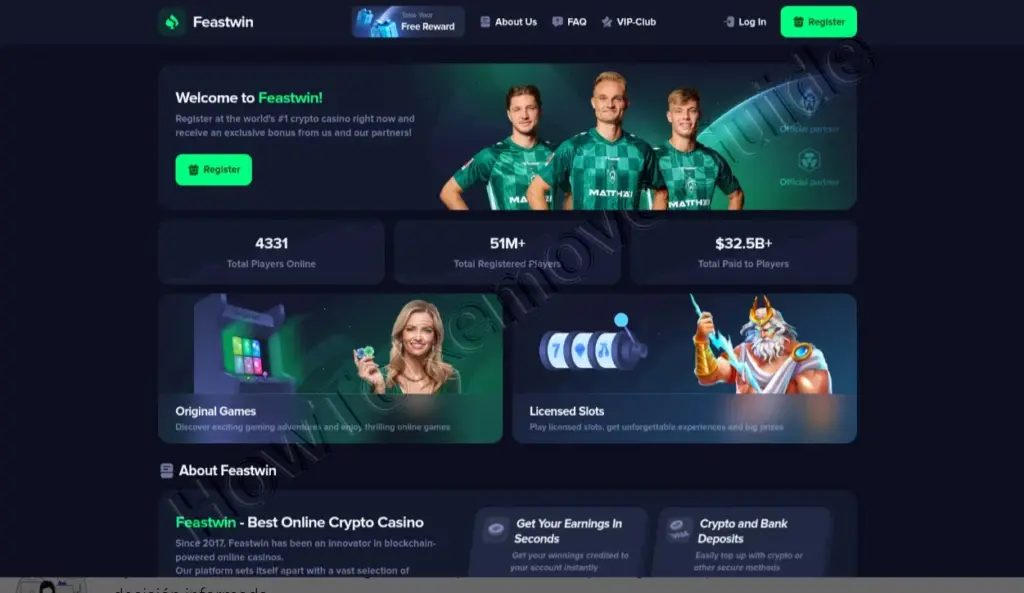
Feastwin.com is specifically designed to look like an actual crypto gambling site that appears to give you the option to quickly make some serious winnings with its free starting bonus. To an experienced user, such unrealistic offers scream “scam”, but people with less experience often fall for such traps and get scammed.
The potential victims are shown polished games, oversized welcome rewards, and improbably smooth winning streaks designed to lower their suspicion and get them to engage with the site. Obviously, any numbers displayed in the account as “winnings” are without any actual value behind them. They rise quickly after each spin to get the users more invested and likely to cooperate.
Scams of Feastwin.com‘s type are known to steal personal data and passwords. Install SpyHunter Pro to scan for risks, remove any dangerous trackers, and enable real-time protection.

Try Free For 7 Days*
Buy now15% OFF if you buy straight without trial.
 OFFER
OFFERThe problem begins at cash-out; then the operators pivot to demands for fees, identity documents, or another crypto transfer. The entire setup is built to get the user to deposit some of their own money and then steal that sum and possibly even harvest personal user data that can be used for accessing wallets and bank accounts.
Think of any interaction with Feastwin, Letoxplay, or Xbezo.bet as a compromise event rather than a customer-service dispute. The notes below explain the pressure tactics, the account risks, the fastest containment steps, and the habits that make it harder for the next clone to pull you into the same trap.
IMPORTANT! READ BEFORE PROCEEDING!
If you have already interacted with Feastwin, assume the people behind it are trying to extract either more money, more documents, or more access. Stop replying, do not send any so-called release payment, and do not allow screen sharing or remote control. Secure your accounts, separate any remaining assets, and preserve evidence while details are fresh. The five actions listed below are the fastest way to reduce additional harm.
- Reset passwords and enable 2FA on your email, crypto exchanges, and wallets; terminate other active sessions.
- Notify any exchanges and services touched by the funds; provide TxIDs and ask that accounts/addresses be flagged per policy.
- Migrate assets to fresh wallets with new seed phrases and revoke any existing token approvals on connected chains.
- If you uploaded ID documents, place credit/fraud alerts where available and monitor for identity-theft signals.
- Assemble an evidence bundle – wallet addresses, TxIDs, site URLs, chats, and screenshots – and file reports with police/IC3 and any involved platforms.
How We Know Feastwin is a Scam
A slick homepage can conceal a very ordinary scam, so the safest way to judge Feastwin is by behavior rather than presentation. The patterns below matter because they recur across fake crypto casinos that recycle the same structure, pressure tactics, and excuses under different names and domains.
Surprise withdrawal charges
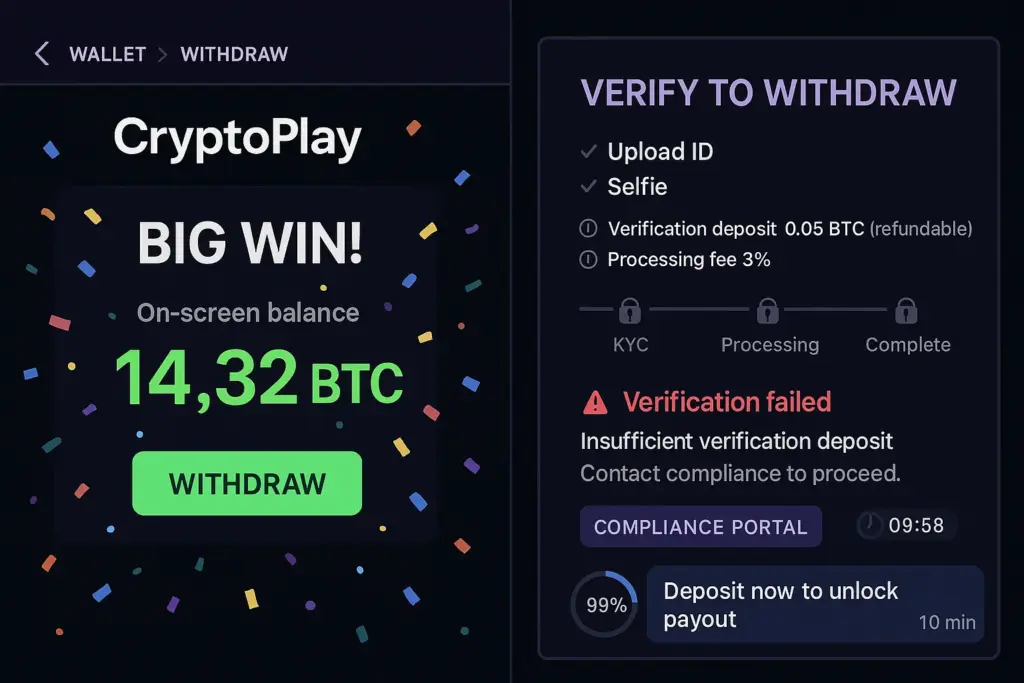
The clearest warning sign is that funds become movable only after extra payments are demanded. Legitimate businesses deduct routine costs from settled balances; they do not insist that customers prepay a release charge to access money that supposedly already belongs to them.
Counterfeit licensing
Many operations of this kind paste seals, registration numbers, and legal language onto the page because most visitors will never verify them. Once checked against official records, the claimed company is often missing, unrelated, or not authorized to offer gambling services at all.
Inflated early “wins”
Another recurring tell is the suspicious ease of winning at the start. That streak of success is not evidence of a generous platform; it is a psychological device meant to make a later deposit request or withdrawal fee feel sensible and low-risk.
Crypto-only rails
Payment options are frequently limited to cryptocurrency because irreversible transfers remove protections that banks and card networks sometimes provide. The lack of normal consumer rails is not a modern convenience here; it is part of the mechanism that keeps victims trapped.
Synthetic social proof
On-page popups, chat notices, review snippets, and influencer-style endorsements are often staged to make the platform appear active and trusted. None of that theater proves independent users are receiving genuine payouts or dealing with a real company.
Fresh, privacy-masked domains
Domain history adds another useful clue. When a casino appears to be newly launched, hides ownership details, and resembles other short-lived sites, caution is warranted; public checks such as who.is can help expose that churn.

How the Feastwin Scam Deception Funnel Works
Understanding the sequence matters because each stage prepares the next one. When you recognize how attention is captured, confidence is manufactured, and withdrawals are obstructed, it becomes much easier to spot the point where a harmless-looking offer turns into a structured extraction scheme.
Most victims are not fooled by a single lie. They are moved through a chain of nudges: curiosity, excitement, small commitment, apparent success, urgency, and finally pressure to send more crypto or surrender identity documents.
Promo hooks and influencer codes
The process often begins away from the site itself, through social posts, comment spam, direct messages, or promo codes framed as exclusive and short-lived. That opening leans on fear of missing out before the target has had time to test whether the platform deserves any trust.

Casino skin and bonus theater
Once a visitor lands on the page, the site presents a polished layout, familiar game imagery, and language borrowed from legitimate casinos. The design is there to reduce friction and make the first deposit feel routine, not to provide real proof of legitimacy.

Inflated balances, then the gate
Early play is where the emotional hook goes in. Small deposits can seem to multiply quickly, bonuses look easy to activate, and the account balance becomes the anchor that keeps people engaged when the first withdrawal barriers begin to appear.
Fee-gates and KYC harvest
When a payout is requested, the tone shifts immediately. Suddenly there is an anti-money-laundering review, tax certificate, account-tier upgrade, or identity checkpoint that can be cleared only by sending more crypto or uploading sensitive documents.

Stalling, rebrands, and “recovery” bait
If the target hesitates, support rarely gives a direct refusal. Instead it buys time with reassuring scripts, partial promises, and ever-changing requirements until the site goes dark, reappears under a new label, or a supposed recovery specialist arrives to sell the encore scam.
Staying safe from crypto casino scams like Feastwin
Avoiding the next loss usually comes down to simple habits performed before emotion takes over. The checks in this section are intentionally boring, and that is exactly why they work: they slow the decision down and force the platform to survive basic scrutiny.
Verify license status in official registers
Never rely on logos or legal text shown by the site itself. Search public regulator databases using the claimed company details and domain, because an authentic license should be independently traceable instead of accepted on faith.
Check domain age and history
Age and history matter more than marketing. A site created recently, shielded by privacy masking, or linked to multiple near-identical copies deserves far more skepticism than a long-running operator with a consistent and verifiable record.
Reject withdrawal fees and “unlock” deposits
Any demand for a release payment should end the conversation. Whether the excuse is tax, liquidity, VIP activation, or wallet verification, sending more money to unlock money is the core logic these schemes depend on.
Prefer venues with recourse
Choose services that offer clear company identification, ordinary payment methods, and documented complaint channels. Fraud flourishes where users are pushed into one-way crypto transfers and left with no practical route to dispute the transaction.
Limit wallet exposure
Even when you are only testing a site, keep wallet exposure low. Use separate addresses for experimentation, enable multifactor protection on related accounts, and clear stale token permissions so one bad decision does not spread across your holdings.
Validate “provably fair” claims
Buzzwords should be tested, not admired. If a platform advertises mathematical fairness, make sure the verification method is publicly explained, independently checkable, and applied consistently instead of hiding behind vague technical language.
Document and report rapidly
Speed matters after exposure. Save transaction identifiers, wallet addresses, messages, screenshots, and any files you uploaded, then report the incident to exchanges, national cybercrime channels, and financial authorities before the trail gets colder.
Build a deliberate slow-down reflex
A built-in pause is one of the strongest defenses available. Step away from the screen, check outside sources, and ask what evidence exists beyond the site’s own claims; scams thrive on momentum, while verification depends on delay.
Useful Resources for Scam Reporting and Prevention (By Country)
Although crypto transfers can be difficult to reverse, timely reporting still has value. Exchanges may flag recipient wallets, investigators can connect complaints across cloned domains, and preserved records can help if a provider later takes action on related addresses.
Click here to report the scam in your country
| Country / Agency | URL | Category / Use-case | Phone/Email |
| Australia – Crime Stoppers | https://www.crimestoppers.com.au | Anonymous tips about crime | 1800 333 000 |
| Australia – National Anti-Scam Center (Scamwatch) | https://www.scamwatch.gov.au/report-a-scam | General scams; phishing; texts/emails | |
| Australia – Police Assistance Line (non-emergency) | https://www.police.gov.au | Local police report | 131 444 |
| Australia – ReportCyber (ACSC) | https://www.cyber.gov.au/report | Cybercrime (hacks, fraud, extortion) | |
| Canada – Canadian Anti-Fraud Center (CAFC) | https://www.antifraudcentre-centreantifraude.ca/report-signalez-eng.htm | General scams incl. phone/text/email | |
| France – DGCCRF (SignalConso) | https://signal.conso.gouv.fr | Consumer scams/deceptive practices | |
| France – PHAROS – Internet-Signalement | https://www.internet-signalement.gouv.fr | Online content & cybercrime reports | |
| Germany – Bundeskriminalamt / Local Police | https://www.polizei.de/Polizei/DE/Home/home_node.html | Report online fraud | |
| Germany – Weißer Ring – Victim Support | https://weisser-ring.de | Victim support | 116 006 |
| India – DoT Helpline (Sanchar Saathi) | https://sancharsaathi.gov.in | Fraudulent telecom/SIM related | 155260 |
| India – National Consumer Helpline | https://consumerhelpline.gov.in | Consumer scams | 1800-11-4000 / 1915 |
| India – National Cyber Crime Reporting Portal | https://cybercrime.gov.in | Cybercrime incl. online fraud | 1930 |
| Japan – Consumer Affairs Agency (CAA) | https://www.caa.go.jp/policies/policy/consumer_policy/caution/cybercrime/ | Consumer scams | |
| Japan – National Police Agency – Cybercrime | https://www.npa.go.jp/bureau/cyber/ | Cybercrime reporting | |
| Mexico – Guardia Nacional (National Guard) | https://www.gob.mx/gn | Cybercrime reporting | |
| Mexico – Instituto Federal de Telecomunicaciones (IFT) | https://www.ift.org.mx | Telecom/online services scams | |
| Mexico – PROFECO | https://www.gob.mx/profeco | Consumer fraud & ecommerce | |
| Netherlands – AFM – Report investment fraud | https://www.afm.nl/en/consumenten/themas/beleggen/misleiding-misbruik | Investment/crypto | |
| Netherlands – Fraudehelpdesk | https://www.fraudehelpdesk.nl/melden | General scams (incl. phishing/SMS) | 088-7867372 |
| Netherlands – Politie – Meldpunt Internetoplichting | https://www.politie.nl/themas/internetoplichting.html | Online shopping fraud | |
| New Zealand – CERT NZ | https://www.cert.govt.nz/individuals/report-an-issue/ | Phishing, identity scams | |
| New Zealand – Department of Internal Affairs – Spam | https://www.dia.govt.nz/Spam-Contact-Us | Email/SMS spam | [email protected] |
| New Zealand – IDCARE | https://www.idcare.org | Victim support (identity compromise) | 0800 121 068 |
| New Zealand – Netsafe – Report | https://www.netsafe.org.nz/report/ | Online harms & scams | |
| New Zealand – New Zealand Police (non-emergency) | https://www.police.govt.nz/use-105 | Report fraud/online crime | 105 |
| Nigeria – Economic & Financial Crimes Commission (EFCC) | https://www.efcc.gov.ng | Financial scams incl. crypto/investment | [email protected] |
| Nigeria – Nigeria Police Special Fraud Unit (SFU) | https://www.specialfraudunit.org.ng | Serious fraud | Voice/SMS: 0708 227 6895; WhatsApp: 0812 760 9914 |
| Poland – CERT Polska (CERT.PL) | https://cert.pl/en/report/ | Cyber incidents & phishing | |
| Poland – Dyzurnet.pl | https://dyzurnet.pl | Illegal online content (esp. child protection) | |
| Poland – Polish Police (Policja) | https://www.policja.pl | Report scams to police | |
| Singapore – Anti-Scam Centre / Anti-Scam Helpline | https://www.scamalert.sg | General scams; texts; calls | 1800-722-6688 |
| Singapore – Monetary Authority of Singapore (MAS) | https://www.mas.gov.sg/investor-alert-list | Investment/crypto checks | |
| Singapore – Singapore Police Force | https://www.police.gov.sg/iwitness | Police report (cybercrime) | |
| South Africa – Cybersecurity Hub (CSIRT) | https://www.cybersecurityhub.gov.za | Cyber incidents incl. scams | |
| South Africa – South African Fraud Prevention Service (SAFPS) | https://www.safps.org.za | Identity fraud support | 011-867-2234 |
| South Africa – South African Police Service (SAPS) | https://www.saps.gov.za | Police report (cybercrime unit) | |
| South Korea – Korea Communications Commission (KCC) | https://www.kcc.go.kr | Telecom-related fraud | |
| South Korea – Korea Internet & Security Agency (KISA) | https://www.kisa.or.kr | Phishing, online harms | |
| South Korea – Korean National Police Agency – Cyber Bureau | https://ecrm.cyber.go.kr | Cybercrime reporting | |
| Spain – INCIBE – Oficina de Seguridad del Internauta (OSI) | https://www.osi.es/es/reporte | Cybersecurity & online fraud | |
| Spain – Policía Nacional / Guardia Civil | https://www.policia.es | Report scams to police | |
| Sweden – Crime Victim Authority (Brottsoffermyndigheten) | https://www.brottsoffermyndigheten.se | Victim support & compensation | 090–70 82 00 |
| Sweden – Polisen (Swedish Police) | https://polisen.se | Report fraud/cybercrime | 114 14 (non-emergency); 112 (emergency) |
| Sweden – Swedish Consumer Agency (Konsumentverket) | https://www.konsumentverket.se | Unfair business practices | |
| United Arab Emirates – Abu Dhabi Police – Aman Service | https://www.adpolice.gov.ae | Cybercrime tips/reporting | SMS 2828; 800 2626 |
| United Arab Emirates – Dubai Police – eCrime | https://www.dubaipolice.gov.ae | Cybercrime reporting | 04 606 1600 |
| United Arab Emirates – Ministry of Interior – Cyber Crime Dept. | https://www.moi.gov.ae | Cybercrime incl. online scams | |
| United Arab Emirates – Telecommunications Regulatory Authority (TRA) / TDRA | https://www.tra.gov.ae | Telecom-related scams/phishing | |
| United Kingdom – Action Fraud (NFIB) | https://www.actionfraud.police.uk | General scams & cybercrime (non-emergency) | 0300 123 2040 |
| United Kingdom – Citizens Advice Consumer Service | https://www.citizensadvice.org.uk/consumer/get-more-help/if-you-need-more-help-about-a-consumer-issue/ | Consumer problems & scam guidance | 0808 223 1133 |
| United Kingdom – Financial Conduct Authority (FCA) | https://www.fca.org.uk/consumers/report-scam-us | Investment/crypto & financial services | |
| United Kingdom – National Cyber Security Centre (NCSC) | https://www.ncsc.gov.uk/collection/phishing-scams | Phishing emails & suspicious websites | |
| United Kingdom – Stop Scams UK ‘159’ | https://stopscamsuk.org.uk/159 | Banking APP fraud (direct to your bank) | 159 |
| United States – AARP Fraud Watch Network Helpline | https://www.aarp.org/money/scams-fraud/ | Victim support | 833-372-8311 |
| United States – Better Business Bureau – Scam Tracker | https://www.bbb.org/scamtracker | Business/marketplace scams | |
| United States – FBI Internet Crime Complaint Center (IC3) | https://www.ic3.gov | Internet crime incl. investment/crypto | |
| United States – Federal Trade Commission – ReportFraud | https://reportfraud.ftc.gov | General scams, phishing, texts/emails | 1-877-382-4357 |
| United States – National Center for Disaster Fraud | https://www.justice.gov/disaster-fraud | Disaster-related scams | (866) 720-5721 |
| United States – SEC Tips & Complaints | https://www.sec.gov/tcr | Investment & securities/crypto-asset offerings |
The central lesson is simple: do not judge Feastwin by its games, graphics, or bonus language, but by what happens the moment you try to withdraw. When access to supposed funds depends on new payments, rushed document checks, and endless excuses, you are not dealing with a casino at all.
