

If you found Hugamb.at through social media bait or some video trading on a famous face, the safest move is to stop there. This is not a real crypto casino in any meaningful sense. It is a setup meant to get cryptocurrency out of people who are unlikely to see it again.
The site may let you register, play around, and even think you have won something. That part is easy to fake. The problem starts when you try to get money out and there is suddenly one more payment in the way, dressed up as verification or activation or whatever label sounds plausible enough. That extra payment is the mechanism.
Scams of Hugamb.at‘s type are known to steal personal data and passwords. Install SpyHunter Pro to scan for risks, remove any dangerous trackers, and enable real-time protection.

Try Free For 7 Days*
Buy now15% OFF if you buy straight without trial.
 OFFER
OFFERA polished front end helps, and so do fake testimonials or borrowed celebrity cues, but those details matter less than the broader pattern. Sites like Hugamb.at, Xaspaze, or Kastwin try to look ordinary long enough for you to trust the balance on screen. Once you check the business basics more closely, the whole thing starts to fall apart. Company details are thin, policies are vague, and the payout story stops making sense.
So the point of this article is simple: how the scam works, and which signs are actually worth taking seriously before you lose more money.
IMPORTANT! READ BEFORE PROCEEDING!
Anyone who has already transferred crypto, shared personal records, approved a wallet connection, or downloaded a file tied to Hugamb should assume the risk is broader than the visible loss. Quick containment can still reduce account takeover, further payments, and identity abuse.
Instead of negotiating with site representatives or trusting a stranger who promises fund recovery, inspect the device and browser session you used. We strongly recommend running SpyHunter 5 first so you can check for malware, suspicious installers, altered settings, or add-ons that may have arrived through this scam path.
Fastest Removal Option: Use SpyHunter 5
- 1.1Click here to download and install the anti-malware tool on your PC.
- 1.2
 Start SpyHunter 5, click the Buy button and choose between starting your 7-days free trial or directly purchasing the tool.
If you choose to buy SpyHunter 5 now, you can use our discount code, “HTRG15“, for 15% off.
- 1.3
 Once you activate SpyHunter, click Start Scan Now, select the Full Scan option, and let the tool do its job.
 - 1.4
 Once the scan completes (it could take a while, so have patience), you’ll see all malware and other undesirables listed.
Click Next to review the detections and then click Next again to delete all rogue items.
After the scan finishes, continue with the account and wallet safeguards below, and treat every password, session, approval, and document shared during contact with Hugamb as potentially exposed.
- Reset passwords and enable 2FA on your email, crypto exchanges, and wallets; terminate other active sessions.
- Notify any exchanges and services touched by the funds; provide TxIDs and ask that accounts/addresses be flagged per policy.
- Migrate assets to fresh wallets with new seed phrases and revoke any existing token approvals on connected chains.
- If you uploaded ID documents, place credit/fraud alerts where available and monitor for identity-theft signals.
- Assemble an evidence bundle – wallet addresses, TxIDs, site URLs, chats, and screenshots – and file reports with police/IC3 and any involved platforms.
How We Know Hugamb is a Scam
Viewed as a whole, the evidence points in one direction. These signals reinforce one another and line up with the same operating model seen across many fake crypto-casino clones.
Exit fees invented at cash-out
One of the clearest warning signs is the sudden appearance of charges only when money is supposed to leave. A real platform does not ask users to prepay release costs, tax holds, or verification deposits before returning their own balance.
Credentials that collapse on inspection
Fraudulent casino pages often lean on pasted seals, vague company claims, and registration numbers that sound official but do not survive outside checking. The presentation aims to borrow trust, not to prove legitimacy.
Convenient winning streaks
Another strong clue is the speed and ease of early success. When a new account seems to win too smoothly, the apparent luck can be part of the persuasion layer that nudges the victim toward higher deposits and less skepticism.
Crypto-only seclusion
When the money flow is limited to cryptocurrency, the victim is cut off from many of the consumer protections people expect elsewhere. That isolation is useful to scammers because it leaves little leverage once funds move.
Crowds that probably are not real
Winner pop-ups, praise-filled comments, promo chatter, and social posts can all be staged to make the platform feel busy and trusted. The goal is to replace independent verification with noise that feels reassuring in the moment.
Brands built to be thrown away
New domains with hidden registration details and near-copycat design patterns deserve special scrutiny. Public checks such as who.is often reveal how recently the site appeared and how little accountability stands behind it.


How the Hugamb Scam Deception Funnel Works
Seeing the sequence for what it is makes the pressure easier to resist. These operations usually move victims through a predictable chain of lures, rewards, obstacles, and delays.
Most victims are not tricked by a single dramatic claim. They are guided through a series of smaller decisions that feel plausible one at a time, even though the full path is engineered to end in loss.
Traffic bait and social grooming
The funnel often opens on social media, in private messages, or through promo-style clips that show exaggerated winnings and referral codes. The purpose is to create curiosity fast and to make the site seem already endorsed by other users.

A storefront designed to disarm doubt
Once someone lands on the page, the visual polish does strategic work. Familiar game layouts, countdowns, rewards panels, and casino language are used to create the impression that the operation is established and routine.

Fake gains that train commitment
After sign-up, the account may display easy profit, bonus credit, or unusually favorable outcomes. Those numbers are not there to enrich the player; they are there to make the next deposit feel rational and the eventual withdrawal attempt feel worth pursuing.
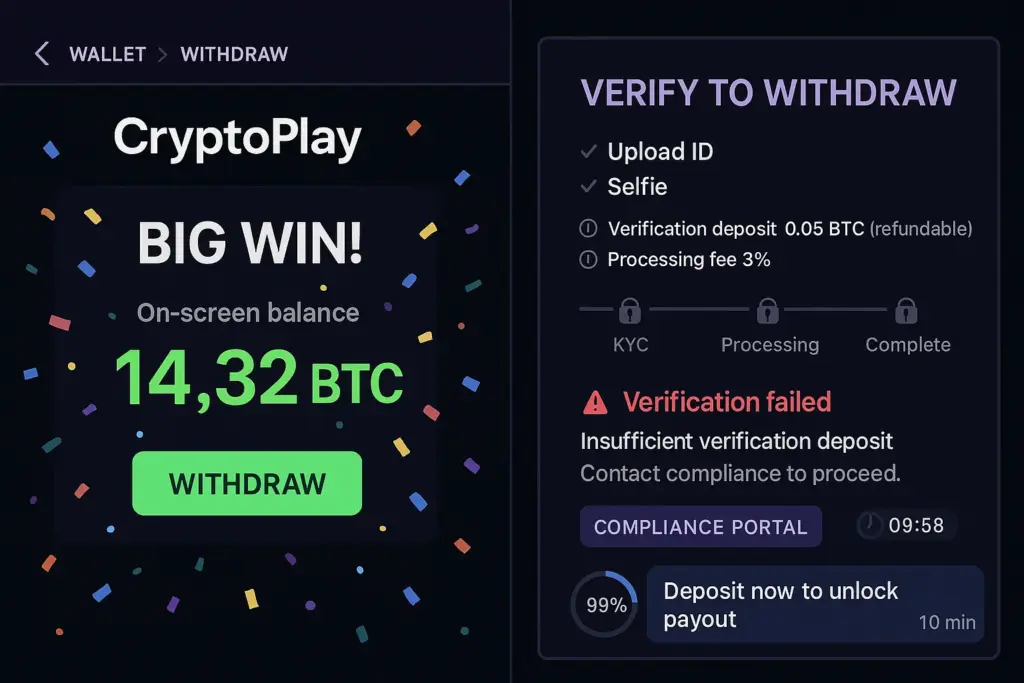
Compliance theater and payment traps
Everything changes at the moment of withdrawal. Suddenly the user may face AML checks, KYC steps, tax obligations, liquidity deposits, or wallet activation charges. Each explanation is crafted to make one more transfer sound temporary and necessary.

Stonewalling and the follow-up con
If the victim slows down, support often pivots to delay tactics, scripted empathy, and repeated assurances that release is almost complete. When the site eventually stops responding or reappears under a new name, so-called recovery helpers may arrive to run a second extraction attempt.
Staying safe from crypto casino scams like Hugamb
A safer habit is to slow the process down before the site can speed it up. The checks below are plain, practical, and effective precisely because they interrupt the emotional rhythm these scams depend on.
Verify the operator outside the site
Start by checking the claimed company, licensing story, and domain independently. If official regulator databases do not confirm what the site says about itself, treat every on-page badge and seal as marketing until proven otherwise.
Check how recently the brand appeared
Domain age matters because many of these operations are disposable by design. A newly created address, hidden ownership, or a cluster of similar domains is consistent with a short-life scam built to burn through victims and move on.
Do not pay to release your own balance
Any request to send more crypto in order to unlock an existing balance should be treated as a stop signal. Processing fees, tax advances, security bonds, and clearance payments are common ways a fake balance is converted into a real loss.
Prefer systems with real recourse
A platform that hides its operator, avoids transparent payment options, and leaves users with no practical dispute path deserves extra suspicion. Independent licensing, clear company identity, and payment methods with actual consumer protections all matter.
Separate wallets and tighten access
Limit the damage any single compromise can cause. Move remaining assets to fresh wallets where appropriate, rotate related passwords, enable 2FA on connected services, and review token approvals that may still expose funds on supported chains.
Assume slogans need proof
Terms such as “provably fair” or “fully verified” should be treated as claims, not evidence. If the platform does not provide a transparent method that users can independently examine, the language is functioning as decoration rather than proof.
Collect records before they vanish
Save transaction hashes, wallet addresses, chats, emails, screenshots, and every page you can still access. Early documentation matters because scam sites and their support channels often disappear once victims stop paying.
Pause before any pressured decision
A forced delay is protective. Step away from the screen, verify the operator, search for outside complaints, and ask what would still support the site’s story if every pop-up, review, and support message turned out to be fake.
Useful Resources for Scam Reporting and Prevention (By Country)
Filing reports is still worthwhile even when crypto transfers cannot simply be reversed. Good records can help exchanges, investigators, and reporting centers connect addresses, complaints, and repeating patterns across domains.
See the reporting directory below
| Country / Agency | URL | Category / Use-case | Phone/Email |
| Australia – Crime Stoppers | https://www.crimestoppers.com.au | Anonymous tips about crime | 1800 333 000 |
| Australia – National Anti-Scam Center (Scamwatch) | https://www.scamwatch.gov.au/report-a-scam | General scams; phishing; texts/emails | |
| Australia – Police Assistance Line (non-emergency) | https://www.police.gov.au | Local police report | 131 444 |
| Australia – ReportCyber (ACSC) | https://www.cyber.gov.au/report | Cybercrime (hacks, fraud, extortion) | |
| Canada – Canadian Anti-Fraud Center (CAFC) | https://www.antifraudcentre-centreantifraude.ca/report-signalez-eng.htm | General scams incl. phone/text/email | |
| France – DGCCRF (SignalConso) | https://signal.conso.gouv.fr | Consumer scams/deceptive practices | |
| France – PHAROS – Internet-Signalement | https://www.internet-signalement.gouv.fr | Online content & cybercrime reports | |
| Germany – Bundeskriminalamt / Local Police | https://www.polizei.de/Polizei/DE/Home/home_node.html | Report online fraud | |
| Germany – Weißer Ring – Victim Support | https://weisser-ring.de | Victim support | 116 006 |
| India – DoT Helpline (Sanchar Saathi) | https://sancharsaathi.gov.in | Fraudulent telecom/SIM related | 155260 |
| India – National Consumer Helpline | https://consumerhelpline.gov.in | Consumer scams | 1800-11-4000 / 1915 |
| India – National Cyber Crime Reporting Portal | https://cybercrime.gov.in | Cybercrime incl. online fraud | 1930 |
| Japan – Consumer Affairs Agency (CAA) | https://www.caa.go.jp/policies/policy/consumer_policy/caution/cybercrime/ | Consumer scams | |
| Japan – National Police Agency – Cybercrime | https://www.npa.go.jp/bureau/cyber/ | Cybercrime reporting | |
| Mexico – Guardia Nacional (National Guard) | https://www.gob.mx/gn | Cybercrime reporting | |
| Mexico – Instituto Federal de Telecomunicaciones (IFT) | https://www.ift.org.mx | Telecom/online services scams | |
| Mexico – PROFECO | https://www.gob.mx/profeco | Consumer fraud & ecommerce | |
| Netherlands – AFM – Report investment fraud | https://www.afm.nl/en/consumenten/themas/beleggen/misleiding-misbruik | Investment/crypto | |
| Netherlands – Fraudehelpdesk | https://www.fraudehelpdesk.nl/melden | General scams (incl. phishing/SMS) | 088-7867372 |
| Netherlands – Politie – Meldpunt Internetoplichting | https://www.politie.nl/themas/internetoplichting.html | Online shopping fraud | |
| New Zealand – CERT NZ | https://www.cert.govt.nz/individuals/report-an-issue/ | Phishing, identity scams | |
| New Zealand – Department of Internal Affairs – Spam | https://www.dia.govt.nz/Spam-Contact-Us | Email/SMS spam | [email protected] |
| New Zealand – IDCARE | https://www.idcare.org | Victim support (identity compromise) | 0800 121 068 |
| New Zealand – Netsafe – Report | https://www.netsafe.org.nz/report/ | Online harms & scams | |
| New Zealand – New Zealand Police (non-emergency) | https://www.police.govt.nz/use-105 | Report fraud/online crime | 105 |
| Nigeria – Economic & Financial Crimes Commission (EFCC) | https://www.efcc.gov.ng | Financial scams incl. crypto/investment | [email protected] |
| Nigeria – Nigeria Police Special Fraud Unit (SFU) | https://www.specialfraudunit.org.ng | Serious fraud | Voice/SMS: 0708 227 6895; WhatsApp: 0812 760 9914 |
| Poland – CERT Polska (CERT.PL) | https://cert.pl/en/report/ | Cyber incidents & phishing | |
| Poland – Dyzurnet.pl | https://dyzurnet.pl | Illegal online content (esp. child protection) | |
| Poland – Polish Police (Policja) | https://www.policja.pl | Report scams to police | |
| Singapore – Anti-Scam Centre / Anti-Scam Helpline | https://www.scamalert.sg | General scams; texts; calls | 1800-722-6688 |
| Singapore – Monetary Authority of Singapore (MAS) | https://www.mas.gov.sg/investor-alert-list | Investment/crypto checks | |
| Singapore – Singapore Police Force | https://www.police.gov.sg/iwitness | Police report (cybercrime) | |
| South Africa – Cybersecurity Hub (CSIRT) | https://www.cybersecurityhub.gov.za | Cyber incidents incl. scams | |
| South Africa – South African Fraud Prevention Service (SAFPS) | https://www.safps.org.za | Identity fraud support | 011-867-2234 |
| South Africa – South African Police Service (SAPS) | https://www.saps.gov.za | Police report (cybercrime unit) | |
| South Korea – Korea Communications Commission (KCC) | https://www.kcc.go.kr | Telecom-related fraud | |
| South Korea – Korea Internet & Security Agency (KISA) | https://www.kisa.or.kr | Phishing, online harms | |
| South Korea – Korean National Police Agency – Cyber Bureau | https://ecrm.cyber.go.kr | Cybercrime reporting | |
| Spain – INCIBE – Oficina de Seguridad del Internauta (OSI) | https://www.osi.es/es/reporte | Cybersecurity & online fraud | |
| Spain – Policía Nacional / Guardia Civil | https://www.policia.es | Report scams to police | |
| Sweden – Crime Victim Authority (Brottsoffermyndigheten) | https://www.brottsoffermyndigheten.se | Victim support & compensation | 090–70 82 00 |
| Sweden – Polisen (Swedish Police) | https://polisen.se | Report fraud/cybercrime | 114 14 (non-emergency); 112 (emergency) |
| Sweden – Swedish Consumer Agency (Konsumentverket) | https://www.konsumentverket.se | Unfair business practices | |
| United Arab Emirates – Abu Dhabi Police – Aman Service | https://www.adpolice.gov.ae | Cybercrime tips/reporting | SMS 2828; 800 2626 |
| United Arab Emirates – Dubai Police – eCrime | https://www.dubaipolice.gov.ae | Cybercrime reporting | 04 606 1600 |
| United Arab Emirates – Ministry of Interior – Cyber Crime Dept. | https://www.moi.gov.ae | Cybercrime incl. online scams | |
| United Arab Emirates – Telecommunications Regulatory Authority (TRA) / TDRA | https://www.tra.gov.ae | Telecom-related scams/phishing | |
| United Kingdom – Action Fraud (NFIB) | https://www.actionfraud.police.uk | General scams & cybercrime (non-emergency) | 0300 123 2040 |
| United Kingdom – Citizens Advice Consumer Service | https://www.citizensadvice.org.uk/consumer/get-more-help/if-you-need-more-help-about-a-consumer-issue/ | Consumer problems & scam guidance | 0808 223 1133 |
| United Kingdom – Financial Conduct Authority (FCA) | https://www.fca.org.uk/consumers/report-scam-us | Investment/crypto & financial services | |
| United Kingdom – National Cyber Security Centre (NCSC) | https://www.ncsc.gov.uk/collection/phishing-scams | Phishing emails & suspicious websites | |
| United Kingdom – Stop Scams UK ‘159’ | https://stopscamsuk.org.uk/159 | Banking APP fraud (direct to your bank) | 159 |
| United States – AARP Fraud Watch Network Helpline | https://www.aarp.org/money/scams-fraud/ | Victim support | 833-372-8311 |
| United States – Better Business Bureau – Scam Tracker | https://www.bbb.org/scamtracker | Business/marketplace scams | |
| United States – FBI Internet Crime Complaint Center (IC3) | https://www.ic3.gov | Internet crime incl. investment/crypto | |
| United States – Federal Trade Commission – ReportFraud | https://reportfraud.ftc.gov | General scams, phishing, texts/emails | 1-877-382-4357 |
| United States – National Center for Disaster Fraud | https://www.justice.gov/disaster-fraud | Disaster-related scams | (866) 720-5721 |
| United States – SEC Tips & Complaints | https://www.sec.gov/tcr | Investment & securities/crypto-asset offerings |
The useful takeaway is not whatever excuse the site gave last. The useful takeaway is the pattern: polished front, easy on-screen gains, blocked withdrawals, more demands, and then silence. Once you recognize that sequence, you can protect accounts faster and stop the damage sooner.
