

The games you can play in Kaovax are designed to make you feel lucky, showing you fake wins and inflated balances. Before you know it, you’re convinced this is a legit casino and start depositing your own crypto to “maximize” those winnings. But the moment you try to withdraw, everything changes. Suddenly, there’s a “transfer fee” or a “deposit requirement.” You pay, expecting to unlock your money, but nothing ever arrives. The entire system behind Kaovax is fake and a scam. It was created to prey on your natural excitement at the idea of free money, nothing more. Kaovax, similar to Yoloshark and Hynplays, isn’t giving you anything – it’s slowly draining everything you put in.
Scams of Kaovax‘s type are known to steal personal data and passwords. Install SpyHunter Pro to scan for risks, remove any dangerous trackers, and enable real-time protection.

Try Free For 7 Days*
Buy now15% OFF if you buy straight without trial.
 OFFER
OFFERWhat Kaovax.com actually is
The verdict is simple. Kaovax.com looks and sounds like a legitimate gambling site, with a chat widget that stays busy. None of that proves fairness or solvency. The only number that matters, the total they say you “won,” lives on a server they control and can edit.
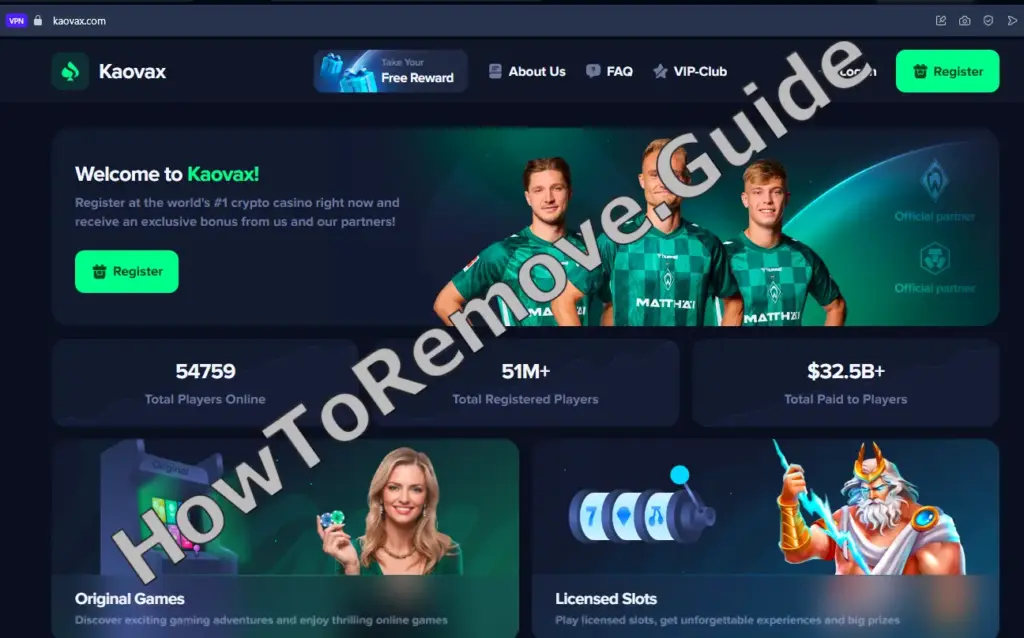
Once the veneer is in place, the funnel starts. The site dangles extravagant signup perks and scripts early “wins” that inflate the balance on command. This manufactured hot streak leans on variable-ratio rewards and near-miss effects to keep visitors spinning. As attention narrows, risk perception softens and deposits feel painless. A sunk-cost mindset settles in.
When a player aims for the exit, the turnstile arrives. A “VIP unlock” may be rewritten as a “verification deposit.” Other pages label the same toll an “anti-fraud collateral” or a “tax prepayment.” Pay once and new pretexts emerge. To keep the theater looking legitimate, Kaovax.com parades counterfeit seals that never click through to a regulator’s validator page, while a rotating set of fresh domains buries earlier complaints.
If Kaovax snagged you: lock down first, chase later
Contain damage before you argue for refunds. Treat funds already sent as likely gone for now, and treat any identification you uploaded as at risk of misuse. Do not send a “verification deposit,” an “anti-fraud collateral,” or a “tax prepayment” fee. That loop does not end. Preserve evidence while it is available. Move any remaining assets you control into safer compartments. Only after you close the gaps and assemble a tidy dossier should you consider formal reports and measured recovery steps.
Break contact immediately and stop paying invented tolls. Capture dashboard views and withdrawal prompts. Save chat logs and emails. Record domain names with timestamps and TXIDs.
Relocate remaining crypto to a brand-new wallet with a fresh seed phrase. If you connected a wallet to Kaovax or granted token allowances, revoke approvals through your wallet’s permissions page or a reputable approval-revocation tool. Retire the exposed address.
Re-key your digital life. Change passwords on exchanges and on the email accounts tied to them. Enable app-based two-factor authentication. Store credentials in a password manager rather than the browser to reduce credential reuse.
Assume identity documents could be misused. If you uploaded IDs, place a credit freeze where available or set a fraud alert. Monitor for new-account openings. Be prepared to reissue compromised documents. Keep a dated list of what you shared.
File reports through real, recognized channels. Use your national cybercrime portal and cross-border consumer complaint hubs. Submit the domain with your screenshots and relevant blockchain evidence to community intelligence repositories that cluster related infrastructure.
Notify any exchanges that handled your deposits or withdrawals. Provide addresses and TXIDs, and include the site’s URL so compliance teams can flag counterparties and respond faster to law-enforcement requests.
Segregate risk going forward. Keep a small burner wallet for experiments. Isolate savings in a separate setup. Revoke stale token approvals on a regular schedule so permissions do not linger.
Signs you can spot with a clear head
Slow down and the pattern becomes plain. These operations overpromise bonuses and hide accountability. They invent “requirements” only when you try to exit with money. Read closely and test the path out before you trust the path in.
Standing tolls on your own funds reveal the core lie. Any request for a “verification deposit,” an “anti-fraud collateral,” or a “tax prepayment” to release your balance is not compliance. It is the scam acting like a checkpoint. Paying once invites the next excuse.
Badges that will not verify betray the costume. A real license claim should link to a regulator’s public lookup that shows the same legal operator. If logos do not click through or the details do not match, you are watching theater, not oversight.
Disposable web scaffolding foreshadows the exit. Very new domains and privacy-masked WHOIS appear, and cloned templates under interchangeable names repeat the pattern.
Engineered hot streaks do not prove fairness. Early wins and uncanny near-misses are variable-reward levers tuned to keep you spinning. The friendlier it feels at the start, the higher your skepticism should rise.
Lavish promos and influencer-styled gloss add pressure. Flashy visuals pair with claims of endorsements and countdown timers that compress your decision window so verification gives way to impulse.
How to stay out of Kaovax-style traps
Prevention works because it denies the grift leverage on you. The instant an offer seems unusually generous or oddly urgent, pause and test it. If details are unverifiable, step back.
Make “never pay to get paid” a rule you never break. If a platform asks for a “verification deposit” or an “anti-fraud collateral” to release your balance, close the tab and do not return. The same applies when they label it a “tax prepayment.”
Verify oversight claims instead of admiring logos. Click through to a regulator’s site and confirm the operator’s legal name in a live registry. If the lookup is missing or the names do not match, walk away.
Run quick due diligence on the shell. Check domain age and registrant transparency. Look for a real company record and scan for prior clones. Five minutes of homework exposes most of these templates.
Use compartmentalized wallets by default. Keep a small play wallet for risky sites and maintain savings in a hardened wallet. Revoke token approvals you no longer need to shrink your attack surface.
Keep identity exposure scarce. If oversight is not verifiable, do not upload passports or licenses. Harm from identity theft outlasts any on-screen balance you think you are chasing.
Document and report suspicious finds. When you spot a clone or a counterfeit license, capture proof and file to national cybercrime portals and community tracking hubs.
Recognize clone-network tactics. If you see interchangeable designs on brand-new domains, assume the operation is built to rebrand and run. In that environment, withdrawals “require” paying first.
