

Kowatu.com presents itself as a crypto casino with fast registration, promo rewards, and a modern interface that can feel convincing to inexperienced users. That first impression matters because scam gambling sites often rely on speed, excitement, and polished visuals to lower suspicion before money is involved.
With Kowatu, the bigger problem is not the marketing but the missing substance behind it. Public warning signs include hard-to-check ownership, limited accountability, and terms that do not clearly connect the platform to a verifiable, licensed gambling business.
Another concern is how familiar the site’s presentation looks. Public scans show Kowatu using the same headline-and-description pattern seen on other suspicious casino domains(Beasttrials.com, Bazowin781), while separate analyses describe the usual mix of inflated credibility cues, weak support, and pressure-driven promotions.
Scams of Kowatu.com‘s type are known to steal personal data and passwords. Install SpyHunter Pro to scan for risks, remove any dangerous trackers, and enable real-time protection.

Try Free For 7 Days*
Buy now15% OFF if you buy straight without trial.
 OFFER
OFFERFor readers, the practical risk is clear: a site built around easy sign-up, bonus codes, and weak operator details can lead to lost crypto, blocked withdrawals, or demands for extra payments. Those are strong reasons to treat Kowatu as a high-risk gambling destination.
Put simply, anyone who cares about funds, identity documents, and wallet safety should avoid engaging with this site. The sections below explain the pressure tactics behind it and the practical steps worth taking if you already interacted with it.
URGENT: LOCK THINGS DOWN FIRST
If you already used Kowatu, cut contact immediately, stop sending funds, and secure every account or wallet the site touched. Move quickly while evidence is still available and while you still control connected services. Priority should go to containing exposure, preserving proof, and preventing follow-on abuse:
- Reset passwords for email and exchanges, then turn on 2FA everywhere you can.
- Disconnect any wallet from the site and revoke permissions, then move remaining funds to a fresh wallet with a new seed.
- If you ever shared a seed phrase or private key, assume that wallet is compromised and migrate immediately from a clean device.
- If you shared ID documents, place a fraud alert or credit freeze and monitor for identity misuse.
- File a report and save proof before the domain disappears, including screenshots, chats, wallet addresses, and transaction hashes.
How We Know Kowatu is a Scam
Taken together, the indicators around Kowatu line up closely with the recurring formula used by fake crypto casinos: synthetic credibility upfront, friction-free play at the beginning, and payment barriers the moment a user tries to leave with winnings.
Withdrawal requests turn into new payment demands
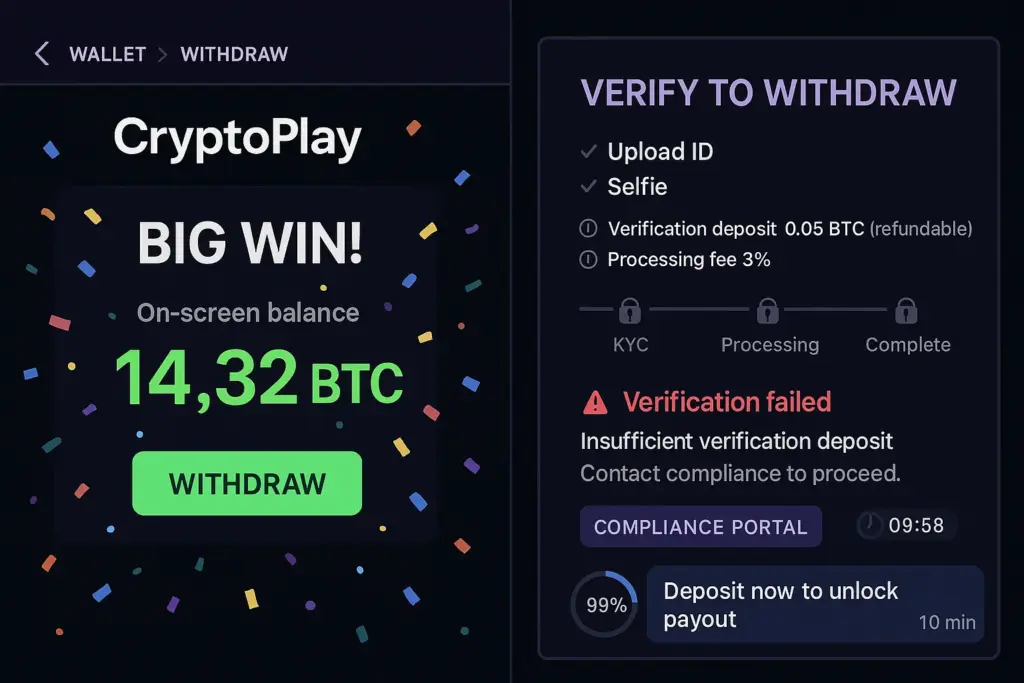
The clearest alarm bell appears at payout time, when the platform suddenly claims you must send more crypto before it can release funds that supposedly already belong to you.
Bonus offers are unrealistically generous
Rather than opening with an obvious cash grab, the site dangles oversized rewards first, using excitement and perceived luck to make a later deposit feel reasonable.
The domain profile looks disposable
A frequent pattern with these operations is short-lived branding: once complaints build, the same layout often reappears under another fresh domain.
Crowded screens do not equal real activity
Chat widgets, spinning counters, and glowing testimonials can all be fabricated to manufacture the feeling that thousands of other users are playing and cashing out.
Support keeps moving the goalposts
Instead of answering a direct withdrawal question, support conversations often loop into ever-changing requirements, delays, and new reasons to wait or pay again.
The endorsements do not stand up to checking
Traffic is commonly driven by copied posts, spam comments, dubious promo codes, and synthetic influencer hype that collapses once you look for an independently verified source.
Basic domain checks matter here
A quick WHOIS lookup can reveal whether the domain is newly registered, privacy-shielded, or repeatedly recycled, and that kind of instability is a major warning sign for any gambling site.


How the Kowatu Scam Deception Funnel Works
Once you see the routine as a script instead of a one-off mystery, it becomes much easier to interrupt it before curiosity, urgency, or greed pull you deeper into the process.
That same pattern recognition also helps when documenting what happened, because many victims think the experience was unique when it is usually a familiar scam flow wearing a different domain name.
Ads, spam, and promo-code bait
The first touchpoint is often a loud promise on social media, a giveaway comment, or a fake creator recommendation pushing a code that makes the casino look both popular and time-sensitive.

A polished front end lowers resistance
After arrival, the clean interface and familiar signup screens are designed to make users treat the site like a normal operator before they have verified who actually runs it.

Early wins create false confidence
Once play begins, generous outcomes and rising balances can be shown early to create the impression that the platform is fair and that the displayed money is genuinely yours.
Payout friction is the real business model
The tone changes as soon as you try to withdraw, with the site suddenly inventing verification deposits, release fees, tax claims, or status upgrades that supposedly must come first.

Delay tactics keep victims engaged
If a user pays once, the operation typically stretches the ordeal with new explanations, repeated waiting periods, and sometimes even “recovery” promises meant to extract one more transfer.
Staying safe from crypto casino scams like Kowatu
The most reliable protection comes from routines you can follow even when tired or excited, because these scams depend on speed, distraction, and the hope that no one will pause to verify anything.
Check the operator in real registries
A real gambling business should be traceable through a regulator or company record, not just through logos and claims placed on its own pages.
Review domain history before trusting it
Age, ownership masking, and abrupt registration changes can reveal that a site was built to burn fast rather than operate transparently over time.
Never pay to unlock money
A demand for extra funds before a withdrawal is released should be treated as disqualifying, because legitimate platforms do not make users ransom their own balance.
Choose services with traceable accountability
The less recourse a platform gives you, the easier it is for the operator to vanish, so anonymous crypto-only setups deserve far more suspicion than regulated services with real dispute paths.
Keep wallet exposure as small as possible
Separate wallets, minimal balances, and quick permission revocations can limit the blast radius if a shady site tries to push harmful approvals or follow-up scams.
Marketing language is not proof
Claims like “provably fair,” “trusted by thousands,” or “featured by creators” should mean nothing until they can be confirmed outside the site’s own promotional material.
Preserve evidence early
Screenshots, wallet addresses, transaction hashes, emails, and chat logs become harder to recover after the domain changes or disappears, so save them before the trail goes cold.
Build a pause-before-action habit
Even a short delay before depositing, signing, or uploading documents can break the emotional momentum that these schemes work so hard to create.
Useful Resources for Scam Reporting and Prevention (By Country)
Gather and store evidence while the site is still live: capture balances, demands for extra fees, conversations with support, URLs, transaction IDs, and any identification requests, because this record will matter far more than arguments with the scammers.
Find the reporting channel for your country
| Country / Agency | URL | Category / Use-case | Phone/Email |
| Australia – Crime Stoppers | https://www.crimestoppers.com.au | Anonymous tips about crime | 1800 333 000 |
| Australia – National Anti-Scam Center (Scamwatch) | https://www.scamwatch.gov.au/report-a-scam | General scams; phishing; texts/emails | |
| Australia – Police Assistance Line (non-emergency) | https://www.police.gov.au | Local police report | 131 444 |
| Australia – ReportCyber (ACSC) | https://www.cyber.gov.au/report | Cybercrime (hacks, fraud, extortion) | |
| Canada – Canadian Anti-Fraud Center (CAFC) | https://www.antifraudcentre-centreantifraude.ca/report-signalez-eng.htm | General scams incl. phone/text/email | |
| France – DGCCRF (SignalConso) | https://signal.conso.gouv.fr | Consumer scams/deceptive practices | |
| France – PHAROS – Internet-Signalement | https://www.internet-signalement.gouv.fr | Online content & cybercrime reports | |
| Germany – Bundeskriminalamt / Local Police | https://www.polizei.de/Polizei/DE/Home/home_node.html | Report online fraud | |
| Germany – Weißer Ring – Victim Support | https://weisser-ring.de | Victim support | 116 006 |
| India – DoT Helpline (Sanchar Saathi) | https://sancharsaathi.gov.in | Fraudulent telecom/SIM related | 155260 |
| India – National Consumer Helpline | https://consumerhelpline.gov.in | Consumer scams | 1800-11-4000 / 1915 |
| India – National Cyber Crime Reporting Portal | https://cybercrime.gov.in | Cybercrime incl. online fraud | 1930 |
| Japan – Consumer Affairs Agency (CAA) | https://www.caa.go.jp/policies/policy/consumer_policy/caution/cybercrime/ | Consumer scams | |
| Japan – National Police Agency – Cybercrime | https://www.npa.go.jp/bureau/cyber/ | Cybercrime reporting | |
| Mexico – Guardia Nacional (National Guard) | https://www.gob.mx/gn | Cybercrime reporting | |
| Mexico – Instituto Federal de Telecomunicaciones (IFT) | https://www.ift.org.mx | Telecom/online services scams | |
| Mexico – PROFECO | https://www.gob.mx/profeco | Consumer fraud & ecommerce | |
| Netherlands – AFM – Report investment fraud | https://www.afm.nl/en/consumenten/themas/beleggen/misleiding-misbruik | Investment/crypto | |
| Netherlands – Fraudehelpdesk | https://www.fraudehelpdesk.nl/melden | General scams (incl. phishing/SMS) | 088-7867372 |
| Netherlands – Politie – Meldpunt Internetoplichting | https://www.politie.nl/themas/internetoplichting.html | Online shopping fraud | |
| New Zealand – CERT NZ | https://www.cert.govt.nz/individuals/report-an-issue/ | Phishing, identity scams | |
| New Zealand – Department of Internal Affairs – Spam | https://www.dia.govt.nz/Spam-Contact-Us | Email/SMS spam | [email protected] |
| New Zealand – IDCARE | https://www.idcare.org | Victim support (identity compromise) | 0800 121 068 |
| New Zealand – Netsafe – Report | https://www.netsafe.org.nz/report/ | Online harms & scams | |
| New Zealand – New Zealand Police (non-emergency) | https://www.police.govt.nz/use-105 | Report fraud/online crime | 105 |
| Nigeria – Economic & Financial Crimes Commission (EFCC) | https://www.efcc.gov.ng | Financial scams incl. crypto/investment | [email protected] |
| Nigeria – Nigeria Police Special Fraud Unit (SFU) | https://www.specialfraudunit.org.ng | Serious fraud | Voice/SMS: 0708 227 6895; WhatsApp: 0812 760 9914 |
| Poland – CERT Polska (CERT.PL) | https://cert.pl/en/report/ | Cyber incidents & phishing | |
| Poland – Dyzurnet.pl | https://dyzurnet.pl | Illegal online content (esp. child protection) | |
| Poland – Polish Police (Policja) | https://www.policja.pl | Report scams to police | |
| Singapore – Anti-Scam Centre / Anti-Scam Helpline | https://www.scamalert.sg | General scams; texts; calls | 1800-722-6688 |
| Singapore – Monetary Authority of Singapore (MAS) | https://www.mas.gov.sg/investor-alert-list | Investment/crypto checks | |
| Singapore – Singapore Police Force | https://www.police.gov.sg/iwitness | Police report (cybercrime) | |
| South Africa – Cybersecurity Hub (CSIRT) | https://www.cybersecurityhub.gov.za | Cyber incidents incl. scams | |
| South Africa – South African Fraud Prevention Service (SAFPS) | https://www.safps.org.za | Identity fraud support | 011-867-2234 |
| South Africa – South African Police Service (SAPS) | https://www.saps.gov.za | Police report (cybercrime unit) | |
| South Korea – Korea Communications Commission (KCC) | https://www.kcc.go.kr | Telecom-related fraud | |
| South Korea – Korea Internet & Security Agency (KISA) | https://www.kisa.or.kr | Phishing, online harms | |
| South Korea – Korean National Police Agency – Cyber Bureau | https://ecrm.cyber.go.kr | Cybercrime reporting | |
| Spain – INCIBE – Oficina de Seguridad del Internauta (OSI) | https://www.osi.es/es/reporte | Cybersecurity & online fraud | |
| Spain – Policía Nacional / Guardia Civil | https://www.policia.es | Report scams to police | |
| Sweden – Crime Victim Authority (Brottsoffermyndigheten) | https://www.brottsoffermyndigheten.se | Victim support & compensation | 090–70 82 00 |
| Sweden – Polisen (Swedish Police) | https://polisen.se | Report fraud/cybercrime | 114 14 (non-emergency); 112 (emergency) |
| Sweden – Swedish Consumer Agency (Konsumentverket) | https://www.konsumentverket.se | Unfair business practices | |
| United Arab Emirates – Abu Dhabi Police – Aman Service | https://www.adpolice.gov.ae | Cybercrime tips/reporting | SMS 2828; 800 2626 |
| United Arab Emirates – Dubai Police – eCrime | https://www.dubaipolice.gov.ae | Cybercrime reporting | 04 606 1600 |
| United Arab Emirates – Ministry of Interior – Cyber Crime Dept. | https://www.moi.gov.ae | Cybercrime incl. online scams | |
| United Arab Emirates – Telecommunications Regulatory Authority (TRA) / TDRA | https://www.tra.gov.ae | Telecom-related scams/phishing | |
| United Kingdom – Action Fraud (NFIB) | https://www.actionfraud.police.uk | General scams & cybercrime (non-emergency) | 0300 123 2040 |
| United Kingdom – Citizens Advice Consumer Service | https://www.citizensadvice.org.uk/consumer/get-more-help/if-you-need-more-help-about-a-consumer-issue/ | Consumer problems & scam guidance | 0808 223 1133 |
| United Kingdom – Financial Conduct Authority (FCA) | https://www.fca.org.uk/consumers/report-scam-us | Investment/crypto & financial services | |
| United Kingdom – National Cyber Security Centre (NCSC) | https://www.ncsc.gov.uk/collection/phishing-scams | Phishing emails & suspicious websites | |
| United Kingdom – Stop Scams UK ‘159’ | https://stopscamsuk.org.uk/159 | Banking APP fraud (direct to your bank) | 159 |
| United States – AARP Fraud Watch Network Helpline | https://www.aarp.org/money/scams-fraud/ | Victim support | 833-372-8311 |
| United States – Better Business Bureau – Scam Tracker | https://www.bbb.org/scamtracker | Business/marketplace scams | |
| United States – FBI Internet Crime Complaint Center (IC3) | https://www.ic3.gov | Internet crime incl. investment/crypto | |
| United States – Federal Trade Commission – ReportFraud | https://reportfraud.ftc.gov | General scams, phishing, texts/emails | 1-877-382-4357 |
| United States – National Center for Disaster Fraud | https://www.justice.gov/disaster-fraud | Disaster-related scams | (866) 720-5721 |
| United States – SEC Tips & Complaints | https://www.sec.gov/tcr | Investment & securities/crypto-asset offerings |
Because crypto payments are hard to reverse, the most useful next step is usually documentation and reporting rather than frantic attempts to win the money back through unverified recovery offers.
