

Online scams don’t live in isolation, and Lerihex is proof of that. This fraudulent site isn’t some one-off shady casino but a part of a large network of cloned sites that reuse the same tricks under different names. Other recent examples of this type of scam are Kaovax and Blowcas. Lerihex is simply the latest one and that’s why we are focusing on it in this post.
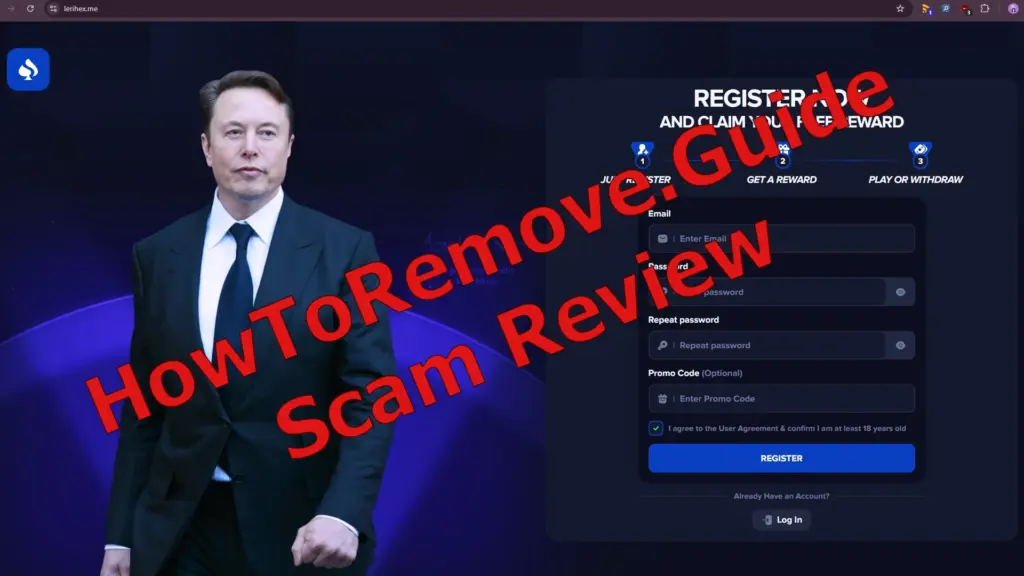
The formula is always the same: the scammers slap a glossy interface on the fake site, sprinkle in fake testimonials, and maybe even roll out a deepfake video of Elon Musk or Mr. Beast grinning about easy crypto wins. To the less experienced users, it looks polished and is enough to convince plenty of people that they’ve stumbled onto a legitimate gambling platform where they can actuallly make some money.
If you take the bait and sign up, you get your “free” starting bonus, you start playing, and your winnings start climbing as if you are on a lucky streak. But once it comes time to take out your money, you’re suddenly asked for deposits, verification fees, or some other excuse, and every coin you send disappears into the scammers’ pockets without you even realizing it.
That’s how Lerihex and other similar scams work. It’s a simple routine, but one that gets thousands of users tricked each day. That is why we strongly recommend you read the rest of this post to learn how to protect yourself from such scams in the future.
Scams of Lerihex.me‘s type are known to steal personal data and passwords. Install SpyHunter Pro to scan for risks, remove any dangerous trackers, and enable real-time protection.

Try Free For 7 Days*
Buy now15% OFF if you buy straight without trial.
 OFFER
OFFERHow the Lerihex.me ruse works (and why it keeps working)
Start with the façade. Lerihex.me presents a glossy lobby, “recent winners,” and a balance that rises on cue. Those numbers are interface theater, not escrowed funds, and they exist to prime expectations. The operational logic is blunt but durable: take deposits, then invent obstacles that require you to send more money to “unlock” your own balance.
Now consider persuasion. Lerihex.me leans on variable-reward nudges that deliver fast, flattering outcomes and on ritualized authority that looks like policy: clipped “support” replies, boilerplate notices, and staged “compliance” messages. When you try to cash out, the script flips to tolls named “processing gas,” “clearance,” or “tier upgrade.” In parallel, you are pushed to use crypto only, which removes chargeback rights and hides behind vague paperwork that slows scrutiny.
Finally, watch the slipperiness. The operator cycles through look-alike domains and recycles templates, testimonials, and UI to stay ahead of complaints and blocklists . Any supposed authorization collapses under an official register check; the company name, license number, or domain does not appear where it should. Off-site searches often reveal the same language across “sibling” sites, which signals a scaled operation rather than a one-off.
If Lerihex has already snagged you: stabilize first, recover later
Momentum is the enemy once you suspect the con. Shift to containment immediately: protect the accounts and identities you still control, assume outgoing crypto is unlikely to return, and document everything with timestamps before details fade. Because blockchain transfers settle quickly and are typically irreversible, paying “release” fees only deepens the hole. Rebuild your security baseline with unique passwords, strong two-factor authentication, and clean devices so the fallout does not cascade . If you uploaded KYC documents, treat them as compromised and act accordingly. Tighten the perimeter first, then explore recovery steps with a clear head.
Sever contact and refuse unlock payments. Any demand to prepay for “processing,” “gas,” or “clearance” is part of the scheme; end conversations across email, chat, and messaging apps and stop negotiating.
Reset authentication and enable robust 2FA. Rotate passwords starting with the email accounts tied to exchanges and wallets, then turn on app- or hardware-based second factors to harden logins .
Move remaining crypto to a clean wallet. Generate a fresh seed phrase offline and transfer assets away from any address that touched Lerihex; treat older keys and devices as potentially burned.
Revoke risky smart-contract permissions. Use a reputable approval-revocation tool to cancel ERC-20, ERC-721, and ERC-1155 allowances you do not recognize so hostile contracts cannot pull tokens later.
Contain identity exposure. If you uploaded passports or utility bills, place a fraud alert or a credit freeze where available, and monitor for new-account openings or reset attempts tied to your email .
Capture a clean evidence bundle. Save domains, support handles, wallet addresses, transaction hashes, and screenshots of withdrawal demands, then arrange them in a dated timeline for later use .
Red flags that give Lerihex away when you’re calm
Panic blurs pattern recognition; composure restores it. These operations reuse the same ingredients because scale beats craft, and that repetition hands you a checklist.
Prepayment to release your own funds. The platform asks you to cover “processing,” “gas,” or a “turnover” requirement before payout; legitimate operators deduct lawful charges from proceeds, not from a new deposit .
Big, fast, conveniently timed wins. Lerihex credits eye-catching results early so you will feel “hot” and keep topping up – an interface trick that has nothing to do with a provably fair payout.
Decorative licensing that fails verification. Footer badges borrow credibility, yet the operator and domain are absent from official regulator searches; a “not found” result ends the evaluation .
Crypto-only cashier and mushy terms. No card or bank rails with dispute rights and ambiguous policies that dodge jurisdiction isolate you from remedies .
Same circus, new tent. The brand molts into a cousin URL with identical copy and chat pop-ups whenever heat rises; template reuse exposes the cloning mill behind it.
Practical habits that keep you out of Lerihex’s blast radius
Avoidance beats any “recovery strategy.” Use a short pre-deposit ritual and keep urgency out of money decisions, and the usual levers lose power.
Check authorization where it matters. Search the regulator’s public register for the operator and the domain you are visiting; a missing or mismatched listing ends the review .
Treat fast profits as interface noise until verified. Early “wins” are conditioning, not proof; without external validation, they carry no weight .
Refuse crypto-only cashiers. A one-way, crypto-only setup paired with shapeless terms is strategic isolation from consumer protections; veto it on sight .
Do research off their turf. Check domain age and ownership, search for complaint patterns, and scan for copy-pasted templates across sibling sites to confirm you are seeing a clone farm .
Make security hygiene routine. Use a password manager, keep every password unique, and require app- or hardware-based 2FA on email and exchanges as your default posture.
Rotate to a clean wallet for trials. Keep a low-balance wallet for experiments, avoid reusing seed phrases, and move assets promptly after tests; irreversible rails reward compartmentalization .
Audit and prune token approvals on a schedule. Revoke unneeded allowances to defang past clicks that could enable future drains.
Verify licensing claims before bonuses sway you. Do not let incentives outrun verification; badges and promotions are secondary to a registry record that names the operator and the domain.
