

Did you recently land on a site called LuvBread.com flashing a banner that says you’ll get a free $100 just for signing up, plus $50 for every person you refer and $2 for every click on your link? Before you race to make an account and start sharing that link, take a breath and pause. This setup carries fingerprints of a scam built around fake numbers, impossible payouts, and withdrawal rules that change the moment you try to collect your “earnings.”
When a brand-new site, similar to RamBread and RamStash, claims hundreds of thousands of members and millions of dollars paid out, that’s not proof of success, that’s a giant red flag. In this case, the domain Luvbread.com was registered on November 21st, 2025, yet the site tries to present itself as if it’s been around since 2016.
Scams of LuvBread‘s type are known to steal personal data and passwords. Install SpyHunter Pro to scan for risks, remove any dangerous trackers, and enable real-time protection.

Try Free For 7 Days*
Buy now15% OFF if you buy straight without trial.
 OFFER
OFFERWhat is the LuvBread Scam?
Here’s how this thing presents itself. LuvBread pitches the idea that advertisers are paying them to reach “influencers” like you on Facebook, Instagram, Snapchat, TikTok, and X. The moment you log in, your dashboard jumps up with a $100 sign-up bonus. Then there’s an Offers section where each “survey” or “task” is supposedly worth another $100. On top of that, every person who joins through your link supposedly earns you $50, and even a simple click on your referral link is meant to bring in $2.
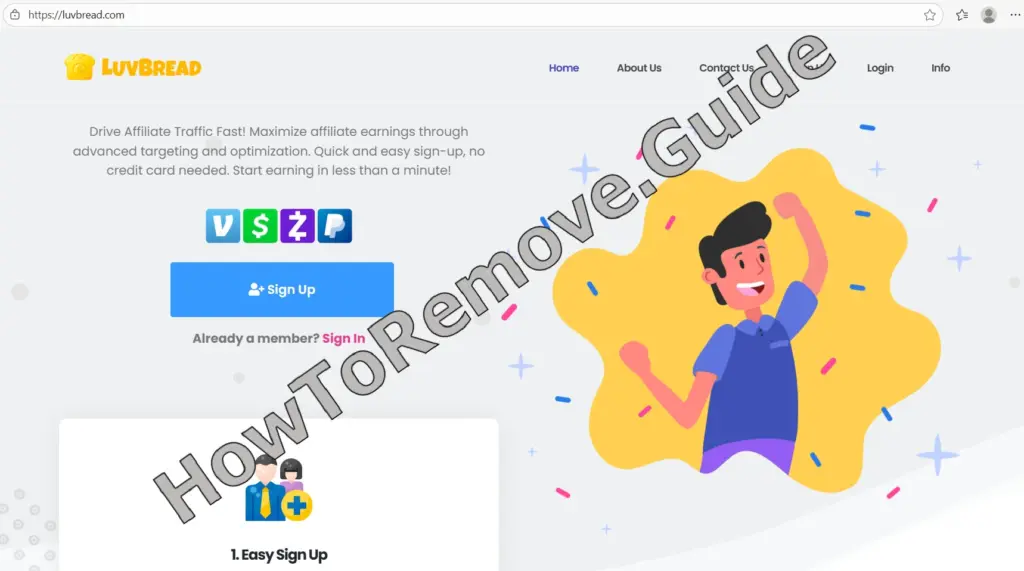
It can sound amazing, right? But if you’ve dealt with even a couple of “too good to be true” platforms, it screams scam. Reviewers who actually tested it report that the offers aren’t real tasks at all. You click a survey, and you’re simply sent to an advertisement. The site is using you as a traffic generator while showing you a fake balance on the screen. One person even noticed they got the $100 bonus without completing anything meaningful – just clicking was enough to make the counter climb.
To make everything look official, LuvBread wraps itself in a long, serious-sounding privacy policy and legal text. It throws around corporate-sounding labels, talks about “Affiliates” and “Trusted Service Providers,” and lists payout options such as PayPal, CashApp, Venmo, Zelle, and Bitcoin to sound familiar. But behind all that, the basic transparency you’d expect just isn’t there. There’s no named founder, no visible CEO, no real human taking responsibility for the platform. External checks flag the domain with a low trust score and warn that it might be a scam.
What Happens When You Try to Withdraw
Now let’s talk about the part they really don’t want you to think too hard about: getting paid. The whole hook of LuvBread is the cartoonish balance that grows almost no matter what you do. Between the instant $100 sign-up “gift” and a few clicks on ad pages dressed up as surveys, hitting the advertised $100 minimum withdrawal is trivial. The site also tells you that before you can withdraw you must finish at least one offer and bring in three referrals, which sounds strict enough to feel “serious” but easy enough that people think they can hit it.
Here’s where the pattern kicks in. People who reached those requirements and tried to cash out describe the same thing happening. As soon as they requested a withdrawal, new conditions suddenly appeared. In one case, after doing everything listed – one offer plus three referrals – the site demanded 27 more referrals before it would even consider releasing the funds. The bar keeps moving. The rules bend just far enough to keep you chasing the next condition, and the payout never actually arrives.
Meanwhile, every extra step you take is valuable to them. Every click, every new person you invite, every bit of time you spend is generating traffic, data, or both. According to its own policy text, the platform logs your device, location, and browsing behavior, and may share or sell that to advertising networks and other partners for “business purposes.” Your time, your data, and your social circle are real.
How the LuvBread Scam Tricks You
So let’s break down how this kind of setup tricks you. First, it throws ridiculous earnings at you: $100 to sign up, $100 per survey, $50 per referral, and $2 per click. No normal, sustainable business pays that kind of money to huge numbers of users. Second, it leans heavily on inflated statistics and borrowed credibility. It shows counters suggesting massive membership and payout totals even though the domain is only days old, and it copies the same look and pitch that other non-paying sites have used before. Third, it hides behind a harsh-sounding Terms & Fraud Policy that threatens to terminate accounts for “unauthentic traffic” – using a VPN, clicking your own link, buying traffic, or using automation. In a setup like this that mostly serves as an excuse to wipe out accounts and balances whenever convenient.
Recognizing Warning Signs of the LuvBread Pattern
What are the warning signs you should train yourself to spot here? Start with the math. If a site claims to hand out $50 per referral and $2 per click on a big scale, you should be asking where that money really comes from. Then look at the timeline. When a platform claims it’s been around for many years, yet the domain was only registered a few days ago, that’s a serious mismatch. Check the ownership as well. If there’s no real person attached to the project, no clear company details, and outside tools are already giving the domain a low trust score, you don’t need to wait for a personal horror story to decide it’s not worth the risk.
If you’ve already shared a link like this, or even joined and started “earning,” this is usually the moment when reality hits. Those big dashboard numbers feel like money you own, even though you’ve never successfully withdrawn it to any of the payment methods they advertise. The longer you stay, the more tempted you are to send the link to friends and family in the hope that just a few more referrals will finally unlock the payout. That’s how these platforms turn one person’s curiosity into a whole little network of victims.
The most useful thing you can do if you’ve tangled with a site like LuvBread isn’t to chase the fake balance; it’s to hit pause, stop sending them traffic, and warn the people you’ve already brought in. Reviewers who’ve gone through this experience are blunt about it: the platform isn’t paying, the owner is simply using your clicks and referrals to make money elsewhere, and even the supposed payment proofs floating around on social media are copied and fake. The sooner everyone in that little circle understands that, the less damage the scam can do.
Bottom Line
Scams like this thrive on fast promises, inflated numbers, and the feeling that you’ve discovered a hidden shortcut that other people don’t know about. If you slow down and line up the facts – brand-new domain, made-up history, anonymous ownership, impossible payout rates, and shifting withdrawal requirements – the picture becomes very clear. Once you’ve seen this pattern a couple of times, the next shiny “referral network” with huge bonuses and a fresh domain stops looking like an opportunity and starts looking exactly like what it is: the same trap with a different name.
