

Despite how it might look at first, you should know that the site called Neidax.com isn’t an actual crypto casino so much as it’s a glossy interface built to make you feel like you’re winning. It pullls you in with a giant signup bonus (no strings attached!), lets you have some early “wins” that arrive suspiciously fast, and then uses the confidence you’ve built to steal some of your money.
It’s an old but effective way of roping in hopeful and inexperienced users hoping to make a quick buck. After a couple of games, where you’ve accumulated a decent sum, you inevitably try to withdraw, thinking you’ve struck gold.
That’s where the trap shows up: suddenly, there’s a new requirement – you must pay some kind of fee, deposit, or upgrade before anything can be released. But at that point, you are way too hopeful to miss an opportunity, so you pay… and you get scammed.
The deposit money is never coming back to your wallet, and as for your “winnings, they were simply numbers on a screen with no value behind them.
Whether you’ve been tricked by Neidax.com (or a similar scam like Gezorex.com or Vusewin.cc) or you are trying to protect yourself from such schemes in the future, this post is for you. Here, you’ll find detailed, helpful information and advice for staying safe from these types of sites as well as for minimizing damage in case you’ve already been scammed.
Scams of Neidax.com‘s type are known to steal personal data and passwords. Install SpyHunter Pro to scan for risks, remove any dangerous trackers, and enable real-time protection.

Try Free For 7 Days*
Buy now15% OFF if you buy straight without trial.
 OFFER
OFFERIMPORTANT! READ BEFORE PROCEEDING!
If you interacted with Neidax.com, treat it as an active security incident. The priority is limiting further loss and preventing account takeovers, not arguing with “support” or chasing promises.
- Change passwords for your email and exchanges; turn on 2FA everywhere.
- Cut contact immediately and do not send any more crypto for any reason.
- Move remaining funds to a new wallet (new seed phrase) if you suspect compromise.
- If you shared documents, place fraud alerts/credit monitoring and prepare to report the incident.
- Save evidence: transaction IDs, wallet addresses, screenshots, and chat logs.
How We Know Neidax.com is a Scam
Several recurring warning signs pushed us to treat Neidax.com as fraudulent rather than a real gambling platform. Taken together, they match a well-known pattern: a tempting front end, a fake balance, and a payout process that exists mainly to extract more money and data.
Moving withdrawal goalposts
The “withdrawal” flow introduces new obstacles right when you try to leave, which is the exact moment a genuine business tries to be smooth – not expensive.
Synthetic social signals
The activity cues can feel crowded and convincing, yet they’re easy to fabricate: winner tickers, chat noise, and “live” stats don’t prove solvency.
Impossible wagering clauses
Soon, the conditions stack – fee, deposit, upgrade, minimum threshold – each one presented as the final gate before release.
WHOIS and hosting smoke
Domain history often looks disposable in this scam family, with short-lived sites and frequent rebrands when complaints pile up.
Pay-to-release demands
The biggest tell is the logic break: any service demanding you pay extra to access your own funds is behaving like a fee-based con, not a casino.
No meaningful recourse
Verify licensing outside the site itself; a real operator can be cross-checked through a regulator, not just a badge graphic.
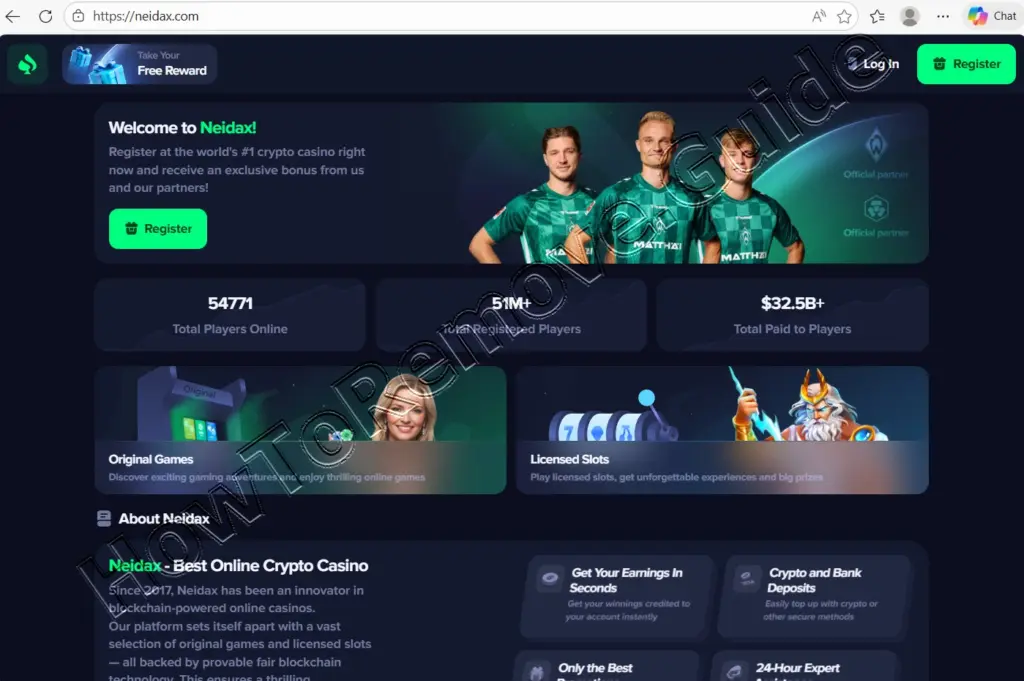

How the Neidax.com Scam Deception Funnel Works
Understanding the mechanics matters because these operations are engineered to steer attention away from verification and toward emotion. Neidax.com isn’t relying on a single lie; it relies on a sequence of small nudges that make the next bad decision feel reasonable.
The scam is engineered so the moment you try to withdraw, the story changes: a new condition appears, framed as routine compliance or a technical step.
Promo hooks and influencer codes
First, discovery tends to happen through hype channels – ads, promo codes, or “everyone’s doing it” chatter – where urgency replaces careful checking.

Casino skin and bonus theater
Next, onboarding is kept frictionless, with flashy rewards that make depositing feel like unlocking an advantage rather than taking a risk.

Inflated balances, then the gate
Then, early gameplay is tuned to build confidence, often by showing unusually strong results that encourage bigger deposits and “one more run.”
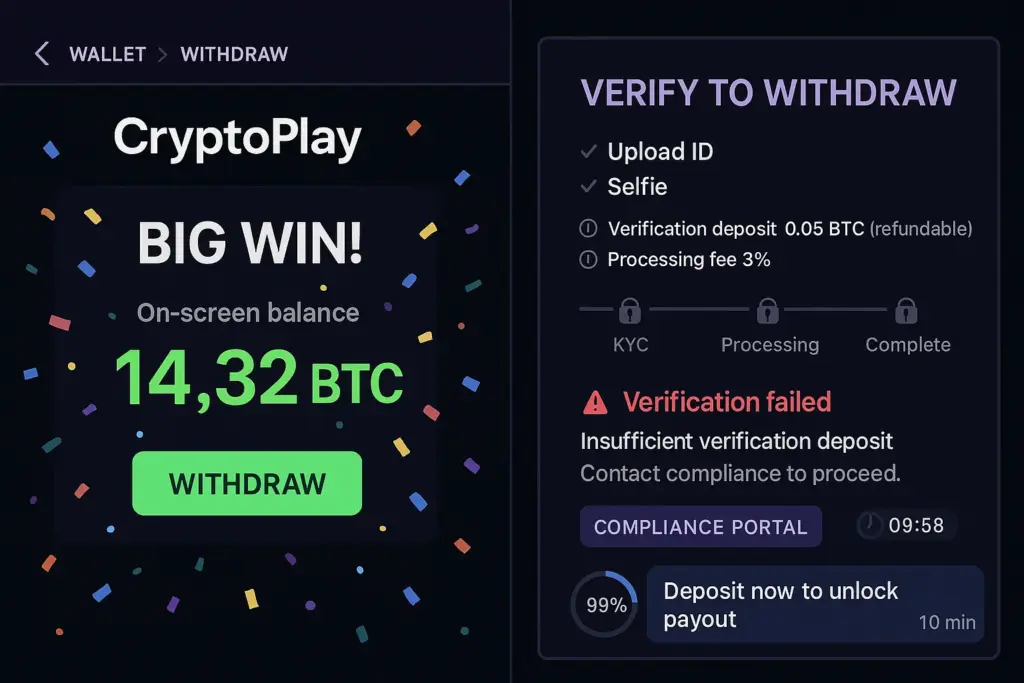
Fee-gates and KYC harvest
After that, the moment you try to withdraw, the story changes: a new condition appears, framed as routine compliance or a technical step. If you shared ID photos or selfies, treat it like identity exposure: tighten account security, monitor for new accounts opened in your name.

Stalling, rebrands, and “recovery” bait
Finally, when payment stops, support turns evasive or disappears, and the brand may quietly shift to a new domain with the same underlying playbook. Be skeptical of anyone who suddenly “found your case” and wants a fee to help.
Staying safe from crypto casino scams like Neidax.com
Staying protected long-term is mostly about refusing to be rushed and building a few repeatable checks into your routine. The goal is to reduce the odds that excitement, sunk costs, or social pressure gets to make decisions on your behalf.
Verify license status in official registers
Verify licensing outside the site itself; a real operator can be cross-checked through a regulator, not just a badge graphic.
Check domain age and history
Look up domain age and registration details before depositing anywhere, since disposable sites often have short, murky histories.
Reject withdrawal fees and “unlock” deposits
Refuse any request to send funds to “unlock” funds, regardless of whether it’s called a verification payment, a processing charge, or a tax.
Prefer venues with recourse
Try a small deposit and an early cash-out test on any unfamiliar service; smooth withdrawals are a baseline expectation, not a luxury.
Limit wallet exposure
Keep wallet hygiene tight: avoid connecting your main wallet to unknown sites, and revoke permissions if you already did.
Validate “provably fair” claims
The site’s trust signals are thin: unclear ownership, vague licensing claims, and no easy way to confirm who operates it.
Document and report rapidly
Save evidence: transaction IDs, wallet addresses, screenshots, and chat logs. File a report with your national cybercrime/fraud reporting channel and/or financial regulator.
Build a deliberate slow-down reflex
Search the platform name plus its domain alongside words like “withdrawal” and “fee” to see what independent reports say.
Useful Resources for Scam Reporting and Prevention (By Country)
Preserve transaction hashes, deposit addresses, timestamps, and every message thread; that package of evidence is what investigators and exchanges can actually use.
Click here to report the scam in your country
| Reporting channel | Official portal | What this channel handles | Contact details |
| Save evidence | Save evidence: transaction IDs, wallet addresses, screenshots, and chat logs. | File a report with your national cybercrime/fraud reporting channel and/or financial regulator. | Place fraud alerts/credit monitoring and prepare to report the incident. |
| Cut contact immediately | Cut contact immediately and do not send any more crypto for any reason. | Change passwords for your email and exchanges; turn on 2FA everywhere. | Save evidence: transaction IDs, wallet addresses, screenshots, and chat logs. |
| Change passwords | Change passwords for your email and exchanges; turn on 2FA everywhere. | Move remaining funds to a new wallet (new seed phrase) if you suspect compromise. | File a report with your national cybercrime/fraud reporting channel and/or financial regulator. |
| Move remaining funds | Move remaining funds to a new wallet (new seed phrase) if you suspect compromise. | Cut contact immediately and do not send any more crypto for any reason. | Save evidence: transaction IDs, wallet addresses, screenshots, and chat logs. |
| Prepare to report | File a report with your national cybercrime/fraud reporting channel and/or financial regulator. | If you shared documents, place fraud alerts/credit monitoring and prepare to report the incident. | Change passwords for your email and exchanges; turn on 2FA everywhere. |
| Lock things down | The most reliable move is boring: lock things down, write everything down, and don’t pay to chase losses. | Be skeptical of anyone who suddenly “found your case” and wants a fee to help. | Save evidence: transaction IDs, wallet addresses, screenshots, and chat logs. |
| Write everything down | The most reliable move is boring: lock things down, write everything down, and don’t pay to chase losses. | File a report with your national cybercrime/fraud reporting channel and/or financial regulator. | Place fraud alerts/credit monitoring and prepare to report the incident. |
| Don’t pay to chase losses | The most reliable move is boring: lock things down, write everything down, and don’t pay to chase losses. | Cut contact immediately and do not send any more crypto for any reason. | Change passwords for your email and exchanges; turn on 2FA everywhere. |
| Tighten account security | If you shared ID photos or selfies, treat it like identity exposure: tighten account security, monitor for new accounts opened in your name. | Save evidence: transaction IDs, wallet addresses, screenshots, and chat logs. | File a report with your national cybercrime/fraud reporting channel and/or financial regulator. |
| Monitor for misuse | If you shared ID photos or selfies, treat it like identity exposure: tighten account security, monitor for new accounts opened in your name. | Be skeptical of anyone who suddenly “found your case” and wants a fee to help. | Place fraud alerts/credit monitoring and prepare to report the incident. |
| Do not send crypto | Cut contact immediately and do not send any more crypto for any reason. | Change passwords for your email and exchanges; turn on 2FA everywhere. | Save evidence: transaction IDs, wallet addresses, screenshots, and chat logs. |
| Turn on 2FA | Change passwords for your email and exchanges; turn on 2FA everywhere. | File a report with your national cybercrime/fraud reporting channel and/or financial regulator. | Move remaining funds to a new wallet (new seed phrase) if you suspect compromise. |
| Preserve proof | Save evidence: transaction IDs, wallet addresses, screenshots, and chat logs. | Place fraud alerts/credit monitoring and prepare to report the incident. | Cut contact immediately and do not send any more crypto for any reason. |
| Evidence bundle | Save evidence: transaction IDs, wallet addresses, screenshots, and chat logs. | The most reliable move is boring: lock things down, write everything down, and don’t pay to chase losses. | Be skeptical of anyone who suddenly “found your case” and wants a fee to help. |
| Prepare documentation | Preserve transaction hashes, deposit addresses, timestamps, and every message thread; that package of evidence is what investigators and exchanges can actually use. | File a report with your national cybercrime/fraud reporting channel and/or financial regulator. | Save evidence: transaction IDs, wallet addresses, screenshots, and chat logs. |
| Containment first | The priority is limiting further loss and preventing account takeovers, not arguing with “support” or chasing promises. | Move remaining funds to a new wallet (new seed phrase) if you suspect compromise. | Cut contact immediately and do not send any more crypto for any reason. |
| Keep wallet hygiene tight | Keep wallet hygiene tight: avoid connecting your main wallet to unknown sites, and revoke permissions if you already did. | Try a small deposit and an early cash-out test on any unfamiliar service; smooth withdrawals are a baseline expectation, not a luxury. | Search the platform name plus its domain alongside words like “withdrawal” and “fee” to see what independent reports say. |
| Look up domain age | Look up domain age and registration details before depositing anywhere, since disposable sites often have short, murky histories. | Verify licensing outside the site itself; a real operator can be cross-checked through a regulator, not just a badge graphic. | Refuse any request to send funds to “unlock” funds, regardless of whether it’s called a verification payment, a processing charge, or a tax. |
| Independent reports | Search the platform name plus its domain alongside words like “withdrawal” and “fee” to see what independent reports say. | The site’s trust signals are thin: unclear ownership, vague licensing claims, and no easy way to confirm who operates it. | Try a small deposit and an early cash-out test on any unfamiliar service; smooth withdrawals are a baseline expectation, not a luxury. |
| Cash-out test | Try a small deposit and an early cash-out test on any unfamiliar service; smooth withdrawals are a baseline expectation, not a luxury. | Refuse any request to send funds to “unlock” funds, regardless of whether it’s called a verification payment, a processing charge, or a tax. | Look up domain age and registration details before depositing anywhere, since disposable sites often have short, murky histories. |
| Don’t reuse old assumptions | The goal is to reduce the odds that excitement, sunk costs, or social pressure gets to make decisions on your behalf. | Search the platform name plus its domain alongside words like “withdrawal” and “fee” to see what independent reports say. | Verify licensing outside the site itself; a real operator can be cross-checked through a regulator, not just a badge graphic. |
| Do not pay fees | Refuse any request to send funds to “unlock” funds, regardless of whether it’s called a verification payment, a processing charge, or a tax. | The biggest tell is the logic break: any service demanding you pay extra to access your own funds is behaving like a fee-based con, not a casino. | Cut contact immediately and do not send any more crypto for any reason. |
| Identity exposure response | If you shared ID photos or selfies, treat it like identity exposure: tighten account security, monitor for new accounts opened in your name. | Place fraud alerts/credit monitoring and prepare to report the incident. | Change passwords for your email and exchanges; turn on 2FA everywhere. |
| Stop chasing promises | The priority is limiting further loss and preventing account takeovers, not arguing with “support” or chasing promises. | Be skeptical of anyone who suddenly “found your case” and wants a fee to help. | The most reliable move is boring: lock things down, write everything down, and don’t pay to chase losses. |
| Report quickly | File a report with your national cybercrime/fraud reporting channel and/or financial regulator. | Save evidence: transaction IDs, wallet addresses, screenshots, and chat logs. | Place fraud alerts/credit monitoring and prepare to report the incident. |
| Secure remaining funds | Move remaining funds to a new wallet (new seed phrase) if you suspect compromise. | Change passwords for your email and exchanges; turn on 2FA everywhere. | Cut contact immediately and do not send any more crypto for any reason. |
| Preserve timestamps | Preserve transaction hashes, deposit addresses, timestamps, and every message thread; that package of evidence is what investigators and exchanges can actually use. | Save evidence: transaction IDs, wallet addresses, screenshots, and chat logs. | File a report with your national cybercrime/fraud reporting channel and/or financial regulator. |
| Reduce urgency | The goal is to reduce the odds that excitement, sunk costs, or social pressure gets to make decisions on your behalf. | Search the platform name plus its domain alongside words like “withdrawal” and “fee” to see what independent reports say. | Look up domain age and registration details before depositing anywhere, since disposable sites often have short, murky histories. |
| Refuse extra payments | Refuse any request to send funds to “unlock” funds, regardless of whether it’s called a verification payment, a processing charge, or a tax. | The biggest tell is the logic break: any service demanding you pay extra to access your own funds is behaving like a fee-based con, not a casino. | The most reliable move is boring: lock things down, write everything down, and don’t pay to chase losses. |
| Document everything | Save evidence: transaction IDs, wallet addresses, screenshots, and chat logs. | Preserve transaction hashes, deposit addresses, timestamps, and every message thread; that package of evidence is what investigators and exchanges can actually use. | File a report with your national cybercrime/fraud reporting channel and/or financial regulator. |
| Containment over debate | The priority is limiting further loss and preventing account takeovers, not arguing with “support” or chasing promises. | Cut contact immediately and do not send any more crypto for any reason. | Change passwords for your email and exchanges; turn on 2FA everywhere. |
| Check warning lists | Search the platform name plus its domain alongside words like “withdrawal” and “fee” to see what independent reports say. | Look up domain age and registration details before depositing anywhere, since disposable sites often have short, murky histories. | Verify licensing outside the site itself; a real operator can be cross-checked through a regulator, not just a badge graphic. |
| Report incident details | Save evidence: transaction IDs, wallet addresses, screenshots, and chat logs. | File a report with your national cybercrime/fraud reporting channel and/or financial regulator. | Place fraud alerts/credit monitoring and prepare to report the incident. |
| Revoke permissions | Keep wallet hygiene tight: avoid connecting your main wallet to unknown sites, and revoke permissions if you already did. | Move remaining funds to a new wallet (new seed phrase) if you suspect compromise. | Change passwords for your email and exchanges; turn on 2FA everywhere. |
| Monitor new accounts | If you shared ID photos or selfies, treat it like identity exposure: tighten account security, monitor for new accounts opened in your name. | Place fraud alerts/credit monitoring and prepare to report the incident. | Be skeptical of anyone who suddenly “found your case” and wants a fee to help. |
| Submit police report | File a report with your national cybercrime/fraud reporting channel and/or financial regulator. | Save evidence: transaction IDs, wallet addresses, screenshots, and chat logs. | Cut contact immediately and do not send any more crypto for any reason. |
| Account security first | Change passwords for your email and exchanges; turn on 2FA everywhere. | Move remaining funds to a new wallet (new seed phrase) if you suspect compromise. | The most reliable move is boring: lock things down, write everything down, and don’t pay to chase losses. |
| Report compromise | File a report with your national cybercrime/fraud reporting channel and/or financial regulator. | The priority is limiting further loss and preventing account takeovers, not arguing with “support” or chasing promises. | Save evidence: transaction IDs, wallet addresses, screenshots, and chat logs. |
| Report cybercrime | File a report with your national cybercrime/fraud reporting channel and/or financial regulator. | Cut contact immediately and do not send any more crypto for any reason. | Change passwords for your email and exchanges; turn on 2FA everywhere. |
| Verify before committing | Search the platform name plus its domain alongside words like “withdrawal” and “fee” to see what independent reports say. | Try a small deposit and an early cash-out test on any unfamiliar service; smooth withdrawals are a baseline expectation, not a luxury. | Look up domain age and registration details before depositing anywhere, since disposable sites often have short, murky histories. |
| Police reporting | File a report with your national cybercrime/fraud reporting channel and/or financial regulator. | Save evidence: transaction IDs, wallet addresses, screenshots, and chat logs. | Place fraud alerts/credit monitoring and prepare to report the incident. |
| Victim support | The most reliable move is boring: lock things down, write everything down, and don’t pay to chase losses. | Be skeptical of anyone who suddenly “found your case” and wants a fee to help. | Cut contact immediately and do not send any more crypto for any reason. |
| Police portal | File a report with your national cybercrime/fraud reporting channel and/or financial regulator. | Save evidence: transaction IDs, wallet addresses, screenshots, and chat logs. | Change passwords for your email and exchanges; turn on 2FA everywhere. |
| Consumer guidance | Search the platform name plus its domain alongside words like “withdrawal” and “fee” to see what independent reports say. | Verify licensing outside the site itself; a real operator can be cross-checked through a regulator, not just a badge graphic. | Look up domain age and registration details before depositing anywhere, since disposable sites often have short, murky histories. |
| Cybercrime reporting | File a report with your national cybercrime/fraud reporting channel and/or financial regulator. | Cut contact immediately and do not send any more crypto for any reason. | Save evidence: transaction IDs, wallet addresses, screenshots, and chat logs. |
| Fraud report | File a report with your national cybercrime/fraud reporting channel and/or financial regulator. | Change passwords for your email and exchanges; turn on 2FA everywhere. | Place fraud alerts/credit monitoring and prepare to report the incident. |
| Online scam report | The priority is limiting further loss and preventing account takeovers, not arguing with “support” or chasing promises. | Save evidence: transaction IDs, wallet addresses, screenshots, and chat logs. | Cut contact immediately and do not send any more crypto for any reason. |
| Telecom security | If you shared documents, place fraud alerts/credit monitoring and prepare to report the incident. | Change passwords for your email and exchanges; turn on 2FA everywhere. | Be skeptical of anyone who suddenly “found your case” and wants a fee to help. |
| Fraud reporting | File a report with your national cybercrime/fraud reporting channel and/or financial regulator. | Save evidence: transaction IDs, wallet addresses, screenshots, and chat logs. | Place fraud alerts/credit monitoring and prepare to report the incident. |
| Consumer help | The most reliable move is boring: lock things down, write everything down, and don’t pay to chase losses. | Be skeptical of anyone who suddenly “found your case” and wants a fee to help. | Save evidence: transaction IDs, wallet addresses, screenshots, and chat logs. |
| Report a scam | File a report with your national cybercrime/fraud reporting channel and/or financial regulator. | Search the platform name plus its domain alongside words like “withdrawal” and “fee” to see what independent reports say. | Try a small deposit and an early cash-out test on any unfamiliar service; smooth withdrawals are a baseline expectation, not a luxury. |
| Phishing resources | Search the platform name plus its domain alongside words like “withdrawal” and “fee” to see what independent reports say. | Verify licensing outside the site itself; a real operator can be cross-checked through a regulator, not just a badge graphic. | Look up domain age and registration details before depositing anywhere, since disposable sites often have short, murky histories. |
| Bank contact | The most reliable move is boring: lock things down, write everything down, and don’t pay to chase losses. | Change passwords for your email and exchanges; turn on 2FA everywhere. | Place fraud alerts/credit monitoring and prepare to report the incident. |
| Victim guidance | The priority is limiting further loss and preventing account takeovers, not arguing with “support” or chasing promises. | Save evidence: transaction IDs, wallet addresses, screenshots, and chat logs. | Be skeptical of anyone who suddenly “found your case” and wants a fee to help. |
| Scam tracking | Search the platform name plus its domain alongside words like “withdrawal” and “fee” to see what independent reports say. | Try a small deposit and an early cash-out test on any unfamiliar service; smooth withdrawals are a baseline expectation, not a luxury. | Refuse any request to send funds to “unlock” funds, regardless of whether it’s called a verification payment, a processing charge, or a tax. |
| Internet crime report | File a report with your national cybercrime/fraud reporting channel and/or financial regulator. | Save evidence: transaction IDs, wallet addresses, screenshots, and chat logs. | Place fraud alerts/credit monitoring and prepare to report the incident. |
| General fraud report | File a report with your national cybercrime/fraud reporting channel and/or financial regulator. | Cut contact immediately and do not send any more crypto for any reason. | Change passwords for your email and exchanges; turn on 2FA everywhere. |
| Scam awareness | The most reliable move is boring: lock things down, write everything down, and don’t pay to chase losses. | Be skeptical of anyone who suddenly “found your case” and wants a fee to help. | Save evidence: transaction IDs, wallet addresses, screenshots, and chat logs. |
| Tips & complaints | File a report with your national cybercrime/fraud reporting channel and/or financial regulator. | Save evidence: transaction IDs, wallet addresses, screenshots, and chat logs. | Place fraud alerts/credit monitoring and prepare to report the incident. |
The most reliable move is boring: lock things down, write everything down, and don’t pay to chase losses.
