

A message pings your phone promising easy money for tiny tasks – like a post, watch a short video, place a small order. Right there in the pitch is a glittery line: “Sign up to get a FREE $100!” Click the link, you’re told, and you’ll step into a sleek dashboard with daily payouts. If that link lands on Ram15.com, pause. Breathe. The page looks serious, the counters shout confidence – 300,543 members, $9,764,893 paid, 500,949 payments made – and the payment logos for PayPal, CashApp, Venmo, and Zelle try to do the trust-building for you. That’s the varnish. Underneath, similar to RamBread and RamStash, is a pay-to-unlock task scam dressed up as an influencer rewards platform.
Scams of Ram15.com‘s type are known to steal personal data and passwords. Install SpyHunter Pro to scan for risks, remove any dangerous trackers, and enable real-time protection.

Try Free For 7 Days*
Buy now15% OFF if you buy straight without trial.
 OFFER
OFFERWhat is Ram15? Is Ram15.com Legit?
Let’s slow this down and walk it the way it actually happens. The first contact isn’t a careful invitation from a verifiable employer. It’s a DM from a stranger or a breezy post in your feed. The channel changes – Facebook, Instagram, LinkedIn, TikTok, X, Snapchat, WhatsApp – but the vibe doesn’t. The tone is friendly, the opportunity flexible, the workload almost laughably simple. You’ll see lines about people being “paid thousands daily,” and you’ll be nudged to click through to a site that mirrors the same counters (even with alternate tallies elsewhere) as if repetition equals proof.
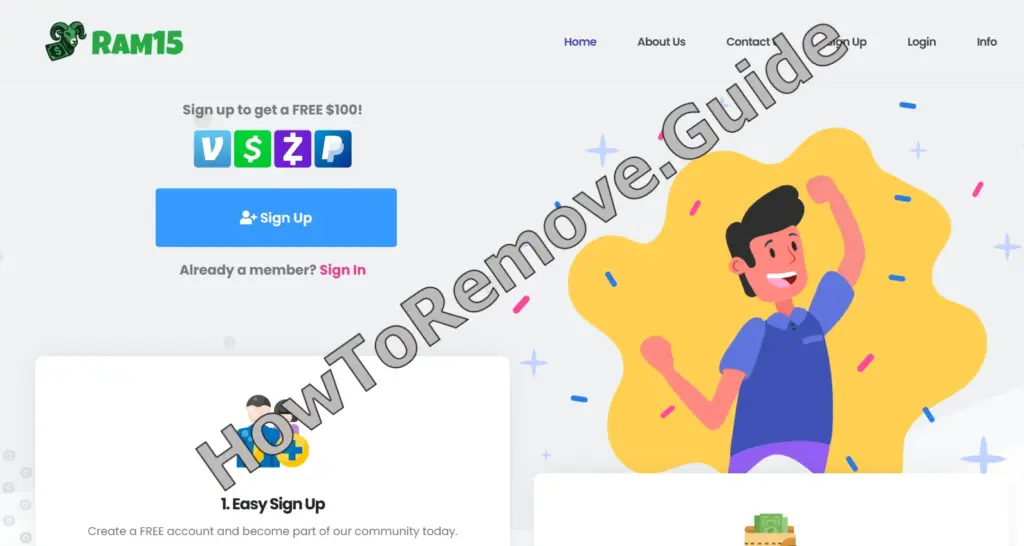
Now, here’s the trust trick. You register with your full name, a username, an email, a password, and you tick the terms box because that’s how websites work. You do a basic task. The dashboard credits you a small amount. Maybe you even withdraw a token payout – just enough to make you think the wheels are turning. That little success is the hook – “See? It works.” Right on cue, a new tier appears. Higher paying tasks. Special promotions. The glitter of “lucky orders.” Unlocking those requires money. There’s an “upgrade.” There’s a “processing” charge. There’s a “tax” to settle before the big withdrawal can go through. Every payment is described as the last step. And then there’s another last step. And another.
Time out again – freeze frame on the red flags that slide past because the page feels busy and official. The “FREE $100” splash is bait, not a generous welcome. The counters exist to make you trust the crowd instead of your own caution. The company identity wobbles: sometimes it’s framed like a corporation, sometimes an LLC, and policy links drift toward odd addresses that look like doubled domains. Recruiters never stand still long enough to verify. When you look for a steady footprint, you find shadows.
What to Do If You’ve Fallen for the Ram15 Scam
What if you’ve already typed your details or sent money? You’re not out of moves. Call your bank or card issuer and freeze anything connected to those fees. If you reused the same password elsewhere, change it now and rotate any repeats. Turn on two-factor authentication where it matters; those codes feel fussy until the moment they save you. Run a full antivirus scan if you touched strange links. Watch your financial accounts for odd charges and challenge anything that traces back to unlocks, upgrades, “processing,” or “lucky order” promises. Report the outreach on the platform that delivered it and flag related emails as phishing so filters get smarter, faster.
How the Ram15 Scam Tricks You
Let’s break down the playbook, step by step, so you can recognize the beats next time even if the brand swaps its mask. One: outreach with urgency, friendly language, and trivial tasks. Two: polished onboarding that feels frictionless and safe. Three: a token win to lower your guard. Four: the upsell to “lucky orders.” Five: the loop of fees – processing, tax, upgrade – each presented as final. Six: pressure to act now so you don’t miss “better” tasks. Seven: the vanishing – stalled payouts, silent chats, access problems. Read that again. It’s simple, and it works because it borrows your optimism one micro-payout at a time.
Another quick aside on the website theatrics. Counters are cheap. Logos are copy-paste. “Daily payouts” is just font weight. The hard part is the boring part: a consistent, checkable identity; contacts that answer; a history that makes sense; payouts that arrive without a gatekeeping fee. If the domain looks newly minted, the owner hides behind privacy shields, or the policy pages bounce you to odd addresses, you have enough to walk away before you ever share a name or password. Treat the unexplained as a stop sign, not a dare.
If you’re reading this because a ping nudged you to register, here’s the simplest plan to keep your footing. Don’t reply. Don’t click. Don’t download anything. Use the report tools wherever the offer appeared and mark similar emails as phishing so filters start earning their keep. If curiosity already pulled you onto the page, close it, clear your recent history, and move on. No dramatic finale required.
What about the testimonials and the screenshots and the breathless “I withdrew today!” posts? Think about the narrative they need you to adopt. Small amounts prove the system, right up until the fee ladder appears. The ladder is the product. The “lucky orders” are the lure. The money you send becomes the only real revenue. Everything else – counters, labels, dashboards – is theater. Once you see that, the glitz dulls fast. The logos remain, but a real payout that arrives without a gatekeeping fee never shows up, because the gate is the point.
For people who’ve already engaged, the cleanup is practical and not glamorous. Change the password you used there and anywhere it repeats. Enable 2FA so a stolen login isn’t a single point of failure. Run updates and a scan. Monitor your statements and set alerts so you’re not catching surprises days later. If any transactions flowed through, document them; your bank’s fraud team will want specifics. Keep reporting the accounts that are pushing these pitches. Silence helps only the sender.
You might wonder whether any of this could be legitimate if the amounts are small and the tasks are simple. Here’s the uncomfortable bit. The complexity isn’t in the task; it’s in the payout conditions. When payment depends on you sending money first – unlock, tax, upgrade, processing – what you’re buying isn’t access to income; you’re buying the story that income is right around the corner. Stories don’t clear. Real payments are not pay-to-play, and real opportunities don’t need you to fund your own “unlock.”
Recognizing Warning Signs Specific to Ram15.com
Zoom out and listen to the language the site uses to sell itself. There’s talk about advertisers paying to reach “influencers,” about users receiving “dividends” based on “influential power.” It sparkles until you ask for the boring pieces – company background you can verify, contacts that respond, payments that arrive without a preliminary fee. The story is glossy; the basics wobble. That contrast is the tell, and once you notice it, you can’t unsee it.
One last mental model to carry with you. Separate appearance from verification. Appearance is a slick dashboard. Verification is a trackable company identity. Appearance is a row of payout logos. Verification is a completed withdrawal you can independently confirm without paying a gate. Appearance is a counter sprinting upward. Verification is a name, a contract, and a history that doesn’t collapse into vague lines about daily rewards. If you can’t reach verification, stop. Let the glitter go.
Let’s land this with concrete snapshots you can keep in your pocket. The bait lines about easy money and daily cash-outs. The counters – 300,543, $9,764,893, 500,949 – and their almost-the-same doubles. The “FREE $100” banner. The pitch that advertisers pay you “dividends” for your social gravity. The “lucky orders” that unlock supposedly larger rewards if you pay first. The recruitment that arrives from nowhere on social apps. The payout names – PayPal, CashApp, Venmo, Zelle – dangling like trust badges while actual payouts stall the moment fees enter the chat.
Final Notes
So here’s the move. Keep your money, keep your credentials, keep your skepticism. When the path to income begins with your payment, you are not being hired; you are being harvested. And if you’ve already stepped onto the page, you can step back off just as quickly. No drama, no final fee, no “one last unlock.” Close the tab. Change the password. Report the message. Then get on with your day – clear-eyed, steady, and a lot less likely to let a counter and a banner talk you into buying a promise that only pays the person who sold it to you.
