

Rezespace is a type of online casino scam that takes its time to get you to establish trust with its potential victims, which is why it and other similar fraudulent platforms are so effective.
First, it pulls you in with a tempting starter bonus that you can use to start playing without risking your own money. Then comes excitement, because the site makes it look like you are winning. It almost looks like the games are rigged in your favor (because they are).
Scams of Rezespace.top‘s type are known to steal personal data and passwords. Install SpyHunter Pro to scan for risks, remove any dangerous trackers, and enable real-time protection.

Try Free For 7 Days*
Buy now15% OFF if you buy straight without trial.
 OFFER
OFFEREventually, you accumulate a high enough balance that you decide to cash out. And since you are already emotionally invested and far less suspicious than when you started, the sudden requirement for a deposit from you before the withdrawal can be processed doesn’t discourage you from continuing.
However, paying that deposit or sharing any type of personal data, like wallet or bank account credentials, is how you get scammed by sites like Rezespace, Ovolion or Rezowin. Never do that if you want to keep your money and maintain your digital security and privacy.
IMPORTANT! READ BEFORE PROCEEDING!
Anyone who created an account, transferred crypto, uploaded identification, connected a wallet, or downloaded files promoted by Rezespace should treat the situation as a live security incident rather than a simple gambling disappointment. The risk can extend beyond the original payment and may include wallet abuse, account takeover attempts, and misuse of personal documents.
Before focusing on the lost balance, contain exposure on the device itself. As an initial cleanup step, we strongly recommend running SpyHunter 5 so you can check for harmful downloads, browser abuse, or other threats that may have been introduced during contact with the scam.
Fastest Removal Option: Use SpyHunter 5
- 1.1Click here to download and install the anti-malware tool on your PC.
- 1.2
 Start SpyHunter 5, click the Buy button and choose between starting your 7-days free trial or directly purchasing the tool.
If you choose to buy SpyHunter 5 now, you can use our discount code, “HTRG15“, for 15% off.
- 1.3
 Once you activate SpyHunter, click Start Scan Now, select the Full Scan option, and let the tool do its job.
 - 1.4
 Once the scan completes (it could take a while, so have patience), you’ll see all malware and other undesirables listed.
Click Next to review the detections and then click Next again to delete all rogue items.
Once the device check is complete, move immediately to account lockdown, wallet migration, evidence collection, exchange notification, and identity monitoring.
- Reset passwords and enable 2FA on your email, crypto exchanges, and wallets; terminate other active sessions.
- Notify any exchanges and services touched by the funds; provide TxIDs and ask that accounts/addresses be flagged per policy.
- Migrate assets to fresh wallets with new seed phrases and revoke any existing token approvals on connected chains.
- If you uploaded ID documents, place credit/fraud alerts where available and monitor for identity-theft signals.
- Assemble an evidence bundle – wallet addresses, TxIDs, site URLs, chats, and screenshots – and file reports with police/IC3 and any involved platforms.
How We Know Rezespace is a Scam
Several warning signs point in the same direction here, and taken together they paint a picture that is hard to mistake. Instead of seeing the normal traits of a transparent gaming business, you see signals commonly associated with cloned crypto-casino scams that rely on false balances and payment hurdles.
Payouts are blocked by invented charges
The supposed winnings remain available only until you request a withdrawal. At that stage, the site introduces a fee, reserve, tax, or minimum deposit requirement that must be paid first, which is a hallmark of advance-fee fraud rather than legitimate account processing.
Regulatory claims do not hold up
Scam pages frequently display license numbers, seals, or compliance wording meant to calm nervous visitors. When those claims are checked against official regulator databases, they are often missing, mismatched, or attached to unrelated entities.
Early success looks unnaturally generous
A real casino expects many users to lose. Fraud sites instead let new accounts appear unusually lucky because rapid “wins” are the bait that nudges victims toward bigger deposits and stronger emotional commitment.
Irreversible payment methods dominate
When a site steers people almost entirely toward cryptocurrency, it strips away much of the dispute protection available with conventional payment channels. That lack of fallback is not accidental; it benefits the operator, not the player.
Trust signals appear manufactured
Chat popups, recent winner banners, enthusiastic comments, and promo codes can all be staged to create the feeling that a busy community is cashing out successfully. None of that is proof unless it can be verified independently.
Domain patterns suggest disposable infrastructure
A quick check with who.is often reveals very recent registration dates, privacy-shielded ownership, or branding that resembles other short-lived casino domains. That kind of churn is consistent with operators who expect to abandon the site once complaints accumulate.


How the Rezespace Scam Deception Funnel Works
Understanding the sequence matters because the scheme usually follows a repeatable script. When you know the order of events, the emotional pressure loses some of its power, and the next request for money or documents becomes easier to recognize as part of the setup.
What begins as entertainment is actually a funnel built to turn excitement into compliance. The victim is first attracted, then reassured, then financially committed, then trapped behind conditions that never stop multiplying.
Step one starts with exposure and temptation
The first contact may come through social media clips, search ads, Telegram groups, Discord messages, fake reviews, or referral-style posts promising bonus codes. The message is usually framed as a rare chance to start with free value and convert it into quick crypto profit.

Step two builds credibility on the page
Once the visitor lands on the site, the platform borrows the visual language of legitimate gambling brands: polished graphics, spinning games, live balances, reward tiers, and claims about fairness or security. The goal is not depth or compliance; it is instant believability.

Step three creates emotional investment
After signup, the account often receives a bonus or a streak of favorable outcomes that makes the balance climb fast. That artificial success encourages the user to imagine the money as already theirs, which lowers skepticism and increases willingness to pay small “unlock” costs.
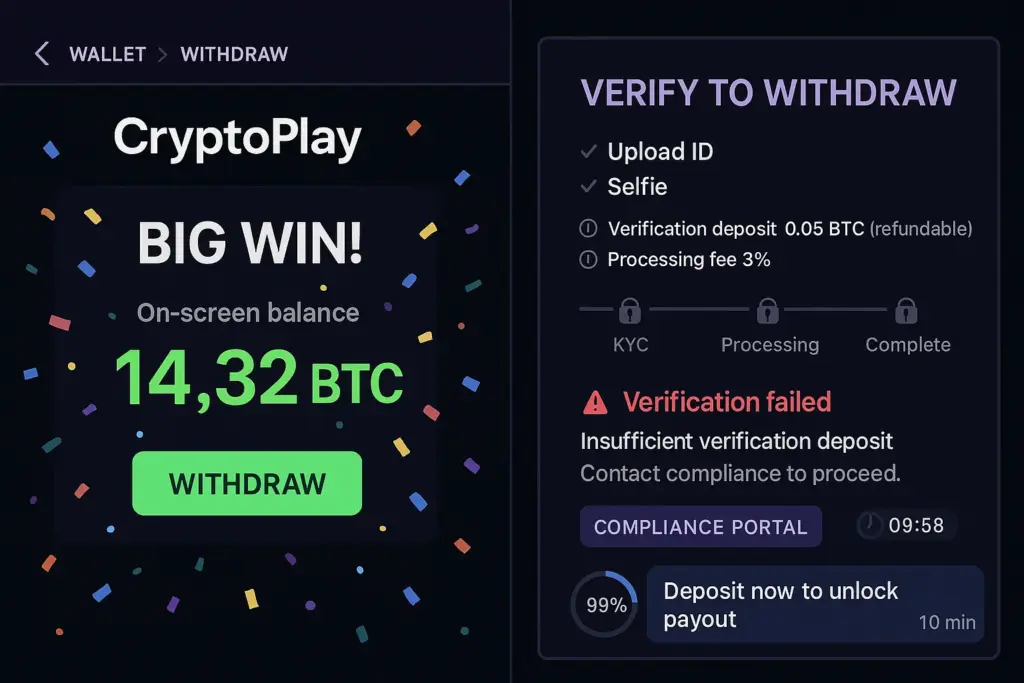
Step four introduces barriers at withdrawal
The moment a user tries to cash out, new obstacles appear: identity verification, anti-money-laundering checks, wallet synchronization, VIP activation, tax settlement, or a deposit supposedly needed to prove account ownership. Each barrier is presented as routine while extracting more crypto and more sensitive data.

Step five drags out the victim and resets the scam
If the target keeps paying, support continues inventing explanations. If the target stops, replies become vague, delayed, or nonexistent, and the site may later reappear under another name. Victims are then especially vulnerable to “asset recovery” impostors who claim they can retrieve the missing funds for yet another fee.
Staying safe from crypto casino scams like Rezespace
The best defense is a routine that slows you down before money leaves your wallet. Scam operators count on momentum, embarrassment, and fear of missing out, so practical verification habits matter far more than gut feeling or slick design.
Confirm licensing from the source, not the homepage
Look up the business in the relevant regulator database using both the brand name and the domain name. A logo on a website means nothing by itself, and a license that cannot be independently confirmed should be treated as absent.
Inspect when the domain appeared and how it has changed
New registration dates, hidden ownership, and abrupt branding changes are all warning signs. Public WHOIS records, cached pages, and archive snapshots can reveal whether the site appeared recently or keeps resurfacing with slightly altered identities.
Refuse any payment that is framed as a condition for withdrawal
Once a platform says you must send crypto to release crypto, stop there. Whether it is called a network charge, clearance deposit, tax prepayment, or wallet verification, the pattern is the same: more money is demanded without proof that any real payout exists.
Choose services that leave room for recourse
Platforms with traceable operators, documented complaints procedures, conventional banking options, and verifiable compliance are safer than anonymous crypto-only fronts. Even then, caution is necessary, but at least there is a framework for disputes and oversight.
Reduce wallet and account blast radius
Keep separate wallets for higher-risk activity, use strong unique passwords, enable two-factor authentication, and revoke token approvals you no longer need. If you already interacted with Rezespace, move remaining assets to new wallets created from fresh seed phrases rather than reusing old exposure.
Question technical claims instead of admiring them
Phrases like “provably fair,” “audited,” or “secure by blockchain” are easy to paste onto a page. If the site does not provide a clear, independently testable method for verifying those claims, treat them as promotional decoration rather than evidence.
Preserve records while the trail is still warm
Save transaction IDs, wallet addresses, support chats, emails, screenshots, and copies of every instruction the site provided. Send that material to any exchange that touched the funds and to your local reporting channels quickly, because frozen accounts or flagged addresses are more likely when evidence is organized early.
Expect follow-up manipulation after the first loss
People who have already been scammed are often targeted again by “investigators,” “hackers,” or “recovery specialists” promising refunds for an upfront charge. Do not pay them. Focus instead on security, reporting, identity monitoring, and realistic documentation in case authorities or service providers can help later.
Useful Resources for Scam Reporting and Prevention (By Country)
Reporting still matters even when crypto transfers are difficult to reverse. Well-documented complaints can help exchanges, wallet providers, law enforcement, and in some cases stablecoin issuers connect your case to a broader pattern and act on linked infrastructure more quickly.
Click here to report the scam in your country
| Country / Agency | URL | Category / Use-case | Phone/Email |
| Australia – Crime Stoppers | https://www.crimestoppers.com.au | Anonymous tips about crime | 1800 333 000 |
| Australia – National Anti-Scam Center (Scamwatch) | https://www.scamwatch.gov.au/report-a-scam | General scams; phishing; texts/emails | |
| Australia – Police Assistance Line (non-emergency) | https://www.police.gov.au | Local police report | 131 444 |
| Australia – ReportCyber (ACSC) | https://www.cyber.gov.au/report | Cybercrime (hacks, fraud, extortion) | |
| Canada – Canadian Anti-Fraud Center (CAFC) | https://www.antifraudcentre-centreantifraude.ca/report-signalez-eng.htm | General scams incl. phone/text/email | |
| France – DGCCRF (SignalConso) | https://signal.conso.gouv.fr | Consumer scams/deceptive practices | |
| France – PHAROS – Internet-Signalement | https://www.internet-signalement.gouv.fr | Online content & cybercrime reports | |
| Germany – Bundeskriminalamt / Local Police | https://www.polizei.de/Polizei/DE/Home/home_node.html | Report online fraud | |
| Germany – Weißer Ring – Victim Support | https://weisser-ring.de | Victim support | 116 006 |
| India – DoT Helpline (Sanchar Saathi) | https://sancharsaathi.gov.in | Fraudulent telecom/SIM related | 155260 |
| India – National Consumer Helpline | https://consumerhelpline.gov.in | Consumer scams | 1800-11-4000 / 1915 |
| India – National Cyber Crime Reporting Portal | https://cybercrime.gov.in | Cybercrime incl. online fraud | 1930 |
| Japan – Consumer Affairs Agency (CAA) | https://www.caa.go.jp/policies/policy/consumer_policy/caution/cybercrime/ | Consumer scams | |
| Japan – National Police Agency – Cybercrime | https://www.npa.go.jp/bureau/cyber/ | Cybercrime reporting | |
| Mexico – Guardia Nacional (National Guard) | https://www.gob.mx/gn | Cybercrime reporting | |
| Mexico – Instituto Federal de Telecomunicaciones (IFT) | https://www.ift.org.mx | Telecom/online services scams | |
| Mexico – PROFECO | https://www.gob.mx/profeco | Consumer fraud & ecommerce | |
| Netherlands – AFM – Report investment fraud | https://www.afm.nl/en/consumenten/themas/beleggen/misleiding-misbruik | Investment/crypto | |
| Netherlands – Fraudehelpdesk | https://www.fraudehelpdesk.nl/melden | General scams (incl. phishing/SMS) | 088-7867372 |
| Netherlands – Politie – Meldpunt Internetoplichting | https://www.politie.nl/themas/internetoplichting.html | Online shopping fraud | |
| New Zealand – CERT NZ | https://www.cert.govt.nz/individuals/report-an-issue/ | Phishing, identity scams | |
| New Zealand – Department of Internal Affairs – Spam | https://www.dia.govt.nz/Spam-Contact-Us | Email/SMS spam | [email protected] |
| New Zealand – IDCARE | https://www.idcare.org | Victim support (identity compromise) | 0800 121 068 |
| New Zealand – Netsafe – Report | https://www.netsafe.org.nz/report/ | Online harms & scams | |
| New Zealand – New Zealand Police (non-emergency) | https://www.police.govt.nz/use-105 | Report fraud/online crime | 105 |
| Nigeria – Economic & Financial Crimes Commission (EFCC) | https://www.efcc.gov.ng | Financial scams incl. crypto/investment | [email protected] |
| Nigeria – Nigeria Police Special Fraud Unit (SFU) | https://www.specialfraudunit.org.ng | Serious fraud | Voice/SMS: 0708 227 6895; WhatsApp: 0812 760 9914 |
| Poland – CERT Polska (CERT.PL) | https://cert.pl/en/report/ | Cyber incidents & phishing | |
| Poland – Dyzurnet.pl | https://dyzurnet.pl | Illegal online content (esp. child protection) | |
| Poland – Polish Police (Policja) | https://www.policja.pl | Report scams to police | |
| Singapore – Anti-Scam Centre / Anti-Scam Helpline | https://www.scamalert.sg | General scams; texts; calls | 1800-722-6688 |
| Singapore – Monetary Authority of Singapore (MAS) | https://www.mas.gov.sg/investor-alert-list | Investment/crypto checks | |
| Singapore – Singapore Police Force | https://www.police.gov.sg/iwitness | Police report (cybercrime) | |
| South Africa – Cybersecurity Hub (CSIRT) | https://www.cybersecurityhub.gov.za | Cyber incidents incl. scams | |
| South Africa – South African Fraud Prevention Service (SAFPS) | https://www.safps.org.za | Identity fraud support | 011-867-2234 |
| South Africa – South African Police Service (SAPS) | https://www.saps.gov.za | Police report (cybercrime unit) | |
| South Korea – Korea Communications Commission (KCC) | https://www.kcc.go.kr | Telecom-related fraud | |
| South Korea – Korea Internet & Security Agency (KISA) | https://www.kisa.or.kr | Phishing, online harms | |
| South Korea – Korean National Police Agency – Cyber Bureau | https://ecrm.cyber.go.kr | Cybercrime reporting | |
| Spain – INCIBE – Oficina de Seguridad del Internauta (OSI) | https://www.osi.es/es/reporte | Cybersecurity & online fraud | |
| Spain – Policía Nacional / Guardia Civil | https://www.policia.es | Report scams to police | |
| Sweden – Crime Victim Authority (Brottsoffermyndigheten) | https://www.brottsoffermyndigheten.se | Victim support & compensation | 090–70 82 00 |
| Sweden – Polisen (Swedish Police) | https://polisen.se | Report fraud/cybercrime | 114 14 (non-emergency); 112 (emergency) |
| Sweden – Swedish Consumer Agency (Konsumentverket) | https://www.konsumentverket.se | Unfair business practices | |
| United Arab Emirates – Abu Dhabi Police – Aman Service | https://www.adpolice.gov.ae | Cybercrime tips/reporting | SMS 2828; 800 2626 |
| United Arab Emirates – Dubai Police – eCrime | https://www.dubaipolice.gov.ae | Cybercrime reporting | 04 606 1600 |
| United Arab Emirates – Ministry of Interior – Cyber Crime Dept. | https://www.moi.gov.ae | Cybercrime incl. online scams | |
| United Arab Emirates – Telecommunications Regulatory Authority (TRA) / TDRA | https://www.tra.gov.ae | Telecom-related scams/phishing | |
| United Kingdom – Action Fraud (NFIB) | https://www.actionfraud.police.uk | General scams & cybercrime (non-emergency) | 0300 123 2040 |
| United Kingdom – Citizens Advice Consumer Service | https://www.citizensadvice.org.uk/consumer/get-more-help/if-you-need-more-help-about-a-consumer-issue/ | Consumer problems & scam guidance | 0808 223 1133 |
| United Kingdom – Financial Conduct Authority (FCA) | https://www.fca.org.uk/consumers/report-scam-us | Investment/crypto & financial services | |
| United Kingdom – National Cyber Security Centre (NCSC) | https://www.ncsc.gov.uk/collection/phishing-scams | Phishing emails & suspicious websites | |
| United Kingdom – Stop Scams UK ‘159’ | https://stopscamsuk.org.uk/159 | Banking APP fraud (direct to your bank) | 159 |
| United States – AARP Fraud Watch Network Helpline | https://www.aarp.org/money/scams-fraud/ | Victim support | 833-372-8311 |
| United States – Better Business Bureau – Scam Tracker | https://www.bbb.org/scamtracker | Business/marketplace scams | |
| United States – FBI Internet Crime Complaint Center (IC3) | https://www.ic3.gov | Internet crime incl. investment/crypto | |
| United States – Federal Trade Commission – ReportFraud | https://reportfraud.ftc.gov | General scams, phishing, texts/emails | 1-877-382-4357 |
| United States – National Center for Disaster Fraud | https://www.justice.gov/disaster-fraud | Disaster-related scams | (866) 720-5721 |
| United States – SEC Tips & Complaints | https://www.sec.gov/tcr | Investment & securities/crypto-asset offerings |
Taken together, the pattern is consistent: false confidence, blocked withdrawals, pressure for more payments, and disappearing operators. Treat Rezespace as unsafe, protect what remains, and verify every future platform as though the next glossy promise is trying to rush you into the same trap.
