

Let me stop you before the click. You land on a glossy site with big promises, shiny charts, and “cutting-edge tools,” and a voice in your head whispers this could be the one. Time out: the name is Ryxbets.com, sometimes shortened to Ryxbets, and before you do anything, breathe. I’m not here to nitpick fonts; I’m here to focus on concrete parts that matter. What shows up is a cluster of tells you shouldn’t ignore. The domain is brand-new, about a month old. The owner is hidden by WHOIS privacy. The site leans, similar to Jackpotcitycasino.com and BitNest, on confidence, but the support pillars are thin. That mismatch is where your skepticism should live.
Scams of Ryxbets.com‘s type are known to steal personal data and passwords. Install SpyHunter Pro to scan for risks, remove any dangerous trackers, and enable real-time protection.

Try Free For 7 Days*
Buy now15% OFF if you buy straight without trial.
 OFFER
OFFERIs Ryxbets Legit?
First, identity drift. On one hand, the site calls itself a crypto trading platform and touts advanced tools that supposedly deliver “massive returns.” On the other hand, the same name is also described as a sports betting and gambling hub where you place stakes on games. Pick a lane, right? Mature platforms don’t wobble between trading and gambling in the same breath. That wobble isn’t a cute brand flourish; it muddies expectations, rules, and what you’re actually being invited to do. When a service can’t keep its own story straight, you shouldn’t be the one doing the translation.
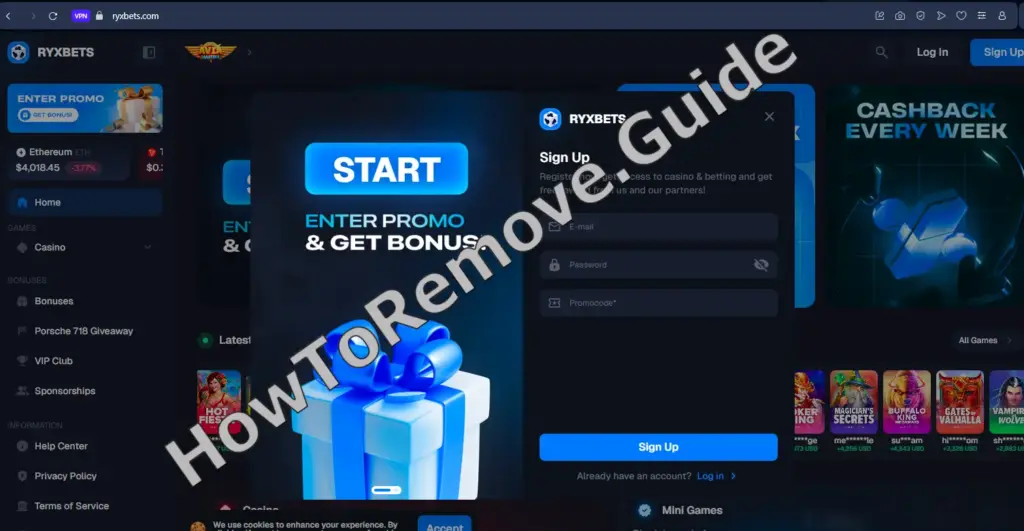
Now, about the age. A one-month-old domain isn’t automatically bad. New ventures appear every day. But when something this new is already soliciting investments, you owe yourself extra scrutiny. Established trading venues have history, user trust, scars, updates, and a breadcrumb trail of accountability. Fresh domains have none of that. Stack the concealed ownership on top. Yes, privacy can be normal, and yes, it can be misused. The risk dial ticks higher when the owner is hidden and the pitch is money in, returns out.
Transparency doesn’t improve when you click around. There’s no comprehensive “About Us” that introduces founders, team, or operational history. No biographies. No track record of how the operation came to be. You get the vibe of a stage set. It looks real from the seats, but when you walk backstage it’s plywood and borrowed lights. Contact is equally thin. You have an email address and a basic form. That’s it. No phone number. No physical address. The absence matters because when funds, identity, or responsibility are involved, reachable humans are part of the product.
Let’s talk function versus promise. A reliable trading platform lives or dies on tools that work and data that mean something. Reports point to limited functionality and glitches, which is already a problem before we even touch the marketing. Then the copy leans hard on “high returns” with “minimal risk.” That combination—operational hiccups riding shotgun with sky-high promises – isn’t just odd; it’s a mismatch. The stronger the pitch, the more you should test the plumbing. If the tools stumble while the slogans sprint, believe the stumble.
Hosting context adds another brick to the wall. Legit sites tend to share servers with other normal, safe neighbors. Here, several unreliable websites were identified on the same server as this platform. No, that alone isn’t a smoking gun; servers are crowded apartment buildings. But if your neighbors smell like trouble and your nameplate is new, that’s not the backdrop you want. There’s even a place to check the neighborhood – the Server tab – so you can see the cluster for yourself. When the address looks noisy and the story is hazy, caution is the only sensible default.
Red flags that reveal the Ryxbets scam early
Let’s break the pattern into portable flags. Newly registered domain with little or no trading history. Promises of high returns and easy money with minimal risk. Look-and-feel similarities to other suspicious websites. Unverified celebrity endorsements waved for credibility. Lack of refund or withdrawal options. Sparse company background and no meaningful “About Us.” No phone number, no physical address, just an email and a form. Owner identity hidden on WHOIS. Server neighbors that don’t inspire confidence. Reports of limited functionality and glitches. Each flag is a nudge; together, they form a loud signal.
You might ask, where are the horror stories and receipts. There aren’t detailed victim narratives in the material at hand. No transcripts, no numbers, no blow-by-blow support exchanges. That absence tracks with the timeline. A one-month-old site hasn’t left much sediment on the riverbed yet. What you do have is a pattern made of observable, checkable facts: youth, opacity, exaggerated claims, and technical friction. Not rumors. Not vibes. Just visible conditions. Early is not the same as trustworthy; it simply means the pattern is visible before the damage piles up.
Okay, so what do you actually do with this. You verify before you engage. Start with the timeline: confirm the domain’s age. Then the people: is there a real “About Us” with names, roles, and histories you can cross-check. Support: do you get more than a mailbox and a form. Ownership: is it hidden, and if so, what does that prevent you from confirming. Functionality: are there consistent reports of glitches or limited tools. Neighborhood: what else is living on that server, and does it look unreliable. None of these checks require a deposit; they only ask for time and attention.
Here’s the sales choreography as it tends to unfold. Step one, a sleek design with bold graphics to build instant trust. Step two, “cutting-edge tools” and a promise that your returns will be high while your risk somehow stays low. Step three, a background that says very little about who runs the place. Step four, a funnel to low-accountability support: email and a form. Step five, friction when you rely on the platform to do anything beyond look impressive. That sequence is not unique; that is precisely why you should recognize it on sight.
I’m going to say the quiet part plainly. It’s easy to be dazzled by a site that looks like a rocket, but rockets are built by named teams with traceable histories, redundancies, and checklists thicker than a brick. When the origin story is a mystery, the contact options are anemic, the neighbors are sketchy, the tools are limited, and the copy talks like a lottery ad in a lab coat, you don’t need to argue with it. You need to step back. Curiosity is healthy. Blind trust is a donation.
None of this is about paranoia. It’s about posture. You’re calibrating skepticism to the evidence in front of you. In this instance, the evidence lines up: very young domain, concealed ownership, missing background, minimal contact options, unreliable neighbors, reported glitches, and big promises about returns and risk. So be methodical. Check the age. Note the hidden owner. Confirm the missing “About Us.” Observe the lack of a phone number and physical address. Map the server neighborhood. Compare the sales pitch to the available function.
If you’re wondering whether you’re being too cautious, remember the asymmetry. Hesitate and verify, and you lose a few minutes. Rush and deposit, and you can lose control. The platform may look like an opportunity, but the specifics don’t add up to trust. Credibility isn’t a filter you slap on a homepage; it’s the sum of history, transparency, working tools, and reachable humans. Until those pieces are in place and visible, keep your hands off the wallet and your eyes on the details.
Bottom Line
So here’s the distilled takeaway you can keep in your back pocket. Appearance is cheap. Consistency is hard. When something calls itself a trading platform one moment and a gambling venue the next, when the domain is barely out of the wrapper, when the owner is masked, when the “About Us” is air, when the contact options don’t extend beyond a mailbox and a form, when the server hosts questionable neighbors, when users report glitches, and when the pitch promises “massive returns” for “minimal risk,” the only rational instinct is to pause and verify.
In the end, staying informed isn’t a slogan; it’s a habit. Verify first. Demand clarity. Reward transparency. And whenever a site asks you to trade skepticism for speed, remember the elementary rule that keeps your accounts safe. If the details don’t stand up on their own, the story doesn’t either. Stay alert, stay methodical, and save your yes for the places that have earned it. Pause, verify, and let facts, not polish, decide where your attention, credentials, and money actually go today and always, consistently.
