

Being suspicious of Spdwin and other sites like it is a healthy mindset, because, unsurprisingly, this is a total and absolute scam that won’t benefit you in any way.
It may look like a legit crypto gambling platform, but be extremely careful with it because, despite its polished design and fat bonuses, it’s all a facade designed with one goal – to pull in as much money as it can before disappearing and then popping up somewhere else under a different name.
That’s how Spdwin and other identical sites like Hotexplay and Gusewin256 operate. They make you believe you are about to win it big and then trick you into making a “small” deposit to claim your winnings. Needless to say, you claim nothing and just lose the deposit.
Scams of Spdwin.com‘s type are known to steal personal data and passwords. Install SpyHunter Pro to scan for risks, remove any dangerous trackers, and enable real-time protection.

Try Free For 7 Days*
Buy now15% OFF if you buy straight without trial.
 OFFER
OFFERBut the real issue here is granting the scammers access to sensitive personal data. If you take their bait, it’s totally possible to let them into your wallet or banking account without even realizing it.
If you’ve fallen for this scam, it’s critical that you take action and do everything you can to mitigate further harm. Check the tips below and apply them to regain your digital security.
IMPORTANT! READ BEFORE PROCEEDING!
Anyone who already deposited, connected a wallet, or sent documents to Spdwin should stop interacting with the site immediately. Do not pay one more “release” fee and do not trust claims that the next transfer will solve the problem. The fastest damage control usually comes from cutting access, securing accounts, and preserving evidence:
- Reset passwords for email and exchange accounts, then enable 2FA everywhere it is available.
- Disconnect any wallet from the site and move remaining assets to a fresh wallet you control.
- Treat any exposed seed phrase or private key as a full compromise and migrate from a clean device.
- If ID files were uploaded, place a fraud alert or credit freeze and monitor for misuse.
- Save screenshots, chats, wallet addresses, and transaction hashes before the domain changes or disappears.
Why Spdwin Fails a Basic Trust Test
Seen one by one, some clues might look ordinary; taken together, they form the classic fake-balance and paywall-withdrawal pattern. Spdwin fits that pattern closely enough that caution alone is not enough anymore.
Paywall withdrawals are a major alarm
The problem usually becomes obvious only when a cash-out request triggers a demand for more crypto, framed as a release fee, verification payment, or account unlock step.
Huge promo credits are there to lower your guard
Instead of proving legitimacy, outsized bonus codes and “free balance” offers are used to create urgency and make a first deposit feel small by comparison.
Fresh domains and obscured operators deserve suspicion
Short domain history, weak company disclosure, and limited ownership transparency are common across clone casinos that reappear under new names when complaints pile up.
Activity cues can be manufactured
Pop-ups, live chat blurbs, winning banners, and positive comments can all be staged to imitate the noise and momentum of a busy gambling platform.
Support behavior often revolves around the next payment
Rather than solving the withdrawal issue, the support loop commonly circles back to one more fee, one more compliance step, or one more promise that never resolves.
Celebrity or influencer hype rarely survives verification
Traffic is frequently driven through social posts, copied clips, or fake endorsements that look persuasive until you try to confirm them outside the casino’s own funnel.
Independent checks tell a harsher story
Lookups for age, ownership, licensing, and third-party discussion often reveal a thin footprint that does not match the polished image shown on the landing page.


Inside the Spdwin Scam Sequence
Recognizing the usual script matters because it turns a confusing experience into a predictable sequence. Once the moving parts become visible, it is much easier to interrupt the process before urgency, greed, and sunk-cost pressure take over.
The same sequence also helps after the fact, because reports become clearer when you can describe what happened as a staged funnel rather than as random bad luck.
The lure usually starts off-platform
Many victims first meet sites like Spdwin through social posts, comment spam, promo codes, or fake influencer recommendations rather than through credible gambling channels.

A polished landing page lowers resistance
Once you arrive, the interface looks routine enough to shrink skepticism: games, bonuses, balances, and signup flows all mimic the surface of a legitimate casino.

Early wins create false confidence
After the account is active, the displayed gameplay often feels unusually generous, encouraging the belief that you found a lucky streak instead of a manipulated balance.
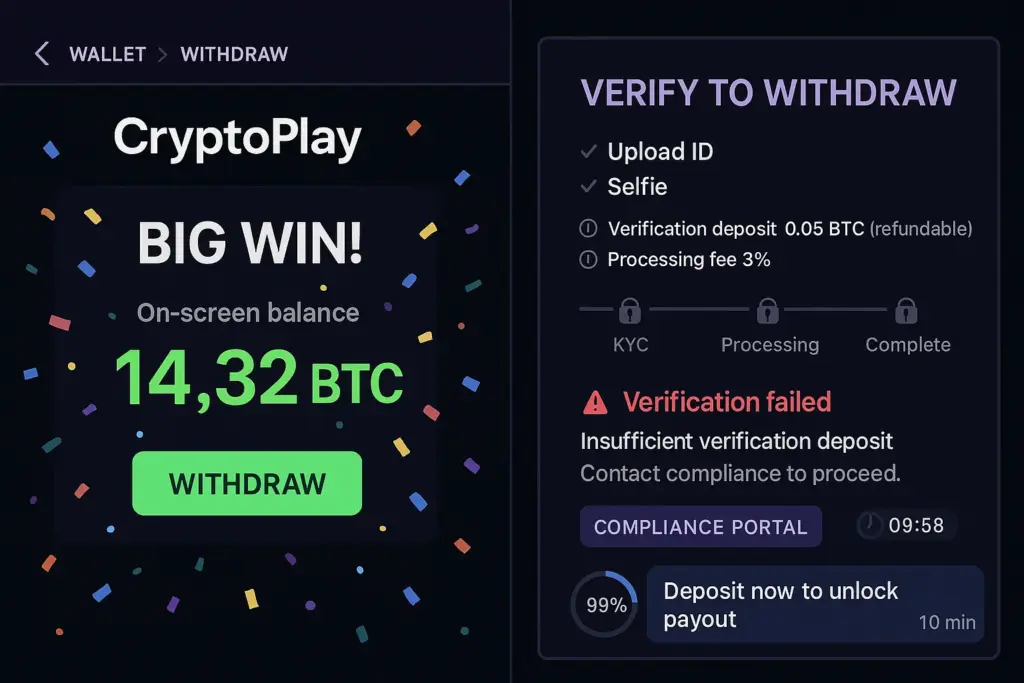
The withdrawal gate is where the trap shows itself
The tone changes when you attempt to cash out: support starts talking about KYC, VIP status, collateral, taxes, or a deposit needed before funds can be released.

Delay, rebrand, and recovery bait often follow
When the victim keeps paying, the hurdles usually multiply until the site stalls, vanishes, or gives way to follow-up scammers promising recovery for another fee.
Practical Ways to Avoid Sites Like Spdwin
Better protection comes from routines that still work when you are tired, rushed, or tempted by a flashy promise. The goal is not perfect judgment every time; it is building habits that make bad platforms easier to reject early.
Confirm license claims in official registers
A footer logo means very little on its own. What matters is whether a real operator, company, and license can be confirmed in an official database outside the site.
Inspect domain age and operator history
A young domain with weak company disclosure should trigger maximum skepticism, especially when the site tries to look older, larger, or more established than its footprint suggests.
Refuse any pay-to-release demand
One rule prevents many losses: never send money to get your own money back. A surprise withdrawal fee, unlock payment, or VIP charge is a stop signal, not a hurdle to work through.
Reduce exposure with separate accounts
Compartmentalization helps. Using a separate email and a low-value wallet for risky experiments can keep one bad site from touching everything else you use.
Disconnect wallets and review permissions
Wallet safety improves when you disconnect sites after use and refuse opaque approval requests that do not clearly explain what access you are granting.
Ignore hype you cannot verify yourself
Glowing reposts, promo codes, and celebrity-style mentions are cheap to fake. Trust only what you can confirm through independent records, not through the campaign itself.
Save evidence and report quickly
Preserve screenshots, wallet addresses, hashes, and chat logs before the site changes. Fast reporting can improve tracing and helps authorities see the wider pattern sooner.
Train a pause before every deposit
Scams thrive on speed. A short pause to verify ownership, age, license claims, and payment logic can break the emotional momentum the whole funnel depends on.
Useful Resources for Scam Reporting and Prevention (By Country)
Before access disappears, collect as much proof as you can: screenshots of balances, fee demands, conversations, the domain name, wallet addresses, and transaction hashes. Contact the exchange used for the transfer quickly, because timing can matter when tracing activity or flagging suspicious movement.
Click here to report the scam in your country
| Country / Agency | URL | Category / Use-case | Phone/Email |
| Australia – Crime Stoppers | https://www.crimestoppers.com.au | Anonymous tips about crime | 1800 333 000 |
| Australia – National Anti-Scam Center (Scamwatch) | https://www.scamwatch.gov.au/report-a-scam | General scams; phishing; texts/emails | |
| Australia – Police Assistance Line (non-emergency) | https://www.police.gov.au | Local police report | 131 444 |
| Australia – ReportCyber (ACSC) | https://www.cyber.gov.au/report | Cybercrime (hacks, fraud, extortion) | |
| Canada – Canadian Anti-Fraud Center (CAFC) | https://www.antifraudcentre-centreantifraude.ca/report-signalez-eng.htm | General scams incl. phone/text/email | |
| France – DGCCRF (SignalConso) | https://signal.conso.gouv.fr | Consumer scams/deceptive practices | |
| France – PHAROS – Internet-Signalement | https://www.internet-signalement.gouv.fr | Online content & cybercrime reports | |
| Germany – Bundeskriminalamt / Local Police | https://www.polizei.de/Polizei/DE/Home/home_node.html | Report online fraud | |
| Germany – Weißer Ring – Victim Support | https://weisser-ring.de | Victim support | 116 006 |
| India – DoT Helpline (Sanchar Saathi) | https://sancharsaathi.gov.in | Fraudulent telecom/SIM related | 155260 |
| India – National Consumer Helpline | https://consumerhelpline.gov.in | Consumer scams | 1800-11-4000 / 1915 |
| India – National Cyber Crime Reporting Portal | https://cybercrime.gov.in | Cybercrime incl. online fraud | 1930 |
| Japan – Consumer Affairs Agency (CAA) | https://www.caa.go.jp/policies/policy/consumer_policy/caution/cybercrime/ | Consumer scams | |
| Japan – National Police Agency – Cybercrime | https://www.npa.go.jp/bureau/cyber/ | Cybercrime reporting | |
| Mexico – Guardia Nacional (National Guard) | https://www.gob.mx/gn | Cybercrime reporting | |
| Mexico – Instituto Federal de Telecomunicaciones (IFT) | https://www.ift.org.mx | Telecom/online services scams | |
| Mexico – PROFECO | https://www.gob.mx/profeco | Consumer fraud & ecommerce | |
| Netherlands – AFM – Report investment fraud | https://www.afm.nl/en/consumenten/themas/beleggen/misleiding-misbruik | Investment/crypto | |
| Netherlands – Fraudehelpdesk | https://www.fraudehelpdesk.nl/melden | General scams (incl. phishing/SMS) | 088-7867372 |
| Netherlands – Politie – Meldpunt Internetoplichting | https://www.politie.nl/themas/internetoplichting.html | Online shopping fraud | |
| New Zealand – CERT NZ | https://www.cert.govt.nz/individuals/report-an-issue/ | Phishing, identity scams | |
| New Zealand – Department of Internal Affairs – Spam | https://www.dia.govt.nz/Spam-Contact-Us | Email/SMS spam | [email protected] |
| New Zealand – IDCARE | https://www.idcare.org | Victim support (identity compromise) | 0800 121 068 |
| New Zealand – Netsafe – Report | https://www.netsafe.org.nz/report/ | Online harms & scams | |
| New Zealand – New Zealand Police (non-emergency) | https://www.police.govt.nz/use-105 | Report fraud/online crime | 105 |
| Nigeria – Economic & Financial Crimes Commission (EFCC) | https://www.efcc.gov.ng | Financial scams incl. crypto/investment | [email protected] |
| Nigeria – Nigeria Police Special Fraud Unit (SFU) | https://www.specialfraudunit.org.ng | Serious fraud | Voice/SMS: 0708 227 6895; WhatsApp: 0812 760 9914 |
| Poland – CERT Polska (CERT.PL) | https://cert.pl/en/report/ | Cyber incidents & phishing | |
| Poland – Dyzurnet.pl | https://dyzurnet.pl | Illegal online content (esp. child protection) | |
| Poland – Polish Police (Policja) | https://www.policja.pl | Report scams to police | |
| Singapore – Anti-Scam Centre / Anti-Scam Helpline | https://www.scamalert.sg | General scams; texts; calls | 1800-722-6688 |
| Singapore – Monetary Authority of Singapore (MAS) | https://www.mas.gov.sg/investor-alert-list | Investment/crypto checks | |
| Singapore – Singapore Police Force | https://www.police.gov.sg/iwitness | Police report (cybercrime) | |
| South Africa – Cybersecurity Hub (CSIRT) | https://www.cybersecurityhub.gov.za | Cyber incidents incl. scams | |
| South Africa – South African Fraud Prevention Service (SAFPS) | https://www.safps.org.za | Identity fraud support | 011-867-2234 |
| South Africa – South African Police Service (SAPS) | https://www.saps.gov.za | Police report (cybercrime unit) | |
| South Korea – Korea Communications Commission (KCC) | https://www.kcc.go.kr | Telecom-related fraud | |
| South Korea – Korea Internet & Security Agency (KISA) | https://www.kisa.or.kr | Phishing, online harms | |
| South Korea – Korean National Police Agency – Cyber Bureau | https://ecrm.cyber.go.kr | Cybercrime reporting | |
| Spain – INCIBE – Oficina de Seguridad del Internauta (OSI) | https://www.osi.es/es/reporte | Cybersecurity & online fraud | |
| Spain – Policía Nacional / Guardia Civil | https://www.policia.es | Report scams to police | |
| Sweden – Crime Victim Authority (Brottsoffermyndigheten) | https://www.brottsoffermyndigheten.se | Victim support & compensation | 090–70 82 00 |
| Sweden – Polisen (Swedish Police) | https://polisen.se | Report fraud/cybercrime | 114 14 (non-emergency); 112 (emergency) |
| Sweden – Swedish Consumer Agency (Konsumentverket) | https://www.konsumentverket.se | Unfair business practices | |
| United Arab Emirates – Abu Dhabi Police – Aman Service | https://www.adpolice.gov.ae | Cybercrime tips/reporting | SMS 2828; 800 2626 |
| United Arab Emirates – Dubai Police – eCrime | https://www.dubaipolice.gov.ae | Cybercrime reporting | 04 606 1600 |
| United Arab Emirates – Ministry of Interior – Cyber Crime Dept. | https://www.moi.gov.ae | Cybercrime incl. online scams | |
| United Arab Emirates – Telecommunications Regulatory Authority (TRA) / TDRA | https://www.tra.gov.ae | Telecom-related scams/phishing | |
| United Kingdom – Action Fraud (NFIB) | https://www.actionfraud.police.uk | General scams & cybercrime (non-emergency) | 0300 123 2040 |
| United Kingdom – Citizens Advice Consumer Service | https://www.citizensadvice.org.uk/consumer/get-more-help/if-you-need-more-help-about-a-consumer-issue/ | Consumer problems & scam guidance | 0808 223 1133 |
| United Kingdom – Financial Conduct Authority (FCA) | https://www.fca.org.uk/consumers/report-scam-us | Investment/crypto & financial services | |
| United Kingdom – National Cyber Security Centre (NCSC) | https://www.ncsc.gov.uk/collection/phishing-scams | Phishing emails & suspicious websites | |
| United Kingdom – Stop Scams UK ‘159’ | https://stopscamsuk.org.uk/159 | Banking APP fraud (direct to your bank) | 159 |
| United States – AARP Fraud Watch Network Helpline | https://www.aarp.org/money/scams-fraud/ | Victim support | 833-372-8311 |
| United States – Better Business Bureau – Scam Tracker | https://www.bbb.org/scamtracker | Business/marketplace scams | |
| United States – FBI Internet Crime Complaint Center (IC3) | https://www.ic3.gov | Internet crime incl. investment/crypto | |
| United States – Federal Trade Commission – ReportFraud | https://reportfraud.ftc.gov | General scams, phishing, texts/emails | 1-877-382-4357 |
| United States – National Center for Disaster Fraud | https://www.justice.gov/disaster-fraud | Disaster-related scams | (866) 720-5721 |
| United States – SEC Tips & Complaints | https://www.sec.gov/tcr | Investment & securities/crypto-asset offerings |
Because crypto transfers are hard to reverse, desperation can become part of the scam’s leverage. The safest next move is usually not another payment, but a calm switch into evidence gathering, account security, and formal reporting.
