

Uzax.top tries to look like a polished crypto casino with a bonus waiting for new users, and that alone should make you stop for a second because that is how a lot of scam sites pull people in. It looks easy, exciting, and safe. It is not.
Now here is where the trap gets obvious. People see a balance on the screen rising and think something real is happening, but there may be nothing behind it except numbers meant to keep them hopeful while fresh fees and vague verification demands start showing up.
And to the average person, that setup can seem believable. The games may work, support may sound routine, and the branding may look professional, but none of that proves the site is licensed, transparent, or trustworthy.
If you already sent money, stop now, save screenshots, wallet details, and messages, and do not send more no matter what excuse appears next. Watch for recovery scams too.
If you have touched Uzax, Rezowin or Aezabet, at all, assume the people operating it may continue the pressure. This guide is here to help you recognize the structure, stop further leakage, and respond in a way that protects the accounts, wallets, and documents still under your control.
Scams of Uzax.top‘s type are known to steal personal data and passwords. Install SpyHunter Pro to scan for risks, remove any dangerous trackers, and enable real-time protection.

Try Free For 7 Days*
Buy now15% OFF if you buy straight without trial.
 OFFER
OFFERIMPORTANT! READ BEFORE PROCEEDING!
If you already interacted with Uzax, do not treat the next message from the site as a customer-service update. It may be another attempt to collect a fee, harvest documents, or keep you engaged long enough to normalize the loss. Secure your accounts first, preserve what happened, and avoid any payment presented as the final step. The five urgent actions listed here are the most practical first moves.
- Reset passwords and enable 2FA on your email, crypto exchanges, and wallets; terminate other active sessions.
- Notify any exchanges and services touched by the funds; provide TxIDs and ask that accounts/addresses be flagged per policy.
- Migrate assets to fresh wallets with new seed phrases and revoke any existing token approvals on connected chains.
- If you uploaded ID documents, place credit/fraud alerts where available and monitor for identity-theft signals.
- Assemble an evidence bundle – wallet addresses, TxIDs, site URLs, chats, and screenshots – and file reports with police/IC3 and any involved platforms.
How We Know Uzax is a Scam
We reach this conclusion because the warning signs reinforce one another. In scam networks like Uzax, blocked withdrawals, questionable compliance claims, copy-pasted trust signals, and disposable web infrastructure usually appear together for a reason: the platform is optimized for intake, not payout.
The first serious problem appears at withdrawal
Everything may feel smooth while the user is depositing or playing. The trouble begins when funds are supposed to leave the platform, and a new requirement appears that somehow demands more crypto before the account can be unlocked.
Claims of regulation are hard to verify
Legitimate oversight should be confirmable through the regulator itself. If the license details on the site do not tie back cleanly to an operator and domain in an external register, the compliance language is doing theater, not proof.
Winning patterns seem too cooperative
Victims are often shown convenient early success, which helps create attachment to the balance on screen. That matters because once people feel they are about to collect, they become easier to pressure into paying obstacles away.
Funding channels favor finality
When a platform is set up around irreversible crypto transfers, recovering from deception becomes much harder. Combined with suspicious withdrawal friction, that payment design deserves strong caution.
Social proof is easy to fake
Review snippets, live notifications, promo chatter, and referral enthusiasm may all be synthetic or recycled. Their purpose is to make risk feel socially pre-approved, not to demonstrate real successful users.
The web identity is easy to swap out
New domains, hidden registration data, and lookalike branding are common because they make replacement fast. A scam that expects complaints later is often built with disappearance in mind from the beginning.

How the Uzax Scam Deception Funnel Works
Recognizing the scam sequence helps remove some of its power. These operations rely on timing and emotion: they create anticipation, reinforce it with visible wins, and then convert that anticipation into compliance when obstacles appear.
At a high level, the funnel is consistent. The victim is lured in, reassured by the presentation, attached to a growing balance, and finally cornered into sending more crypto or more documents to chase a withdrawal that never lands.
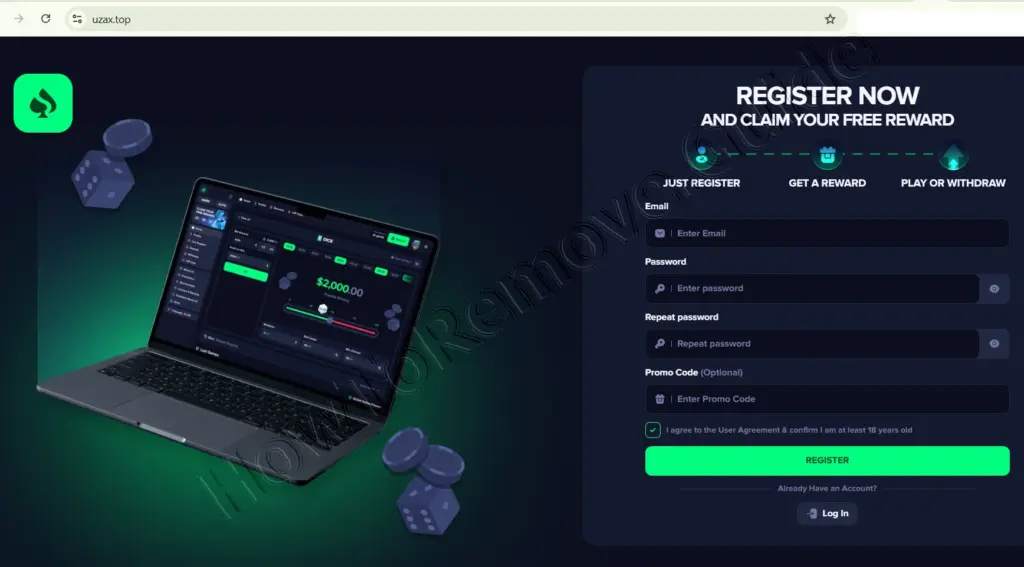
A reward-led invitation draws attention
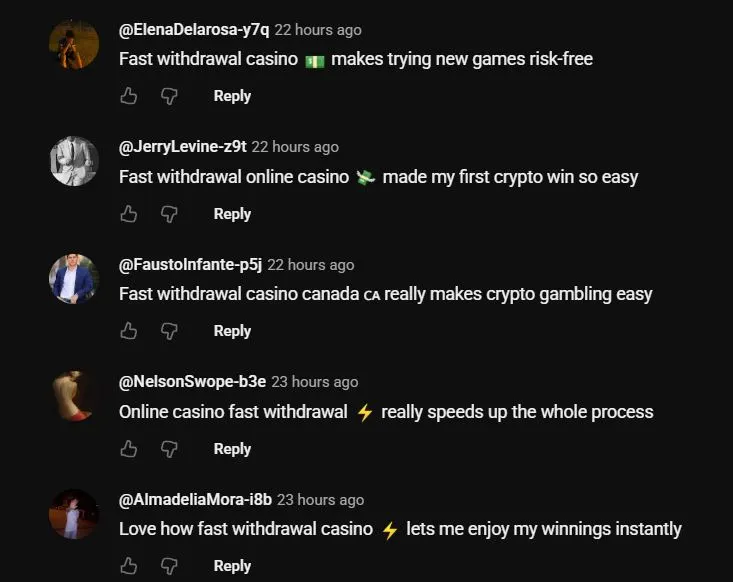
People often encounter Uzax through promotional content, comments, messages, or codes that imply urgency or insider access. The message is designed to feel like an opportunity discovered early rather than a scheme being sold.
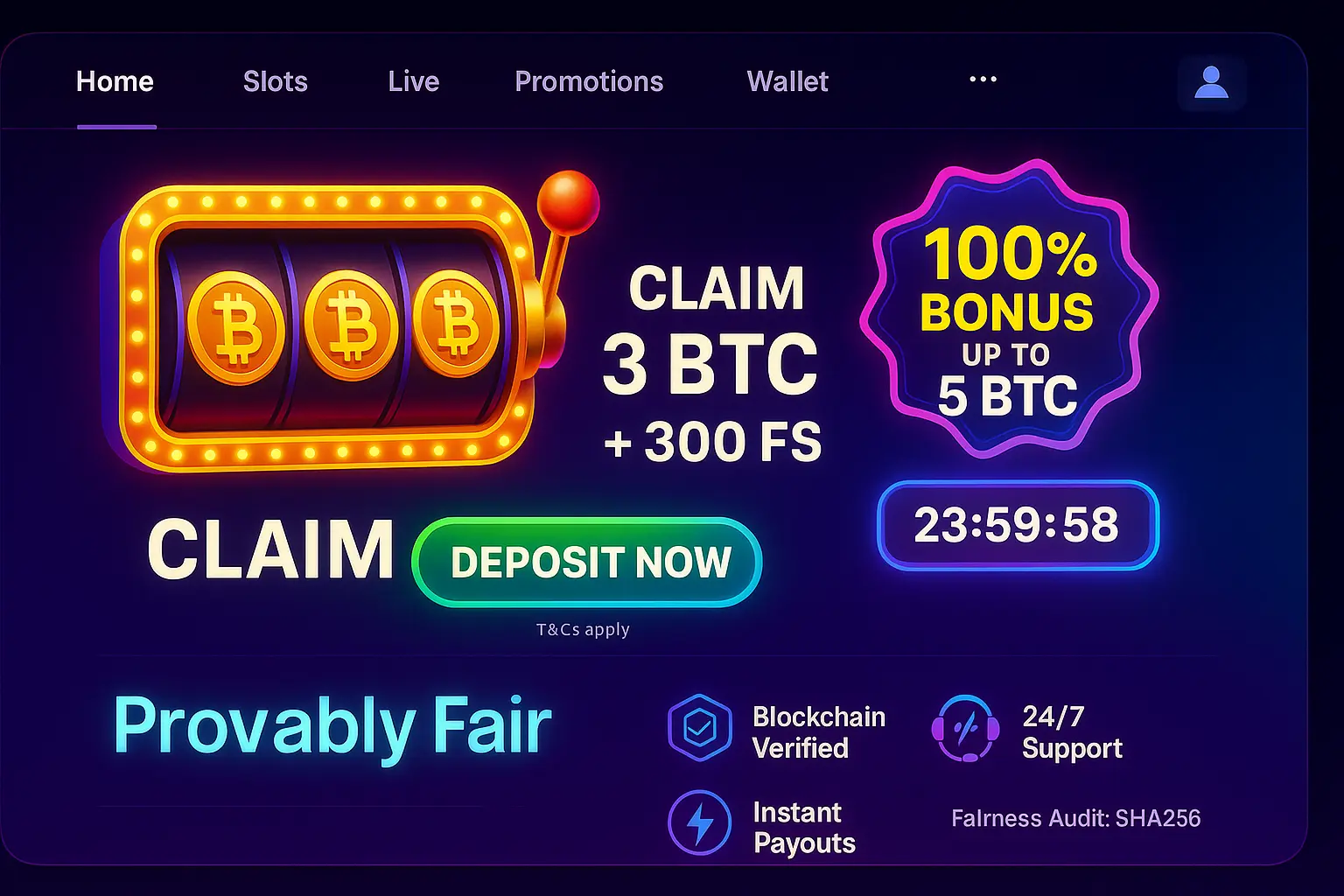
The site borrows cues from real platforms
Once inside, the user sees enough familiar casino design to relax: polished visuals, bonus prompts, account panels, and responsive controls. The effect is to replace verification with familiarity.
Visible gains create emotional buy-in
When the displayed balance starts climbing, the account begins to feel real in the user’s mind. That sense of ownership makes later friction feel like a temporary hurdle instead of a signal to stop.
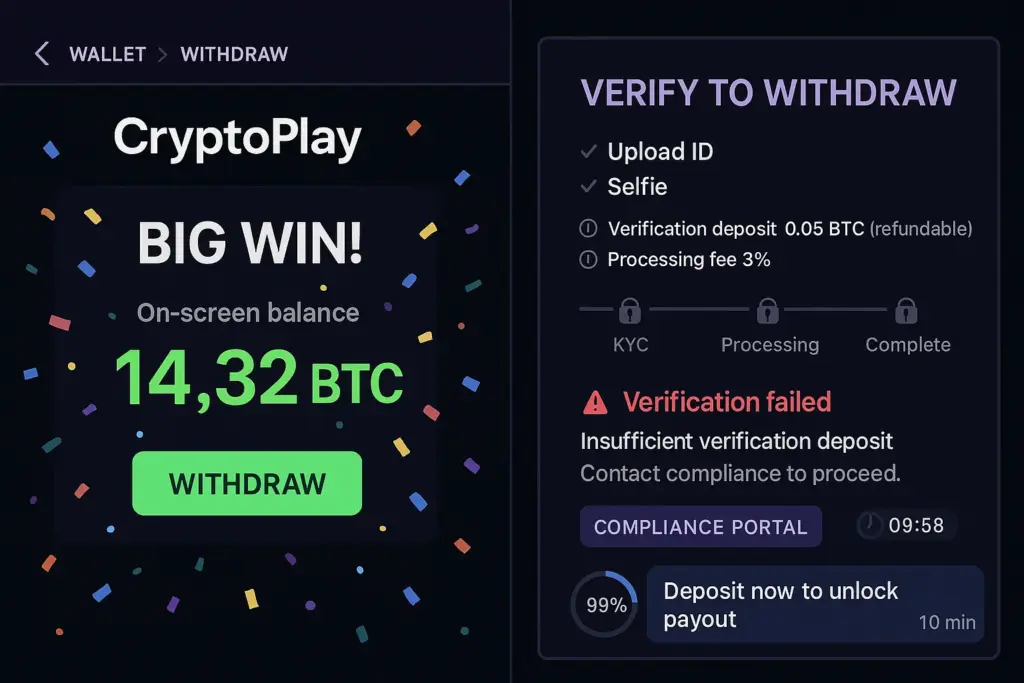
The payout path introduces new conditions
Taxes, identity checks, reserve transfers, anti-fraud reviews, and VIP unlocks may all suddenly appear at cash-out. The labels vary, but the pattern stays constant: the site asks the victim to solve the problem with another transfer.

Delay tactics preserve the illusion
Once resistance appears, support often shifts into scripted reassurance, repeated waiting periods, or vague escalation language. These delays buy time, reduce confrontation, and keep hope alive just long enough to extract more.
Staying safe from crypto casino scams like Uzax
To stay safer from scams like Uzax, treat verification as a habit rather than a feeling. Most of the protection comes from checks that are dull, repeatable, and easy to skip when excitement is high – which is exactly why they matter.
Confirm licensing from outside sources
Use the regulator or public registry directly and compare the listed company, brand, and domain with what the site is claiming. If the pieces do not align neatly, the safest move is not to proceed.
Inspect domain age and surrounding clones
Archived snapshots, registration dates, ownership masking, and related lookalike sites can reveal whether a brand appeared recently out of nowhere. A fragile domain footprint is common in scam campaigns.
Never ‘top up’ a withdrawal
Any request for an activation fee, collateral amount, tax advance, or processing deposit should be treated as a hard stop. A genuine payout does not require the customer to send more money first.
Prefer providers that can be challenged
Transparent businesses leave trails: named ownership, licensure, complaint channels, and payment systems that do not rely entirely on irreversible transfers. Those features do not guarantee honesty, but their absence raises the stakes sharply.
Keep separate wallets for separate roles
Using one wallet for storage, another for routine transfers, and another for experimentation limits the impact of a bad interaction. Containment is valuable because mistakes happen faster than recoveries.
Look for proof behind technical promises
If a platform advertises “provably fair,” audited, or verified systems, there should be a way to inspect that claim independently. Unsupported technical language should be discounted heavily.
Capture your records before they vanish
Save addresses, hashes, support logs, screenshots, emails, and copies of any material you uploaded. Evidence gathered early is often cleaner and more useful than evidence reconstructed weeks later.
Make delay part of your defense
Set a rule that every new platform must wait through a verification pause before you deposit, connect a wallet, or send ID. Slowing the decision down is often enough to break the scam’s emotional timing.
Useful Resources for Scam Reporting and Prevention (By Country)
Even if you cannot reverse a transfer, reporting can still be worthwhile. Exchanges and investigators may use your wallet data, timestamps, and screenshots to connect activity across a broader fraud pattern.
Open the reporting resources list
| Country / Agency | URL | Category / Use-case | Phone/Email |
| Australia – Crime Stoppers | https://www.crimestoppers.com.au | Anonymous tips about crime | 1800 333 000 |
| Australia – National Anti-Scam Center (Scamwatch) | https://www.scamwatch.gov.au/report-a-scam | General scams; phishing; texts/emails | |
| Australia – Police Assistance Line (non-emergency) | https://www.police.gov.au | Local police report | 131 444 |
| Australia – ReportCyber (ACSC) | https://www.cyber.gov.au/report | Cybercrime (hacks, fraud, extortion) | |
| Canada – Canadian Anti-Fraud Center (CAFC) | https://www.antifraudcentre-centreantifraude.ca/report-signalez-eng.htm | General scams incl. phone/text/email | |
| France – DGCCRF (SignalConso) | https://signal.conso.gouv.fr | Consumer scams/deceptive practices | |
| France – PHAROS – Internet-Signalement | https://www.internet-signalement.gouv.fr | Online content & cybercrime reports | |
| Germany – Bundeskriminalamt / Local Police | https://www.polizei.de/Polizei/DE/Home/home_node.html | Report online fraud | |
| Germany – Weißer Ring – Victim Support | https://weisser-ring.de | Victim support | 116 006 |
| India – DoT Helpline (Sanchar Saathi) | https://sancharsaathi.gov.in | Fraudulent telecom/SIM related | 155260 |
| India – National Consumer Helpline | https://consumerhelpline.gov.in | Consumer scams | 1800-11-4000 / 1915 |
| India – National Cyber Crime Reporting Portal | https://cybercrime.gov.in | Cybercrime incl. online fraud | 1930 |
| Japan – Consumer Affairs Agency (CAA) | https://www.caa.go.jp/policies/policy/consumer_policy/caution/cybercrime/ | Consumer scams | |
| Japan – National Police Agency – Cybercrime | https://www.npa.go.jp/bureau/cyber/ | Cybercrime reporting | |
| Mexico – Guardia Nacional (National Guard) | https://www.gob.mx/gn | Cybercrime reporting | |
| Mexico – Instituto Federal de Telecomunicaciones (IFT) | https://www.ift.org.mx | Telecom/online services scams | |
| Mexico – PROFECO | https://www.gob.mx/profeco | Consumer fraud & ecommerce | |
| Netherlands – AFM – Report investment fraud | https://www.afm.nl/en/consumenten/themas/beleggen/misleiding-misbruik | Investment/crypto | |
| Netherlands – Fraudehelpdesk | https://www.fraudehelpdesk.nl/melden | General scams (incl. phishing/SMS) | 088-7867372 |
| Netherlands – Politie – Meldpunt Internetoplichting | https://www.politie.nl/themas/internetoplichting.html | Online shopping fraud | |
| New Zealand – CERT NZ | https://www.cert.govt.nz/individuals/report-an-issue/ | Phishing, identity scams | |
| New Zealand – Department of Internal Affairs – Spam | https://www.dia.govt.nz/Spam-Contact-Us | Email/SMS spam | [email protected] |
| New Zealand – IDCARE | https://www.idcare.org | Victim support (identity compromise) | 0800 121 068 |
| New Zealand – Netsafe – Report | https://www.netsafe.org.nz/report/ | Online harms & scams | |
| New Zealand – New Zealand Police (non-emergency) | https://www.police.govt.nz/use-105 | Report fraud/online crime | 105 |
| Nigeria – Economic & Financial Crimes Commission (EFCC) | https://www.efcc.gov.ng | Financial scams incl. crypto/investment | [email protected] |
| Nigeria – Nigeria Police Special Fraud Unit (SFU) | https://www.specialfraudunit.org.ng | Serious fraud | Voice/SMS: 0708 227 6895; WhatsApp: 0812 760 9914 |
| Poland – CERT Polska (CERT.PL) | https://cert.pl/en/report/ | Cyber incidents & phishing | |
| Poland – Dyzurnet.pl | https://dyzurnet.pl | Illegal online content (esp. child protection) | |
| Poland – Polish Police (Policja) | https://www.policja.pl | Report scams to police | |
| Singapore – Anti-Scam Centre / Anti-Scam Helpline | https://www.scamalert.sg | General scams; texts; calls | 1800-722-6688 |
| Singapore – Monetary Authority of Singapore (MAS) | https://www.mas.gov.sg/investor-alert-list | Investment/crypto checks | |
| Singapore – Singapore Police Force | https://www.police.gov.sg/iwitness | Police report (cybercrime) | |
| South Africa – Cybersecurity Hub (CSIRT) | https://www.cybersecurityhub.gov.za | Cyber incidents incl. scams | |
| South Africa – South African Fraud Prevention Service (SAFPS) | https://www.safps.org.za | Identity fraud support | 011-867-2234 |
| South Africa – South African Police Service (SAPS) | https://www.saps.gov.za | Police report (cybercrime unit) | |
| South Korea – Korea Communications Commission (KCC) | https://www.kcc.go.kr | Telecom-related fraud | |
| South Korea – Korea Internet & Security Agency (KISA) | https://www.kisa.or.kr | Phishing, online harms | |
| South Korea – Korean National Police Agency – Cyber Bureau | https://ecrm.cyber.go.kr | Cybercrime reporting | |
| Spain – INCIBE – Oficina de Seguridad del Internauta (OSI) | https://www.osi.es/es/reporte | Cybersecurity & online fraud | |
| Spain – Policía Nacional / Guardia Civil | https://www.policia.es | Report scams to police | |
| Sweden – Crime Victim Authority (Brottsoffermyndigheten) | https://www.brottsoffermyndigheten.se | Victim support & compensation | 090–70 82 00 |
| Sweden – Polisen (Swedish Police) | https://polisen.se | Report fraud/cybercrime | 114 14 (non-emergency); 112 (emergency) |
| Sweden – Swedish Consumer Agency (Konsumentverket) | https://www.konsumentverket.se | Unfair business practices | |
| United Arab Emirates – Abu Dhabi Police – Aman Service | https://www.adpolice.gov.ae | Cybercrime tips/reporting | SMS 2828; 800 2626 |
| United Arab Emirates – Dubai Police – eCrime | https://www.dubaipolice.gov.ae | Cybercrime reporting | 04 606 1600 |
| United Arab Emirates – Ministry of Interior – Cyber Crime Dept. | https://www.moi.gov.ae | Cybercrime incl. online scams | |
| United Arab Emirates – Telecommunications Regulatory Authority (TRA) / TDRA | https://www.tra.gov.ae | Telecom-related scams/phishing | |
| United Kingdom – Action Fraud (NFIB) | https://www.actionfraud.police.uk | General scams & cybercrime (non-emergency) | 0300 123 2040 |
| United Kingdom – Citizens Advice Consumer Service | https://www.citizensadvice.org.uk/consumer/get-more-help/if-you-need-more-help-about-a-consumer-issue/ | Consumer problems & scam guidance | 0808 223 1133 |
| United Kingdom – Financial Conduct Authority (FCA) | https://www.fca.org.uk/consumers/report-scam-us | Investment/crypto & financial services | |
| United Kingdom – National Cyber Security Centre (NCSC) | https://www.ncsc.gov.uk/collection/phishing-scams | Phishing emails & suspicious websites | |
| United Kingdom – Stop Scams UK ‘159’ | https://stopscamsuk.org.uk/159 | Banking APP fraud (direct to your bank) | 159 |
| United States – AARP Fraud Watch Network Helpline | https://www.aarp.org/money/scams-fraud/ | Victim support | 833-372-8311 |
| United States – Better Business Bureau – Scam Tracker | https://www.bbb.org/scamtracker | Business/marketplace scams | |
| United States – FBI Internet Crime Complaint Center (IC3) | https://www.ic3.gov | Internet crime incl. investment/crypto | |
| United States – Federal Trade Commission – ReportFraud | https://reportfraud.ftc.gov | General scams, phishing, texts/emails | 1-877-382-4357 |
| United States – National Center for Disaster Fraud | https://www.justice.gov/disaster-fraud | Disaster-related scams | (866) 720-5721 |
| United States – SEC Tips & Complaints | https://www.sec.gov/tcr | Investment & securities/crypto-asset offerings |
The clearest takeaway is this: with Uzax, the exciting part is the setup and the costly part is the exit. If the story only works while money is going in, stop treating it like a casino and start treating it like a fraud attempt.
