

Vyroso777’s scam is a simple loop dressed up as a crypto casino. We’ve seen many like it before and covered them on our site, with Cuesax.com and Xslots.cc being two other recent examples.
The core scheme structure is as follows: First, the site’s owners bait inexperienced and hopeful users through social-media hype, sometimes flaunting celebrity names and deepfakes, plus a “free” signup bonus that can reach thousands in crypto.
Next, registered users do get to use the promised bonus and place bets with house credit. The games let you play immediately, and the balance usually rises fast, so people think they’ve beaten the odds.
Scams of Vyroso777.to‘s type are known to steal personal data and passwords. Install SpyHunter Pro to scan for risks, remove any dangerous trackers, and enable real-time protection.

Try Free For 7 Days*
Buy now15% OFF if you buy straight without trial.
 OFFER
OFFERThen comes the commitment. When you try to withdraw, Vyroso777 blocks the request and introduces a new rule: you must make a deposit to “verify” your wallet, “activate” the account, or cover a “transfer” fee.
That’s the key point, beyond which there’s no return. If you transfer that deposit, you not only lose the money but also potentially grant the scammers access to sensitive private data which is generally the bigger problem.
If you’ve already signed up on this or any other similar site, and especially if you’ve deposited anything, it’s crucial that you take immediate precautions to secure your online accounts and wallets. Damage control should be your main focus now, and the tips below will give you the best course of action.
IMPORTANT! READ BEFORE PROCEEDING!
If you have already interacted with Vyroso777, treat it like an active incident: stop sending funds, stop responding, and focus on containment. Assume anything after a withdrawal attempt is engineered to keep you paying. Here are five emergency steps we strongly recommend you take right now:
- Reset passwords and enable 2FA across email and exchanges, and sign out other sessions to cut off further access.
- Notify any exchanges and services touched by the funds, share TxIDs, and ask whether they can flag the destination addresses.
- Migrate assets to fresh wallets with new seed phrases, and revoke any approvals you may have granted while interacting with the site.
- If you uploaded ID documents, watch for identity misuse and place fraud alerts or a credit freeze where available.
- Assemble an evidence bundle (wallets, TxIDs, site URLs, chats, screenshots) and file reports with local cybercrime channels and the platform that promoted Vyroso777.
How We Know Vyroso777 is a Scam
What persuaded us is the pattern of behavior, not a single screenshot. Real platforms make withdrawal rules clear in advance; a scam invents new requirements exactly when you try to leave. The signals below match the same “pay-to-withdraw” blueprint used by many lookalike crypto casino fronts.
Withdrawal paywalls
A separate payment suddenly becomes “required” before your funds can move, and the amount or reason tends to change after you comply.
Unverifiable operator identity
Company details stay vague, licensing claims don’t stand up to independent checks, and accountability is always one click out of reach.
Too-lucky early results
Early play feels unusually generous, building confidence and commitment while inflating a balance that exists mostly as a number on a page.
Crypto-only exposure
By keeping everything in crypto, the setup minimizes chargeback-style recourse and pushes you toward irreversible transfers.
Manufactured crowds
Popups, chat noise, and “recent winner” banners are tuned to create social proof without offering anything you can independently verify.
Rapid domain churn
Fresh, privacy-masked domains and repeated rebrands are typical in this ecosystem; public lookups like who.is can reveal how often the shell changes.
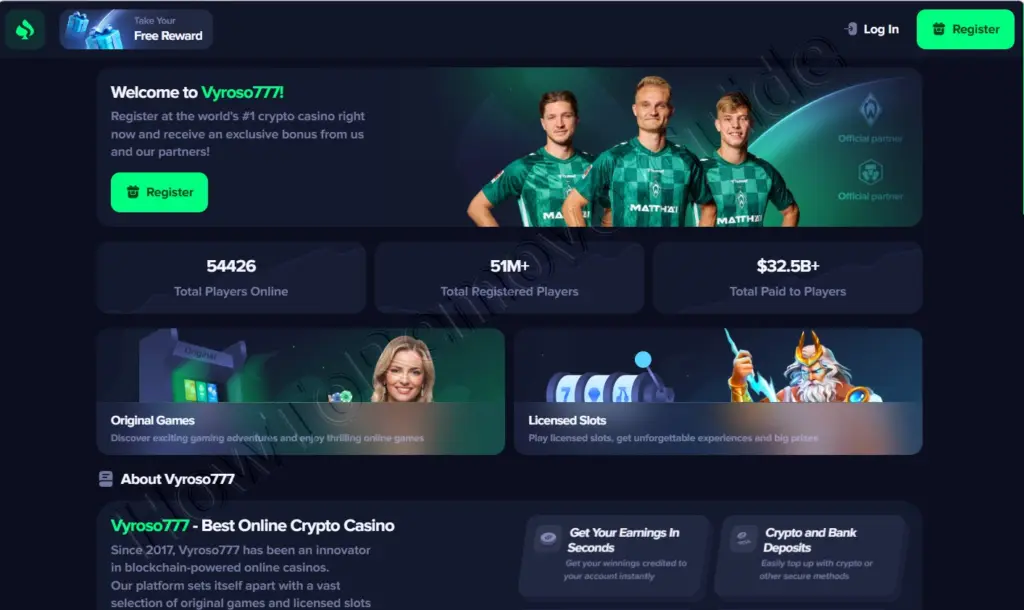

How the Vyroso777 Scam Deception Funnel Works
Understanding the sequence matters because the trick isn’t only the final demand for money – it’s the slow conversion of curiosity into commitment. Once you see the gears, the next move is easier to predict, and the pressure loses a lot of its power.
On the front end, the hook is usually a bonus code or “exclusive” promotion; then the site builds a big on-screen balance, and the moment you attempt to withdraw, new requirements appear that exist to extract more crypto or documents.
Promo hooks and influencer codes
On the front end, the hook is a bonus code or giveaway that tries to make hesitation feel like missing out.
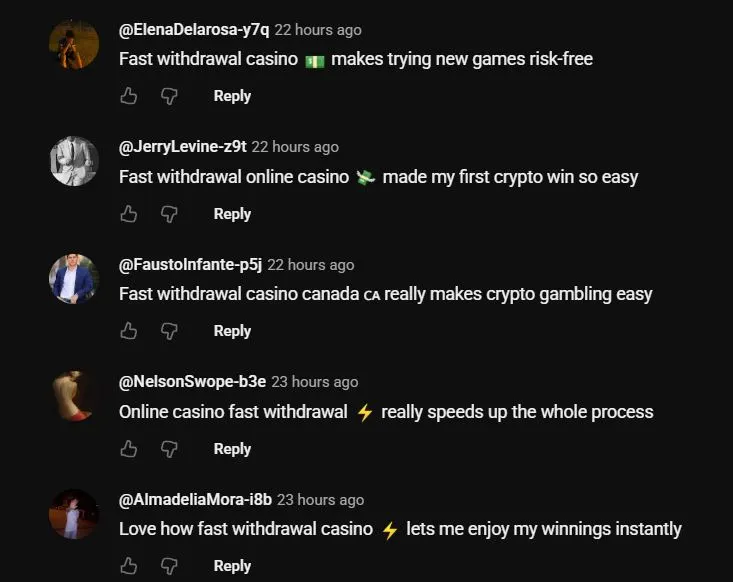
Casino skin and bonus theater
The glossy interface is the packaging: smooth games and big counters exist to build trust before the payout trap appears.

Inflated balances, then the gate
Early sessions feel strangely lucky, and that growing balance becomes the lever that pushes you to “just do the next step.”
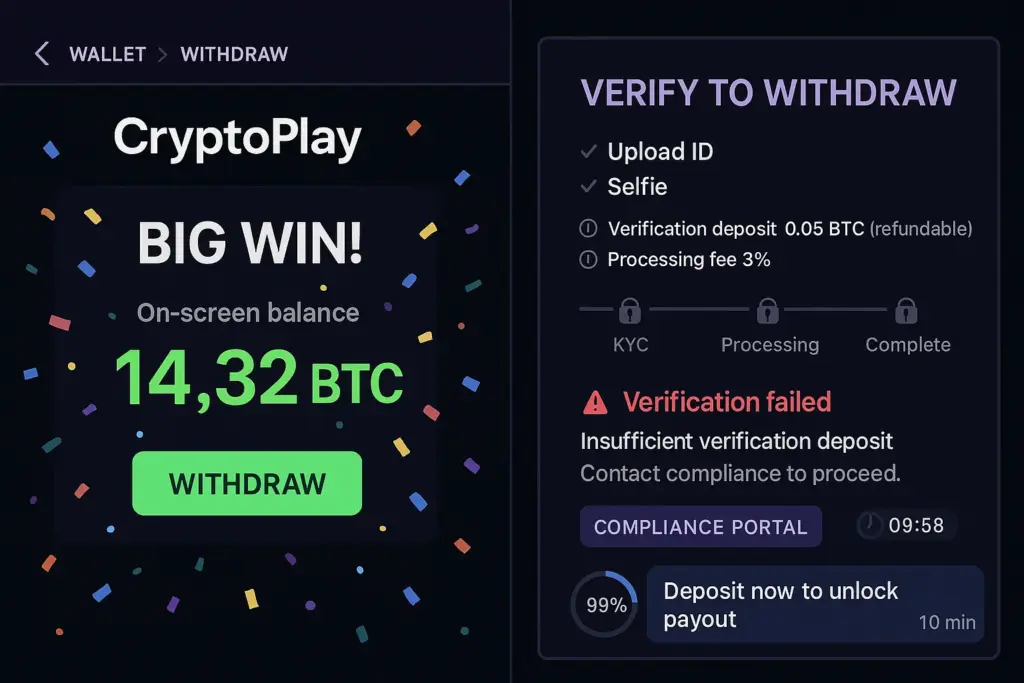
Fee-gates and KYC harvest
When you finally try to withdraw, the site introduces a fee or deposit as a condition, and may demand documents under compliance-sounding pretexts.

Stalling, rebrands, and “recovery” bait
Try to comply and the goalposts shift; refuse and the site stalls, ghosts, or pivots to a new name, while a second-wave “recovery” pitch often follows.
Staying safe from crypto casino scams like Vyroso777
No checklist is magic, but a few habits make this scam pattern much harder to run on you. The goal is to slow yourself down, force verification outside the site’s bubble, and keep any single mistake from becoming a cascade across wallets and accounts.
Verify license status in official registers
Make independent verification your default, because the site’s own “proof” is part of the performance, not evidence.
Check domain age and history
Look for signs of churn and rebranding, because short-lived domains are a common way these operations dodge consequences.
Reject withdrawal fees and “unlock” deposits
Never pay to withdraw – any demand to send more crypto to “unlock” access is the core extraction mechanism.
Prefer venues with recourse
Keep your risk small until withdrawals are proven, because “balances” are cheap and exits are what count.
Limit wallet exposure
Assume wallet connections can have consequences: revoke approvals you don’t need and treat unknown dapps as hostile by default.
Validate “provably fair” claims
Trust the exit, not the marketing: if the only “proof” is a slogan, treat it as branding rather than a guarantee.
Document and report rapidly
Save the evidence while it exists – wallet addresses, TxIDs, chats, screenshots – and file reports quickly before the domain vanishes.
Build a deliberate slow-down reflex
Let the urge pass: pause before depositing, confirm identity off-site, and treat pressure tactics as a stop sign.
Useful Resources for Scam Reporting and Prevention (By Country)
Document everything and report fast. Sometimes an exchange can act if funds reach them quickly, but there are no guarantees – speed and clear evidence give you the best odds. Also beware the “recovery” sequel: anyone promising guaranteed returns for an upfront payment is often running the next trap.
Click here to report the scam in your country
| Country / Agency | URL | Category / Use-case | Phone/Email |
| Australia – Crime Stoppers | https://www.crimestoppers.com.au | Anonymous tips about crime | 1800 333 000 |
| Australia – National Anti-Scam Center (Scamwatch) | https://www.scamwatch.gov.au/report-a-scam | General scams; phishing; texts/emails | |
| Australia – Police Assistance Line (non-emergency) | https://www.police.gov.au | Local police report | 131 444 |
| Australia – ReportCyber (ACSC) | https://www.cyber.gov.au/report | Cybercrime (hacks, fraud, extortion) | |
| Canada – Canadian Anti-Fraud Center (CAFC) | https://www.antifraudcentre-centreantifraude.ca/report-signalez-eng.htm | General scams incl. phone/text/email | |
| France – DGCCRF (SignalConso) | https://signal.conso.gouv.fr | Consumer scams/deceptive practices | |
| France – PHAROS – Internet-Signalement | https://www.internet-signalement.gouv.fr | Online content & cybercrime reports | |
| Germany – Bundeskriminalamt / Local Police | https://www.polizei.de/Polizei/DE/Home/home_node.html | Report online fraud | |
| Germany – Weißer Ring – Victim Support | https://weisser-ring.de | Victim support | 116 006 |
| India – DoT Helpline (Sanchar Saathi) | https://sancharsaathi.gov.in | Fraudulent telecom/SIM related | 155260 |
| India – National Consumer Helpline | https://consumerhelpline.gov.in | Consumer scams | 1800-11-4000 / 1915 |
| India – National Cyber Crime Reporting Portal | https://cybercrime.gov.in | Cybercrime incl. online fraud | 1930 |
| Japan – Consumer Affairs Agency (CAA) | https://www.caa.go.jp/policies/policy/consumer_policy/caution/cybercrime/ | Consumer scams | |
| Japan – National Police Agency – Cybercrime | https://www.npa.go.jp/bureau/cyber/ | Cybercrime reporting | |
| Mexico – Guardia Nacional (National Guard) | https://www.gob.mx/gn | Cybercrime reporting | |
| Mexico – Instituto Federal de Telecomunicaciones (IFT) | https://www.ift.org.mx | Telecom/online services scams | |
| Mexico – PROFECO | https://www.gob.mx/profeco | Consumer fraud & ecommerce | |
| Netherlands – AFM – Report investment fraud | https://www.afm.nl/en/consumenten/themas/beleggen/misleiding-misbruik | Investment/crypto | |
| Netherlands – Fraudehelpdesk | https://www.fraudehelpdesk.nl/melden | General scams (incl. phishing/SMS) | 088-7867372 |
| Netherlands – Politie – Meldpunt Internetoplichting | https://www.politie.nl/themas/internetoplichting.html | Online shopping fraud | |
| New Zealand – CERT NZ | https://www.cert.govt.nz/individuals/report-an-issue/ | Phishing, identity scams | |
| New Zealand – Department of Internal Affairs – Spam | https://www.dia.govt.nz/Spam-Contact-Us | Email/SMS spam | [email protected] |
| New Zealand – IDCARE | https://www.idcare.org | Victim support (identity compromise) | 0800 121 068 |
| New Zealand – Netsafe – Report | https://www.netsafe.org.nz/report/ | Online harms & scams | |
| New Zealand – New Zealand Police (non-emergency) | https://www.police.govt.nz/use-105 | Report fraud/online crime | 105 |
| Nigeria – Economic & Financial Crimes Commission (EFCC) | https://www.efcc.gov.ng | Financial scams incl. crypto/investment | [email protected] |
| Nigeria – Nigeria Police Special Fraud Unit (SFU) | https://www.specialfraudunit.org.ng | Serious fraud | Voice/SMS: 0708 227 6895; WhatsApp: 0812 760 9914 |
| Poland – CERT Polska (CERT.PL) | https://cert.pl/en/report/ | Cyber incidents & phishing | |
| Poland – Dyzurnet.pl | https://dyzurnet.pl | Illegal online content (esp. child protection) | |
| Poland – Polish Police (Policja) | https://www.policja.pl | Report scams to police | |
| Singapore – Anti-Scam Centre / Anti-Scam Helpline | https://www.scamalert.sg | General scams; texts; calls | 1800-722-6688 |
| Singapore – Monetary Authority of Singapore (MAS) | https://www.mas.gov.sg/investor-alert-list | Investment/crypto checks | |
| Singapore – Singapore Police Force | https://www.police.gov.sg/iwitness | Police report (cybercrime) | |
| South Africa – Cybersecurity Hub (CSIRT) | https://www.cybersecurityhub.gov.za | Cyber incidents incl. scams | |
| South Africa – South African Fraud Prevention Service (SAFPS) | https://www.safps.org.za | Identity fraud support | 011-867-2234 |
| South Africa – South African Police Service (SAPS) | https://www.saps.gov.za | Police report (cybercrime unit) | |
| South Korea – Korea Communications Commission (KCC) | https://www.kcc.go.kr | Telecom-related fraud | |
| South Korea – Korea Internet & Security Agency (KISA) | https://www.kisa.or.kr | Phishing, online harms | |
| South Korea – Korean National Police Agency – Cyber Bureau | https://ecrm.cyber.go.kr | Cybercrime reporting | |
| Spain – INCIBE – Oficina de Seguridad del Internauta (OSI) | https://www.osi.es/es/reporte | Cybersecurity & online fraud | |
| Spain – Policía Nacional / Guardia Civil | https://www.policia.es | Report scams to police | |
| Sweden – Crime Victim Authority (Brottsoffermyndigheten) | https://www.brottsoffermyndigheten.se | Victim support & compensation | 090–70 82 00 |
| Sweden – Polisen (Swedish Police) | https://polisen.se | Report fraud/cybercrime | 114 14 (non-emergency); 112 (emergency) |
| Sweden – Swedish Consumer Agency (Konsumentverket) | https://www.konsumentverket.se | Unfair business practices | |
| United Arab Emirates – Abu Dhabi Police – Aman Service | https://www.adpolice.gov.ae | Cybercrime tips/reporting | SMS 2828; 800 2626 |
| United Arab Emirates – Dubai Police – eCrime | https://www.dubaipolice.gov.ae | Cybercrime reporting | 04 606 1600 |
| United Arab Emirates – Ministry of Interior – Cyber Crime Dept. | https://www.moi.gov.ae | Cybercrime incl. online scams | |
| United Arab Emirates – Telecommunications Regulatory Authority (TRA) / TDRA | https://www.tra.gov.ae | Telecom-related scams/phishing | |
| United Kingdom – Action Fraud (NFIB) | https://www.actionfraud.police.uk | General scams & cybercrime (non-emergency) | 0300 123 2040 |
| United Kingdom – Citizens Advice Consumer Service | https://www.citizensadvice.org.uk/consumer/get-more-help/if-you-need-more-help-about-a-consumer-issue/ | Consumer problems & scam guidance | 0808 223 1133 |
| United Kingdom – Financial Conduct Authority (FCA) | https://www.fca.org.uk/consumers/report-scam-us | Investment/crypto & financial services | |
| United Kingdom – National Cyber Security Centre (NCSC) | https://www.ncsc.gov.uk/collection/phishing-scams | Phishing emails & suspicious websites | |
| United Kingdom – Stop Scams UK ‘159’ | https://stopscamsuk.org.uk/159 | Banking APP fraud (direct to your bank) | 159 |
| United States – AARP Fraud Watch Network Helpline | https://www.aarp.org/money/scams-fraud/ | Victim support | 833-372-8311 |
| United States – Better Business Bureau – Scam Tracker | https://www.bbb.org/scamtracker | Business/marketplace scams | |
| United States – FBI Internet Crime Complaint Center (IC3) | https://www.ic3.gov | Internet crime incl. investment/crypto | |
| United States – Federal Trade Commission – ReportFraud | https://reportfraud.ftc.gov | General scams, phishing, texts/emails | 1-877-382-4357 |
| United States – National Center for Disaster Fraud | https://www.justice.gov/disaster-fraud | Disaster-related scams | (866) 720-5721 |
| United States – SEC Tips & Complaints | https://www.sec.gov/tcr | Investment & securities/crypto-asset offerings |
That’s the full picture: claims are cheap, withdrawals are reality – contain exposure fast, keep your identity guarded, and verify operators off-site before you deposit anything or upload documents.
Staying grounded is the real cheat code: when a platform demands extra payment to access your own funds, the safest move is to stop, document, and walk away.
