

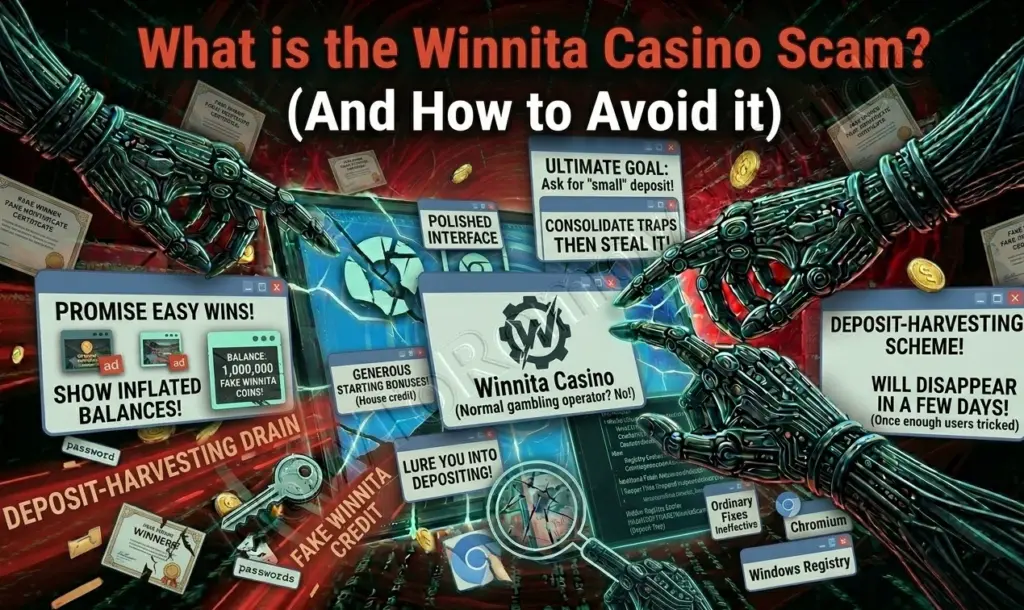
Winnita may look like a normal gambling operator but it certainly doesn’t behave like one under the hood. Under closer inspection, it quickly becomes obvious that this site fits a pattern seen across crypto-casino traps that promise easy wins and show inflated balances to get you hooked and then lure you into depositing your own money in order to steal it.
The polished interface is the bait, and so are the generous starting bonuses that every user gets upon signing up. On the surface, it looks like you are gambling risk-free with house credit, but that’s also part of the bait.
The ultimate goal is to ask you for a “small” deposit once you attempt to withdraw your winnings. That deposit is the goal, and you should view Winnita as nothing more than a deposit-harvesting scheme that will disappear in a few days once enough users have been tricked.
Scams of Winnita‘s type are known to steal personal data and passwords. Install SpyHunter Pro to scan for risks, remove any dangerous trackers, and enable real-time protection.

Try Free For 7 Days*
Buy now15% OFF if you buy straight without trial.
 OFFER
OFFERWe’ve seen the same with similar sites like Mdg188del.cfd and Fowatu, and we are convinced that the situation with Winnita is the same.
Any contact with Winnita should be handled as a security incident, not as a customer-support problem. The material below is meant to stop further harm, explain the scam pattern clearly, and help you avoid sending one more coin or one more document to the people behind it.
IMPORTANT! READ BEFORE PROCEEDING!
If you have already used Winnita, assume the operators may continue pressing for more money, more identity documents, or more wallet activity. Do not negotiate with them and do not try one last payment to “unlock” anything. Shift immediately into containment: secure your accounts, save your evidence, and work from the assumption that anything you submitted could be reused. The five urgent actions listed here are the fastest way to cut off follow-on damage.
- Reset passwords and enable 2FA on your email, crypto exchanges, and wallets; terminate other active sessions.
- Notify any exchanges and services touched by the funds; provide TxIDs and ask that accounts/addresses be flagged per policy.
- Migrate assets to fresh wallets with new seed phrases and revoke any existing token approvals on connected chains.
- If you uploaded ID documents, place credit/fraud alerts where available and monitor for identity-theft signals.
- Assemble an evidence bundle – wallet addresses, TxIDs, site URLs, chats, and screenshots – and file reports with police/IC3 and any involved platforms.
How We Know Winnita is a Scam
What convinced us was not a single dramatic clue but the familiar fraud pattern. When a crypto site mixes blocked withdrawals, copied trust signals, vague ownership, and pressure for extra payments, the safer conclusion is that the platform exists to collect deposits, not honor balances.
Cash-out barriers appear
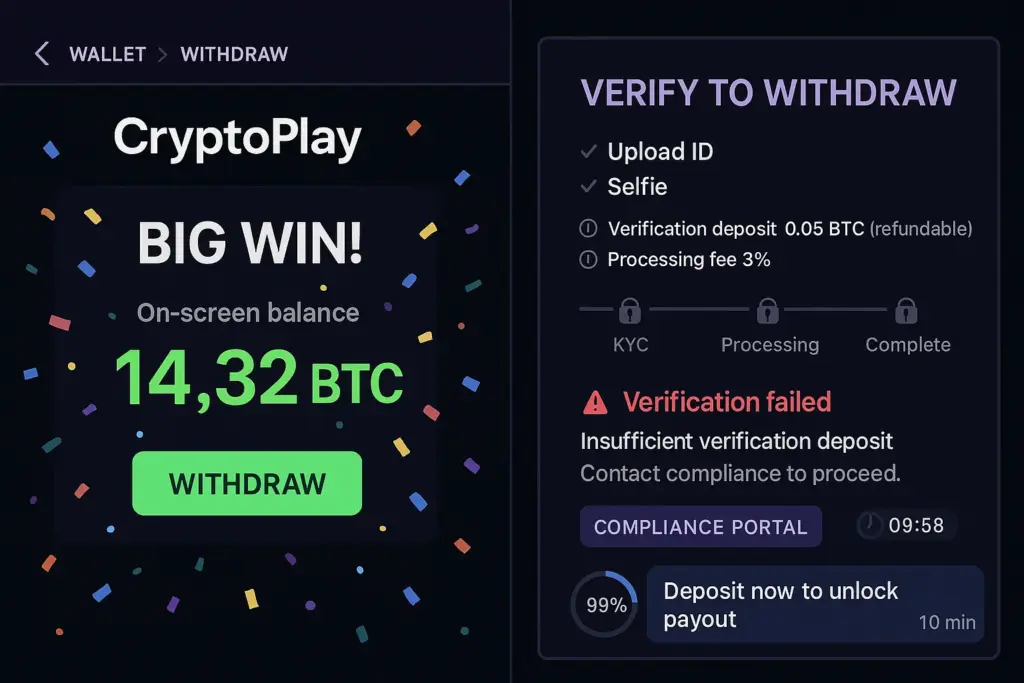
The turning point is predictable: once the user wants money out, Winnita suddenly demands another transfer first. A “processing fee,” “verification deposit,” or “release charge” is not a normal withdrawal step; it is the scam showing its real purpose.
The credentials do not verify
Bad actors can paste seals, numbers, and regulator names onto any page. What matters is whether an independent register connects the company, domain, and authorization details in a way that can actually be confirmed. With scams like Winnita, that chain usually breaks immediately.
The balance grows too neatly
Instead of messy, ordinary gambling outcomes, victims often report suspiciously convenient early success. The point is emotional conditioning: a growing number on screen makes later payment demands feel worth the risk.
Crypto-only rails remove recourse
When a site limits funding to irreversible crypto transfers, the victim loses many of the protections that card networks and conventional payment systems can sometimes offer. That makes one-way loss much easier for the operator to engineer.
The crowd noise feels staged
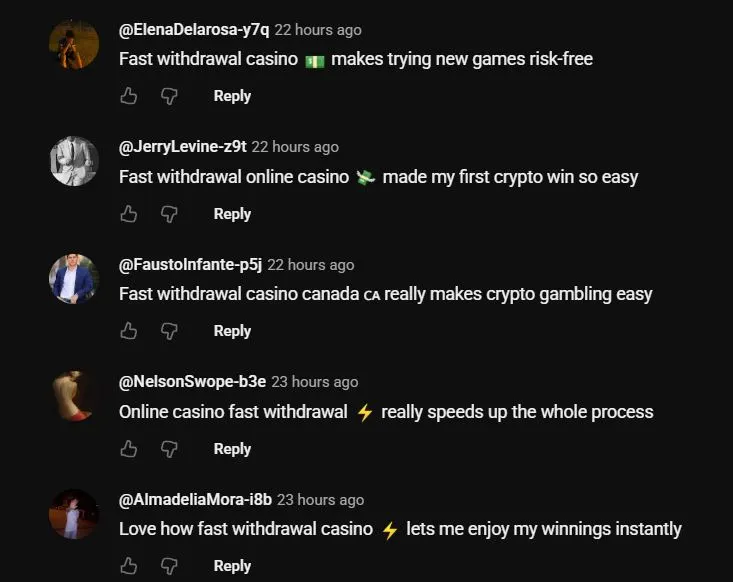
Popup wins, glowing comments, referral codes, and influencer-style promotions can all be manufactured. None of those signals prove genuine customers are withdrawing real funds from Winnita.
The domain identity is disposable
Short-lived registration history, hidden ownership, and clusters of nearly interchangeable domains are common in this category. A site built to vanish quickly will often look new, generic, and difficult to tie to a real business.

How the Winnita Scam Deception Funnel Works
Understanding the sequence matters because these scams rely on emotional momentum. If you can recognize the progression early, it becomes much easier to stop before excitement turns into repeated payments and document surrender.
In practice, the funnel usually moves from attraction to confidence-building and then into obstruction. The victim is shown enough apparent success to keep going, then is trapped in a series of excuses when withdrawal time arrives.
Referral links and DMs set the hook
Many victims first encounter Winnita through social posts, chat groups, promo codes, or direct messages that imply exclusivity. The goal is to create curiosity fast and reduce the chance that the person pauses to verify anything independently.
The website looks finished enough
Once on the platform, the user sees sleek game tiles, bonus banners, moving balances, and a support layer that makes the whole thing feel operational. That surface polish is not proof of legitimacy; it is part of the persuasion system.

Visible wins create commitment
After sign-up, the user may see bonus credits or favorable game outcomes that make the balance rise quickly. Because the numbers seem to confirm the promise, skepticism drops and the urge to deposit becomes easier to exploit.
Withdrawal triggers the real demands
The mood changes as soon as funds are supposed to leave. Suddenly there are taxes, anti-fraud checks, wallet activation fees, VIP upgrades, or identity barriers that all require yet another payment or another file upload.

Support fades when payments stop
If the victim stops cooperating, replies often shift from confident reassurance to delay tactics and then silence. Soon the same scam pattern may reappear under a different name and domain, ready to trap the next user the same way.
Staying safe from crypto casino scams like Winnita
Staying safer from scams like Winnita is less about instinct and more about routine. A few slow, boring checks carried out before any deposit can interrupt the urgency these sites depend on and expose the weak points in their story.
Start with the regulator, not the footer
Look up the operator through the actual regulator or public register rather than trusting what the website claims about itself. If the company name, license number, and domain do not line up cleanly, walk away.
Review domain history and clone patterns
Check when the address was registered, whether ownership is hidden, and whether lookalike domains exist. Scam networks often launch fresh sites that resemble each other closely because the brand name itself is disposable.
Never pay to free your own money
A request for a release fee, tax prepayment, collateral top-up, or unlock deposit should end the interaction immediately. A platform that claims you already have a balance does not need new money from you to send it back.
Prefer operators with accountability
Verifiable licensing, transparent ownership, normal payment methods, and visible dispute channels all matter. Fraud thrives in setups where the user has no realistic path to challenge a transfer or identify the people running the service.
Limit wallet exposure by purpose
Keep separate wallets for long-term storage, day-to-day transfers, and experimental activity. If you ever connect to the wrong site or expose an address tied to your identity, compartmentalization reduces the damage.
Demand proof, not slogans
Claims such as “provably fair” or “fully verified” should be independently testable. If the user cannot inspect the mechanism behind the claim or verify it outside the website, treat it as marketing language rather than evidence.
Save records while the trail is fresh
Capture wallet addresses, transaction IDs, support chats, emails, screenshots, and uploaded files as soon as your suspicion rises. Fast documentation gives exchanges, investigators, and future reporting channels something concrete to work with.
Create a pause-before-pay rule
Make it a personal rule that no deposit, document upload, or wallet connection happens until you have checked licensing, domain history, and independent complaints. That pause disrupts the urgency the scam needs to keep control.
Useful Resources for Scam Reporting and Prevention (By Country)
Even though crypto transfers are often irreversible, rapid reporting can still matter. Addresses can sometimes be flagged, exchanges can preserve records, and investigators may benefit from a clearer transaction trail if you move quickly.
Open the country-by-country reporting list
| Country / Agency | URL | Category / Use-case | Phone/Email |
| Australia – Crime Stoppers | https://www.crimestoppers.com.au | Anonymous tips about crime | 1800 333 000 |
| Australia – National Anti-Scam Center (Scamwatch) | https://www.scamwatch.gov.au/report-a-scam | General scams; phishing; texts/emails | |
| Australia – Police Assistance Line (non-emergency) | https://www.police.gov.au | Local police report | 131 444 |
| Australia – ReportCyber (ACSC) | https://www.cyber.gov.au/report | Cybercrime (hacks, fraud, extortion) | |
| Canada – Canadian Anti-Fraud Center (CAFC) | https://www.antifraudcentre-centreantifraude.ca/report-signalez-eng.htm | General scams incl. phone/text/email | |
| France – DGCCRF (SignalConso) | https://signal.conso.gouv.fr | Consumer scams/deceptive practices | |
| France – PHAROS – Internet-Signalement | https://www.internet-signalement.gouv.fr | Online content & cybercrime reports | |
| Germany – Bundeskriminalamt / Local Police | https://www.polizei.de/Polizei/DE/Home/home_node.html | Report online fraud | |
| Germany – Weißer Ring – Victim Support | https://weisser-ring.de | Victim support | 116 006 |
| India – DoT Helpline (Sanchar Saathi) | https://sancharsaathi.gov.in | Fraudulent telecom/SIM related | 155260 |
| India – National Consumer Helpline | https://consumerhelpline.gov.in | Consumer scams | 1800-11-4000 / 1915 |
| India – National Cyber Crime Reporting Portal | https://cybercrime.gov.in | Cybercrime incl. online fraud | 1930 |
| Japan – Consumer Affairs Agency (CAA) | https://www.caa.go.jp/policies/policy/consumer_policy/caution/cybercrime/ | Consumer scams | |
| Japan – National Police Agency – Cybercrime | https://www.npa.go.jp/bureau/cyber/ | Cybercrime reporting | |
| Mexico – Guardia Nacional (National Guard) | https://www.gob.mx/gn | Cybercrime reporting | |
| Mexico – Instituto Federal de Telecomunicaciones (IFT) | https://www.ift.org.mx | Telecom/online services scams | |
| Mexico – PROFECO | https://www.gob.mx/profeco | Consumer fraud & ecommerce | |
| Netherlands – AFM – Report investment fraud | https://www.afm.nl/en/consumenten/themas/beleggen/misleiding-misbruik | Investment/crypto | |
| Netherlands – Fraudehelpdesk | https://www.fraudehelpdesk.nl/melden | General scams (incl. phishing/SMS) | 088-7867372 |
| Netherlands – Politie – Meldpunt Internetoplichting | https://www.politie.nl/themas/internetoplichting.html | Online shopping fraud | |
| New Zealand – CERT NZ | https://www.cert.govt.nz/individuals/report-an-issue/ | Phishing, identity scams | |
| New Zealand – Department of Internal Affairs – Spam | https://www.dia.govt.nz/Spam-Contact-Us | Email/SMS spam | [email protected] |
| New Zealand – IDCARE | https://www.idcare.org | Victim support (identity compromise) | 0800 121 068 |
| New Zealand – Netsafe – Report | https://www.netsafe.org.nz/report/ | Online harms & scams | |
| New Zealand – New Zealand Police (non-emergency) | https://www.police.govt.nz/use-105 | Report fraud/online crime | 105 |
| Nigeria – Economic & Financial Crimes Commission (EFCC) | https://www.efcc.gov.ng | Financial scams incl. crypto/investment | [email protected] |
| Nigeria – Nigeria Police Special Fraud Unit (SFU) | https://www.specialfraudunit.org.ng | Serious fraud | Voice/SMS: 0708 227 6895; WhatsApp: 0812 760 9914 |
| Poland – CERT Polska (CERT.PL) | https://cert.pl/en/report/ | Cyber incidents & phishing | |
| Poland – Dyzurnet.pl | https://dyzurnet.pl | Illegal online content (esp. child protection) | |
| Poland – Polish Police (Policja) | https://www.policja.pl | Report scams to police | |
| Singapore – Anti-Scam Centre / Anti-Scam Helpline | https://www.scamalert.sg | General scams; texts; calls | 1800-722-6688 |
| Singapore – Monetary Authority of Singapore (MAS) | https://www.mas.gov.sg/investor-alert-list | Investment/crypto checks | |
| Singapore – Singapore Police Force | https://www.police.gov.sg/iwitness | Police report (cybercrime) | |
| South Africa – Cybersecurity Hub (CSIRT) | https://www.cybersecurityhub.gov.za | Cyber incidents incl. scams | |
| South Africa – South African Fraud Prevention Service (SAFPS) | https://www.safps.org.za | Identity fraud support | 011-867-2234 |
| South Africa – South African Police Service (SAPS) | https://www.saps.gov.za | Police report (cybercrime unit) | |
| South Korea – Korea Communications Commission (KCC) | https://www.kcc.go.kr | Telecom-related fraud | |
| South Korea – Korea Internet & Security Agency (KISA) | https://www.kisa.or.kr | Phishing, online harms | |
| South Korea – Korean National Police Agency – Cyber Bureau | https://ecrm.cyber.go.kr | Cybercrime reporting | |
| Spain – INCIBE – Oficina de Seguridad del Internauta (OSI) | https://www.osi.es/es/reporte | Cybersecurity & online fraud | |
| Spain – Policía Nacional / Guardia Civil | https://www.policia.es | Report scams to police | |
| Sweden – Crime Victim Authority (Brottsoffermyndigheten) | https://www.brottsoffermyndigheten.se | Victim support & compensation | 090–70 82 00 |
| Sweden – Polisen (Swedish Police) | https://polisen.se | Report fraud/cybercrime | 114 14 (non-emergency); 112 (emergency) |
| Sweden – Swedish Consumer Agency (Konsumentverket) | https://www.konsumentverket.se | Unfair business practices | |
| United Arab Emirates – Abu Dhabi Police – Aman Service | https://www.adpolice.gov.ae | Cybercrime tips/reporting | SMS 2828; 800 2626 |
| United Arab Emirates – Dubai Police – eCrime | https://www.dubaipolice.gov.ae | Cybercrime reporting | 04 606 1600 |
| United Arab Emirates – Ministry of Interior – Cyber Crime Dept. | https://www.moi.gov.ae | Cybercrime incl. online scams | |
| United Arab Emirates – Telecommunications Regulatory Authority (TRA) / TDRA | https://www.tra.gov.ae | Telecom-related scams/phishing | |
| United Kingdom – Action Fraud (NFIB) | https://www.actionfraud.police.uk | General scams & cybercrime (non-emergency) | 0300 123 2040 |
| United Kingdom – Citizens Advice Consumer Service | https://www.citizensadvice.org.uk/consumer/get-more-help/if-you-need-more-help-about-a-consumer-issue/ | Consumer problems & scam guidance | 0808 223 1133 |
| United Kingdom – Financial Conduct Authority (FCA) | https://www.fca.org.uk/consumers/report-scam-us | Investment/crypto & financial services | |
| United Kingdom – National Cyber Security Centre (NCSC) | https://www.ncsc.gov.uk/collection/phishing-scams | Phishing emails & suspicious websites | |
| United Kingdom – Stop Scams UK ‘159’ | https://stopscamsuk.org.uk/159 | Banking APP fraud (direct to your bank) | 159 |
| United States – AARP Fraud Watch Network Helpline | https://www.aarp.org/money/scams-fraud/ | Victim support | 833-372-8311 |
| United States – Better Business Bureau – Scam Tracker | https://www.bbb.org/scamtracker | Business/marketplace scams | |
| United States – FBI Internet Crime Complaint Center (IC3) | https://www.ic3.gov | Internet crime incl. investment/crypto | |
| United States – Federal Trade Commission – ReportFraud | https://reportfraud.ftc.gov | General scams, phishing, texts/emails | 1-877-382-4357 |
| United States – National Center for Disaster Fraud | https://www.justice.gov/disaster-fraud | Disaster-related scams | (866) 720-5721 |
| United States – SEC Tips & Complaints | https://www.sec.gov/tcr | Investment & securities/crypto-asset offerings |
Taken together, the lesson is simple: distrust the bonus, question the on-screen balance, refuse every pay-to-withdraw demand, and treat late-stage KYC pressure as a serious warning. The earlier you slow the process down and verify the story, the harder it is for Winnita to turn attention into loss.
