

Xhopex.com may look like a legit crypto casino platform to inexperienced users, but beneath its flashy exterior is a tired old scam model: a fake dashboard invents non-existent profits, and then, once you decide to withdraw what you’ve supposedly earned through crypto investments, you must make a “small” deposit.
Nothing about that sequence reflects genuine trading. It’s all just a staged confidence trick that’s built to make you feel you are one small payment away from unlocking a huge pile of money (which doesn’t really exist).
Scams of Xhopex.com‘s type are known to steal personal data and passwords. Install SpyHunter Pro to scan for risks, remove any dangerous trackers, and enable real-time protection.

Try Free For 7 Days*
Buy now15% OFF if you buy straight without trial.
 OFFER
OFFEROnce any of your real crypto leaves your wallet and goes into the owners of Xhopex, consider that money gone and yourself scammed.
But the bigger issue here is that this lets the scammers potentially gain access to your personal wallet and/or banking account, so the damage to your assets may not stop there.
Read this carefully if Xhopex or any lookalike site, such as Kotewex or Rezowin, has crossed your path. The notes below break down the pressure tactics, fake promises, and payout traps these operations rely on, while also laying out practical steps you can take right now to reduce damage and make your accounts harder to exploit later.
IMPORTANT! READ BEFORE PROCEEDING!
If you have already dealt with Xhopex – opened an account, linked a wallet, uploaded ID, or transferred crypto – act quickly and keep your next steps simple. Stop sending money, ignore anyone offering paid fund recovery, secure the accounts around the incident, and save every trace of the interaction before the site or its messages vanish.
- Move remaining assets to a fresh, clean wallet and revoke any suspicious token approvals linked to the scam touchpoint.
- Change passwords and enable app-based 2FA on email, exchanges, and chat accounts; review active sessions and delete unused API keys.
- Preserve evidence: screenshots, URLs, videos or ads, wallet addresses, TXIDs, and chat logs – keep everything for official reports.
- Notify the sending platform (your exchange or service) with TXIDs and the destination address so they can flag or freeze if possible.
- Report promptly to your national cybercrime unit (e.g., IC3 in the US, Action Fraud in the UK) and to the platform where you saw the promotion.
How We Know Xhopex is a Scam
Taken together, the warning signs do not point to a rough new business. They point to a rehearsed fraud template seen across disposable crypto sites. Xhopex shows the same cues investigators and victim reports keep surfacing: imaginary balances, pay-first withdrawals, credibility theater, and infrastructure built to be abandoned when suspicion grows.
Balance-from-thin-air trick
A code, bonus, or welcome offer suddenly makes the account look rich, yet no corresponding transfer can be verified on any public blockchain. That kind of instant paper wealth is there to trigger excitement, reduce skepticism, and make the next payment request feel rational.
Pay-before-you-withdraw setup
Any instruction to send crypto for account activation, wallet syncing, tax clearance, or withdrawal release is a classic advance-fee tactic. Real platforms do not lock up your own funds and then demand a separate blockchain payment to let you touch them.
Borrowed fame and authority
Videos, voice clips, and endorsements tied to celebrities, founders, or influencers can be fabricated or repurposed. Scammers use familiar faces because borrowed authority lowers resistance faster than technical proof ever could.
No verifiable payout trail
When a platform claims it has processed your withdrawal but cannot provide a traceable transaction hash that matches the network and destination wallet, the payout likely never existed. A real transfer leaves evidence beyond a support message and a changing dashboard number.
Decorative compliance claims
Badges about licensing, AML controls, audits, or regulation are easy to paste onto a page. What matters is whether the operator can be verified through an official register, a real company record, and transparent contact details that withstand scrutiny.
Disposable-domain behavior
Fraud networks often burn a domain once complaints pile up, then relaunch the same script, visuals, and promises elsewhere. That pattern of rapid domain churn is not a branding refresh; it is operational camouflage.

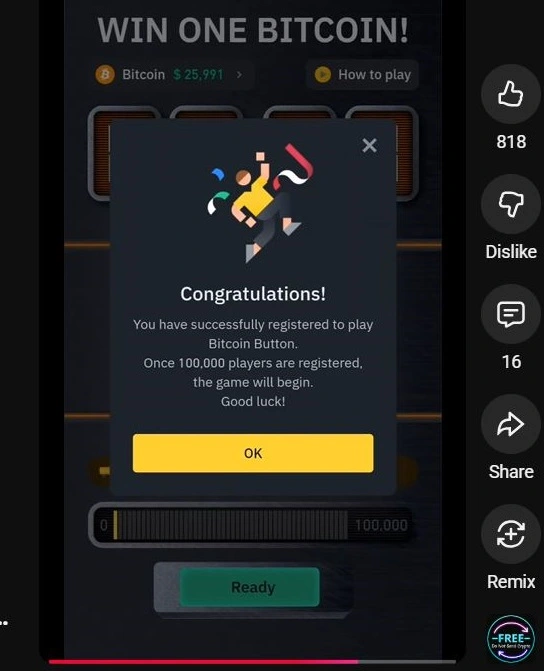
How the Xhopex Casino Scam Deception Funnel Works
Understanding the scam flow matters because each stage is designed to reshape your judgment. First it wins attention, then it manufactures trust, then it makes the fake balance feel personal, and only after that does it begin asking for money. Once you recognize the sequence, the illusion loses much of its force.
In practice, the playbook usually starts with a tempting ad or message, moves into frictionless registration, displays invented gains, and then blocks withdrawal behind one or more payments or identity checks. Delays, excuses, and a sudden disappearance often close the loop, followed by the same scheme on a fresh domain.
Promo hooks and influencer codes
Instead of waiting for cautious users to discover the site organically, the operators push it through short videos, comment spam, private messages, and flashy posts that frame the opportunity as time-sensitive. Bonus codes and staged praise do the psychological work of making strangers feel they are arriving late to something everybody else is already profiting from.
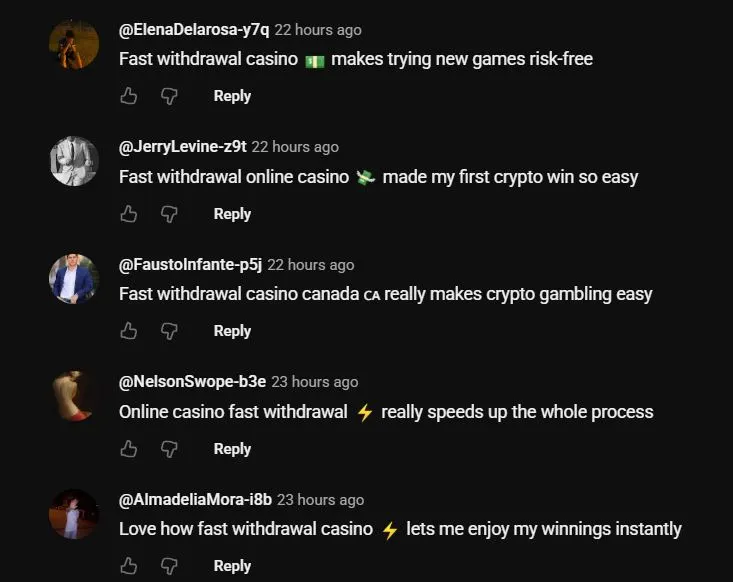
Casino skin and bonus theater
Once you land on the site, the design tries to do the convincing for them. Bright balance boxes, animated counters, branded jargon, and oversized bonus claims are there to make the environment feel busy, lucrative, and already trusted. The goal is not realism alone; it is immersion strong enough to keep you from pausing and verifying.

Inflated balances, then the gate
After registration, the account may show a bonus, early winnings, or a surprisingly valuable balance that appears to belong to you immediately. That screen is the baited hook. The moment you try to cash out, the system introduces a barrier – often phrased as verification, unlocking, network validation, or a minimum deposit requirement.
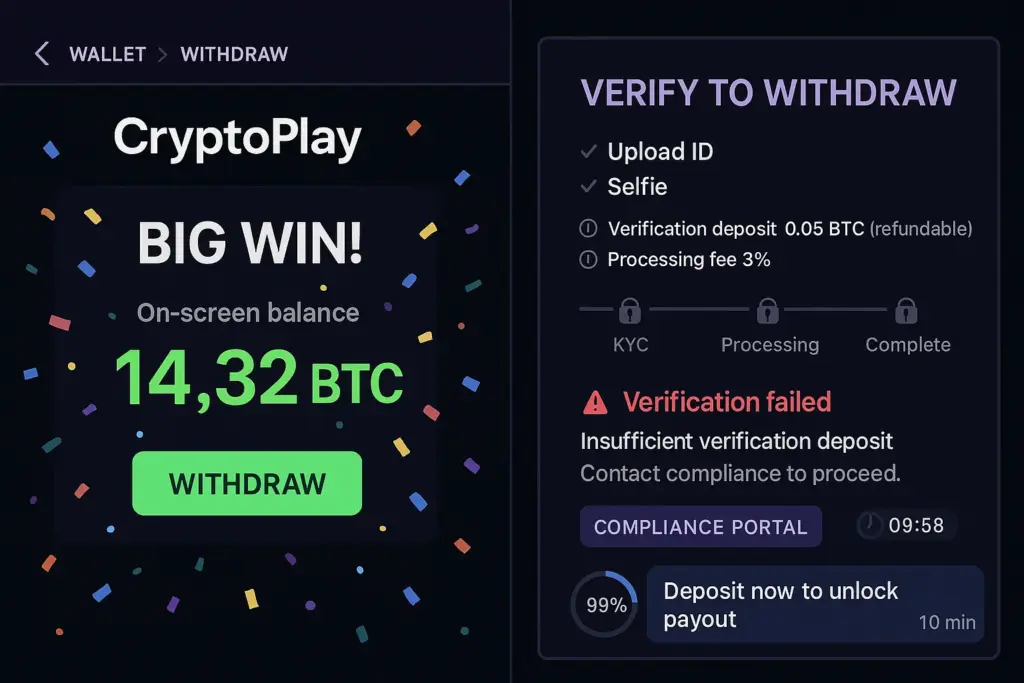
Fee-gates and KYC harvest
From there, the excuses can multiply. One payment becomes several, or the site begins asking for identity documents, selfies, addresses, and other data under the cover of compliance. This expands the harm: even if you stop sending crypto, the scam may now possess information useful for later impersonation, account takeover attempts, or follow-on fraud.

Stalling, rebrands, and “recovery” bait
When victims start pressing for answers, support tends to pivot into delay mode. Responses become vague, additional conditions appear, and promised processing dates slide. Then the platform goes quiet, reappears under another name, or a separate actor contacts the victim claiming they can recover the funds for a fee, turning one scam into two.
Staying safe from crypto casino scams like Xhopex
A safer routine does not require expert knowledge. It requires a few defensive habits applied consistently before money moves, documents get uploaded, or wallets get connected. Those habits break the emotional rhythm these scams rely on and give you enough distance to spot the contradictions.
Never pay to withdraw
Treat any request for an unlocking payment, clearance deposit, or advance tax as a stop signal. A legitimate service can explain its fees plainly and reflect them in normal account statements; it does not hold your balance hostage until you send extra crypto to an arbitrary address.
Verify endorsements at the source
Before trusting a celebrity clip, influencer mention, or news-style promotion, check whether it appears on that person’s verified channels or official website. Scammers know that people often verify the emotion of a message before they verify the source, and they build campaigns around that weakness.
Navigate with your own bookmarks
Reach exchanges, wallets, and related services through bookmarks you created yourself, not through ads, search placements, forwarded links, or social messages. Cutting off those discovery paths removes many of the fake lookalike sites that depend on impulse clicks and visual similarity.
Check regulator registers & warnings
If a platform claims to be licensed or compliant, try to confirm the claim independently through regulator databases, company records, and public warning pages. Fraud sites often sound convincing at the surface but collapse under even basic checks for legal identity and authorization.
Segregate risk with burner wallets
Keep meaningful holdings away from experimental or unverified sites. A separate low-value wallet for risky interactions can limit the blast radius if you connect it somewhere malicious, sign an approval you should not have signed, or discover too late that the platform is counterfeit.
Harden accounts with 2FA & hygiene
Use unique passwords, turn on app-based two-factor authentication where available, remove stale API keys, and review account sessions regularly. These steps do not undo a bad transfer, but they can stop the same incident from spilling into your email, exchange profile, or chat accounts.
Revoke approvals & migrate
If a wallet touched Xhopex or any related page, assume that trust was misplaced. Revoke permissions you no longer need, move remaining assets to a fresh address if appropriate, and avoid reusing the compromised wallet for important holdings. Standing approvals can continue to create risk after the original encounter ends.
Protect identity & slow down
Where documents were uploaded to a fake verification portal, watch for secondary misuse such as impersonation or account-opening attempts, and use identity-protection options available in your country if needed. Just as important, build a pause-and-check habit whenever a crypto offer feels urgent, exclusive, or unusually generous.
Where to report Xhopex-style crypto scams (by country)
Clear reporting will not guarantee recovery, but it can still reduce downstream harm. Save screenshots, wallet addresses, transaction hashes, email headers, promo messages, and chat logs, then report the incident through official channels. If an exchange was used to send the funds, contact it promptly with the destination address and transaction details so the activity can be flagged.
Click here to report the scam in your country
| Country / Agency | URL | Category / Use-case | Phone/Email |
| Australia – Crime Stoppers | https://www.crimestoppers.com.au | Anonymous tips about crime | 1800 333 000 |
| Australia – National Anti-Scam Center (Scamwatch) | https://www.scamwatch.gov.au/report-a-scam | General scams; phishing; texts/emails | |
| Australia – Police Assistance Line (non-emergency) | https://www.police.gov.au | Local police report | 131 444 |
| Australia – ReportCyber (ACSC) | https://www.cyber.gov.au/report | Cybercrime (hacks, fraud, extortion) | |
| Canada – Canadian Anti-Fraud Center (CAFC) | https://www.antifraudcentre-centreantifraude.ca/report-signalez-eng.htm | General scams incl. phone/text/email | |
| France – DGCCRF (SignalConso) | https://signal.conso.gouv.fr | Consumer scams/deceptive practices | |
| France – PHAROS – Internet-Signalement | https://www.internet-signalement.gouv.fr | Online content & cybercrime reports | |
| Germany – Bundeskriminalamt / Local Police | https://www.polizei.de/Polizei/DE/Home/home_node.html | Report online fraud | |
| Germany – Weißer Ring – Victim Support | https://weisser-ring.de | Victim support | 116 006 |
| India – DoT Helpline (Sanchar Saathi) | https://sancharsaathi.gov.in | Fraudulent telecom/SIM related | 155260 |
| India – National Consumer Helpline | https://consumerhelpline.gov.in | Consumer scams | 1800-11-4000 / 1915 |
| India – National Cyber Crime Reporting Portal | https://cybercrime.gov.in | Cybercrime incl. online fraud | 1930 |
| Japan – Consumer Affairs Agency (CAA) | https://www.caa.go.jp/policies/policy/consumer_policy/caution/cybercrime/ | Consumer scams | |
| Japan – National Police Agency – Cybercrime | https://www.npa.go.jp/bureau/cyber/ | Cybercrime reporting | |
| Mexico – Guardia Nacional (National Guard) | https://www.gob.mx/gn | Cybercrime reporting | |
| Mexico – Instituto Federal de Telecomunicaciones (IFT) | https://www.ift.org.mx | Telecom/online services scams | |
| Mexico – PROFECO | https://www.gob.mx/profeco | Consumer fraud & ecommerce | |
| Netherlands – AFM – Report investment fraud | https://www.afm.nl/en/consumenten/themas/beleggen/misleiding-misbruik | Investment/crypto | |
| Netherlands – Fraudehelpdesk | https://www.fraudehelpdesk.nl/melden | General scams (incl. phishing/SMS) | 088-7867372 |
| Netherlands – Politie – Meldpunt Internetoplichting | https://www.politie.nl/themas/internetoplichting.html | Online shopping fraud | |
| New Zealand – CERT NZ | https://www.cert.govt.nz/individuals/report-an-issue/ | Phishing, identity scams | |
| New Zealand – Department of Internal Affairs – Spam | https://www.dia.govt.nz/Spam-Contact-Us | Email/SMS spam | [email protected] |
| New Zealand – IDCARE | https://www.idcare.org | Victim support (identity compromise) | 0800 121 068 |
| New Zealand – Netsafe – Report | https://www.netsafe.org.nz/report/ | Online harms & scams | |
| New Zealand – New Zealand Police (non-emergency) | https://www.police.govt.nz/use-105 | Report fraud/online crime | 105 |
| Nigeria – Economic & Financial Crimes Commission (EFCC) | https://www.efcc.gov.ng | Financial scams incl. crypto/investment | [email protected] |
| Nigeria – Nigeria Police Special Fraud Unit (SFU) | https://www.specialfraudunit.org.ng | Serious fraud | Voice/SMS: 0708 227 6895; WhatsApp: 0812 760 9914 |
| Poland – CERT Polska (CERT.PL) | https://cert.pl/en/report/ | Cyber incidents & phishing | |
| Poland – Dyzurnet.pl | https://dyzurnet.pl | Illegal online content (esp. child protection) | |
| Poland – Polish Police (Policja) | https://www.policja.pl | Report scams to police | |
| Singapore – Anti-Scam Centre / Anti-Scam Helpline | https://www.scamalert.sg | General scams; texts; calls | 1800-722-6688 |
| Singapore – Monetary Authority of Singapore (MAS) | https://www.mas.gov.sg/investor-alert-list | Investment/crypto checks | |
| Singapore – Singapore Police Force | https://www.police.gov.sg/iwitness | Police report (cybercrime) | |
| South Africa – Cybersecurity Hub (CSIRT) | https://www.cybersecurityhub.gov.za | Cyber incidents incl. scams | |
| South Africa – South African Fraud Prevention Service (SAFPS) | https://www.safps.org.za | Identity fraud support | 011-867-2234 |
| South Africa – South African Police Service (SAPS) | https://www.saps.gov.za | Police report (cybercrime unit) | |
| South Korea – Korea Communications Commission (KCC) | https://www.kcc.go.kr | Telecom-related fraud | |
| South Korea – Korea Internet & Security Agency (KISA) | https://www.kisa.or.kr | Phishing, online harms | |
| South Korea – Korean National Police Agency – Cyber Bureau | https://ecrm.cyber.go.kr | Cybercrime reporting | |
| Spain – INCIBE – Oficina de Seguridad del Internauta (OSI) | https://www.osi.es/es/reporte | Cybersecurity & online fraud | |
| Spain – Policía Nacional / Guardia Civil | https://www.policia.es | Report scams to police | |
| Sweden – Crime Victim Authority (Brottsoffermyndigheten) | https://www.brottsoffermyndigheten.se | Victim support & compensation | 090–70 82 00 |
| Sweden – Polisen (Swedish Police) | https://polisen.se | Report fraud/cybercrime | 114 14 (non-emergency); 112 (emergency) |
| Sweden – Swedish Consumer Agency (Konsumentverket) | https://www.konsumentverket.se | Unfair business practices | |
| United Arab Emirates – Abu Dhabi Police – Aman Service | https://www.adpolice.gov.ae | Cybercrime tips/reporting | SMS 2828; 800 2626 |
| United Arab Emirates – Dubai Police – eCrime | https://www.dubaipolice.gov.ae | Cybercrime reporting | 04 606 1600 |
| United Arab Emirates – Ministry of Interior – Cyber Crime Dept. | https://www.moi.gov.ae | Cybercrime incl. online scams | |
| United Arab Emirates – Telecommunications Regulatory Authority (TRA) / TDRA | https://www.tra.gov.ae | Telecom-related scams/phishing | |
| United Kingdom – Action Fraud (NFIB) | https://www.actionfraud.police.uk | General scams & cybercrime (non-emergency) | 0300 123 2040 |
| United Kingdom – Citizens Advice Consumer Service | https://www.citizensadvice.org.uk/consumer/get-more-help/if-you-need-more-help-about-a-consumer-issue/ | Consumer problems & scam guidance | 0808 223 1133 |
| United Kingdom – Financial Conduct Authority (FCA) | https://www.fca.org.uk/consumers/report-scam-us | Investment/crypto & financial services | |
| United Kingdom – National Cyber Security Centre (NCSC) | https://www.ncsc.gov.uk/collection/phishing-scams | Phishing emails & suspicious websites | |
| United Kingdom – Stop Scams UK ‘159’ | https://stopscamsuk.org.uk/159 | Banking APP fraud (direct to your bank) | 159 |
| United States – AARP Fraud Watch Network Helpline | https://www.aarp.org/money/scams-fraud/ | Victim support | 833-372-8311 |
| United States – Better Business Bureau – Scam Tracker | https://www.bbb.org/scamtracker | Business/marketplace scams | |
| United States – FBI Internet Crime Complaint Center (IC3) | https://www.ic3.gov | Internet crime incl. investment/crypto | |
| United States – Federal Trade Commission – ReportFraud | https://reportfraud.ftc.gov | General scams, phishing, texts/emails | 1-877-382-4357 |
| United States – National Center for Disaster Fraud | https://www.justice.gov/disaster-fraud | Disaster-related scams | (866) 720-5721 |
| United States – SEC Tips & Complaints | https://www.sec.gov/tcr | Investment & securities/crypto-asset offerings |
