

Kotewex.com looks polished right away, and that is exactly why people need to slow down here. The site leans hard on slick casino visuals, crypto language, big bonus promises, and a fast sign up process that makes the whole thing feel easy, modern, and low risk when it may be anything but.
Now here is the problem. A professional looking website does not mean the operation behind it is legitimate, and in this case the concern gets bigger because the domain appears to be very new and was marked as suspicious by security tools on April 12, 2026. To an untrained eye that may not seem like much, but it matters.
This is usually where people get trapped. Everything can seem fine while money is going in, but the moment someone tries to cash out, the excuses start showing up one after another.
Scams of Kotewex.com‘s type are known to steal personal data and passwords. Install SpyHunter Pro to scan for risks, remove any dangerous trackers, and enable real-time protection.

Try Free For 7 Days*
Buy now15% OFF if you buy straight without trial.
 OFFER
OFFERSo treat the bonuses, account balance, and wins as part of the sales pitch, not proof that money is real or recoverable once you need it back.
Consider any interaction with Kotewex, Kowatu, or Aroxplay a containment issue, not a customer-service problem. The guidance below explains the warning signs, the pressure tactics, and the defensive steps that matter most after exposure.
IMPORTANT! READ BEFORE PROCEEDING!
When you have already dealt with Kotewex, treat the situation as active compromise rather than a routine dispute. Cut off communication, refuse every new payment request, secure linked accounts, and preserve records before details disappear. The five actions below are the fastest way to reduce further harm and protect what is still under your control:
- Reset passwords and enable 2FA on your email, crypto exchanges, and wallets; terminate other active sessions.
- Notify any exchanges and services touched by the funds; provide TxIDs and ask that accounts/addresses be flagged per policy.
- Migrate assets to fresh wallets with new seed phrases and revoke any existing token approvals on connected chains.
- If you uploaded ID documents, place credit/fraud alerts where available and monitor for identity-theft signals.
- Assemble an evidence bundle – wallet addresses, TxIDs, site URLs, chats, and screenshots – and file reports with police/IC3 and any involved platforms.
How We Know Kotewex is a Scam
Strip away the casino-themed branding and the same telltale fraud markers remain. These are the recurring warning signs that push operations like Kotewex out of the legitimate-gambling category and into the withdrawal-extortion category.
Surprise withdrawal charges
Money is not supposed to be trapped behind surprise release charges. When a platform invents a payout toll such as a service fee, compliance fee, tax prepayment, or verification transfer, it is usually proving that the displayed balance was never truly available to you.
Counterfeit licensing
Regulatory claims on scam casinos are often decorative. A badge, number, or seal may appear convincing on the page, yet the supposed operator cannot be matched to a real public register, real company address, or real licensing record.
Inflated early “wins”
Rapid success at the beginning is another common manipulation. The account value jumps upward so quickly that users stop evaluating the site like a stranger and start treating it like a place where they already have winnings waiting.
Crypto-only rails
Crypto-only funding is not automatically fraudulent, but in this scam family it serves a clear purpose. It strips away chargeback options, increases transaction irreversibility, and pushes victims into a payment channel where fast pressure works in the scammers’ favor.
Synthetic social proof
Social proof on these sites is routinely manufactured. Fake chat bubbles, scripted winners, copied testimonials, and suspicious promo codes are there to create the sense that other people have already checked the site for you.
Fresh, privacy-masked domains
Domain behavior often gives the game away before the games do. Short-lived registrations, privacy-shielded ownership, and clusters of near-copycat sites all point to a disposable operation; open lookups such as who.is can help expose that churn.
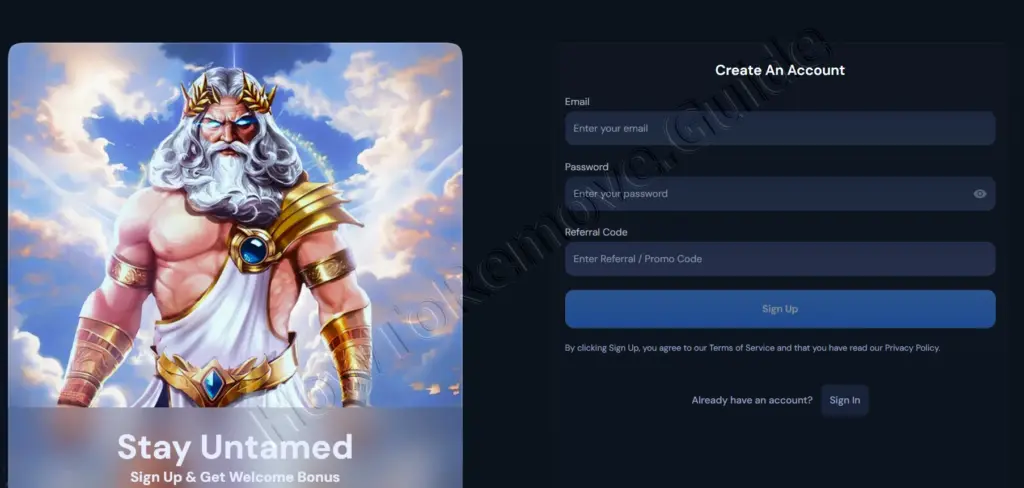

How the Kotewex Scam Deception Funnel Works
Learning the sequence matters because the scheme becomes easier to interrupt once you know what stage comes next. Sites like Kotewex depend on people reacting emotionally to excitement, frustration, and urgency instead of stepping back and naming the tactic.
From start to finish, the funnel is built to turn curiosity into deposits, deposits into more demands, and failed withdrawals into data collection. Every step exists to either extract more crypto, capture documents, or keep the victim engaged long enough for both.
Promo hooks and influencer codes
The first contact point is usually promotional rather than technical. A code, ad, short video, or planted recommendation frames Kotewex as an easy opportunity and suggests that fast action is needed before a bonus window closes.

Casino skin and bonus theater
Once the user lands on the site, the design does heavy lifting. Familiar casino visuals, polished account pages, and repeated references to fairness or liquidity are meant to calm suspicion before any meaningful verification takes place.

Inflated balances, then the gate
Soon after, the account starts performing unusually well. Wins arrive often enough to make a withdrawal feel worthwhile, but the real purpose of that growing balance is to justify the victim sending actual cryptocurrency to “unlock” it.
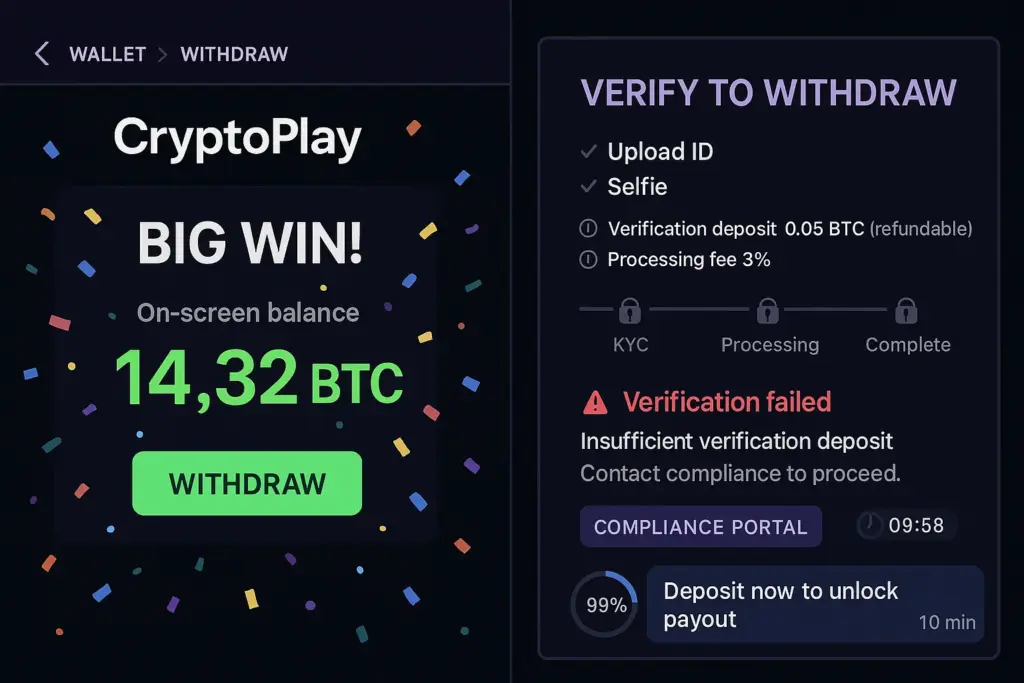
Fee-gates and KYC harvest
When withdrawal is attempted, the fraud switches from seduction to obstruction. New identity requests appear, then AML wording, then tax language, then a demand for one more transfer; every added checkpoint is a pretext, not a legitimate compliance workflow.

Stalling, rebrands, and “recovery” bait
If the victim keeps paying, support finds another reason to stall. If the victim stops, messages slow down, the domain may vanish, and a second-wave scammer can later reappear pretending to offer tracing, legal help, or guaranteed crypto recovery for another fee.
Staying safe from crypto casino scams like Kotewex
Protecting yourself against the next clone starts with habits that feel a little slower and a lot less exciting. The checks below are practical because they reduce dependence on gut feeling and force a suspicious site to prove itself before it gets money or documents.
Verify license status in official registers
Always verify gambling or financial claims at the source. A real license should lead back to a regulator entry you can confirm independently by company name, legal entity, and jurisdiction instead of by whatever screenshot the website decided to display.
Check domain age and history
Registration history is often more revealing than homepage copy. A domain that appeared recently, hides its owner, and resembles older scam brands should be treated as disposable infrastructure rather than as evidence of a new legitimate business.
Reject withdrawal fees and “unlock” deposits
Refuse the entire idea of paying to access your own balance. Real operators may have withdrawal rules, but they do not solve them by demanding an advance transfer labeled as tax, unlock fee, wallet activation, or review deposit.
Prefer venues with recourse
Choose platforms that leave room for accountability. Clear company information, transparent complaint procedures, recognizable licensing, and non-crypto payment options all improve your ability to challenge problems before they become permanent loss.
Limit wallet exposure
Keep wallet exposure narrow even when you think you are only experimenting. Separate addresses, fresh seed phrases, strong account passwords, and active two-factor protection make it harder for one bad interaction to cascade across everything else you use.
Validate “provably fair” claims
Do not accept technical-sounding fairness claims on faith. If a service cannot explain in a checkable way how outcomes are verified and how funds are actually held, the jargon is functioning as costume, not as assurance.
Document and report rapidly
Document events early instead of trying to reconstruct them later. Wallet addresses, TxIDs, screenshots, usernames, support messages, domain names, and timestamps can all become useful if an exchange, law-enforcement unit, or regulator asks for specifics.
Build a deliberate slow-down reflex
Build a pause into your process before every deposit. Scam casinos thrive on urgency, ego, and the fear of missing out; a short verification routine is often enough to break the spell and expose that the offer makes no business sense.
Useful Resources for Scam Reporting and Prevention (By Country)
Although crypto transfers can be hard to unwind, prompt reporting still matters. Exchange compliance teams, blockchain analytics, and law-enforcement coordination all work better when victims preserve evidence and speak up before trails go completely cold.
Click here to report the scam in your country
| Country / Agency | URL | Category / Use-case | Phone/Email |
| Australia – Crime Stoppers | https://www.crimestoppers.com.au | Anonymous tips about crime | 1800 333 000 |
| Australia – National Anti-Scam Center (Scamwatch) | https://www.scamwatch.gov.au/report-a-scam | General scams; phishing; texts/emails | |
| Australia – Police Assistance Line (non-emergency) | https://www.police.gov.au | Local police report | 131 444 |
| Australia – ReportCyber (ACSC) | https://www.cyber.gov.au/report | Cybercrime (hacks, fraud, extortion) | |
| Canada – Canadian Anti-Fraud Center (CAFC) | https://www.antifraudcentre-centreantifraude.ca/report-signalez-eng.htm | General scams incl. phone/text/email | |
| France – DGCCRF (SignalConso) | https://signal.conso.gouv.fr | Consumer scams/deceptive practices | |
| France – PHAROS – Internet-Signalement | https://www.internet-signalement.gouv.fr | Online content & cybercrime reports | |
| Germany – Bundeskriminalamt / Local Police | https://www.polizei.de/Polizei/DE/Home/home_node.html | Report online fraud | |
| Germany – Weißer Ring – Victim Support | https://weisser-ring.de | Victim support | 116 006 |
| India – DoT Helpline (Sanchar Saathi) | https://sancharsaathi.gov.in | Fraudulent telecom/SIM related | 155260 |
| India – National Consumer Helpline | https://consumerhelpline.gov.in | Consumer scams | 1800-11-4000 / 1915 |
| India – National Cyber Crime Reporting Portal | https://cybercrime.gov.in | Cybercrime incl. online fraud | 1930 |
| Japan – Consumer Affairs Agency (CAA) | https://www.caa.go.jp/policies/policy/consumer_policy/caution/cybercrime/ | Consumer scams | |
| Japan – National Police Agency – Cybercrime | https://www.npa.go.jp/bureau/cyber/ | Cybercrime reporting | |
| Mexico – Guardia Nacional (National Guard) | https://www.gob.mx/gn | Cybercrime reporting | |
| Mexico – Instituto Federal de Telecomunicaciones (IFT) | https://www.ift.org.mx | Telecom/online services scams | |
| Mexico – PROFECO | https://www.gob.mx/profeco | Consumer fraud & ecommerce | |
| Netherlands – AFM – Report investment fraud | https://www.afm.nl/en/consumenten/themas/beleggen/misleiding-misbruik | Investment/crypto | |
| Netherlands – Fraudehelpdesk | https://www.fraudehelpdesk.nl/melden | General scams (incl. phishing/SMS) | 088-7867372 |
| Netherlands – Politie – Meldpunt Internetoplichting | https://www.politie.nl/themas/internetoplichting.html | Online shopping fraud | |
| New Zealand – CERT NZ | https://www.cert.govt.nz/individuals/report-an-issue/ | Phishing, identity scams | |
| New Zealand – Department of Internal Affairs – Spam | https://www.dia.govt.nz/Spam-Contact-Us | Email/SMS spam | [email protected] |
| New Zealand – IDCARE | https://www.idcare.org | Victim support (identity compromise) | 0800 121 068 |
| New Zealand – Netsafe – Report | https://www.netsafe.org.nz/report/ | Online harms & scams | |
| New Zealand – New Zealand Police (non-emergency) | https://www.police.govt.nz/use-105 | Report fraud/online crime | 105 |
| Nigeria – Economic & Financial Crimes Commission (EFCC) | https://www.efcc.gov.ng | Financial scams incl. crypto/investment | [email protected] |
| Nigeria – Nigeria Police Special Fraud Unit (SFU) | https://www.specialfraudunit.org.ng | Serious fraud | Voice/SMS: 0708 227 6895; WhatsApp: 0812 760 9914 |
| Poland – CERT Polska (CERT.PL) | https://cert.pl/en/report/ | Cyber incidents & phishing | |
| Poland – Dyzurnet.pl | https://dyzurnet.pl | Illegal online content (esp. child protection) | |
| Poland – Polish Police (Policja) | https://www.policja.pl | Report scams to police | |
| Singapore – Anti-Scam Centre / Anti-Scam Helpline | https://www.scamalert.sg | General scams; texts; calls | 1800-722-6688 |
| Singapore – Monetary Authority of Singapore (MAS) | https://www.mas.gov.sg/investor-alert-list | Investment/crypto checks | |
| Singapore – Singapore Police Force | https://www.police.gov.sg/iwitness | Police report (cybercrime) | |
| South Africa – Cybersecurity Hub (CSIRT) | https://www.cybersecurityhub.gov.za | Cyber incidents incl. scams | |
| South Africa – South African Fraud Prevention Service (SAFPS) | https://www.safps.org.za | Identity fraud support | 011-867-2234 |
| South Africa – South African Police Service (SAPS) | https://www.saps.gov.za | Police report (cybercrime unit) | |
| South Korea – Korea Communications Commission (KCC) | https://www.kcc.go.kr | Telecom-related fraud | |
| South Korea – Korea Internet & Security Agency (KISA) | https://www.kisa.or.kr | Phishing, online harms | |
| South Korea – Korean National Police Agency – Cyber Bureau | https://ecrm.cyber.go.kr | Cybercrime reporting | |
| Spain – INCIBE – Oficina de Seguridad del Internauta (OSI) | https://www.osi.es/es/reporte | Cybersecurity & online fraud | |
| Spain – Policía Nacional / Guardia Civil | https://www.policia.es | Report scams to police | |
| Sweden – Crime Victim Authority (Brottsoffermyndigheten) | https://www.brottsoffermyndigheten.se | Victim support & compensation | 090–70 82 00 |
| Sweden – Polisen (Swedish Police) | https://polisen.se | Report fraud/cybercrime | 114 14 (non-emergency); 112 (emergency) |
| Sweden – Swedish Consumer Agency (Konsumentverket) | https://www.konsumentverket.se | Unfair business practices | |
| United Arab Emirates – Abu Dhabi Police – Aman Service | https://www.adpolice.gov.ae | Cybercrime tips/reporting | SMS 2828; 800 2626 |
| United Arab Emirates – Dubai Police – eCrime | https://www.dubaipolice.gov.ae | Cybercrime reporting | 04 606 1600 |
| United Arab Emirates – Ministry of Interior – Cyber Crime Dept. | https://www.moi.gov.ae | Cybercrime incl. online scams | |
| United Arab Emirates – Telecommunications Regulatory Authority (TRA) / TDRA | https://www.tra.gov.ae | Telecom-related scams/phishing | |
| United Kingdom – Action Fraud (NFIB) | https://www.actionfraud.police.uk | General scams & cybercrime (non-emergency) | 0300 123 2040 |
| United Kingdom – Citizens Advice Consumer Service | https://www.citizensadvice.org.uk/consumer/get-more-help/if-you-need-more-help-about-a-consumer-issue/ | Consumer problems & scam guidance | 0808 223 1133 |
| United Kingdom – Financial Conduct Authority (FCA) | https://www.fca.org.uk/consumers/report-scam-us | Investment/crypto & financial services | |
| United Kingdom – National Cyber Security Centre (NCSC) | https://www.ncsc.gov.uk/collection/phishing-scams | Phishing emails & suspicious websites | |
| United Kingdom – Stop Scams UK ‘159’ | https://stopscamsuk.org.uk/159 | Banking APP fraud (direct to your bank) | 159 |
| United States – AARP Fraud Watch Network Helpline | https://www.aarp.org/money/scams-fraud/ | Victim support | 833-372-8311 |
| United States – Better Business Bureau – Scam Tracker | https://www.bbb.org/scamtracker | Business/marketplace scams | |
| United States – FBI Internet Crime Complaint Center (IC3) | https://www.ic3.gov | Internet crime incl. investment/crypto | |
| United States – Federal Trade Commission – ReportFraud | https://reportfraud.ftc.gov | General scams, phishing, texts/emails | 1-877-382-4357 |
| United States – National Center for Disaster Fraud | https://www.justice.gov/disaster-fraud | Disaster-related scams | (866) 720-5721 |
| United States – SEC Tips & Complaints | https://www.sec.gov/tcr | Investment & securities/crypto-asset offerings |
In practical terms, that is the takeaway: recognize the pattern early, stop paying when the story changes, and verify every claimed credential before you send funds or upload identification.
