

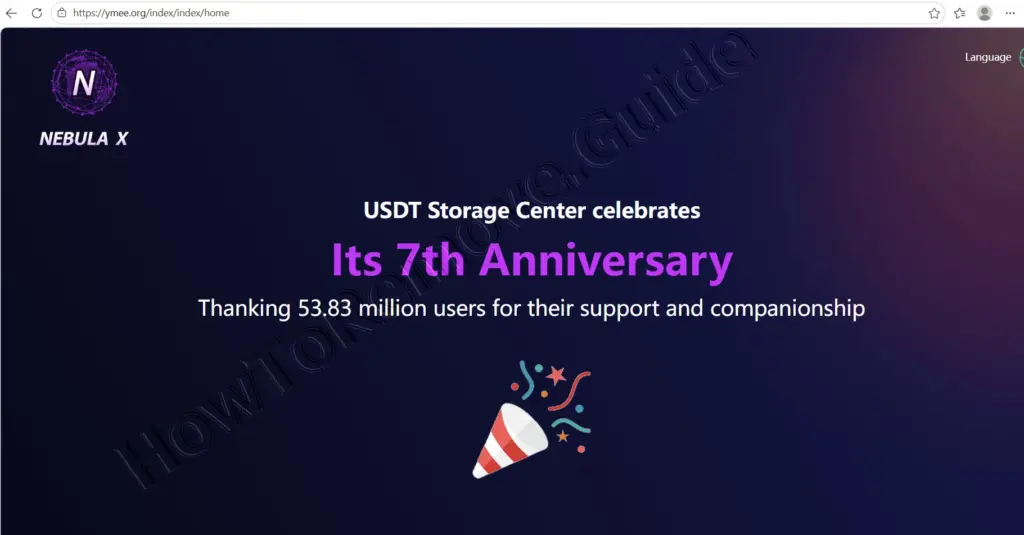
To someone who hasn’t encountered scammy sites like Ymee.org before, this might initially look like a real opportunity to make some extra money through smart, low-risk crypto investments. However, since you are here, you’ve got the opportunity to learn a bit more about this site and save yourself from its deceptive practices.
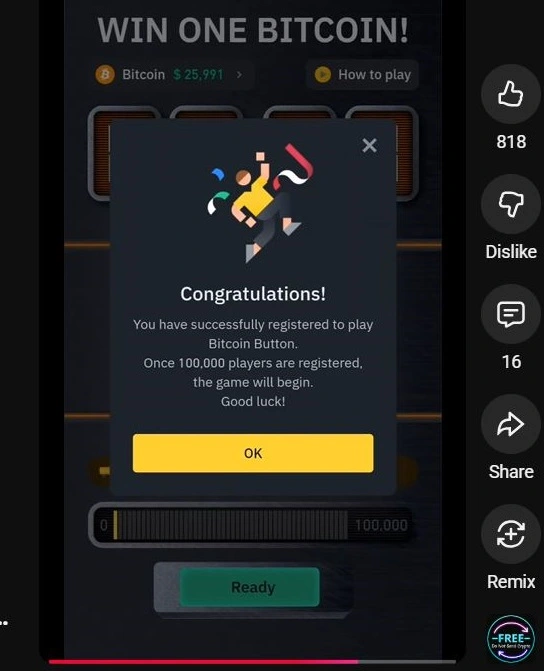
Ymee.org and other operations like it, often lean on viral clips, fake testimonials, and bonus claims to pull users into a closed environment where every visible number is under the scammer’s control.
You see, nothing displayed on Ymee.org’s pages is real except the address you send your own crypto to. The rest can be fabricated on demand, including your profile balance and profits, support messages, compliance notices, and, especially, reviews from other users.
Scams of Ymee.org‘s type are known to steal personal data and passwords. Install SpyHunter Pro to scan for risks, remove any dangerous trackers, and enable real-time protection.

Try Free For 7 Days*
Buy now15% OFF if you buy straight without trial.
 OFFER
OFFERThe end goal is simple -lure you with promises of low-risk, high-reward investments, get you to deposit some of your own crypto and then steal it from you. It’s a tried-and-tested scheme that continues to claim new victims every day, so you must be very careful with such sites.
The notes below are meant to help you spot Ymee.org and closely related clones such as Dsj913.com or Velriqo.com, before they take more. They explain the visual tricks, social pressure, and fee traps these sites use, along with practical containment steps and safer habits for whatever platform you check next.
IMPORTANT! READ BEFORE PROCEEDING!
If Ymee.org has already touched your money or data — through registration, wallet connection, KYC upload, or a transfer — assume the problem can widen unless you act quickly. Cut off further contact, preserve the trail, secure linked accounts, and ignore anyone who promises a paid recovery or a final unlocking step.
- Move remaining assets to a fresh, clean wallet and revoke any suspicious token approvals linked to the scam touchpoint.
- Change passwords and enable app-based 2FA on email, exchanges, and chat accounts; review active sessions and delete unused API keys.
- Preserve evidence: screenshots, URLs, videos or ads, wallet addresses, TXIDs, and chat logs – keep everything for official reports.
- Notify the sending platform (your exchange or service) with TXIDs and the destination address so they can flag or freeze if possible.
- Report promptly to your national cybercrime unit (e.g., IC3 in the US, Action Fraud in the UK) and to the platform where you saw the promotion.
How We Know Ymee.org is a Scam
The case against Ymee.org is not based on one dramatic clue but on a cluster of behaviors that repeatedly appear in fake exchanges and gambling-style crypto fronts. Put together, they reveal a service designed to extract more from users than it ever intends to return.
Bonus code illusion
The instant appearance of a large balance after entering a code is not generosity; it is stage dressing. Real assets do not materialize because a text box accepted a promotional word on a barely known site.
Pre-withdrawal payment trap
When a platform says you must deposit before it can process your withdrawal, it has inverted the relationship on purpose. That reversal is one of the clearest hallmarks of an advance-fee scam dressed up in crypto language.
Synthetic authority signals
Famous faces, polished interviews, and confident narration can all be manufactured with modern editing and AI tools. The scammers are not proving legitimacy; they are borrowing familiarity to lower your guard.
Missing evidence on the ledger
Claims about completed payouts mean very little without a verifiable blockchain record. If the site cannot show a real transaction hash tied to the supposed withdrawal, the balance on screen is likely fictional from the start.
Compliance theater everywhere
Ymee.org may talk about security, licensing, or anti-money-laundering checks, yet those claims often collapse under basic verification. Real operators can be traced through public records, corporate details, and regulator databases instead of decorative icons.
Same shell, new address
These scams rarely die when exposed; they shed a skin. A shutdown or complaint spike is often followed by the same design, language, and process reappearing on another domain with a fresh name.
How the Ymee.org Scam Deception Funnel Works
Understanding the scam flow matters because each phase is built to feel reasonable in isolation. Once the full chain is visible, the pattern stops looking like a complicated platform problem and starts looking like a scripted money-extraction process.
The journey usually begins with easy trust and ends with layered excuses. A user is enticed by a promotion, shown an impressive account, pushed toward a small transfer, and then trapped in a cycle of new requirements that never actually unlock anything.
Attention bait and social proof staging
Many victims first encounter Ymee.org through ads, reposted videos, fake comments, or direct outreach that frames the platform as popular and time-sensitive. The point is to make verification feel slower than acting right away.

Low-friction entry, high-friction exit
Opening an account is intentionally simple because the site wants as many users inside the funnel as possible. Once registered, the clean dashboard and congratulatory prompts are used to make the environment seem settled and trustworthy.

Displayed profit becomes the hook
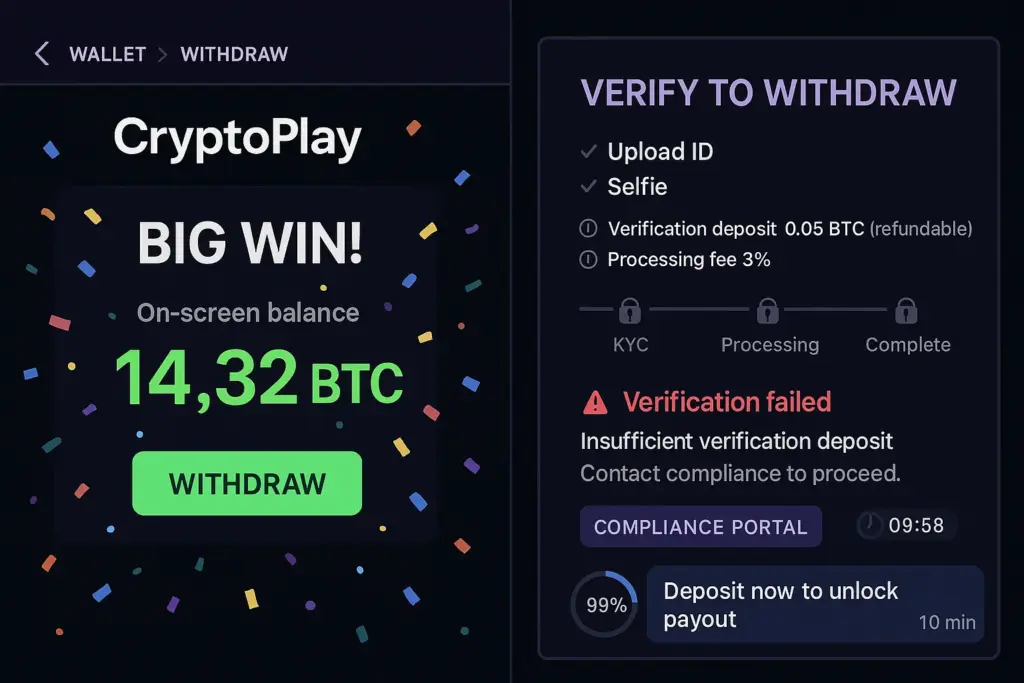
After the user sees a big number attached to their account, the psychological balance shifts. The victim starts thinking about withdrawing what appears to already be theirs instead of pausing to question whether the number represents anything real.
Verification loops and fee stacking
At withdrawal time, Ymee.org starts inventing reasons a payment cannot yet proceed. A network charge turns into a tax issue, then into an AML review, then into a wallet check or identification request, each one buying time and extracting more value.

Ghosting, relaunches, and recovery follow-ups
Eventually the support line slows, the excuses repeat, and the site may stop responding altogether. In many cases the story continues under a new brand, or the victim is contacted later by someone claiming they can recover the lost funds for a fee.
Staying safe from crypto scams like Ymee.org
Protection is mostly about interrupting momentum. You do not need to predict every scam variation if you build habits that force independent checks, shrink the blast radius of risky interactions, and prevent a moment of excitement from turning into a chain of losses.
Refuse any release fee demand
The moment a site asks for an unlocking deposit, tax prepayment, or verification transfer, treat that as your answer. Authentic services do not require customers to send fresh funds merely to access existing balances.
Audit celebrity claims independently
Do not judge a platform by the confidence of the video promoting it. Check the official pages of the person or company being referenced, because manipulated clips are now cheap and widely used in scam campaigns.
Type or bookmark the destination yourself
Fraud operators love search ads, shortened links, chat messages, and comment sections because they can intercept users before they reach the real service. Enter destinations manually or rely on bookmarks you created earlier from trusted sources.
Check the watchdogs, not the badges
A badge on the site proves only that someone placed an image there. Look for official warning pages, licensing databases, or company registries that can confirm whether the operator exists beyond the page in front of you.
Compartmentalize wallet risk
Keep primary holdings separate from anything experimental. A low-value wallet for testing unfamiliar platforms limits what can be lost if approvals, signatures, or links turn out to be part of a broader scam setup.
Lock down the surrounding accounts
Crypto fraud often overlaps with email compromise, credential reuse, and account takeover attempts. Update passwords, enable app-based 2FA, review sessions, and remove unnecessary API keys wherever the scam interaction may have overlapped.
Review approvals and consider migration
Wallet connections can outlast the moment that created them. If you signed anything or granted token access, inspect and revoke permissions through trusted tools, and consider moving assets if you no longer trust the address history.
Protect documents and resist haste
KYC uploads, selfies, and identity scans can have value long after the original theft. Watch for secondary misuse and give yourself time before making any new payment decision, especially if pressure is being framed as urgent or one-time only.
Where to report Ymee.org-style crypto scams (by country)
Reports help investigators link domains, wallet addresses, and ad campaigns that may otherwise look isolated. Save everything you can, then notify the relevant cybercrime authorities, your sending platform, and the site or social network where the lure appeared.
Report Ymee.org through official channels
| Country / Agency | URL | Category / Use-case | Phone/Email |
| Australia – Crime Stoppers | https://www.crimestoppers.com.au | Anonymous tips about crime | 1800 333 000 |
| Australia – National Anti-Scam Center (Scamwatch) | https://www.scamwatch.gov.au/report-a-scam | General scams; phishing; texts/emails | |
| Australia – Police Assistance Line (non-emergency) | https://www.police.gov.au | Local police report | 131 444 |
| Australia – ReportCyber (ACSC) | https://www.cyber.gov.au/report | Cybercrime (hacks, fraud, extortion) | |
| Canada – Canadian Anti-Fraud Center (CAFC) | https://www.antifraudcentre-centreantifraude.ca/report-signalez-eng.htm | General scams incl. phone/text/email | |
| France – DGCCRF (SignalConso) | https://signal.conso.gouv.fr | Consumer scams/deceptive practices | |
| France – PHAROS – Internet-Signalement | https://www.internet-signalement.gouv.fr | Online content & cybercrime reports | |
| Germany – Bundeskriminalamt / Local Police | https://www.polizei.de/Polizei/DE/Home/home_node.html | Report online fraud | |
| Germany – Weißer Ring – Victim Support | https://weisser-ring.de | Victim support | 116 006 |
| India – DoT Helpline (Sanchar Saathi) | https://sancharsaathi.gov.in | Fraudulent telecom/SIM related | 155260 |
| India – National Consumer Helpline | https://consumerhelpline.gov.in | Consumer scams | 1800-11-4000 / 1915 |
| India – National Cyber Crime Reporting Portal | https://cybercrime.gov.in | Cybercrime incl. online fraud | 1930 |
| Japan – Consumer Affairs Agency (CAA) | https://www.caa.go.jp/policies/policy/consumer_policy/caution/cybercrime/ | Consumer scams | |
| Japan – National Police Agency – Cybercrime | https://www.npa.go.jp/bureau/cyber/ | Cybercrime reporting | |
| Mexico – Guardia Nacional (National Guard) | https://www.gob.mx/gn | Cybercrime reporting | |
| Mexico – Instituto Federal de Telecomunicaciones (IFT) | https://www.ift.org.mx | Telecom/online services scams | |
| Mexico – PROFECO | https://www.gob.mx/profeco | Consumer fraud & ecommerce | |
| Netherlands – AFM – Report investment fraud | https://www.afm.nl/en/consumenten/themas/beleggen/misleiding-misbruik | Investment/crypto | |
| Netherlands – Fraudehelpdesk | https://www.fraudehelpdesk.nl/melden | General scams (incl. phishing/SMS) | 088-7867372 |
| Netherlands – Politie – Meldpunt Internetoplichting | https://www.politie.nl/themas/internetoplichting.html | Online shopping fraud | |
| New Zealand – CERT NZ | https://www.cert.govt.nz/individuals/report-an-issue/ | Phishing, identity scams | |
| New Zealand – Department of Internal Affairs – Spam | https://www.dia.govt.nz/Spam-Contact-Us | Email/SMS spam | [email protected] |
| New Zealand – IDCARE | https://www.idcare.org | Victim support (identity compromise) | 0800 121 068 |
| New Zealand – Netsafe – Report | https://www.netsafe.org.nz/report/ | Online harms & scams | |
| New Zealand – New Zealand Police (non-emergency) | https://www.police.govt.nz/use-105 | Report fraud/online crime | 105 |
| Nigeria – Economic & Financial Crimes Commission (EFCC) | https://www.efcc.gov.ng | Financial scams incl. crypto/investment | [email protected] |
| Nigeria – Nigeria Police Special Fraud Unit (SFU) | https://www.specialfraudunit.org.ng | Serious fraud | Voice/SMS: 0708 227 6895; WhatsApp: 0812 760 9914 |
| Poland – CERT Polska (CERT.PL) | https://cert.pl/en/report/ | Cyber incidents & phishing | |
| Poland – Dyzurnet.pl | https://dyzurnet.pl | Illegal online content (esp. child protection) | |
| Poland – Polish Police (Policja) | https://www.policja.pl | Report scams to police | |
| Singapore – Anti-Scam Centre / Anti-Scam Helpline | https://www.scamalert.sg | General scams; texts; calls | 1800-722-6688 |
| Singapore – Monetary Authority of Singapore (MAS) | https://www.mas.gov.sg/investor-alert-list | Investment/crypto checks | |
| Singapore – Singapore Police Force | https://www.police.gov.sg/iwitness | Police report (cybercrime) | |
| South Africa – Cybersecurity Hub (CSIRT) | https://www.cybersecurityhub.gov.za | Cyber incidents incl. scams | |
| South Africa – South African Fraud Prevention Service (SAFPS) | https://www.safps.org.za | Identity fraud support | 011-867-2234 |
| South Africa – South African Police Service (SAPS) | https://www.saps.gov.za | Police report (cybercrime unit) | |
| South Korea – Korea Communications Commission (KCC) | https://www.kcc.go.kr | Telecom-related fraud | |
| South Korea – Korea Internet & Security Agency (KISA) | https://www.kisa.or.kr | Phishing, online harms | |
| South Korea – Korean National Police Agency – Cyber Bureau | https://ecrm.cyber.go.kr | Cybercrime reporting | |
| Spain – INCIBE – Oficina de Seguridad del Internauta (OSI) | https://www.osi.es/es/reporte | Cybersecurity & online fraud | |
| Spain – Policía Nacional / Guardia Civil | https://www.policia.es | Report scams to police | |
| Sweden – Crime Victim Authority (Brottsoffermyndigheten) | https://www.brottsoffermyndigheten.se | Victim support & compensation | 090–70 82 00 |
| Sweden – Polisen (Swedish Police) | https://polisen.se | Report fraud/cybercrime | 114 14 (non-emergency); 112 (emergency) |
| Sweden – Swedish Consumer Agency (Konsumentverket) | https://www.konsumentverket.se | Unfair business practices | |
| United Arab Emirates – Abu Dhabi Police – Aman Service | https://www.adpolice.gov.ae | Cybercrime tips/reporting | SMS 2828; 800 2626 |
| United Arab Emirates – Dubai Police – eCrime | https://www.dubaipolice.gov.ae | Cybercrime reporting | 04 606 1600 |
| United Arab Emirates – Ministry of Interior – Cyber Crime Dept. | https://www.moi.gov.ae | Cybercrime incl. online scams | |
| United Arab Emirates – Telecommunications Regulatory Authority (TRA) / TDRA | https://www.tra.gov.ae | Telecom-related scams/phishing | |
| United Kingdom – Action Fraud (NFIB) | https://www.actionfraud.police.uk | General scams & cybercrime (non-emergency) | 0300 123 2040 |
| United Kingdom – Citizens Advice Consumer Service | https://www.citizensadvice.org.uk/consumer/get-more-help/if-you-need-more-help-about-a-consumer-issue/ | Consumer problems & scam guidance | 0808 223 1133 |
| United Kingdom – Financial Conduct Authority (FCA) | https://www.fca.org.uk/consumers/report-scam-us | Investment/crypto & financial services | |
| United Kingdom – National Cyber Security Centre (NCSC) | https://www.ncsc.gov.uk/collection/phishing-scams | Phishing emails & suspicious websites | |
| United Kingdom – Stop Scams UK ‘159’ | https://stopscamsuk.org.uk/159 | Banking APP fraud (direct to your bank) | 159 |
| United States – AARP Fraud Watch Network Helpline | https://www.aarp.org/money/scams-fraud/ | Victim support | 833-372-8311 |
| United States – Better Business Bureau – Scam Tracker | https://www.bbb.org/scamtracker | Business/marketplace scams | |
| United States – FBI Internet Crime Complaint Center (IC3) | https://www.ic3.gov | Internet crime incl. investment/crypto | |
| United States – Federal Trade Commission – ReportFraud | https://reportfraud.ftc.gov | General scams, phishing, texts/emails | 1-877-382-4357 |
| United States – National Center for Disaster Fraud | https://www.justice.gov/disaster-fraud | Disaster-related scams | (866) 720-5721 |
| United States – SEC Tips & Complaints | https://www.sec.gov/tcr | Investment & securities/crypto-asset offerings |
