

If you’ve ever scrolled through your feed late at night – you know, that soft, guilty doom-scroll where everything starts to look a little more appealing than it should – you’ve probably seen one of those ads promising quick cash for almost no effort. And honestly, if you paused for even half a second and thought, “Well, maybe…,” you’re not alone. That’s exactly the kind of moment these scammers live for. Lately, a whole ecosystem of suspicious little websites has been popping up under names like Rambuzz.com, TikApply, RamStash, RamBread, Ram15.com, and TikFunds.com. And, okay, I know that’s a lot of names to take in at once, but just remember them as the kind of places that talk big and disappear fast. They push this shiny vision of easy income – watch a video, like a post, click a button – and somehow you walk away with fifty bucks. At least, that’s the fantasy they’re selling.
Scams of RamBuzz‘s type are known to steal personal data and passwords. Install SpyHunter Pro to scan for risks, remove any dangerous trackers, and enable real-time protection.

Try Free For 7 Days*
Buy now15% OFF if you buy straight without trial.
 OFFER
OFFERUnderstanding the RamBuzz Scam
Now, the first thing to understand is that these scams don’t start with fireworks or elaborate storylines. They usually slip in quietly through a simple Facebook ad, an Instagram reel, a random LinkedIn message, or, more annoyingly, a surprise WhatsApp ping from a number you’ve never seen before. The phrasing is always the same: flexible work, simple tasks, daily commissions, quick payouts. And the tone? Friendly, almost casual, like a recruiter who just happened to stumble on your profile and thought, hey, you look like someone who deserves a break. It feels harmless. That’s the hook.
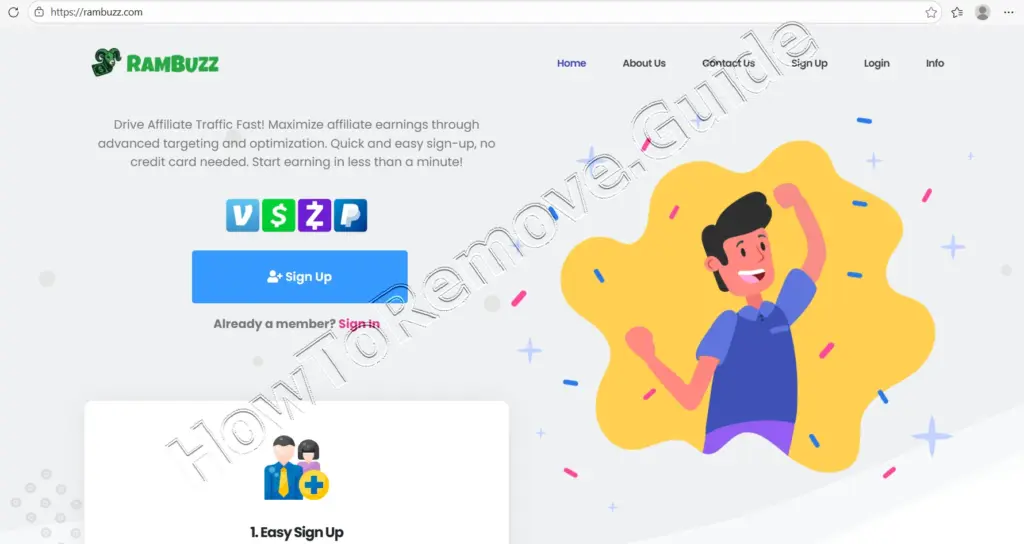
Once you click – because curiosity is a powerful force, isn’t it – you’re taken to one of these sleek, almost-professional websites. They’re built to look trustworthy, with dashboards, progress bars, “earnings history,” and fake testimonials sprinkled around like confetti. And at first, everything seems legitimate. You complete a tiny task, something so small it barely qualifies as work, and suddenly there’s money added to your balance. You might even be able to withdraw a couple of dollars just to help the illusion settle in. And here’s the tricky part: that small payout feels real enough to silence your doubts. It’s intentional. It’s psychological. It’s how they get you to lean forward instead of stepping back.
But this is where the story shifts. After those tiny wins, you’re nudged toward bigger tasks – the so-called “lucky orders” or “premium tasks” that offer high rewards. Except, of course, there’s a catch. To access them, you have to pay a small fee. Nothing dramatic at first – just a few dollars for “activation” or “verification.” And because you’ve already earned something, paying feels like an investment rather than a risk. That’s the moment the scam cracks open. As soon as you pay once, the requests multiply. There’s always another fee: a larger one for processing, another for tax clearance, another for unlocking a backlog of “pending earnings.” Each milestone keeps shifting right as you reach for it.
And this pattern isn’t random. It’s a deliberate funnel designed to escalate your commitment. You get emotionally invested – almost like you’re following through on a promise made to yourself. You’ve put time in, you’ve put money in, and you’re trying to reach the finish line they keep moving. Victims describe going through the same cycle: a small payout for reassurance, a series of escalating fees, and eventually a point where the website stops responding altogether. You try to log in and the system suddenly can’t find your account. You check the recruiter’s number, and it’s gone. The support email bounces. And that balance you built up? It was never real.
What To Look For: The RamBuzz Scam Warning Signs
There are some early warning signs, though, and once you start paying attention, you’ll notice that these sites all follow the same blueprint. The domains are usually brand-new – sometimes only weeks old – with no identifiable owners. The people contacting you use generic names like “Sarah HR” or “Daniel from Online Tasks Dept.,” and their profiles vanish the moment you ask anything specific. The offers sound too good to be true because they are. Tasks that pay absurd amounts, reviews with suspiciously perfect grammar, company pages with no history, no registration, no footprint outside their own ecosystem. And the pressure tactics? Classic. Messages like “Congratulations, you’ve been selected!” or “Only five spots left today!” exist purely to shut down your critical thinking.
What really gives these schemes their power, though, is the emotional timing. They catch people when money is tight, when side gigs sound appealing, when stress makes shortcuts look like opportunities. And because the internet is full of legitimate remote work options, the fake ones blend in too easily. Once those first dollars hit your dashboard, it feels like maybe – just maybe – this one is real. That moment of hope is the lever scammers use to move everything else.
And let’s talk about the payment methods, because that’s another big clue. These scams rarely ask for credit cards; those are too easy to dispute. Instead, they push PayPal, CashApp, Venmo, and Zelle – fast, irreversible, peer-to-peer transfers. Once the money leaves your account, it’s gone in the same way a message in a bottle disappears into the ocean. You can try calling your bank, and you absolutely should, but the recovery rate is slim because these are treated as voluntary transfers. And the scammers know that. That’s why they use them.
What to Do If You Fall Into the RamBuzz Scam
Still, if you ever find yourself wrapped up in one of these situations – maybe because a friend forwarded a link, or you clicked something without thinking, or the promise of easy money landed on a day when you were just tired enough to believe it – there are steps you can take right away. Contact your payment provider as fast as you can. Change the passwords you used on the scam site. Block the contacts who reached out to you. And then, even though it might feel embarrassing, consider filing a report with your local consumer protection agency or even your country’s cybercrime center. That kind of data helps prevent future scams, and honestly, your story might save someone else from making the same mistake.
If you haven’t fallen for one yet, the best protection is staying just a little skeptical – the healthy kind, not the cynical kind. Ask questions. Google the website. Check WHOIS data. Look for reviews outside their own ecosystem. Avoid any opportunity that needs you to pay first in order to get paid later. Real jobs don’t work like that. Real companies don’t make you buy your way in. And real recruiters don’t vanish into thin air when you ask a basic question like, “Where is your office located?”
At the end of the day, these scams survive because they mimic legitimacy with just enough accuracy to fool people who are only trying to make their lives a little easier. If something online promises effortless money through tasks so simple they barely qualify as work, pause for a moment. Take a breath. Ask yourself whether the promise fits the reality you know. And if the answer feels off – even slightly – trust that feeling. It’s trying to protect you.
