

No matter how polished and hyped up the front page of a site like Denevex.com may look, you should always be prepared to dig deeper and look beyond the surface, or else you may fall victim to a run-of-the-mill online scam, identical to many other ones we’ve seen in the past.
In other words, Denevex isn’t an actual legit crypto casino. It’s just a fraudulent site, identical to Gusewin256, Spdwin.com and others we’ve covered in the past. It matches a fraud model that keeps resurfacing across clone gambling sites: oversized signup rewards, game results that look unusually generous, and a payout screen that suddenly demands that you pay first.
That last part is the gist of the scam. The user payment is framed as a “verification deposit,” but it’s really the end goal of the scammers. They want to keep that deposit and possibly also get hold of your wallet or banking account credentials.
Scams of Denevex.com‘s type are known to steal personal data and passwords. Install SpyHunter Pro to scan for risks, remove any dangerous trackers, and enable real-time protection.

Try Free For 7 Days*
Buy now15% OFF if you buy straight without trial.
 OFFER
OFFERNeedless to say, there’s no actual payout waiting for you because your “winnings” were never real. And if you’ve already shared any personal data or sent some of your actual money to the site, your other digital assets may be in danger too.
An interaction with Denevex, is not a customer-service problem but an active security hazard and should be addressed duly. The guidance below explains how to act in case you think your credentials have been compromised and how to stay safe from copycat scams in the future.
IMPORTANT! READ BEFORE PROCEEDING!
If you already sent money, documents, or wallet details to Denevex, stop trying to “finish” the withdrawal and move straight into protection mode. Cut off conversation, refuse every added payment request, secure the accounts that touch your money or identity, and save screenshots before the site changes again. Use the five steps below as your first-response checklist.
- Reset passwords and enable 2FA on your email, crypto exchanges, and wallets; terminate other active sessions.
- Notify any exchanges and services touched by the funds; provide TxIDs and ask that accounts/addresses be flagged per policy.
- Migrate assets to fresh wallets with new seed phrases and revoke any existing token approvals on connected chains.
- If you uploaded ID documents, place credit/fraud alerts where available and monitor for identity-theft signals.
- Assemble an evidence bundle – wallet addresses, TxIDs, site URLs, chats, and screenshots – and file reports with police/IC3 and any involved platforms.
How We Know Denevex is a Scam
Once the marketing gloss is stripped away, the warning pattern is hard to miss. The indicators below are the same ones repeatedly seen on bogus crypto betting portals: engineered urgency, unverifiable legitimacy claims, fake account growth, and payment barriers that appear only when a user asks for money back.
Paywall before payout
A genuine operator does not ask you to send more funds in order to receive your own balance. When a withdrawal is blocked behind a “release fee,” that is the scam logic revealing itself.
Borrowed credibility
License seals, trust badges, and registration numbers may appear impressive at first glance, yet scam pages often copy this material because most visitors never check the regulator’s actual register.
Screen-only winnings
Early rounds often seem unusually lucky because the visible balance is part of the persuasion system. The goal is not fair play; it is to make the victim feel close enough to cashing out that another deposit seems rational.
Crypto as the only lane
When deposits run only through cryptocurrency, the operators gain speed, anonymity, and resistance to chargebacks. That setup sharply reduces a victim’s practical options once the money leaves.
Manufactured crowd trust
Busy chat widgets, glowing comments, countdown offers, and influencer-style codes can all be staged. These cues are meant to lower suspicion by making the site appear popular, active, and already vetted by other people.
Disposable web identity
Fraud rings frequently rotate through fresh domains, privacy-shielded registrations, and near-copy layouts so complaints never stay attached to one name for long. Basic checks with tools such as who.is can expose how recently a site appeared and how little ownership transparency it offers.


How the Denevex Scam Deception Funnel Works
Recognizing the sequence matters because these operations do not improvise much. They rely on a repeatable path that moves a target from curiosity to deposit, from deposit to document upload, and from there to escalating payment requests dressed up as compliance or security steps.
In practice, the funnel usually starts with attraction, shifts into false reassurance, then hardens into obstruction the moment withdrawal is attempted. Each stage is designed to create just enough hope to keep the victim engaged while more crypto or personal information is extracted.
Bait arrives first
Promotional clips, direct messages, comment spam, and referral codes often serve as the entry point. The pitch usually combines scarcity with easy upside: a bonus that “expires tonight,” a creator endorsement, or a claim that newcomers are cashing out with almost no effort.

The interface sells legitimacy
After the click, the site tries to look polished enough that questions fade into the background. Game tiles, live-looking balances, customer support boxes, and slogans about fairness are arranged to make the platform feel routine rather than risky.

Success is displayed early
Soon after sign-up, the account may show rapid gains or suspiciously favorable outcomes. This is where the trap tightens, because visible profit encourages bigger deposits and makes the future withdrawal seem emotionally “earned.”
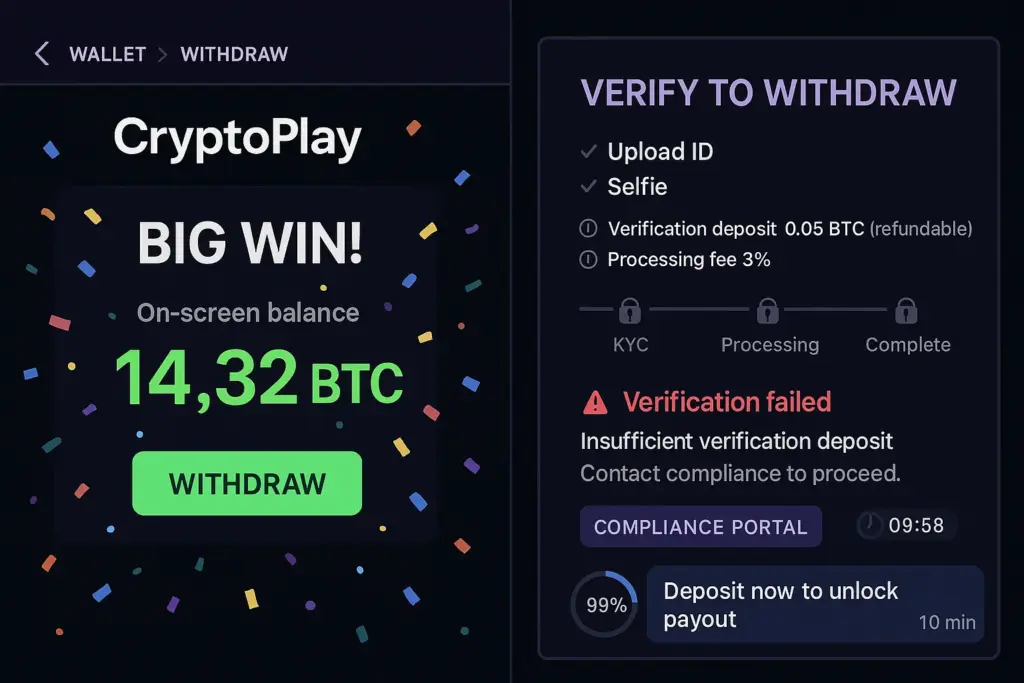
The cash-out request triggers conditions
Only when money is supposed to leave the platform do the hidden requirements appear. Suddenly there is an AML review, a tax clearance, a wallet verification transfer, or a tier upgrade that must be paid first.

Delays become the weapon
If the victim hesitates, support often switches to reassurance mixed with pressure: one last payment, one final check, one more form. When that stops working, replies taper off, the domain may vanish, and follow-up “recovery” approaches can target the same victim again with a second fee-based lie.
Staying safe from crypto casino scams like Denevex
Avoiding the next version of this scam is mostly about building a slow, repeatable review habit before you ever connect a wallet or send funds. The checks below will not eliminate all risk, but they sharply reduce the odds of being manipulated by polished design, urgency, and false social proof.
Check the regulator, not the banner
Do not rely on logos pasted onto the page. Search the relevant gambling or financial authority register by company name, license number, and domain to see whether the claimed operator is actually listed and currently authorized.
Inspect domain history before depositing
A site that appeared recently, hides ownership, and has little independent history deserves extra suspicion. Archived pages and public registration data can show whether the brand has substance or simply replaced yesterday’s failed clone.
Refuse any pay-to-release story
Up-front charges framed as processing, tax, wallet activation, or account unlocking are a major danger sign. Consumer-protection agencies repeatedly warn that demands for advance payment to recover or release money are how fee-based scams keep losses growing.
Prefer payment methods with recourse
Platforms that isolate users inside crypto-only transfers give victims fewer ways to dispute a transaction. Where gambling is legal in your area, verifiable licensing, clear company information, and recognizable consumer protections matter far more than flashy bonus offers.
Segment wallets and lock accounts down
Use unique passwords, enable two-factor authentication, keep exchange email accounts hardened, and move remaining assets to fresh wallets if you suspect compromise. On chains that support approvals, review and revoke permissions you no longer trust.
Treat grand technical claims skeptically
Phrases like “provably fair,” “fully audited,” or “guaranteed withdrawal” should be tested, not admired. If the site offers no independent proof you can verify yourself, the language is serving as marketing camouflage rather than evidence.
Preserve evidence while acting quickly
Save wallet addresses, transaction IDs, chat logs, deposit receipts, and every URL connected to the incident. Timely reports to exchanges, blockchain analytics contacts where available, and your national cybercrime channel may not reverse a transfer, but they can help flag related infrastructure and support later investigations.
Expect a second scam after the first
People who lose money to crypto fraud are often approached again by supposed recovery specialists, tracing experts, or officials who promise retrieval for a fee. Authorities such as the FTC and FBI warn that paying someone upfront to get lost crypto back usually compounds the damage instead of solving it.
Useful Resources for Scam Reporting and Prevention (By Country)
Because reporting channels vary by location, use the directory below to notify the most relevant authority in your country, along with any exchange, wallet provider, or platform that touched the transaction as quickly as possible.
Find the right reporting channel below
| Country / Agency | URL | Category / Use-case | Phone/Email |
| Australia – Crime Stoppers | https://www.crimestoppers.com.au | Anonymous tips about crime | 1800 333 000 |
| Australia – National Anti-Scam Center (Scamwatch) | https://www.scamwatch.gov.au/report-a-scam | General scams; phishing; texts/emails | |
| Australia – Police Assistance Line (non-emergency) | https://www.police.gov.au | Local police report | 131 444 |
| Australia – ReportCyber (ACSC) | https://www.cyber.gov.au/report | Cybercrime (hacks, fraud, extortion) | |
| Canada – Canadian Anti-Fraud Center (CAFC) | https://www.antifraudcentre-centreantifraude.ca/report-signalez-eng.htm | General scams incl. phone/text/email | |
| France – DGCCRF (SignalConso) | https://signal.conso.gouv.fr | Consumer scams/deceptive practices | |
| France – PHAROS – Internet-Signalement | https://www.internet-signalement.gouv.fr | Online content & cybercrime reports | |
| Germany – Bundeskriminalamt / Local Police | https://www.polizei.de/Polizei/DE/Home/home_node.html | Report online fraud | |
| Germany – Weißer Ring – Victim Support | https://weisser-ring.de | Victim support | 116 006 |
| India – DoT Helpline (Sanchar Saathi) | https://sancharsaathi.gov.in | Fraudulent telecom/SIM related | 155260 |
| India – National Consumer Helpline | https://consumerhelpline.gov.in | Consumer scams | 1800-11-4000 / 1915 |
| India – National Cyber Crime Reporting Portal | https://cybercrime.gov.in | Cybercrime incl. online fraud | 1930 |
| Japan – Consumer Affairs Agency (CAA) | https://www.caa.go.jp/policies/policy/consumer_policy/caution/cybercrime/ | Consumer scams | |
| Japan – National Police Agency – Cybercrime | https://www.npa.go.jp/bureau/cyber/ | Cybercrime reporting | |
| Mexico – Guardia Nacional (National Guard) | https://www.gob.mx/gn | Cybercrime reporting | |
| Mexico – Instituto Federal de Telecomunicaciones (IFT) | https://www.ift.org.mx | Telecom/online services scams | |
| Mexico – PROFECO | https://www.gob.mx/profeco | Consumer fraud & ecommerce | |
| Netherlands – AFM – Report investment fraud | https://www.afm.nl/en/consumenten/themas/beleggen/misleiding-misbruik | Investment/crypto | |
| Netherlands – Fraudehelpdesk | https://www.fraudehelpdesk.nl/melden | General scams (incl. phishing/SMS) | 088-7867372 |
| Netherlands – Politie – Meldpunt Internetoplichting | https://www.politie.nl/themas/internetoplichting.html | Online shopping fraud | |
| New Zealand – CERT NZ | https://www.cert.govt.nz/individuals/report-an-issue/ | Phishing, identity scams | |
| New Zealand – Department of Internal Affairs – Spam | https://www.dia.govt.nz/Spam-Contact-Us | Email/SMS spam | [email protected] |
| New Zealand – IDCARE | https://www.idcare.org | Victim support (identity compromise) | 0800 121 068 |
| New Zealand – Netsafe – Report | https://www.netsafe.org.nz/report/ | Online harms & scams | |
| New Zealand – New Zealand Police (non-emergency) | https://www.police.govt.nz/use-105 | Report fraud/online crime | 105 |
| Nigeria – Economic & Financial Crimes Commission (EFCC) | https://www.efcc.gov.ng | Financial scams incl. crypto/investment | [email protected] |
| Nigeria – Nigeria Police Special Fraud Unit (SFU) | https://www.specialfraudunit.org.ng | Serious fraud | Voice/SMS: 0708 227 6895; WhatsApp: 0812 760 9914 |
| Poland – CERT Polska (CERT.PL) | https://cert.pl/en/report/ | Cyber incidents & phishing | |
| Poland – Dyzurnet.pl | https://dyzurnet.pl | Illegal online content (esp. child protection) | |
| Poland – Polish Police (Policja) | https://www.policja.pl | Report scams to police | |
| Singapore – Anti-Scam Centre / Anti-Scam Helpline | https://www.scamalert.sg | General scams; texts; calls | 1800-722-6688 |
| Singapore – Monetary Authority of Singapore (MAS) | https://www.mas.gov.sg/investor-alert-list | Investment/crypto checks | |
| Singapore – Singapore Police Force | https://www.police.gov.sg/iwitness | Police report (cybercrime) | |
| South Africa – Cybersecurity Hub (CSIRT) | https://www.cybersecurityhub.gov.za | Cyber incidents incl. scams | |
| South Africa – South African Fraud Prevention Service (SAFPS) | https://www.safps.org.za | Identity fraud support | 011-867-2234 |
| South Africa – South African Police Service (SAPS) | https://www.saps.gov.za | Police report (cybercrime unit) | |
| South Korea – Korea Communications Commission (KCC) | https://www.kcc.go.kr | Telecom-related fraud | |
| South Korea – Korea Internet & Security Agency (KISA) | https://www.kisa.or.kr | Phishing, online harms | |
| South Korea – Korean National Police Agency – Cyber Bureau | https://ecrm.cyber.go.kr | Cybercrime reporting | |
| Spain – INCIBE – Oficina de Seguridad del Internauta (OSI) | https://www.osi.es/es/reporte | Cybersecurity & online fraud | |
| Spain – Policía Nacional / Guardia Civil | https://www.policia.es | Report scams to police | |
| Sweden – Crime Victim Authority (Brottsoffermyndigheten) | https://www.brottsoffermyndigheten.se | Victim support & compensation | 090–70 82 00 |
| Sweden – Polisen (Swedish Police) | https://polisen.se | Report fraud/cybercrime | 114 14 (non-emergency); 112 (emergency) |
| Sweden – Swedish Consumer Agency (Konsumentverket) | https://www.konsumentverket.se | Unfair business practices | |
| United Arab Emirates – Abu Dhabi Police – Aman Service | https://www.adpolice.gov.ae | Cybercrime tips/reporting | SMS 2828; 800 2626 |
| United Arab Emirates – Dubai Police – eCrime | https://www.dubaipolice.gov.ae | Cybercrime reporting | 04 606 1600 |
| United Arab Emirates – Ministry of Interior – Cyber Crime Dept. | https://www.moi.gov.ae | Cybercrime incl. online scams | |
| United Arab Emirates – Telecommunications Regulatory Authority (TRA) / TDRA | https://www.tra.gov.ae | Telecom-related scams/phishing | |
| United Kingdom – Action Fraud (NFIB) | https://www.actionfraud.police.uk | General scams & cybercrime (non-emergency) | 0300 123 2040 |
| United Kingdom – Citizens Advice Consumer Service | https://www.citizensadvice.org.uk/consumer/get-more-help/if-you-need-more-help-about-a-consumer-issue/ | Consumer problems & scam guidance | 0808 223 1133 |
| United Kingdom – Financial Conduct Authority (FCA) | https://www.fca.org.uk/consumers/report-scam-us | Investment/crypto & financial services | |
| United Kingdom – National Cyber Security Centre (NCSC) | https://www.ncsc.gov.uk/collection/phishing-scams | Phishing emails & suspicious websites | |
| United Kingdom – Stop Scams UK ‘159’ | https://stopscamsuk.org.uk/159 | Banking APP fraud (direct to your bank) | 159 |
| United States – AARP Fraud Watch Network Helpline | https://www.aarp.org/money/scams-fraud/ | Victim support | 833-372-8311 |
| United States – Better Business Bureau – Scam Tracker | https://www.bbb.org/scamtracker | Business/marketplace scams | |
| United States – FBI Internet Crime Complaint Center (IC3) | https://www.ic3.gov | Internet crime incl. investment/crypto | |
| United States – Federal Trade Commission – ReportFraud | https://reportfraud.ftc.gov | General scams, phishing, texts/emails | 1-877-382-4357 |
| United States – National Center for Disaster Fraud | https://www.justice.gov/disaster-fraud | Disaster-related scams | (866) 720-5721 |
| United States – SEC Tips & Complaints | https://www.sec.gov/tcr | Investment & securities/crypto-asset offerings |
The safest takeaway is simple: a casino that pays only on the screen, asks for money to release money, and hides behind shifting excuses is not experiencing a temporary issue. It is operating exactly as the fraud was designed to operate, so the winning move is to stop, secure, document, and report.
