

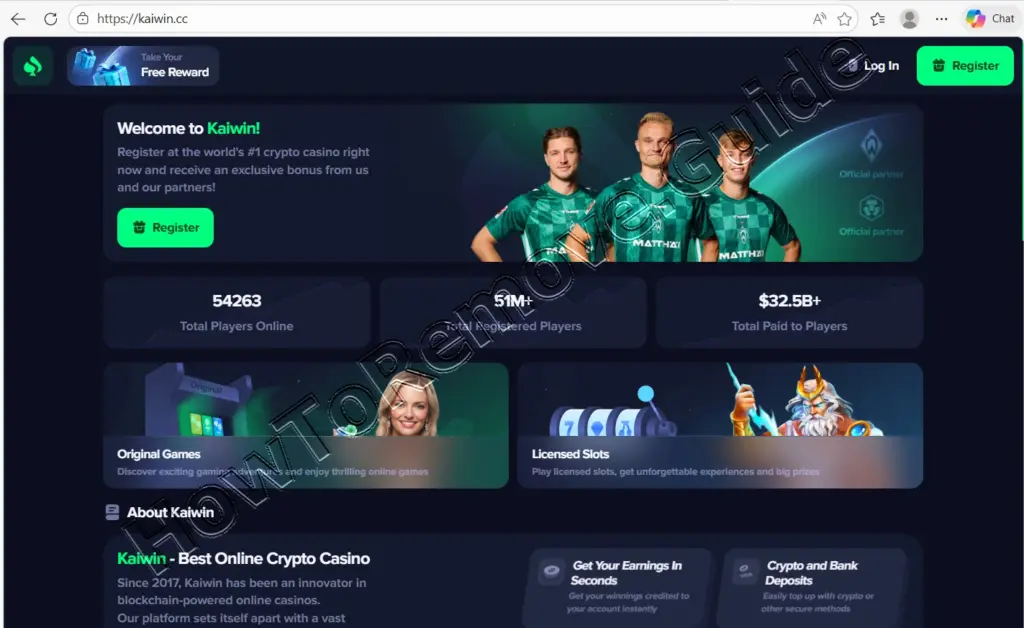
Like most online scams nowadays, Kaiwin.cc steals your money by getting your dopamine high and then exploiting that to make you careless.
Step one: you see a clip on TikTok, YT, or X that claims a celebrity is giving away promo codes and that newly registered accounts are getting a huge starting bonus at the Kaiwin.cc crypto casino.
Step two: you go to the site, and it looks polished, so you register, spin a few games with the free bonus, and you actually “win”.
Scams of Kaiwin.cc‘s type are known to steal personal data and passwords. Install SpyHunter Pro to scan for risks, remove any dangerous trackers, and enable real-time protection.

Try Free For 7 Days*
Buy now15% OFF if you buy straight without trial.
 OFFER
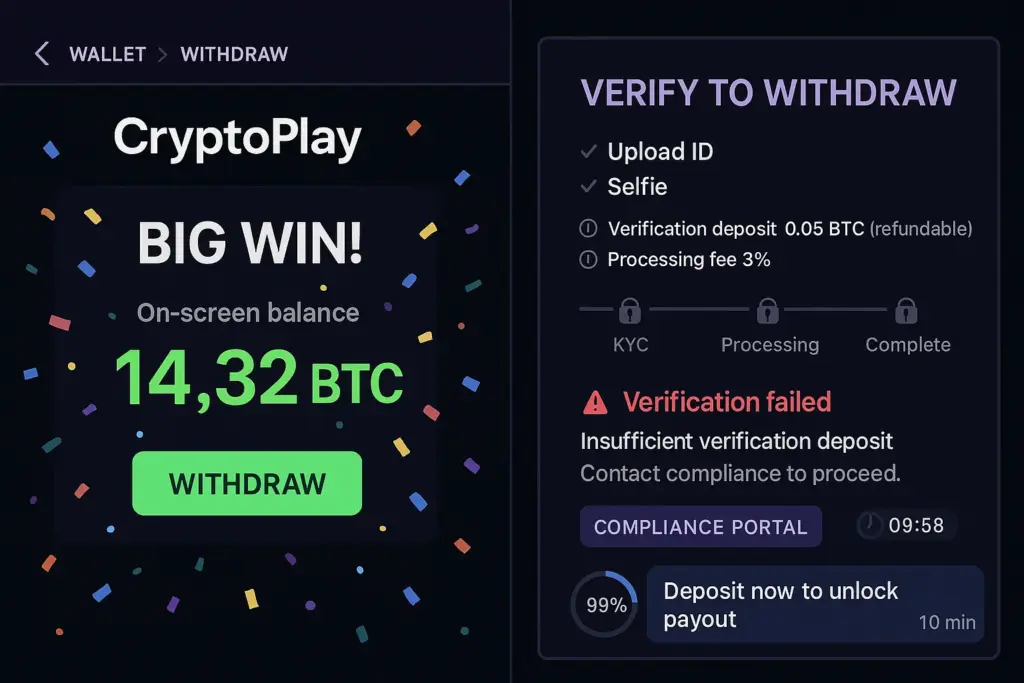
OFFERAfter a couple of wins, most users will decide to cash out, at which point the platform casually asks them for a routine “verification deposit”. It’s always “small” compared to your fake winnings, but in reality, it’s not that small.
Anyway, people usually don’t care because all they can think about is the big money they are about to claim, so they send the deposit and… get scammed. Any money sent to these scammers is gone for good, and, needless to say, there’s nothing you get in return.
Treat any contact with Kaiwin.cc or similar clones like Bezhope.bet, or Rusewin.cc as pontential security hazard, especially if you’ve already fallen for the scam. Any money already sent is likely unrecoverable, but the bigger risk is exposure of accounts, wallets, and identity data. The guidance below outlines the mechanics, the fastest containment steps, and the habits that help you recognize the next copy before it does damage.
IMPORTANT! READ BEFORE PROCEEDING!
If you have already interacted with Kaiwin.cc, cut the line immediately – no more messages, no more “unlock” payments, no screen-sharing – and switch to containment. Lock down accounts, separate remaining assets, and preserve anything that shows what happened. Here are five emergency actions we strongly recommend you do right now:
- Change passwords and turn on 2FA for email, exchanges, and wallets; sign out other devices and revoke old sessions.
- Alert any exchanges or services involved with transaction details (TxIDs, addresses) and request internal flags where possible.
- Move remaining assets to clean wallets using brand-new seed phrases, and cancel token approvals on any chains you used.
- If you shared identity documents, set fraud/credit alerts where available and watch for account openings or verification abuse.
- Create an evidence pack – URLs, wallet addresses, TxIDs, chat logs, emails, screenshots – and report it to authorities and any platforms touched.
How We Know Kaiwin.cc Is a Scam
Ignore the neon and the “jackpots” for a moment: the same indicators that define fake crypto gambling fronts show up here in a predictable set. For Kaiwin.cc, the combination points to a fee-gated withdrawal setup that also pressures victims into sharing sensitive information.
Hidden payout charges
“Release,” “compliance,” or “handling” fees often appear only after you request a withdrawal. Legit services don’t require a pre-payment to send you what you already own.
Fake licensing signals
Regulator badges and license numbers are used as decoration, but they don’t line up with official registers – it’s confidence theater, not real oversight.
Early “wins” that feel too easy
The system “pays” you quickly to encourage bigger deposits; the generosity ends right where withdrawals start.
Crypto-only payment rails
When everything is pushed through irreversible transfers, chargebacks and disputes vanish – which is exactly why scammers prefer it.
Manufactured social proof
Popups, “recent winner” banners, and suspicious review patterns try to simulate real credibility and urgency.
New, privacy-masked domains
Short-lived domains with hidden ownership and multiple near-twin copies are a classic footprint; quick checks via public lookups like who.is often show the churn.

How the Scam Deception Funnel Works
It helps to map the sequence because these operations repeat the same moves across new domains. With Kaiwin.cc, once you recognize each stage, you can anticipate the next “requirement” before you are pressured into paying it, and that predictability makes it easier to stop in time.
The flow is straightforward: lure you with bonuses, inflate the on-screen balance, block withdrawals behind fees and late-stage KYC, then stall until you disengage – while the brand quietly rotates to a fresh domain.
Promo hooks and influencer codes
The entry point is hype: promo codes, staged “success” comments, and friendly DMs that push you toward opening an account and sending an initial deposit.

Casino skin and bonus theater
A clean-looking interface does the convincing: large welcome bonuses and “fair play” language are used as shortcuts to trust.

Inflated balances, then the gate
Your balance grows quickly, then the payout option suddenly demands “verification,” a “deposit,” or a “service charge” before it will proceed.
Fee-gates and KYC harvest
Each “check” turns into a toll: VIP tiers, AML pretexts, tax stories – plus repeated requests for sensitive documents that remain valuable long after the transaction.

Stalling, rebrands, and “recovery” bait
Support stays “kind” while adding delays, then communication fades and the domain changes. After that, a “recovery specialist” may show up to sell a second scam disguised as assistance.
Staying safe from crypto casino scams like Kaiwin.cc
Safety here is mostly about doing the dull checks before you pay or upload anything. With Kaiwin.cc-style sites, a few minutes of verification can prevent irreversible losses, because these pages often exist only long enough to collect deposits and personal documents before shifting to a new address.
Verify license status in official registers
Check regulators by company name and domain – not by whatever badge is placed on the homepage. No listing is often the entire answer.
Check domain age and history
A newborn domain plus hidden registration details is a bad combination. Add web archives and you can often spot repeated copycat builds.
Reject withdrawal fees and “unlock” deposits
Any request to pay “first” to withdraw is a flashing siren. Real services deduct fees from the payout or disclose them upfront.
Prefer venues with recourse
Choose operators with transparent licensing, clear dispute paths, and reversible payment options. “Crypto only” is the scammer’s comfort zone.
Limit wallet exposure
Segment your funds, use new addresses for new services, keep 2FA on everything, and regularly remove token approvals you don’t recognize.
Validate “provably fair” claims
If the fairness claim can’t be independently verified with public seeds/hashes and a clear check method, treat it as decoration.
Document and report rapidly
Save everything: TxIDs, addresses, emails, and chat logs. Report to cybercrime channels and any exchanges involved while evidence is fresh.
Build a deliberate slow-down reflex
Urgency is their fuel. Slow down, do the checks, and decide only after the “bonus” adrenaline wears off.
Useful Resources for Scam Reporting and Prevention (By Country)
Even with fast crypto transfers, reporting quickly can still help – especially when exchanges, platforms, or investigators can link your evidence to other victims and known infrastructure. Use the directory below to file a report and attach the documentation you saved.
Click here to report the scam in your country
| Country / Agency | URL | Category / Use-case | Phone/Email |
| Australia – Crime Stoppers | https://www.crimestoppers.com.au | Anonymous tips about crime | 1800 333 000 |
| Australia – National Anti-Scam Center (Scamwatch) | https://www.scamwatch.gov.au/report-a-scam | General scams; phishing; texts/emails | |
| Australia – Police Assistance Line (non-emergency) | https://www.police.gov.au | Local police report | 131 444 |
| Australia – ReportCyber (ACSC) | https://www.cyber.gov.au/report | Cybercrime (hacks, fraud, extortion) | |
| Canada – Canadian Anti-Fraud Center (CAFC) | https://www.antifraudcentre-centreantifraude.ca/report-signalez-eng.htm | General scams incl. phone/text/email | |
| France – DGCCRF (SignalConso) | https://signal.conso.gouv.fr | Consumer scams/deceptive practices | |
| France – PHAROS – Internet-Signalement | https://www.internet-signalement.gouv.fr | Online content & cybercrime reports | |
| Germany – Bundeskriminalamt / Local Police | https://www.polizei.de/Polizei/DE/Home/home_node.html | Report online fraud | |
| Germany – Weißer Ring – Victim Support | https://weisser-ring.de | Victim support | 116 006 |
| India – DoT Helpline (Sanchar Saathi) | https://sancharsaathi.gov.in | Fraudulent telecom/SIM related | 155260 |
| India – National Consumer Helpline | https://consumerhelpline.gov.in | Consumer scams | 1800-11-4000 / 1915 |
| India – National Cyber Crime Reporting Portal | https://cybercrime.gov.in | Cybercrime incl. online fraud | 1930 |
| Japan – Consumer Affairs Agency (CAA) | https://www.caa.go.jp/policies/policy/consumer_policy/caution/cybercrime/ | Consumer scams | |
| Japan – National Police Agency – Cybercrime | https://www.npa.go.jp/bureau/cyber/ | Cybercrime reporting | |
| Mexico – Guardia Nacional (National Guard) | https://www.gob.mx/gn | Cybercrime reporting | |
| Mexico – Instituto Federal de Telecomunicaciones (IFT) | https://www.ift.org.mx | Telecom/online services scams | |
| Mexico – PROFECO | https://www.gob.mx/profeco | Consumer fraud & ecommerce | |
| Netherlands – AFM – Report investment fraud | https://www.afm.nl/en/consumenten/themas/beleggen/misleiding-misbruik | Investment/crypto | |
| Netherlands – Fraudehelpdesk | https://www.fraudehelpdesk.nl/melden | General scams (incl. phishing/SMS) | 088-7867372 |
| Netherlands – Politie – Meldpunt Internetoplichting | https://www.politie.nl/themas/internetoplichting.html | Online shopping fraud | |
| New Zealand – CERT NZ | https://www.cert.govt.nz/individuals/report-an-issue/ | Phishing, identity scams | |
| New Zealand – Department of Internal Affairs – Spam | https://www.dia.govt.nz/Spam-Contact-Us | Email/SMS spam | [email protected] |
| New Zealand – IDCARE | https://www.idcare.org | Victim support (identity compromise) | 0800 121 068 |
| New Zealand – Netsafe – Report | https://www.netsafe.org.nz/report/ | Online harms & scams | |
| New Zealand – New Zealand Police (non-emergency) | https://www.police.govt.nz/use-105 | Report fraud/online crime | 105 |
| Nigeria – Economic & Financial Crimes Commission (EFCC) | https://www.efcc.gov.ng | Financial scams incl. crypto/investment | [email protected] |
| Nigeria – Nigeria Police Special Fraud Unit (SFU) | https://www.specialfraudunit.org.ng | Serious fraud | Voice/SMS: 0708 227 6895; WhatsApp: 0812 760 9914 |
| Poland – CERT Polska (CERT.PL) | https://cert.pl/en/report/ | Cyber incidents & phishing | |
| Poland – Dyzurnet.pl | https://dyzurnet.pl | Illegal online content (esp. child protection) | |
| Poland – Polish Police (Policja) | https://www.policja.pl | Report scams to police | |
| Singapore – Anti-Scam Centre / Anti-Scam Helpline | https://www.scamalert.sg | General scams; texts; calls | 1800-722-6688 |
| Singapore – Monetary Authority of Singapore (MAS) | https://www.mas.gov.sg/investor-alert-list | Investment/crypto checks | |
| Singapore – Singapore Police Force | https://www.police.gov.sg/iwitness | Police report (cybercrime) | |
| South Africa – Cybersecurity Hub (CSIRT) | https://www.cybersecurityhub.gov.za | Cyber incidents incl. scams | |
| South Africa – South African Fraud Prevention Service (SAFPS) | https://www.safps.org.za | Identity fraud support | 011-867-2234 |
| South Africa – South African Police Service (SAPS) | https://www.saps.gov.za | Police report (cybercrime unit) | |
| South Korea – Korea Communications Commission (KCC) | https://www.kcc.go.kr | Telecom-related fraud | |
| South Korea – Korea Internet & Security Agency (KISA) | https://www.kisa.or.kr | Phishing, online harms | |
| South Korea – Korean National Police Agency – Cyber Bureau | https://ecrm.cyber.go.kr | Cybercrime reporting | |
| Spain – INCIBE – Oficina de Seguridad del Internauta (OSI) | https://www.osi.es/es/reporte | Cybersecurity & online fraud | |
| Spain – Policía Nacional / Guardia Civil | https://www.policia.es | Report scams to police | |
| Sweden – Crime Victim Authority (Brottsoffermyndigheten) | https://www.brottsoffermyndigheten.se | Victim support & compensation | 090–70 82 00 |
| Sweden – Polisen (Swedish Police) | https://polisen.se | Report fraud/cybercrime | 114 14 (non-emergency); 112 (emergency) |
| Sweden – Swedish Consumer Agency (Konsumentverket) | https://www.konsumentverket.se | Unfair business practices | |
| United Arab Emirates – Abu Dhabi Police – Aman Service | https://www.adpolice.gov.ae | Cybercrime tips/reporting | SMS 2828; 800 2626 |
| United Arab Emirates – Dubai Police – eCrime | https://www.dubaipolice.gov.ae | Cybercrime reporting | 04 606 1600 |
| United Arab Emirates – Ministry of Interior – Cyber Crime Dept. | https://www.moi.gov.ae | Cybercrime incl. online scams | |
| United Arab Emirates – Telecommunications Regulatory Authority (TRA) / TDRA | https://www.tra.gov.ae | Telecom-related scams/phishing | |
| United Kingdom – Action Fraud (NFIB) | https://www.actionfraud.police.uk | General scams & cybercrime (non-emergency) | 0300 123 2040 |
| United Kingdom – Citizens Advice Consumer Service | https://www.citizensadvice.org.uk/consumer/get-more-help/if-you-need-more-help-about-a-consumer-issue/ | Consumer problems & scam guidance | 0808 223 1133 |
| United Kingdom – Financial Conduct Authority (FCA) | https://www.fca.org.uk/consumers/report-scam-us | Investment/crypto & financial services | |
| United Kingdom – National Cyber Security Centre (NCSC) | https://www.ncsc.gov.uk/collection/phishing-scams | Phishing emails & suspicious websites | |
| United Kingdom – Stop Scams UK ‘159’ | https://stopscamsuk.org.uk/159 | Banking APP fraud (direct to your bank) | 159 |
| United States – AARP Fraud Watch Network Helpline | https://www.aarp.org/money/scams-fraud/ | Victim support | 833-372-8311 |
| United States – Better Business Bureau – Scam Tracker | https://www.bbb.org/scamtracker | Business/marketplace scams | |
| United States – FBI Internet Crime Complaint Center (IC3) | https://www.ic3.gov | Internet crime incl. investment/crypto | |
| United States – Federal Trade Commission – ReportFraud | https://reportfraud.ftc.gov | General scams, phishing, texts/emails | 1-877-382-4357 |
| United States – National Center for Disaster Fraud | https://www.justice.gov/disaster-fraud | Disaster-related scams | (866) 720-5721 |
| United States – SEC Tips & Complaints | https://www.sec.gov/tcr | Investment & securities/crypto-asset offerings |
Bottom line: recognize the pattern, contain exposure quickly, and do verifiable checks before you deposit or share documents – because scam operations depend on speed and uncertainty.
