

If you’ve stumbled on a crypto casino called Salexplay, pause before you connect a wallet or type in a promo code. New accounts are baited with oversized “free” signup bonuses – often thousands in crypto – so it feels like risk-free fun. The trap snaps shut when you try to withdraw. Suddenly you’re told your account needs verification first – basically a withdrawal fee paid up front. Send that extra deposit and the money vanishes, while payouts stay “pending” forever. In the next lines, I’ll break down how this clone-scam works and how to spot it early. Don’t let glossy design fool you; Salexplay.cc exists to steal deposits.
Scams of Salexplay.cc‘s type are known to steal personal data and passwords. Install SpyHunter Pro to scan for risks, remove any dangerous trackers, and enable real-time protection.

Try Free For 7 Days*
Buy now15% OFF if you buy straight without trial.
 OFFER
OFFERTreat any contact with Salexplay.cc or similar clones like Rusewin.cc, or Kaiwin.cc as a potential security hazard, especially if you already paid once. Funds you sent are likely unrecoverable, but the larger risk is exposure of accounts, wallets, and identity data. The guidance below explains how the scheme works, what to secure first, and the habits that help you spot the next copy before it causes harm.
IMPORTANT – READ THIS BEFORE YOU CONTINUE!
If you have already interacted with Salexplay, break contact immediately – no more messages, no more “unlock” payments, no screen-sharing – and move straight into containment. Secure your logins, isolate any remaining assets, and save anything that documents the exchange. Here are five emergency actions we recommend doing right now:
- Change passwords and turn on 2FA for email, exchanges, and wallets; sign out other devices and revoke old sessions.
- Notify any exchanges or services involved using transaction details (TxIDs, addresses) and ask for internal flags or monitoring where available.
- Move remaining assets to clean wallets using brand-new seed phrases, and cancel token approvals on any chains you used.
- If you shared identity documents, set fraud/credit alerts where available and monitor for account openings or verification misuse.
- Create an evidence pack – URLs, wallet addresses, TxIDs, chat logs, emails, screenshots – and report it to authorities and any platforms touched.
How We Spot This Is a Scam
Ignore the bright graphics and “jackpots” for a moment and look at the mechanics: the same red flags that mark fake crypto gambling fronts show up in a familiar cluster. For Salexplay, the overall pattern points to a withdrawal barrier built around invented fees, paired with steady pressure to hand over sensitive information.
Concealed payout fees
“Release,” “compliance,” or “handling” charges often surface only after you request a withdrawal. Legit services do not require a pre-payment to send you money you already hold.
Decorative licensing claims
Regulator logos and license numbers are displayed as props, but they do not match official registries – it is confidence theater, not real oversight.
Early “wins” that come too easily
The system “pays” quickly to nudge larger deposits; the generosity ends right where withdrawals begin.
Crypto-only payment routes
When everything is pushed through irreversible transfers, chargebacks and disputes disappear – which is exactly why this rail is favored by fraud operations.
Fabricated social proof
Popups, “recent winner” banners, and odd review patterns are used to simulate credibility and urgency, not to provide verifiable proof.
New, privacy-shielded domains
Short-lived domains with hidden ownership and near-identical copies are a common footprint; quick checks via public lookups like who.is often reveal the churn.

How the Deception Funnel Works
Mapping the sequence matters because these operations recycle the same script across new domains. With Salexplay, once you can name each stage, the next “requirement” becomes predictable, which makes it easier to stop before you are nudged into paying another fee or handing over more personal data.
The flow is simple: lure you with bonuses, inflate the displayed balance, lock withdrawals behind fees and late-stage KYC, then stall until you give up – while the brand quietly shifts to a new domain.
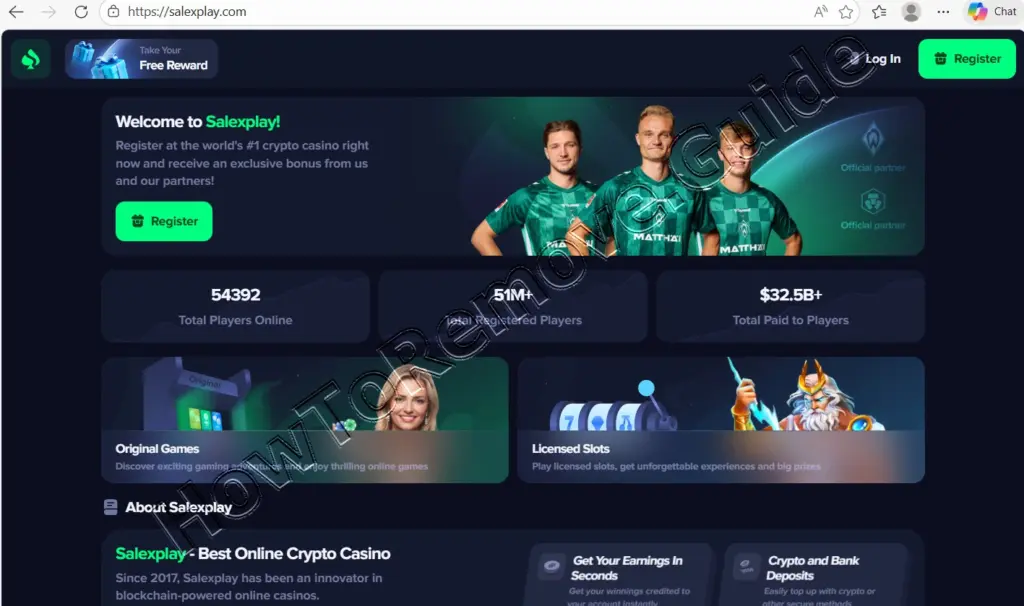
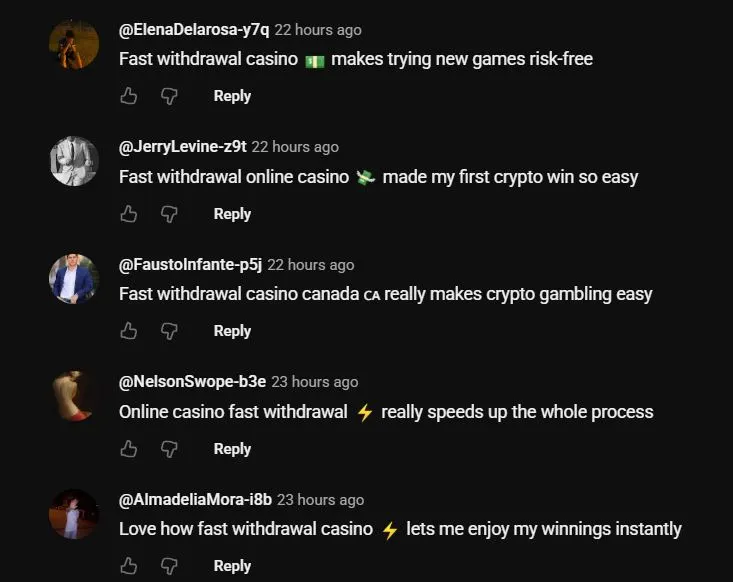
Promo bait and influencer codes
It usually starts with manufactured hype: promo codes, staged “success” replies, and friendly DMs that steer you toward creating an account and sending an initial deposit.
Polished casino skin and bonus show
A clean interface does the selling: oversized welcome bonuses and “fair play” messaging are presented as shortcuts to credibility.

Inflated balances, then the lock
Your on-screen balance climbs quickly, and then the payout button suddenly demands “verification,” a “deposit,” or a “service charge” before it will move forward.
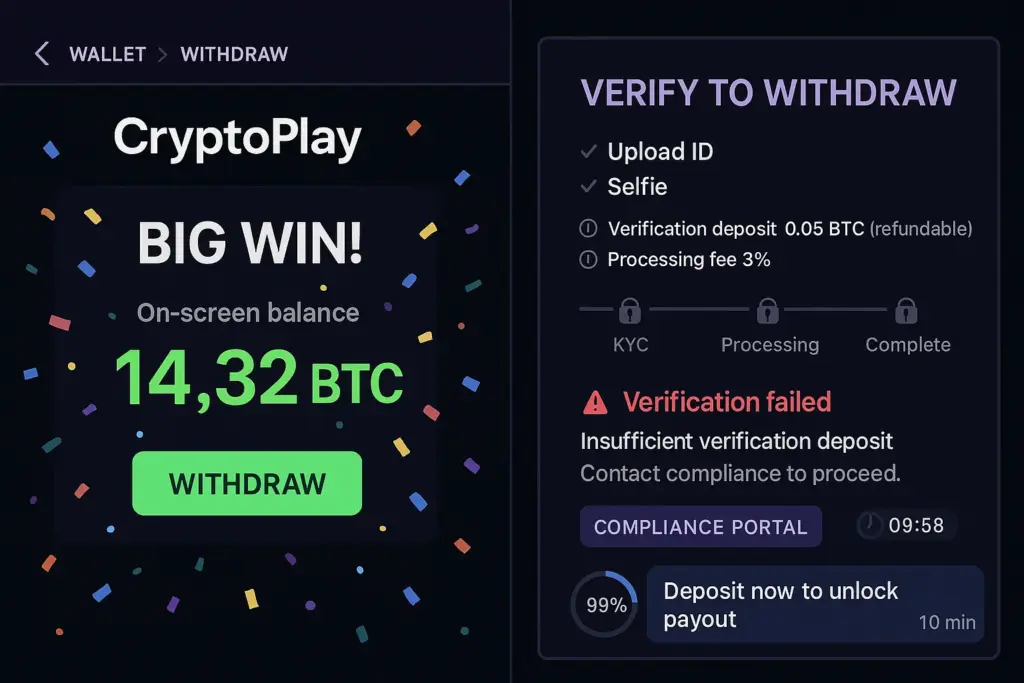
Fee-gates and KYC harvesting
Each “check” turns into another toll: VIP tiers, AML stories, tax pretexts – plus repeated demands for sensitive documents that remain valuable long after the transfer.

Stalling, rebrands, and “recovery” lures
Support stays “polite” while introducing delays, then replies slow down and the domain changes. After that, a “recovery specialist” may appear to sell a second scam dressed up as help.
Staying safe from crypto casino scams like Salexplay
Staying safe is mostly about doing the boring checks before you pay or upload anything. With Salexplay-style sites, a few minutes of verification can prevent irreversible losses, because these pages often exist only long enough to collect deposits and identity documents before shifting to a new address.
Confirm licensing in official registers
Search regulators by company name and domain – not by whatever badge is placed on the homepage. No listing is often the entire answer.
Check domain age and history
A newborn domain plus hidden registration details is a bad combination. Add web archives and you can often spot repeated copycat builds.
Refuse withdrawal fees and “unlock” deposits
Any request to pay “first” to withdraw is a flashing siren. Real services deduct fees from the payout or disclose them upfront.
Choose venues with recourse
Use operators with transparent licensing, clear dispute paths, and reversible payment options. “Crypto only” is the scammer’s comfort zone.
Reduce wallet exposure
Segment your funds, use new addresses for new services, keep 2FA on everything, and regularly remove token approvals you don’t recognize.
Check “provably fair” claims
If the fairness claim cannot be independently verified using public seeds/hashes and a clear check method, treat it as decoration.
Save evidence and report quickly
Save everything: TxIDs, addresses, emails, and chat logs. Report to cybercrime channels and any exchanges involved while evidence is fresh.
Practice a deliberate slow-down reflex
Urgency is their fuel. Slow down, do the checks, and decide only after the “bonus” adrenaline wears off.
Useful Resources for Scam Reporting and Prevention (By Country)
Even with fast crypto transfers, reporting quickly can still matter – especially when exchanges, platforms, or investigators can connect your evidence to other victims and shared infrastructure. Use the directory below to file a report and attach the documentation you saved.
Open this list to report the scam in your country
| Country / Agency | URL | Category / Use-case | Phone/Email |
| Australia – Crime Stoppers | https://www.crimestoppers.com.au | Anonymous tips about crime | 1800 333 000 |
| Australia – National Anti-Scam Center (Scamwatch) | https://www.scamwatch.gov.au/report-a-scam | General scams; phishing; texts/emails | |
| Australia – Police Assistance Line (non-emergency) | https://www.police.gov.au | Local police report | 131 444 |
| Australia – ReportCyber (ACSC) | https://www.cyber.gov.au/report | Cybercrime (hacks, fraud, extortion) | |
| Canada – Canadian Anti-Fraud Center (CAFC) | https://www.antifraudcentre-centreantifraude.ca/report-signalez-eng.htm | General scams incl. phone/text/email | |
| France – DGCCRF (SignalConso) | https://signal.conso.gouv.fr | Consumer scams/deceptive practices | |
| France – PHAROS – Internet-Signalement | https://www.internet-signalement.gouv.fr | Online content & cybercrime reports | |
| Germany – Bundeskriminalamt / Local Police | https://www.polizei.de/Polizei/DE/Home/home_node.html | Report online fraud | |
| Germany – Weißer Ring – Victim Support | https://weisser-ring.de | Victim support | 116 006 |
| India – DoT Helpline (Sanchar Saathi) | https://sancharsaathi.gov.in | Fraudulent telecom/SIM related | 155260 |
| India – National Consumer Helpline | https://consumerhelpline.gov.in | Consumer scams | 1800-11-4000 / 1915 |
| India – National Cyber Crime Reporting Portal | https://cybercrime.gov.in | Cybercrime incl. online fraud | 1930 |
| Japan – Consumer Affairs Agency (CAA) | https://www.caa.go.jp/policies/policy/consumer_policy/caution/cybercrime/ | Consumer scams | |
| Japan – National Police Agency – Cybercrime | https://www.npa.go.jp/bureau/cyber/ | Cybercrime reporting | |
| Mexico – Guardia Nacional (National Guard) | https://www.gob.mx/gn | Cybercrime reporting | |
| Mexico – Instituto Federal de Telecomunicaciones (IFT) | https://www.ift.org.mx | Telecom/online services scams | |
| Mexico – PROFECO | https://www.gob.mx/profeco | Consumer fraud & ecommerce | |
| Netherlands – AFM – Report investment fraud | https://www.afm.nl/en/consumenten/themas/beleggen/misleiding-misbruik | Investment/crypto | |
| Netherlands – Fraudehelpdesk | https://www.fraudehelpdesk.nl/melden | General scams (incl. phishing/SMS) | 088-7867372 |
| Netherlands – Politie – Meldpunt Internetoplichting | https://www.politie.nl/themas/internetoplichting.html | Online shopping fraud | |
| New Zealand – CERT NZ | https://www.cert.govt.nz/individuals/report-an-issue/ | Phishing, identity scams | |
| New Zealand – Department of Internal Affairs – Spam | https://www.dia.govt.nz/Spam-Contact-Us | Email/SMS spam | [email protected] |
| New Zealand – IDCARE | https://www.idcare.org | Victim support (identity compromise) | 0800 121 068 |
| New Zealand – Netsafe – Report | https://www.netsafe.org.nz/report/ | Online harms & scams | |
| New Zealand – New Zealand Police (non-emergency) | https://www.police.govt.nz/use-105 | Report fraud/online crime | 105 |
| Nigeria – Economic & Financial Crimes Commission (EFCC) | https://www.efcc.gov.ng | Financial scams incl. crypto/investment | [email protected] |
| Nigeria – Nigeria Police Special Fraud Unit (SFU) | https://www.specialfraudunit.org.ng | Serious fraud | Voice/SMS: 0708 227 6895; WhatsApp: 0812 760 9914 |
| Poland – CERT Polska (CERT.PL) | https://cert.pl/en/report/ | Cyber incidents & phishing | |
| Poland – Dyzurnet.pl | https://dyzurnet.pl | Illegal online content (esp. child protection) | |
| Poland – Polish Police (Policja) | https://www.policja.pl | Report scams to police | |
| Singapore – Anti-Scam Centre / Anti-Scam Helpline | https://www.scamalert.sg | General scams; texts; calls | 1800-722-6688 |
| Singapore – Monetary Authority of Singapore (MAS) | https://www.mas.gov.sg/investor-alert-list | Investment/crypto checks | |
| Singapore – Singapore Police Force | https://www.police.gov.sg/iwitness | Police report (cybercrime) | |
| South Africa – Cybersecurity Hub (CSIRT) | https://www.cybersecurityhub.gov.za | Cyber incidents incl. scams | |
| South Africa – South African Fraud Prevention Service (SAFPS) | https://www.safps.org.za | Identity fraud support | 011-867-2234 |
| South Africa – South African Police Service (SAPS) | https://www.saps.gov.za | Police report (cybercrime unit) | |
| South Korea – Korea Communications Commission (KCC) | https://www.kcc.go.kr | Telecom-related fraud | |
| South Korea – Korea Internet & Security Agency (KISA) | https://www.kisa.or.kr | Phishing, online harms | |
| South Korea – Korean National Police Agency – Cyber Bureau | https://ecrm.cyber.go.kr | Cybercrime reporting | |
| Spain – INCIBE – Oficina de Seguridad del Internauta (OSI) | https://www.osi.es/es/reporte | Cybersecurity & online fraud | |
| Spain – Policía Nacional / Guardia Civil | https://www.policia.es | Report scams to police | |
| Sweden – Crime Victim Authority (Brottsoffermyndigheten) | https://www.brottsoffermyndigheten.se | Victim support & compensation | 090–70 82 00 |
| Sweden – Polisen (Swedish Police) | https://polisen.se | Report fraud/cybercrime | 114 14 (non-emergency); 112 (emergency) |
| Sweden – Swedish Consumer Agency (Konsumentverket) | https://www.konsumentverket.se | Unfair business practices | |
| United Arab Emirates – Abu Dhabi Police – Aman Service | https://www.adpolice.gov.ae | Cybercrime tips/reporting | SMS 2828; 800 2626 |
| United Arab Emirates – Dubai Police – eCrime | https://www.dubaipolice.gov.ae | Cybercrime reporting | 04 606 1600 |
| United Arab Emirates – Ministry of Interior – Cyber Crime Dept. | https://www.moi.gov.ae | Cybercrime incl. online scams | |
| United Arab Emirates – Telecommunications Regulatory Authority (TRA) / TDRA | https://www.tra.gov.ae | Telecom-related scams/phishing | |
| United Kingdom – Action Fraud (NFIB) | https://www.actionfraud.police.uk | General scams & cybercrime (non-emergency) | 0300 123 2040 |
| United Kingdom – Citizens Advice Consumer Service | https://www.citizensadvice.org.uk/consumer/get-more-help/if-you-need-more-help-about-a-consumer-issue/ | Consumer problems & scam guidance | 0808 223 1133 |
| United Kingdom – Financial Conduct Authority (FCA) | https://www.fca.org.uk/consumers/report-scam-us | Investment/crypto & financial services | |
| United Kingdom – National Cyber Security Centre (NCSC) | https://www.ncsc.gov.uk/collection/phishing-scams | Phishing emails & suspicious websites | |
| United Kingdom – Stop Scams UK ‘159’ | https://stopscamsuk.org.uk/159 | Banking APP fraud (direct to your bank) | 159 |
| United States – AARP Fraud Watch Network Helpline | https://www.aarp.org/money/scams-fraud/ | Victim support | 833-372-8311 |
| United States – Better Business Bureau – Scam Tracker | https://www.bbb.org/scamtracker | Business/marketplace scams | |
| United States – FBI Internet Crime Complaint Center (IC3) | https://www.ic3.gov | Internet crime incl. investment/crypto | |
| United States – Federal Trade Commission – ReportFraud | https://reportfraud.ftc.gov | General scams, phishing, texts/emails | 1-877-382-4357 |
| United States – National Center for Disaster Fraud | https://www.justice.gov/disaster-fraud | Disaster-related scams | (866) 720-5721 |
| United States – SEC Tips & Complaints | https://www.sec.gov/tcr | Investment & securities/crypto-asset offerings |
Bottom line: learn the script, contain exposure quickly, and run verifiable checks before you deposit or upload documents – because these operations rely on speed, confusion, and victims acting before they confirm the basics.
