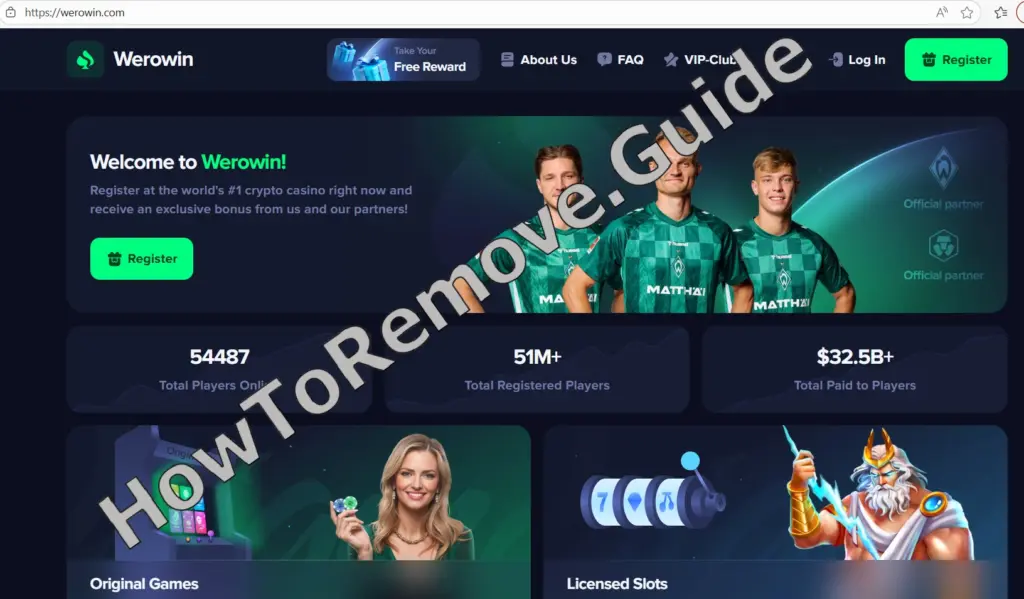
Against a backdrop of slick graphics and jackpot confetti, Werowin almost looks like like a legitimate crypto gambling platform, especially to someone who lacks experience.
But under this glossy coat, four recurrent realities define this breed of fraud: cloned skins that hop domains to outrun complaints; “miraculous” early wins engineered to build confidence; withdrawal blockades that demand a “processing fee,” “verification deposit,” or “VIP upgrade” before releasing funds; and counterfeit licensing badges that don’t trace back to any regulator.
Through that quartet, victims are shepherded from curiosity to commitment to… getting their money stolen. The flashy exterior lowers skepticism, the lucky streak spikes dopamine, the pay-to-withdraw wall converts hope into another transfer, and the fake credentials silence the last internal alarms.
Treat any contact with Werowin, Meancas, or Hezowex as a live-security problem. Assume financial and identity exposure; do not send another coin, do not upload new documents, and do not negotiate with “support” about unlocking funds. Contain the damage first, document everything, and expect any follow-up “recovery” pitches to be a second scam. Read the rest of this post to learn more and mitigate and minimize any damage caused by Werowin.
Scams of Werowin.com‘s type are known to steal personal data and passwords. Install SpyHunter Pro to scan for risks, remove any dangerous trackers, and enable real-time protection.
 Try Free For 7 Days*
Buy now15% OFF if you buy straight without trial.
Try Free For 7 Days*
Buy now15% OFF if you buy straight without trial.
 OFFER
OFFERIMPORTANT! READ BEFORE PROCEEDING!
If you’ve engaged with Werowin in any way, assume financial and identity exposure. Do not send another satoshi, do not upload new documents, and do not chat with “support” about unlocking funds. Contain the damage first; attempts to recover via more payments only deepen the loss.
- Move remaining crypto to fresh wallets with new seed phrases; stop using any wallet or address exposed to the site.
- Change passwords on email, exchanges, and wallets; enable 2FA to block account-takeover.
- Preserve evidence: URLs, chat logs, screenshots, TXIDs, wallet addresses, timestamps.
- Report to your national cybercrime unit and the exchanges involved so addresses can be flagged and traced.
- Ignore unsolicited “recovery services” demanding retainers or “taxes”; they’re second-wave scams.
How We Know Werowin is a Scam
Before we go further, here’s why we’re confident Werowin isn’t a genuine gambling operator: the patterns match the classic crypto-casino con, where deposits flow freely and withdrawals hit engineered roadblocks.
Any request to pay to withdraw
Any “deposit to release winnings” request is advance-fee fraud; legitimate operators never require fresh payment to send your own balance.
License claims you can’t verify
Badges appear, but no matching entry exists in a regulator’s public register – or the number maps to another entity altogether.
Early “wins” that inflate balances
Early play looks suspiciously generous; on-screen balances swell to build trust before cash-out, then generosity evaporates.
Crypto-only cashiering + new domain
Crypto-only rails and a recently registered, privacy-shielded domain minimize chargeback risk and undermine accountability.
Fake social proof
Fabricated live chats, bot reviews, and influencer coupons simulate a busy floor while masking the lack of real payouts.
Template clones and domain churn
Near-identical templates and constant rebrands indicate an operation designed to outrun complaints and reset reputation.

How the Werowin Scam Deception Funnel Works
To sidestep the trap, it helps to map the trap. Understanding the funnel reveals why otherwise cautious people get pulled in and why “just one more step” keeps snowballing into new losses.
To start, traffic flows from social ads, influencer codes, or SEO-bait landing pages into a glossy lobby flaunting huge signup perks. Then, account creation is friction-light and crypto deposits are effortless while fiat rails are absent. Next, early spins and hands “win,” chat tickers announce others’ jackpots, and “provably fair” rhetoric is waved to cement trust. After that, the first withdrawal triggers document uploads and compliance theater, followed by demands for “gas,” processing fees, taxes, or a “verification deposit.” Subsequently, if any fee is paid, new hurdles appear – VIP upgrades, turnover requirements, or larger collateral – until resistance leads to ghosting, blocking, or migration to a look-alike domain.
Here is how the Scam Works:
⮟ Promo hooks and influencer codes
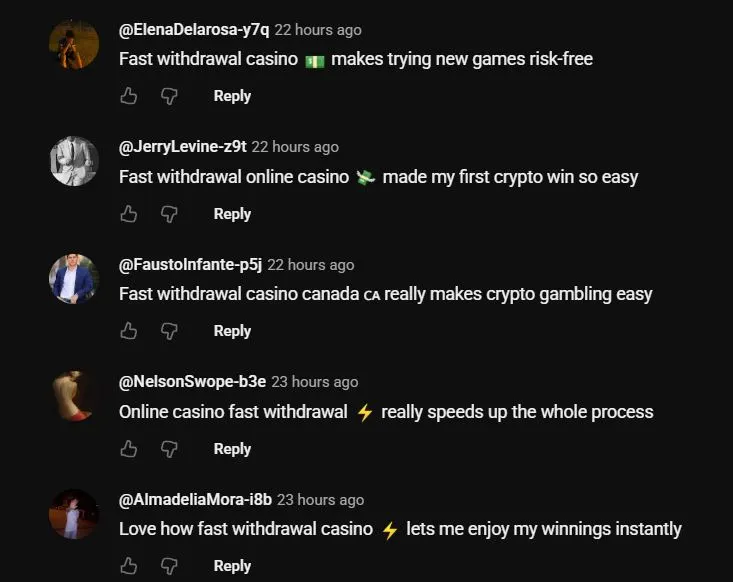
Glossy ads, seeded comments, and DMs dangle “limited” bonuses and fake testimonials to start the funnel and manufacture urgency.
⮟ Casino skin and bonus theater
The landing page mimics a legitimate casino, flashes giant crypto bonuses, and promises “provably fair” play to create instant credibility.

⮟ Inflated balances, then the gate
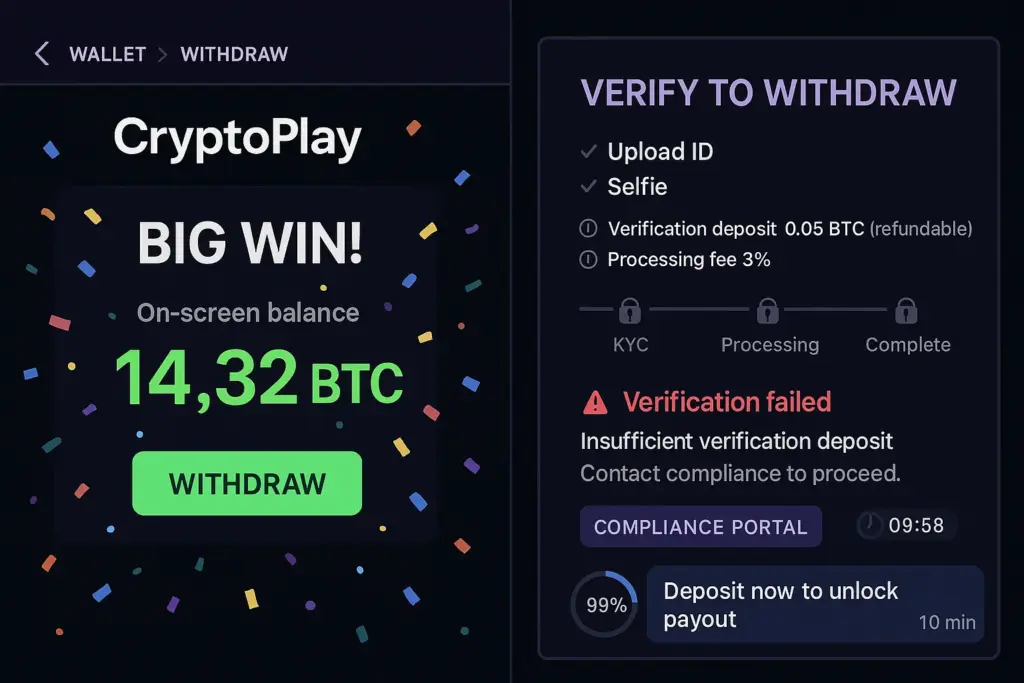
Early “wins” swell your on-screen balance, then withdrawal triggers KYC and a “verification deposit” or “processing fee” to proceed.
⮟ Fee-gates and KYC harvest
Each step adds a pretext—VIP upgrades, AML checks, taxes—while siphoning more crypto and collecting high-value identity documents.

⮟ Stalling, rebrands, and “recovery” bait
Support scripts empathy while adding hurdles, then the site ghosts and pivots to a new domain. Soon after, a “recovery agent” appears to sell the encore scam.
Staying safe from scam casino traps like Werowin
From here on, treat prevention as a checklist. The ideas below are simple on paper yet powerful in practice, especially when applied before the first deposit or document upload.
⮟ Verify licenses on official registers
Find the claimed regulator and confirm the operator’s legal name and domain in the public register. If there’s no match – or the listing belongs to someone else – walk away.
⮟ Inspect domain age and clone patterns
Use WHOIS and the Internet Archive. Newborn, privacy-shielded domains claiming to be “since 2018,” plus look-alike siblings, are high-risk tells.
⮟ Refuse up-front withdrawal “fees”
Any demand to send money to release your funds is disqualifying on its face. Real operators do not require “verification deposits.”
⮟ Prefer platforms with real recourse
Choose operators with verifiable licenses, fiat rails, and clear dispute processes. Crypto-only fronts maximize irreversibility by design.
⮟ Reduce wallet exposure
Maintain strict hygiene: unique wallets per platform, never reuse seed phrases, migrate assets to fresh wallets after any exposure, and disconnect linked wallets.
⮟ Validate “provably fair” claims
Randomness proofs say little about banking integrity; “provably fair” doesn’t guarantee withdrawals or honest cashiering.
⮟ Document quickly and report
Capture TXIDs, addresses, chats, and screenshots. File with your national cybercrime unit and the exchanges touched so flows can be traced and flagged.
⮟ Practice a slow-down reflex
Heuristics save money: giant bonuses, guaranteed returns, countdown timers, and any “send crypto to receive crypto” demand are textbook advance-fee markers – pause before committing.
Useful Resources for Scam Reporting and Prevention (By Country)
Even if crypto transfers are irreversible, detailed reports with TXIDs and addresses help investigators and exchanges trace flows and sometimes seize funds at chokepoints – verify first, then spend.
Click here to report the scam in your country
| Country / Agency | URL | Category / Use-case | Phone/Email |
| Australia – Crime Stoppers | https://www.crimestoppers.com.au | Anonymous tips about crime | 1800 333 000 |
| Australia – National Anti-Scam Center (Scamwatch) | https://www.scamwatch.gov.au/report-a-scam | General scams; phishing; texts/emails | |
| Australia – Police Assistance Line (non-emergency) | https://www.police.gov.au | Local police report | 131 444 |
| Australia – ReportCyber (ACSC) | https://www.cyber.gov.au/report | Cybercrime (hacks, fraud, extortion) | |
| Canada – Canadian Anti-Fraud Center (CAFC) | https://www.antifraudcentre-centreantifraude.ca/report-signalez-eng.htm | General scams incl. phone/text/email | |
| France – DGCCRF (SignalConso) | https://signal.conso.gouv.fr | Consumer scams/deceptive practices | |
| France – PHAROS – Internet-Signalement | https://www.internet-signalement.gouv.fr | Online content & cybercrime reports | |
| Germany – Bundeskriminalamt / Local Police | https://www.polizei.de/Polizei/DE/Home/home_node.html | Report online fraud | |
| Germany – Weißer Ring – Victim Support | https://weisser-ring.de | Victim support | 116 006 |
| India – DoT Helpline (Sanchar Saathi) | https://sancharsaathi.gov.in | Fraudulent telecom/SIM related | 155260 |
| India – National Consumer Helpline | https://consumerhelpline.gov.in | Consumer scams | 1800-11-4000 / 1915 |
| India – National Cyber Crime Reporting Portal | https://cybercrime.gov.in | Cybercrime incl. online fraud | 1930 |
| Japan – Consumer Affairs Agency (CAA) | https://www.caa.go.jp/policies/policy/consumer_policy/caution/cybercrime/ | Consumer scams | |
| Japan – National Police Agency – Cybercrime | https://www.npa.go.jp/bureau/cyber/ | Cybercrime reporting | |
| Mexico – Guardia Nacional (National Guard) | https://www.gob.mx/gn | Cybercrime reporting | |
| Mexico – Instituto Federal de Telecomunicaciones (IFT) | https://www.ift.org.mx | Telecom/online services scams | |
| Mexico – PROFECO | https://www.gob.mx/profeco | Consumer fraud & ecommerce | |
| Netherlands – AFM – Report investment fraud | https://www.afm.nl/en/consumenten/themas/beleggen/misleiding-misbruik | Investment/crypto | |
| Netherlands – Fraudehelpdesk | https://www.fraudehelpdesk.nl/melden | General scams (incl. phishing/SMS) | 088-7867372 |
| Netherlands – Politie – Meldpunt Internetoplichting | https://www.politie.nl/themas/internetoplichting.html | Online shopping fraud | |
| New Zealand – CERT NZ | https://www.cert.govt.nz/individuals/report-an-issue/ | Phishing, identity scams | |
| New Zealand – Department of Internal Affairs – Spam | https://www.dia.govt.nz/Spam-Contact-Us | Email/SMS spam | [email protected] |
| New Zealand – IDCARE | https://www.idcare.org | Victim support (identity compromise) | 0800 121 068 |
| New Zealand – Netsafe – Report | https://www.netsafe.org.nz/report/ | Online harms & scams | |
| New Zealand – New Zealand Police (non-emergency) | https://www.police.govt.nz/use-105 | Report fraud/online crime | 105 |
| Nigeria – Economic & Financial Crimes Commission (EFCC) | https://www.efcc.gov.ng | Financial scams incl. crypto/investment | [email protected] |
| Nigeria – Nigeria Police Special Fraud Unit (SFU) | https://www.specialfraudunit.org.ng | Serious fraud | Voice/SMS: 0708 227 6895; WhatsApp: 0812 760 9914 [email protected]; [email protected] |
| Poland – CERT Polska (CERT.PL) | https://cert.pl/en/report/ | Cyber incidents & phishing | |
| Poland – Dyzurnet.pl | https://dyzurnet.pl | Illegal online content (esp. child protection) | |
| Poland – Polish Police (Policja) | https://www.policja.pl | Report scams to police | |
| Singapore – Anti-Scam Centre / Anti-Scam Helpline | https://www.scamalert.sg | General scams; texts; calls | 1800-722-6688 |
| Singapore – Monetary Authority of Singapore (MAS) | https://www.mas.gov.sg/investor-alert-list | Investment/crypto checks | |
| Singapore – Singapore Police Force | https://www.police.gov.sg/iwitness | Police report (cybercrime) | |
| South Africa – Cybersecurity Hub (CSIRT) | https://www.cybersecurityhub.gov.za | Cyber incidents incl. scams | |
| South Africa – South African Fraud Prevention Service (SAFPS) | https://www.safps.org.za | Identity fraud support | 011-867-2234 |
| South Africa – South African Police Service (SAPS) | https://www.saps.gov.za | Police report (cybercrime unit) | |
| South Korea – Korea Communications Commission (KCC) | https://www.kcc.go.kr | Telecom-related fraud | |
| South Korea – Korea Internet & Security Agency (KISA) | https://www.kisa.or.kr | Phishing, online harms | |
| South Korea – Korean National Police Agency – Cyber Bureau | https://ecrm.cyber.go.kr | Cybercrime reporting | |
| Spain – INCIBE – Oficina de Seguridad del Internauta (OSI) | https://www.osi.es/es/reporte | Cybersecurity & online fraud | |
| Spain – Policía Nacional / Guardia Civil | https://www.policia.es | Report scams to police | |
| Sweden – Crime Victim Authority (Brottsoffermyndigheten) | https://www.brottsoffermyndigheten.se | Victim support & compensation | 090–70 82 00 |
| Sweden – Polisen (Swedish Police) | https://polisen.se | Report fraud/cybercrime | 114 14 (non-emergency); 112 (emergency) |
| Sweden – Swedish Consumer Agency (Konsumentverket) | https://www.konsumentverket.se | Unfair business practices | |
| United Arab Emirates – Abu Dhabi Police – Aman Service | https://www.adpolice.gov.ae | Cybercrime tips/reporting | SMS 2828; 800 2626 [email protected] |
| United Arab Emirates – Dubai Police – eCrime | https://www.dubaipolice.gov.ae | Cybercrime reporting | 04 606 1600 |
| United Arab Emirates – Ministry of Interior – Cyber Crime Dept. | https://www.moi.gov.ae | Cybercrime incl. online scams | |
| United Arab Emirates – Telecommunications Regulatory Authority (TRA) / TDRA | https://www.tra.gov.ae | Telecom-related scams/phishing | |
| United Kingdom – Action Fraud (NFIB) | https://www.actionfraud.police.uk | General scams & cybercrime (non-emergency) | 0300 123 2040 |
| United Kingdom – Citizens Advice Consumer Service | https://www.citizensadvice.org.uk/consumer/get-more-help/if-you-need-more-help-about-a-consumer-issue/ | Consumer problems & scam guidance | 0808 223 1133 |
| United Kingdom – Financial Conduct Authority (FCA) | https://www.fca.org.uk/consumers/report-scam-us | Investment/crypto & financial services | |
| United Kingdom – National Cyber Security Centre (NCSC) | https://www.ncsc.gov.uk/collection/phishing-scams | Phishing emails & suspicious websites | |
| United Kingdom – Stop Scams UK ‘159’ | https://stopscamsuk.org.uk/159 | Banking APP fraud (direct to your bank) | 159 |
| United States – AARP Fraud Watch Network Helpline | https://www.aarp.org/money/scams-fraud/ | Victim support | 833-372-8311 |
| United States – Better Business Bureau – Scam Tracker | https://www.bbb.org/scamtracker | Business/marketplace scams | |
| United States – FBI Internet Crime Complaint Center (IC3) | https://www.ic3.gov | Internet crime incl. investment/crypto | |
| United States – Federal Trade Commission – ReportFraud | https://reportfraud.ftc.gov | General scams, phishing, texts/emails | 1-877-382-4357 |
| United States – National Center for Disaster Fraud | https://www.justice.gov/disaster-fraud | Disaster-related scams | (866) 720-5721 |
| United States – SEC Tips & Complaints | https://www.sec.gov/tcr | Investment & securities/crypto-asset offerings |
Law enforcement reports show crypto-enabled fraud concentrated around advance-fee patterns like “pay to unlock,” and organized groups industrialize the playbook through domain churn and fake social proof. Don’t wrestle the hydra – verify first, spend later.

![Remove Malware-gen[Trj] from Your Computer – The Easy Way](https://howtoremove.guide/wp-content/uploads/2026/07/Remove-Malware-genTrj-from-Your-Computer-%E2%80%93-The-Easy-Way-150x84.webp)